

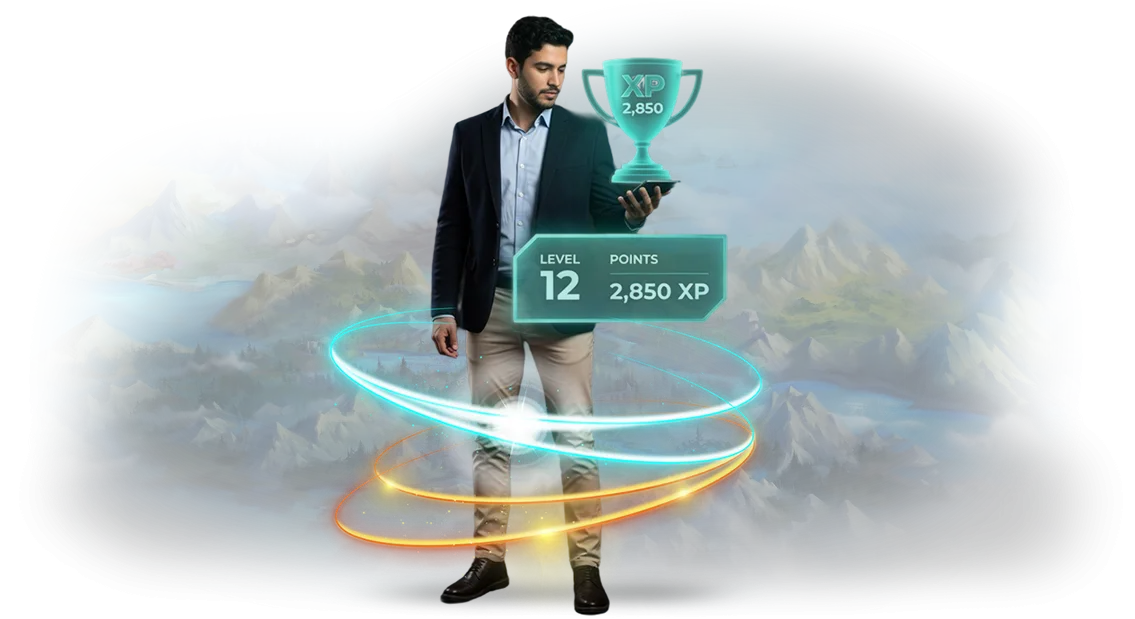
Gamification mechanics against boredom: how to bring excitement back to work
When work turns into endless routine, employees lose interest: tasks get done on autopilot, initiative disappears, and results stop bringing satisfaction. Sound familiar?
Against this backdrop, team engagement drops, turnover rises, and the best specialists leave for places where they feel excitement again. The problem is not people — it is monotony that kills intrinsic motivation.
Gamification mechanics help here. These are not points for the sake of points, but a well-thought-out system that turns routine processes into a clear game with goals, progress, and quick wins.
Employees see their contribution, receive feedback, and strive for the next level — just like in a good video game. This is how business gamification brings energy back to everyday tasks.
Properly configured mechanics solve specific business problems: they increase productivity without burnout, reduce turnover, and create healthy competition. At the same time, employees do not just hit KPIs — they engage in the process because it interests them. And employee motivation stops depending only on bonuses and becomes sustainable.
We help implement gamification mechanics so that they work for your business model: from simple recognition systems to comprehensive engagement scenarios.
You get predictable growth in team engagement and reduced employee attrition, while your employees get a reason to come to work with excitement.
What a business gets from implementing game mechanics
Routine kills interest, and interest is the main driver of results. Game mechanics turn daily tasks into a clear system of challenges, rewards, and progress, where every step brings an employee closer to a visible goal.
Productivity growth without overwork
When employees see progress and understand that their actions affect the overall result, the quality and speed of work rise. Process gamification builds a transparent link between effort and reward: completed a task — got points, hit the plan — unlocked a new level. This motivates working more effectively, not longer.
Managers get a clear picture: which areas of the team work faster, and where delays occur. Instead of manual control, a system appears that itself shows growth zones.
Reduced attrition and increased loyalty
People stay where they see development and recognition. Game mechanics give employees a sense of achievement and status, and this directly affects loyalty.
Companies with well-designed gamification have noticeably lower turnover: employees do not just perform duties — they strive to reach the next goal within the company.
This preserves an experienced team and reduces the cost of finding and training new hires, which is especially important for businesses with a long onboarding cycle.
Engagement as a driver of results
Engaged employees approach tasks differently: they show initiative, help colleagues, and are more willing to participate in change. Games create healthy competition and team spirit, so every participant feels part of the common process.
This is especially important for sales, support, and operational teams, where revenue directly depends on engagement.
We design mechanics around your processes, not the other way around: we select scenarios that fit naturally into the workflow and quickly deliver measurable results.
You get not a “game for the sake of a game” but a tool that strengthens motivation, productivity, and employee retention.
Gamification mechanics: formats for any task
Gamification mechanics work only when the format matches the business task. Rankings motivate some people, reward stores motivate others, and a virtual office unites a distributed team.
Choosing the right mechanic for a specific scenario gives you not a “game for the sake of a game” but a tool that moves the needle.
Below are three basic formats and scenarios where each of them delivers maximum value.
| Format | Who it is for | What it gives the client |
|---|---|---|
| Corporate store | Teams where rewarding regular actions is important: hitting KPIs, meeting project deadlines, helping colleagues | Employees choose their own rewards — this increases the value of results and reduces turnover through point accumulation. Managers see which actions truly motivate the team. |
| Rankings and leaderboards | Sales departments, support, any teams with a competitive spirit | Healthy competition drives revenue: employees see their position in real time and improve weak areas. Transparent criteria eliminate disputes over “why I didn’t get the bonus”. |
| Virtual office | Remote and hybrid teams where employees rarely meet in person | Creates a sense of presence and a shared goal: avatars, joint quests, and informal communication zones reduce burnout and retain valuable people. |
The formats do not have to be chosen one instead of another. In our projects, the store is often combined with rankings: competition provides energy, while accumulated points create long-term interest.
The main thing is that the mechanics are understandable to employees and require no more than five minutes of training.
If you don’t know where to start, start with a diagnosis: we will look at your business processes and propose a format that addresses exactly your pain point — whether it’s sales growth, engagement, or team retention.
How implementation works: project stages
For every company, gamification implementation is a new project that must deliver a measurable business result, not just a “nice addition”.
We have built a transparent six-stage process: you always see what happens at each step, what the timelines are, and what you get as an output. This approach reduces risks and lets you launch the system without lengthy approvals or disruptions.
-
Brief and process audit. At the first meeting, we record business goals, the target audience, and weak spots in motivation or sales. You get a vision of which mechanic we will use and why it will work in your specific case.
-
Strategy and plan. We develop the game scenario or loyalty program, define success metrics, and create a rollout timetable with clear deadlines — from one week to several months depending on scale. We confirm the budget and the expected effect.
-
Mechanic design. We think through a system of points, levels, rewards, and tasks that fits into your ecosystem — website, CRM, app, or internal portal. The output is a description of mechanics and user scenarios, not an abstract idea.
-
Development and integration. We build the product and connect it to your systems and data. At this stage, we regularly show intermediate versions so you can see progress and influence the outcome before the final launch.
-
Testing and launch. We run a pilot with real users, identify bottlenecks, refine details, and launch at full scale. Your team receives instructions and training to manage the system without our constant assistance.
-
Support and evolution. After launch, we do not disappear: we analyze participant behavior, improve the mechanics, and add new tasks and scenarios. This helps maintain audience interest and improve the metrics the project was launched for.
The main thing you get at the end of each stage is transparent reporting and clear artifacts: from strategy to employee instructions.
This process has been proven on dozens of projects and allows us to meet deadlines predictably while preserving quality and peace of mind for your team.
What is included in the delivery: a complete launch kit
You receive not a “file with an idea” but a ready-to-use kit — everything needed to launch and run the system on a daily basis.
Inside are mechanics already configured for your business processes, clear regulations, and tools so your team can manage gamification independently, without developers on standby.
The standard delivery includes:
- Mechanics configured for your processes — scenarios, levels, points, and rewards that work with your specific logic: KPIs, deal stages, task completion.
- Gamification documentation — participant regulations, point accrual rules, onboarding scenarios for new employees, and guides for managers.
- Administrator instructions — a step-by-step guide to managing the system: changing rewards, adding employees, adjusting rules without involving a contractor.
- Employee training — a practical session for your team: how to participate, where to see results, what to do in disputed situations. The training will be recorded so you can revisit it.
- Technical support — a dedicated communication channel with our team during the support period. We answer questions, help with settings, and fix errors within agreed timeframes.
- Administrator panel — an easy-to-use interface that shows participant activity, progress, and results in real time. Everything in one window, without complex reports.
- Engagement reports — regular summaries: who is active, which mechanics drive growth, and where participants lose interest. Based on these, you adjust the program as you go.
After the handover, you are not left alone with the system. We stay in touch so that the first weeks run smoothly and you see a measurable result from the implementation.
Case study: how we brought excitement back to a sales department
When a sales department works on inertia, plans remain on paper. At distributor «AlphaTrade», managers were hitting 60–70% of their targets, the best ones burned out quickly, and newcomers had no idea where to start.
The manager asked us to bring excitement back to the team — without increasing the budget or hiring new employees.
We started with an audit of the sales process and identified the metrics that truly affect revenue: number of calls, meetings, sent proposals, and closed deals.
Around these metrics, we built gamification mechanics: a shared leaderboard, personal levels, team challenges, and rewards for every meaningful action.
The entire system was visible in real time — each manager always knew how many points they had brought to the company and what to do to climb higher.
What changed in two months
Plan fulfillment increased by 25%, and the share of employees closing more than 100% of their target grew by one and a half times. Competition became healthy: managers started sharing techniques with new hires because team bonuses depended on the overall result. The average sales cycle shortened by a third — quick wins provided energy for complex negotiations.
The manager noted that excitement returned within a week of launch. Employees stopped waiting for instructions — they actively looked for opportunities, discussed the ranking in chats, and suggested improvements.
Gamification did not turn into a “toy for the sake of a toy”: every point was tied to a real action that moved revenue.
Why the mechanics worked
The secret is not in points but in transparency. People want to see how their efforts affect the result. We simply made that contribution visible. After the pilot, the client ordered gamification scaled to an adjacent department — with the same connection to business metrics.
This case shows: gamification mechanics work when they are based on real processes and clear metrics. The result is sustainable sales growth and engagement that doesn’t need constant financial topping up.
How to choose the right game format for your company’s goals?
The game format cannot be chosen “because it looks nice” — it must follow from the business task. If the goal is to train employees on a new product, scenarios with knowledge checks and difficulty levels work well.
If the goal is to increase sales, competitive mechanics with a leaderboard and quick rounds are better. And for engaging clients at an event, short interactive formats where a participant gets a result in a couple of minutes are more effective.
The second factor is the audience. What excites a young team often doesn’t work with experienced managers. That is why choosing mechanics starts with analysis: who the participants are, what motivates them, and how much time they are willing to spend on the game.
A company that runs gamification on a regular basis usually combines several formats — so every employee finds what resonates with them.
The third point is a measurable result. A game for the sake of a game doesn’t pay for itself. The right mechanic is tied to a specific metric: number of trained employees, speed of processing requests, repeat customer visits, sales volume.
We determine in advance which metric counts as success and design the scenario so that it leads precisely to that metric.
Finally, it is worth considering the company’s resources: preparation time, technical infrastructure, and the ability to support the game with a facilitator or an automated system.
Some tasks only require a light board-based mechanic; others need a full-fledged digital platform that calculates points, creates rankings, and displays results in a personal account.
We select mechanics individually for each project: we analyze the goals, audience, and constraints, then propose 2–3 format options with an engagement forecast.
Decisions are made based on data, not intuition — so the client understands in advance what result they will get and why this particular format was chosen.
Frequently asked questions about gamification
Gamification of business processes is a topic that raises more questions than ready-made answers among clients. Most often, doubts concern three things: how difficult it is to implement, how long it will take, and how the mechanics will fit into an already running system. Below, we address typical concerns — honestly and to the point.
How difficult is it to integrate gamification into an existing process?
Implementation does not require restructuring the business. We adapt game mechanics to your current tasks: employee training, client work, team motivation. The project is divided into stages, each of which you can see and control.
At the start, it is enough to conduct a brief and identify growth points — then we take over the implementation.
You don’t need to change processes you have been using for years. We embed the mechanics so they strengthen the existing system rather than break it. For employees and clients, it looks like a convenient tool, not “yet another program”.
How long does development take?
A typical project takes two to four weeks — depending on scale and the number of business processes. A short mechanic (for example, a loyalty program or a client quiz) can be launched within a week after the brief.
We work in iterations: first we build a base version, you test it with a real audience, and then we enhance it. This allows you to get quick results and adjust the mechanics along the way, instead of waiting for the “perfect” launch for several months.
Is gamification only suitable for IT companies?
No. Mechanics work wherever there is human interaction: retail, HoReCa, education, corporate culture, marketing campaigns. The principle is the same — people are interested in achieving goals, getting feedback, and seeing progress.
We adapt the mechanics to your industry and audience. For salespeople — rankings and mastery levels; for clients — accumulating points and bonuses; for employees — challenges and team competitions. The tool is universal; only the presentation changes.
How do you guarantee the mechanics will work?
We don’t promise magic — we rely on data. Before launch, we record current metrics: activity, conversion, engagement. After implementation, we compare the results. If we see that the mechanics are stalling, we quickly make adjustments — this is part of our support.
The indicators that should grow are specified in the contract. You pay for a business result, not for a “pretty toy”. And you always stay in touch with us: ask questions, share feedback from employees or clients — we respond.
Launch gamification in your company
When gamification is embedded in business processes, employees stop “serving out” tasks — they join the game. But for the mechanics to work rather than remain a pretty wrapper, you need a project tailored to your processes and audience.
We take care of this: at the start, we conduct a consultation, analyze the tasks, select mechanics, and calculate the cost after audit — without unnecessary expenses.
Leave a request for gamification — and in return you will receive:
- A transparent cost estimate for your scale: no hidden payments or fine print.
- Expert consultation explaining which mechanics suit your team.
- An analysis of growth points: where gamification will deliver quick results, and where deeper development is needed.
- A clear launch plan: from brief to pilot in one department — with clear timelines.
- Post-launch support: we adjust mechanics based on results to keep motivation alive.
- The backing of ten years of experience: dozens of projects across various industries, so risks are reduced.
Technically, this works on professional equipment and proven tools, but what matters to you is the outcome: it is measured in engagement, task completion speed, and repeat client inquiries. We’ll send case studies from your industry and estimate the effect before the work begins.
Leave a request for a consultation — within a day you will understand how to launch gamification and what it will bring your business.