

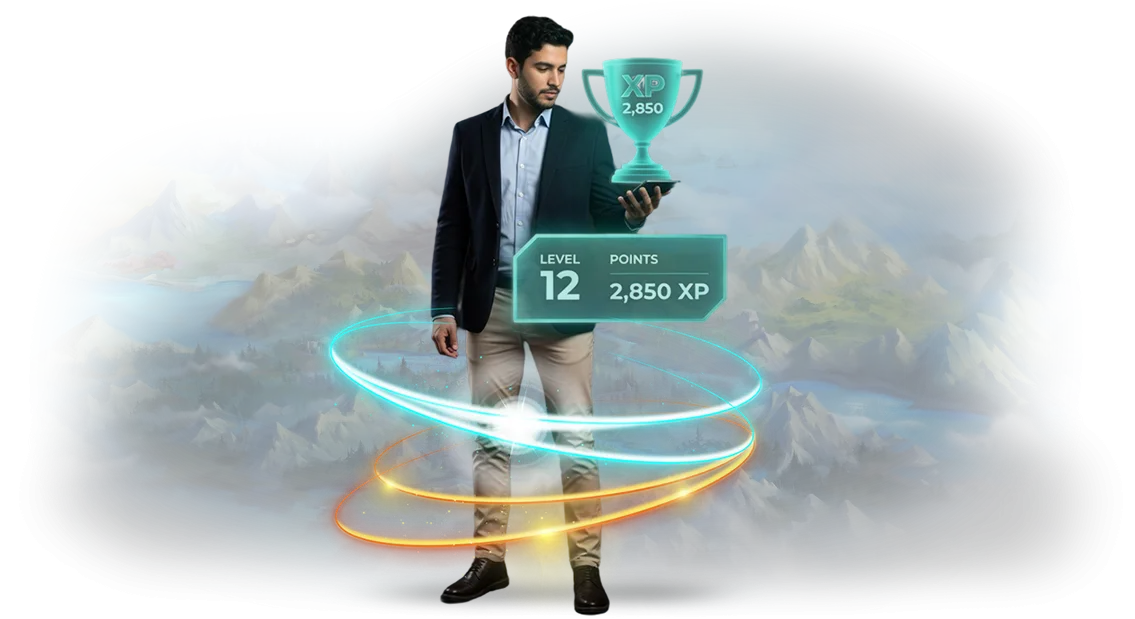
Employees abandon LinkedIn Learning courses — how to fix it?
When employees sign up for LinkedIn Learning courses and then drop them at the third module — that's not laziness, it's a signal.
Learning loses the battle for attention: deadlines, meetings, and the daily grind always matter more than "a course that can be done tomorrow." As a result, the subscription is paid, development goals are set, and real skills don't grow.
For business, this is a silent loss: money goes to the platform, and learning KPIs go unmet. A manager sees "100 enrolled, 12 completed" in the report and understands: the system isn't working. But the issue isn't content quality — on LinkedIn Learning it's strong. The issue is the lack of a mechanism that brings a person back to the course day after day.
Gamification solves exactly this problem. It turns learning from an obligation into a game with clear rules: accumulate points — earn expert status, complete a series of modules — unlock access to the advanced level.
The employee sees their progress, compares it with colleagues' results, and doesn't want to fall out of the race. This taps into the natural competitive instinct that exists in any team.
Implementing game mechanics in corporate learning isn't about rewards for the sake of ticking a box. It's a way to boost engagement, reduce course drop-off, and get a team that actually applies new knowledge at work.
We design the reward system so that it's embedded in the familiar learning process and requires no extra effort from employees — just taking courses and completing assignments.
In the end, the client gets not "another motivational program" but measurable growth: more completed courses, higher platform activity, and a team that connects learning with career growth.
Gamification gives LinkedIn Learning back its role as a working tool rather than an "abandoned training machine" in the corporate portal.
What a reward store provides: motivation, growth, and loyalty
A corporate reward store turns employee learning from scattered courses into a clear and motivating system. When every completed module in LinkedIn Learning earns points, badges, and access to new levels, learning stops being an obligation and becomes part of workplace culture.
Employees see a direct link between their efforts and recognition — this works stronger than standard KPIs.
Gamification of business processes directly increases staff motivation: people need fast feedback on their achievements. A reward store provides this feedback in a visual form — from virtual trophies to real bonuses.
As a result, not only engagement in learning grows, but overall productivity too. Employees start applying new skills at work, which inevitably impacts the team's key indicators.
KPI growth happens not through coercion but through interest. We design the system so that learning goals align with business goals: complete a negotiation course — get a reward and immediately apply the techniques in deals.
Every achievement brings the employee closer to a valuable prize, and the company gets a measurable result — faster closed tasks, fewer errors, higher service quality.
Employee loyalty is built on a feeling of care. When a company invests in development and gives tangible bonuses for it, a person understands they are valued. This reduces turnover and retains strong specialists who want to grow together with their employer.
The virtual store becomes a symbol that the company doesn't just demand results but supports the path to them.
Finally, a reward store builds a lasting learning habit. Short sessions, regular rewards, and visible progress turn learning from a rare event into daily practice. In two or three months, it becomes routine, and employees look for new courses on their own to get the next reward.
That's how gamification works for long-term growth — of both the employee and the business as a whole.
Virtual reward store formats for LinkedIn Learning
A virtual reward store turns learning on LinkedIn Learning from a "must-do" into an understandable game with a tangible result.
The employee sees how many points they earned for completing a course and can exchange them for prizes — from branded merch to an extra day off. This boosts engagement and creates a habit of returning to learning regularly.
But there's no one-size-fits-all solution: the store format depends on your task. Some need a simple prize catalog to quickly launch motivation, while others build a long-running program with levels and rare rewards. Below are three proven formats that we adapt to the company's business processes.
Corporate store formats
| Format | Who it's for | What it gives the client |
|---|---|---|
| Store with a fixed catalog | Teams that need to launch a program quickly without complex setup | Transparent rules, clear prize choices, quick start, and minimal load on HR |
| Store with access levels | Companies with different roles and grades that need reward differentiation | Employees see a personalized prize showcase — this raises status and motivation to grow |
| Store with auction and rare lots | Long-term learning programs where sustaining interest is key | Excitement and competition, rare rewards are raffled off by points — interest doesn't fade for months |
What this gives the business
Any of the formats integrates into your points system and syncs with progress in LinkedIn Learning. Employees earn points for completed courses, tests, and activity, and the prize catalog is filled with rewards that are actually valued inside the company.
We handle the showcase development, accrual rule setup, and automatic prize issuance. All you need to do is watch the metrics: growth in completed courses, share of active employees, return to learning after the first reward. Such a store works as an ongoing incentive, not a one-time promotion.
How gamification development proceeds: 6 steps to launch
Gamification development is not a one-off campaign but a structured process that starts with your business task and ends with a working motivation system.
We broke it down into six clear stages so that you always know what's happening, what results you get, and when the project will be ready.
-
Development brief. We record goals, audience, and the desired outcome. We determine which business process needs improvement: sales, learning, loyalty, or internal communications.
-
Implementation plan. We build a project map with stages and timelines. You see what will be ready and when, and what resources are needed from your team.
-
Mechanics design. We develop the game logic: tasks, levels, rewards, and feedback. We tailor solutions to your users' scenarios — so that it's clear and interesting for them.
-
Prototype approval. We show a working model of the future product. You make edits before the main development begins — this saves time and budget.
-
Implementation and integration. We build the product on professional equipment and embed it into your system. We focus on reliability and speed so that users don't experience failures.
-
Launch and support. We test on real scenarios, train your team, and launch the project. After launch, we monitor metrics, evolve the mechanics, and add new elements.
What's included in the delivery package: from tasks to analytics
We assembled the delivery package covering all stages — from setting tasks to evaluating results. Together with the virtual reward store for LinkedIn Learning, you get ready-to-use tools that start working immediately and solve engagement and learning challenges.
Package contents
- Reward showcase — a space where employees see available prizes, exchange terms, and their current balance. It integrates with the corporate portal and requires no additional actions from the user.
- Prize catalog with stock control: items are automatically marked as unavailable when they run out. You always see an up-to-date list and can manage the budget without extra manual work.
- Points system — transparent accrual and deduction rules. Points are earned for completing tasks, taking courses, participating in activities — you decide which actions to reward.
- Learning analytics — clear reports for each employee and group: who completes tasks, which rewards are popular, where employees lose interest. This data helps adjust the program in time.
- Launch methodology guide — ready-made task scenarios, announcement templates, and motivation recommendations. Your HR and marketing teams can launch communication without lengthy preparation.
- Administrator training — a practical walkthrough of settings and instructions, after which your team independently manages the showcase, catalog, and reports.
All documentation is included in the package and adapted to your business processes. We support you at launch, help set up the showcase in your brand style, and answer team questions.
You get not just a set of features but a working system that's easy to manage and can be evolved.
Case study: how a reward store increased course completion by 34%
Before the reward store implementation, the learning platform faced a typical problem: users actively enrolled in courses, but only a few made it to the end. Motivation faded after 2-3 modules, and investments in content didn't deliver the expected educational results.
We designed the corporate reward store as a full-fledged engagement tool: for every completed learning stage, the user earned points that could be exchanged for real prizes and statuses. Gamification was built directly into the learning process rather than existing separately from it.
Results that speak for themselves
After launch, course completion grew by 34%. Average time spent learning increased 2.1 times, and engagement in the first 7 days after registration rose by 58%.
Users returned to the platform not because of a reminder but for a new reward. Repeat visits increased by 41%, which directly improved learning regularity. NPS rose from 24 to 58 points — users didn't just complete courses; they recommended the platform to colleagues.
Rewards turned mandatory learning into a habit. Internal analytics showed that 72% of reward program participants chose additional courses unrelated to their direct responsibilities.
This confirms that gamification created lasting interest in self-development, not just a short-term spike in activity.
--- The client confirms the result:
We expected an increase in engagement, but got systemic changes in the learning culture. The reward store became the center of motivation around which the entire user journey is built.
--- We apply the same approach in projects for companies in retail, education, and corporate universities. What matters is not the number of points and prizes but a properly designed mechanic: clear rules, quick early wins, and the value of rewards for a specific audience.
That's why we first analyze user behavior and the business goal, and only then design the gamification scenario.
The result is always measurable: higher course completion rates, more time spent learning, repeat visits, and user loyalty to the platform. Return on investment is visible within the first month after launch.
How to choose a store format for your company's task?
Choosing a corporate reward store format is not a technology question but a question of matching your business goals and team size. First, determine what matters more: fast engagement of the whole company or targeted rewards for key employees. The complexity of the catalog and the way rewards are issued depend on this.
For teams of up to a few hundred people, a compact solution with a limited set of rewards is enough — employees value speed and simplicity.
When a company grows, departments with different specifics appear, and a universal showcase with every possible option can hardly cover all scenarios. In that case, a modular format where the assortment can be adjusted for each team works better.
The choice of solution also depends on the goal. If you need to increase participation frequency in learning, choose short reward cycles and instant bonus issuance. If the goal is a long-term recognition culture, you'll need an extensive catalog and an accumulation system.
This is how we approach the task every time: first we immerse ourselves in the business, then we propose a specific format.
For example, for LinkedIn Learning we built a reward store that simultaneously addressed three tasks: rewarding completed courses, accessibility for remote employees in different countries, and integration with internal HR processes.
This project confirms: choosing a format means finding a balance between reach, launch speed, and value for each employee. We select a solution based on your team size and goals, recording expectations as early as the brief stage.
Answering common questions about reward implementation
Any implementation of corporate rewards raises questions: how fast can we launch, will it break the system, how secure is employee data.
We honestly answer the most common objections so that you understand the whole process before starting — no technical details, only practical points.
Below are the answers we give to managers at meetings. If you still have doubts, ask your question — we'll answer it.
How long does implementation take?
On average, the project takes two to four weeks — the timeline depends on the number of rewards and how much the catalog needs to be adapted to the corporate culture. We work in stages: first we agree on the concept, then we configure the showcase, run testing, and launch. You get a ready tool that employees start using immediately, without lengthy training.
How will rewards match our brand style?
We fully adapt the showcase to your brand: brand colors, logo, reward names, and texts.
Employees see a familiar interface in their native language, and the rewards themselves reflect company values — for example, "For mentorship" or "For innovation." This strengthens recognition and makes the program feel like the team's own.
How secure is employee data?
We use a secure server architecture with role-based access control: an employee sees only their own rewards, a manager sees reporting for their team. Data is not shared with third parties and is stored in accordance with legal requirements. Only company accounts are used for reward accrual — no extra information.
Is the system hard to administer?
Management takes minutes: a reward can be issued in a few clicks, and automatic reports show activity without manual counting. No special technical knowledge is required — an HR manager or administrator can figure out the panel after a short guide. We also remain on support after launch and help with questions.
How does it integrate with LinkedIn Learning?
We've already implemented a seamless connection: when an employee completes a course, the system automatically marks it and offers the corresponding reward. The manager sees learning progress and team achievements in one window, and the employee gets instant recognition. No manual transfers or double data entry — everything works on its own.
Order gamification development and launch your store in 4 weeks
Place an order for gamification development — and in just 4 weeks your corporate reward store will be up and running, increasing engagement and retaining key employees.
We've completed more than 50 implementations and take on the entire process — from idea to store launch — so you don't waste time coordinating contractors.
Immediately after your request, you get:
- A personal gamification consultation — we'll analyze your task and select a reward mechanic that fits your team.
- A clear launch plan with stages and timelines — you see what happens each week and when results will appear.
- A showcase prototype and points accrual logic — before development starts, you understand how employees will earn and spend rewards.
- Integration with LinkedIn Learning — rewards appear in the familiar learning environment, and employees don't need to learn new tools.
- Design in your brand style — the store looks like a natural part of corporate culture.
- Launch in 4 weeks — a fixed timeline committed to in the contract.
- Administrator training and an employee guide — your team fills the catalog and manages requests on its own.
- Post-release support and initial analytics recommendations — we adjust mechanics in time and strengthen results.
To order development, leave a request on the website or call us. You can get a consultation within the day — the manager will answer questions, clarify requirements, and prepare an offer without lengthy approvals.