

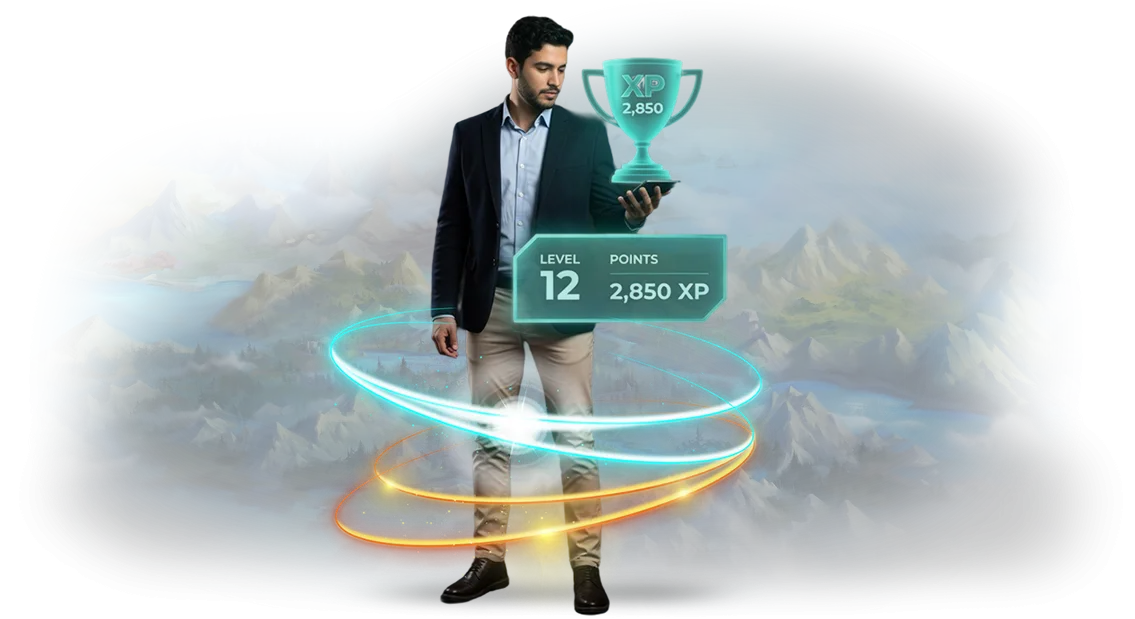
Gamification of HR Processes: Solving the Staff Turnover Problem
Every manager knows how costly staff turnover is: job ads, weeks of onboarding, rookie mistakes, and the experience that leaves with the employee.
But most importantly, it's the atmosphere: when key people leave one after another, the team loses motivation and the business starts to stall.
Standard retention tools — bonuses, pay raises, an honor board — only work for a short while. People quickly get used to bonuses, while routine tasks still cause boredom and the urge to change companies. What’s needed is a system that engages employees daily, not once a quarter.
Gamification of HR processes solves this: it turns everyday work into an engaging process with goals, levels, and rewards.
Employees see their progress, understand how their efforts affect the company’s results, and receive recognition not only through money but also through status. This creates healthy competition and a sense of belonging to a common cause.
The practical result: lower turnover, higher engagement and loyalty. Team members leave less often, reach KPIs faster, and new employees are more likely to join on colleagues’ recommendations.
You cut recruiting and training costs, and the HR department stops putting out daily fires and focuses on developing people.
We build HR gamification around your company’s specific needs: we analyze the points of demotivation, design a motivation system, and implement it so that employees embrace it right away. This resolves the turnover problem and brings energy back to the team.
What You Get from Game-Based Motivation: 5 Key Benefits
Routine HR processes — onboarding, training, performance review — are often seen by employees as a forced obligation. As a result, motivation drops, turnover rises, and each new hire costs more.
Game mechanics solve this: they turn boring tasks into an engaging process with clear rules and a reward.
The first benefit is employee engagement. When employees see progress, levels, and achievement bonuses, they perform tasks with interest rather than under pressure.
Engaged employees work better and are distracted less often, which means productivity grows without additional spending on supervision.
The second benefit is loyalty. Gamification creates a recognition system in which everyone receives feedback and feels the value of their contribution. An employee who feels their success is being noticed doesn’t look for another job. This reduces turnover and keeps an experienced team.
The third benefit is transparent results. Rating boards, badges, and rewards make everyone’s contribution visible to the whole team. Managers can assess performance more easily, and employees can understand which actions lead to success. This removes the ground for conflicts and misunderstandings.
The fourth benefit is lower hiring and onboarding costs. When a company is known for an interesting motivation system, it attracts candidates on its own, without expensive ad campaigns. And retaining experienced employees costs a fraction of finding and training new ones.
In the end, HR gamification is not entertainment but a management tool. It connects business goals with employees’ daily actions and delivers measurable results: higher engagement, lower turnover, and steady productivity growth.
Gamification of HR Processes: Choose the Right Format for Your Team
Any team performs better when it sees a clear goal and quick personal results. Gamification turns routine HR processes — training, onboarding, motivation, quality control — into a system that guides employee behavior without orders or reminders.
But there is no universal format. Sales departments live by plans and KPIs, call centers by workload and scripts, warehouses by speed and accuracy, retail by service and average ticket. So the format must be chosen for the team’s specific task.
Gamification Formats for Each Department’s Task
| Format | For Whom | What It Gives the Client |
|---|---|---|
| Leaderboards, “department battles,” personal growth stages | Sales department | Higher plan attainment, healthy competition, transparent results for managers |
| Call-scenario games, script quests, “level completion” for quality | Call center | Less fatigue from repetitive calls, higher conversion and dialogue quality |
| Quests for picking speed, “error hunt,” receiving standards | Warehouse | Shorter picking time, fewer losses and errors, faster onboarding for new employees |
| Service-standard marathons, checks, “showcase of the month” | Retail | Higher average ticket, better service quality, engaged floor staff |
We will pick a format that works specifically in your environment, taking into account team size, current metrics, and the business result you need. This is not a one-off motivation campaign but an embedded mechanism that works in daily processes.
Implementation Stages: From Brief to Launch in 6 Steps
Gamification implementation may seem complicated until there is a clear plan. We have structured the process so that at every stage you understand what is happening, what you are paying for, and what result you get. There are six steps in total, from the first brief to a working system and its support.
-
Brief and task analysis. We collect requirements: which HR processes need to accelerate — onboarding, training, motivation, or internal communications. We align goals and success criteria so there is something to measure at the end.
-
Game mechanics development. We propose a scenario, a points system, levels, and rewards tailored to your corporate culture. We show how this will affect employee behavior and adjust the concept when needed.
-
Concept approval. You receive a description of the mechanics, interface samples, and a pilot plan. At this stage, we make revisions without extra cost — before development begins.
-
Implementation and testing. We build the system on a professional platform and run an internal test with a control group. We make sure everything works reliably and is user-friendly.
-
Launch and communication. We prepare an announcement for employees and train the HR team and administrators. We launch gamification into the workflow with clear instructions and support at the start.
-
Support and development. We analyze activity, collect feedback, and adjust the balance. If necessary, we add new levels, scenarios, and rewards — the system stays alive and engaging.
This way you get not a “box” with a game but a working tool that engages employees and achieves business metrics. Every stage is recorded with deadlines and results — you always know where the project stands and what comes next.
What’s Included: A Complete Package for Your Project
For us, it’s important that you receive not just program code but a complete solution that can be implemented from day one.
That’s why the package includes everything needed to launch, support, and develop gamification in your company — it covers the needs of HR specialists, the IT department, and management.
- Ready-made motivation system — a module for awarding points, levels, badges, and rewards. Employees immediately see how their actions affect their status and rewards, and HR no longer has to count results manually.
- Employee personal account — a clear showcase of achievements, ratings, and activity history. Everyone sees how their contribution grows, and managers see the team’s real engagement.
- Dashboard for managers and HR — analytics on engagement, KPI achievement, and activity by department and time. No need to gather data from multiple reports — all metrics in one window.
- Admin panel — configure rules, scenarios, and rewards in a few clicks. You can change gamification conditions for new tasks without involving programmers.
- Training materials and guides — step-by-step manuals for administrators, employees, and managers. You can set up the system and explain its value to the team without external contractors.
- Launch instructions — a checklist and procedure for the pilot launch. Within the first week, you’ll understand how the mechanics work and which scenarios are more effective.
- Service support — assistance at every stage, from launch to ongoing operation. We’re available when you need to answer questions, adjust settings, or suggest improvements.
In the end, you get not just a service but a working tool that is easy to integrate into existing HR processes.
The whole team works with the system in a coordinated way: employees through the personal account, managers through the dashboard, and you through transparent reporting and support at every step. This saves time on launch and lets you focus on the main thing — increasing people’s engagement.
Case Study: How Gamification Increased Sales Department Productivity 1.5 Times
The sales department is the revenue engine, but it’s also where motivation most often suffers. Repetitive calls, manual work with the client database, and identical bonuses quickly become tiresome: managers work by rote and productivity drops.
We solve this task through HR gamification — turning routine into a game with clear goals and quick rewards.
A good example is a project for the hypermarket chain Lenta. Our task was to raise the productivity of the sales department that worked with corporate clients.
Managers fulfilled the plan at 70–80%, top employees burned out due to a lack of feedback, and new hires took a long time to get up to speed.
We developed a gamification system: every stage of work — from the first call to signing a contract — began to earn points and unlock new levels. On screen, employees saw their progress, their colleagues’ ratings, and personal weekly challenges.
Results appeared in the first quarter: department productivity grew by 45% in three months. Plan attainment approached 100%, and several managers exceeded it by a quarter.
Application processing speed increased 1.5 times, and team turnover decreased — employees felt the thrill and a fair assessment of their work. The manager received transparent statistics for each employee and was able to support those who were falling behind.
After the pilot launch, the client expanded gamification to adjacent departments, and we continued to develop the mechanics for new business tasks. This case shows that HR gamification is not entertainment but a working tool that quickly pays off and delivers measurable results.
How to Choose a Gamification Format That Won’t Fail?
There is no universal “best format” for HR gamification. What works well for a competitor may fail at your company if the tasks are different: one thing is to increase new-hire engagement, another is to reduce turnover or accelerate training.
Start by defining the business task, and only then choose the mechanics: a quest, competition, points with prizes, or a long-running role-playing game.
The second important criterion is the audience and corporate culture. The main mistake is copying someone else’s example or implementing mechanics that contradict the management style. If public competition is not accepted in the team, ratings will cause rejection.
So before launch, we study how employees are used to communicating, what tools are convenient for them, and what really motivates them.
The third mistake is chasing complexity. Flashy mechanics without a clear connection to the work task quickly get boring. A reliable path is a pilot on a small group: a simple scenario, measurable results, and a clear interface.
The pilot shows what ignites people and what irritates them, and only then can you scale to the whole company.
Individual requirements are determined by the HR process. For onboarding, a step-by-step quest works well; for training, points and levels; for motivating salespeople, team competitions with transparent statistics.
The right format solves the task without unnecessary costs rather than becoming an end in itself. If in doubt, choose proven solutions: they deliver sustainable results and are easy to adapt to your company.
Addressing Common Concerns Before Starting a Project
Before starting HR gamification, managers have the same concerns: will it cause resistance among employees, how long will the launch take, and what happens after implementation. That’s normal — every project begins with questions.
Below we answer the most common ones — directly and without technical details. We rely on experience from dozens of projects and are ready to discuss your situation separately.
Is it safe for employees?
Gamification is based on voluntary participation and transparent rules. Employees see their progress and receive rewards, not penalties. Engagement grows through competing with oneself rather than with colleagues, so the project doesn’t create pressure.
How much time does launching take?
A typical pilot project takes two to four weeks. Together we define goals, set up the mechanics, test, and launch — without stopping work processes. Exact timelines depend on scale, but in most cases we stay within this range.
Who supports the system after launch?
We don’t abandon the project after launch. We train the team, answer questions, collect feedback, and adjust settings. Support continues under the contract — you can request improvements and mechanic development at any time.
How safe is it for the business?
We work officially under a contract and keep employee data confidential. Gamification is an add-on over current processes: it doesn’t require stopping work or replacing accounting systems, so integration happens without risks to daily operations.
Discuss Your Task and Get an Implementation Plan
HR gamification is a working tool, but only when the mechanics are chosen for your task, not haphazardly.
So you don’t have to guess whether it will work for you, we offer a consultation: we’ll analyze your situation, show which engagement elements will deliver results, and prepare an implementation plan — without obligations or pushing unnecessary options.
What You Get After Submitting a Request
- Consultation — 30–40 minutes with an expert who has already implemented projects in companies of your scale.
- Task analysis — we’ll discuss which process you want to “revive”: onboarding, training, motivation, or internal communications.
- Selection of suitable mechanics — we’ll suggest 2–3 gamification formats that fit your corporate culture and budget.
- Cost estimation — we’ll provide a budget range and timeline so you understand the expected figures before work begins.
- Clear implementation plan — stages, responsible people, expected results, and metrics we’ll use to evaluate effectiveness.
Leave a request — and within one business day we’ll contact you, clarify the details, and prepare a personalized proposal. It’s not binding, but it gives you clarity: whether gamification is worth implementing in your HR processes and what results it will bring.