

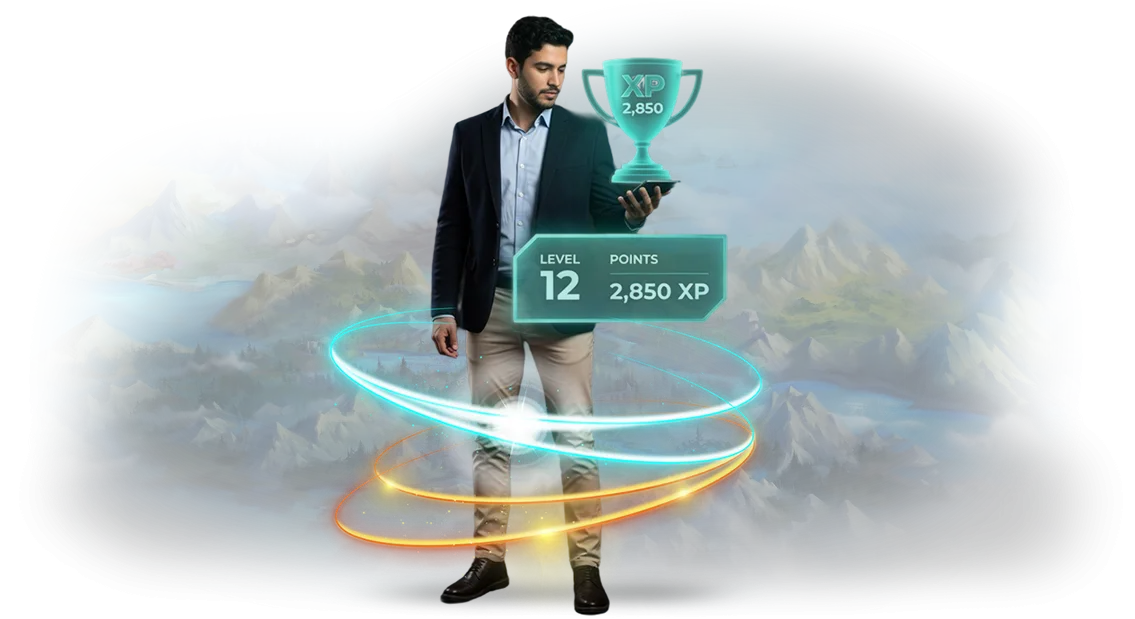
Why Project Management Systems Don't Work Without Gamification?
Implementing a project management system often looks like this: tasks are assigned, deadlines are set, and owners are defined — yet the results still don't show up.
Employees say "I'll do it later," deadlines slip, and the manager spends hours on reminders instead of strategic work. Sound familiar?
The problem isn't the tool — it's the loss of team engagement: even the most well-thought-out system remains just a list of duties for people.
The diagnosis is simple: classic project management is built on control and coercion, not on motivation. Tasks, statuses, and deadlines are the manager's language, not the employee's language.
People need to see how their contribution impacts the overall result, receive recognition for their successes, and understand what's going on around them. When that's missing, interest drops — and with it, productivity.
Low productivity in projects is almost always a consequence of a lack of motivation, not laziness or incompetence.
Business gamification solves exactly this problem: it turns routine into a game with clear goals, levels, and rewards. Employees start to close tasks on their own initiative, compete for the top of the leaderboard, and see the progress of their department and the entire company.
Employee motivation stops depending on the manager's reminders — it becomes built into the work process itself.
Team engagement grows, and the project management system finally starts delivering results: deadlines are met, quality improves, and the manager focuses on development instead of "chasing" statuses.
As long as you rely only on control, lists, and deadlines, engagement will inevitably decline. Gamification doesn't replace project management — it makes it come alive for people.
It's not a decoration on the corporate portal; it's a mechanism that makes project processes work as intended: fast, transparent, and with genuine interest from the team.
Five Key Benefits of Gamification for Business
Gamification in project management is not a "toy" — it's a working way to boost team engagement and results.
We've been implementing game mechanics into business processes for over 10 years and we see the numbers change: tasks get closed faster, loyalty rises, and turnover drops.
Five Benefits the Business Gains
- Increased efficiency. Employees complete routine operations faster because they see progress and small wins along the way. In our projects, task completion speed grows by 30–40% without overtime.
- Employee loyalty. Game mechanics reduce burnout: people receive recognition and rewards for their achievements. This works better than dry KPIs and helps retain valuable specialists.
- Learning through play. New employees ramp up faster when training is turned into a quest with levels and feedback. On average, onboarding time is cut in half.
- Teamwork. Shared challenges and common goals bring departments together. Employees start helping one another instead of just competing — and that directly impacts project outcomes.
- Predictable results. The manager sees a transparent picture: who is actively participating, which stages are stalling, and where support is needed. Project management becomes deliberate, not "by feel."
These benefits deliver measurable results within the first few months of implementation. The key is choosing the right mechanics for your business objectives.
Gamification Formats for Your Company's Needs
Gamification formats differ not in the set of bonuses, but in the business problem they solve. Game mechanics can be carefully embedded into daily processes so that employees see their progress and managers see metrics grow.
There is no one-size-fits-all template for project management, so we tailor the format to your team — from simple leaderboards to full-scale corporate games. Below are typical scenarios that deliver results for our clients.
| Format | For Whom | What It Gives the Client |
|---|---|---|
| Ratings and levels | For sales, support, and delivery teams | Transparent motivation, healthy competition, growth of recurring metrics |
| Employee quests | For onboarding, training, and rolling out new processes | Quick engagement, learning procedures without boring instructions |
| Corporate games | For team meetings, planning sessions, and team building | Team cohesion, practicing collaboration in a safe environment |
| Team competitions | For project groups and contractors | Deadline control, joint movement toward a goal, visible contribution from each member |
| Role mechanics | For managers and key specialists | Development of management skills, understanding of responsibility areas |
The same format can easily be combined: for example, levels and quests can run in parallel across different departments. The main thing is that the mechanics serve business metrics and don't turn into entertainment for its own sake.
Stages of Implementing Gamification into Project Management Processes
Any change in project management requires a clear plan — otherwise, the team resists and results get diluted. We implement gamification in stages: at every step you see interim outcomes, understand what's happening, and can adjust course without losing time.
- Brief and process immersion. We study how work is currently organized: who is responsible for what, where motivation gets lost, which tasks "get stuck." The outcome is a clear understanding of goals and constraints.
- Designing game mechanics. We decide what will actually engage employees: ratings, levels, team competitions, or a reward system. Each mechanic is tied to real project metrics.
- Aligning scenarios and rules. We lock down the rules for earning points, victory conditions, and the connection to your KPIs. You get a transparent system with no "magic" or gray areas.
- Development and configuration. We build the gamification on proven tools and integrate it with your current management systems — so employees work in a familiar environment instead of switching between windows.
- Pilot launch. We roll out the mechanics on one team or a pilot project. This lets you quickly gather feedback and assess the real effect without risking the rest of the business.
- Analysis and refinement. We look at what worked and what didn't. We adjust the difficulty, event frequency, and reward system — to keep interest high and keep gamification from becoming routine.
- Scaling and support. We extend the successful solution to the entire department or company, bring in new roles, and continue supporting the project if needed.
This step-by-step approach protects against the biggest mistake — implementing gamification "for everyone at once" and watching it quickly grow stale. You get a working tool that genuinely affects deadlines, quality, and team engagement.
What's Included in the Gamification Delivery Package
In the final package, you get not just configured mechanics, but a working project management system embedded into the team's daily processes. We hand over everything needed to launch, track results, and develop the gamification without constant involvement from developers.
- Methodology and game rules — a description of goals, business objectives, participant roles, and motivation scenarios. You understand how gamification affects project outcomes and which KPIs it supports.
- Methodical materials for the team — instructions for working with the mechanics, rules for earning points and levels, and templates for typical project tasks. Everything is ready to use; you just assign owners.
- Analytics and reports — a configured dashboard for engagement, progress, and achievement metrics. Regular reports show which employees are active, where risks exist, and how dynamics shift across projects.
- Team training — hands-on training for administrators and managers: how to run the gamification, respond to results, and adjust the rules. After the training, the team works independently.
- Technical support — assistance at launch and throughout an agreed period. We help with configuration, answer questions, and resolve issues quickly.
- Documentation for growth — a guide on adding new projects, levels, or rewards. You can scale the gamification as your business grows without extra approvals.
Every item in the package comes in clear, usable formats: regulations, checklists, report templates, and training materials. This lets you launch gamification in days rather than weeks and see the effect on project management right away. If fine-tuning is needed — you know who to contact and get support without delays.
Case Study: How Gamification Boosted Team Engagement
When a company's sales department works "hit or miss," the manager looks not for disciplinary measures, but for a way to change attitudes toward tasks.
That's exactly the request we received from the director of a digital agency: plans were falling apart, tracker statuses weren't being updated, and managers were wasting two hours a day on reports.
We proposed turning project work into a game: the 12-person team got a shared "quest" — not a competition for prizes, but a system where every project stage earns points and visible progress. Routine task updates became simple actions with instant feedback. Within a month, the director saw changes not in reporting numbers, but in employee behavior.
Project Results
Within two months, we nearly doubled team engagement — on-time task completion rose from 43% to 81%. Time spent preparing for status meetings dropped by a third, and productivity on client projects grew by a quarter.
The team itself started asking for more challenging rules — neither bonuses nor reprimands had ever produced that effect.
Here's what the agency owner said after three months with the system:
Before, managers would "hand off" a project and forget about it. Now they refine details on their own because they see how their contribution moves the overall result. We didn't expect the game to work as a management tool rather than entertainment. We're already discussing scaling it to new departments.
Why It Worked
The secret isn't points or rewards — it's transparency. Every employee sees how their personal tasks affect the overall project and the company's success. We kept the interface as simple as possible — no extra steps, no long training. The system itself suggests the next action, so the manager doesn't have to watch over every detail.
We replicate this case for teams of 10 to 50 people across a wide range of industries, from IT to logistics. The approach adapts to the company's internal processes rather than forcing the work to fit the system.
If tasks are stalling in your department and control is turning into micromanagement — you know what to do.
How to Choose the Right Gamification Format?
Choosing a gamification format starts not with trendy mechanics, but with the question of which business problem you're solving. Need to speed up project delivery and improve discipline? Competitive mechanics with a task rating will work.
For learning engagement or onboarding newcomers, narrative scenarios with stages and rewards are the way to go.
The second factor is implementation scale. For a team of 10–15 people, a lightweight points-and-rewards system is enough — we can launch it in a few weeks.
In a company with multiple departments and a hundred employees, a deeper integration is needed: gamification must account for roles, metrics, and project stages. Scale determines timelines, budget, and how quickly you see first results.
The project budget also affects the format, but not the way you might think. With a limited budget, you can start with a pilot in one department, measure the momentum, and then scale.
If resources allow, we design a full system right away — with personal tracks, team competitions, and engagement analytics. That gives you controllability and a predictable outcome.
There's no universal recipe: what worked elsewhere may not fit your team. That's why we start with an expert consultation: we review your processes, tasks, and expectations, and propose 2–3 formats with an assessment of impact and timelines. You get not a presentation, but a concrete plan you can discuss and launch.
The key is not to pick a format "by eye." The right gamification, matched to the task, works as a management tool: employees see the goals, feel their progress, and get involved.
Leave a request for a consultation — we'll match a format to your objectives, project budget, and implementation scale.
Frequently Asked Questions About Gamification of Business Processes
Bringing game mechanics into project management raises questions — and that's normal. Any new practice requires understanding how it will affect the team and business results.
We've gathered answers to the most common concerns managers have — from timelines to employee adaptation.
How long does gamification implementation take?
It depends on the scale and how ready your processes are. For a small department, 2–3 weeks is enough to put together a brief, configure the mechanics, and run the first launch.
Complex programs for multiple departments roll out in 1–2 months, but the team sees first results as early as the first week.
What about employee adaptation? Won't they push back against gamification?
The biggest fear is that the team will see the game as "not serious" or as manipulation. That's why we design mechanics not around points and leaderboards, but around real goals: transparent KPIs, visible progress, and a clear connection between effort and results.
Within a couple of weeks, employees usually come to see gamification as a convenient planning and motivation tool — not a toy.
What if the mechanics don't work? Are there guarantees?
Yes, we guarantee the result and adapt the solution at the start. During the first month after launch, we track engagement and goal achievement and make adjustments as needed. If a specific element doesn't land, we replace it with a better fit at no extra cost. This minimizes risk before gamification becomes part of regular practice.
This Q&A format removes most doubts before the contract is signed. If you still have questions about gamification for your project — ask them directly. Our experience shows: companies that discuss their concerns during negotiations get results from implementation faster and encounter less resistance from the team.Order Turnkey Gamification Development
To launch gamification in project management, you don't need to research the market and pick a vendor. Leave a request — and we'll offer a solution tailored to your task, timelines, and budget.
We work with managers, so we speak the language of goals: team engagement, task speed, status transparency. The mechanics integrate into your current processes — without chaos or extra burden.
You get a tool that improves discipline without harsh control — which is especially important for remote work.
After placing an order, you receive:
- A consultation: we analyze your situation and identify growth points.
- A commercial proposal with the exact scope, timeline, and composition — no hidden conditions.
- An individual design: levels, rewards, and scenarios for your team, not a template.
- An implementation plan: stages, owners, and checkpoints.
- Post-launch support: training, feedback, and fine-tuning of the mechanics.
- A result guarantee: we set goals before launch and check against them at every stage.
Order gamification development now — fill out the form or write to us. The first consultation will show you which mechanics fit your processes and help you make a decision with zero risk.