

Clients leave because of boring training and development — how to retain them?
Boring training and development is perceived by employees as an obligation. They put in the hours on courses to pass the test, but within a week they forget the material. The knowledge never makes it into real work, and every such investment in staff becomes a mere formality.
The company pays for programs, but there is no result — only wasted time and growing team frustration.
When training delivers no value, the quality of work drops, dissatisfaction grows, and the best employees start looking for another company. Clients follow them out the door: constant mistakes and slow service undermine trust in the brand.
Turnover and loss of loyalty cost far more than reworking a training program, so retaining employees becomes a matter of business survival.
The problem is not a lack of materials but how they are presented. People are naturally driven to compete, achieve goals, and earn recognition — it is built into human nature.
If business processes and regulations are presented in a dry, emotionless way, the brain quickly switches to another task, and the training simply does not stick. A month after the course, employees fall back into old habits, and every training investment is devalued.
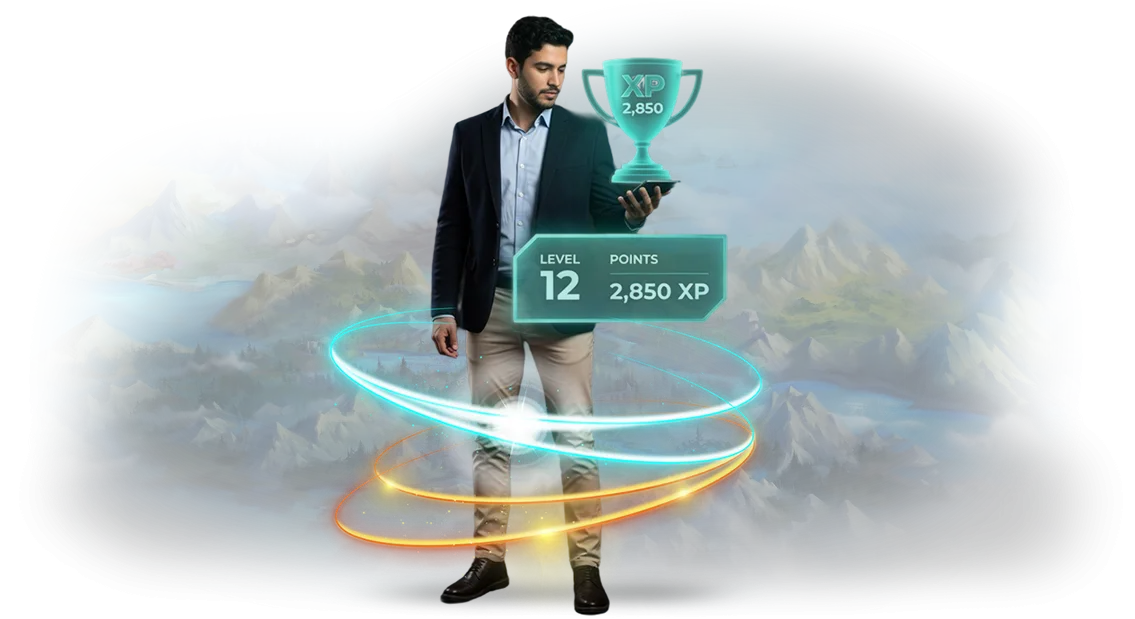
Gamification of training solves this problem: mechanics of progress, levels, rewards, and competition turn routine into an engaging process. Employees themselves want to complete a scenario, apply knowledge to a virtual or real task, and receive feedback.
As a result, learning becomes a regular part of work rather than an isolated event — the material is reinforced and carried over into daily practice.
That is why companies that introduce gamification into training and development retain both employees and clients. People feel that they are being developed, they solve tasks better, and clients receive a consistently high level of service.
Newcomers adapt faster, the team changes less often, and every employee becomes a carrier of the company’s standards. This is not entertainment for the sake of a game, but a tool that works for your business processes and returns the investment in every subsequent project.
What does gamification give to employee training and development?
Traditional training faces the same problem over and over: employees complete courses "for show" and forget the material within a week.
Gamification for training and development changes the mechanics — it turns a boring obligation into a clear game where everyone can see their own progress and results.
Employee engagement grows not because they are forced, but because reaching the next level is genuinely interesting.
Staff development accelerates through constant practice. Instead of passively watching webinars, a person solves real tasks in a safe environment: they can make mistakes, receive feedback, and try again.
This way, the skill forms faster and sticks for much longer, and the manager can see which competencies have already been mastered and which still need attention.
Training effectiveness becomes measurable. Business gamification gives the manager a transparent picture: who has completed the material, who is leading, who is falling behind — and allows for timely support.
The team stops being a "black box," and training investments begin to produce clear results in the form of growing competence and faster task completion.
Finally, gamification helps retain staff. Employees value an employer that invests in their growth, and an engaging learning format increases loyalty. The faster a person sees their progress and receives recognition, the less they want to leave for a competitor.
In the end, you get not just a trained team, but a motivated team that grows together with the company.
Gamification formats for training and development: what to choose?
Gamification works differently depending on the task: onboarding a newcomer, training skills, or maintaining motivation in an experienced team requires different scenarios. A correctly chosen format delivers measurable results faster and with less control overhead.
Below is a cheat sheet of gamification formats for training and development. Use it to determine which option covers your current need.
| Format | Best for | What it gives the client |
|---|---|---|
| Onboarding quests | Quickly introducing a newcomer to the product, processes, and team | The employee becomes productive from the first days, turnover during the probation period decreases |
| Training quizzes and practical scenarios | Mastering the product, service standards, handling objections | Material is absorbed through real-life situations, fewer mistakes in daily work |
| Ratings and internal competitions | Ongoing training, improving quality of work | Engagement and sales grow without rigid administrative control |
| Team quests | Strengthening department cohesion, teaching collaboration | Communication improves, employees pull each other toward results |
If your goal is to reduce the time a newcomer needs to reach full productivity, choose onboarding quests. If you need to systematically build skills, use quizzes with ratings. For long-term team motivation, choose competitive and collaborative scenarios.
In practice, the best effect comes from a combination: an employee completes onboarding, then regularly participates in learning activities and sees their progress.
We help you select a format that fits your task and audience, rather than simply "making a game for the sake of a game." At the start, we analyze your business goals, the team’s current level, and existing processes — and only then design mechanics that will work toward a specific result: faster onboarding, more consistent learning, higher motivation.
How the project works: gamification implementation stages
A clear implementation process is half the success. When the client sees in advance what will happen at each stage, there are fewer questions during the work and the outcome is predictable. We have structured the process so that you control the key checkpoints without drowning in details.
-
Brief and immersion in the task. We get on a call and break down your goals: what the gamification should change — accelerate learning, boost employee engagement, or affect business metrics. We lock in timelines, audience, and success criteria.
-
Scenario and mechanics design. Based on the brief, we propose a concept: how employees will go through the training, which scenarios and rewards will motivate your particular team. We agree on the approach before development starts — no surprises at the finish line.
-
Implementation plan and cost estimate. We show the scope of work, timelines, and cost for each stage. You see exactly what you are paying for and can adjust priorities before development begins.
-
Development and content delivery. We build a prototype, fill it with your materials, and test the logic against real scenarios. At this stage, you receive a demo version and provide feedback.
-
Testing and approval. We check stability, catch bugs, and run scenarios with a pilot group of users. After that, we finalize the version for launch.
-
Launch and team training. We set up access, show administrators how to manage the system, and launch gamification into the work process. From that moment, you can track participant progress in real time.
-
Support and development. After launch, we stay in touch: we quickly fix issues, help add new levels or materials, analyze metrics, and suggest improvements.
This approach ensures transparency at every step: you always know where the project stands and what comes next. And most importantly, the final decision is yours, not the contractor’s.
What is included in the delivery: a complete gamification launch kit
We put together a kit that lets you launch gamification in your company without a separate development team. You don’t need to understand the mechanics or invent scenarios — everything is already prepared, all that remains is to integrate it into your workflow.
Here is what is included in the delivery:
- Game scenario tailored to training and development goals: story, levels, tasks, and rules — the employee understands why they should participate and sees their own progress.
- Gamification mechanics: points, badges, ratings, team competitions — they create engagement and build a habit of returning to learning.
- System setup for your process: uploading training materials, connecting employees, configuring deadlines and difficulty levels.
- Communication materials kit: announcements, emails, posters, message templates for internal channels — the team learns about the launch and understands the rules.
- Administrator instructions: clear checklists for launch, user management, and result analysis.
- Administrator training: a short session where responsible staff learn to change settings, add tasks, and monitor engagement.
- Post-launch support: for the first month we stay in touch and help adjust the mechanics if we see something going off track.
This kit covers the main questions every client asks: how to launch quickly, who will maintain the system, and what to do if participants lose interest. You get a tool that works right away, and your employees get a clear, motivating program.
Case study: how a retail chain increased staff engagement
A retail chain called Market+ with 200 stores and a headcount of more than 3,000 employees faced a typical problem: mandatory courses were completed sluggishly, and knowledge was quickly forgotten.
Staff turnover in the customer-facing zone reached one-third per year, and every new hire required lengthy training.
To change this, we turned training into an engaging game. The internal portal became a platform with quest-based courses, duels between stores, and a system of points and rewards.
Employees themselves were motivated to complete modules, competing for the title of best team of the month.
Numbers after implementation
Within six months, the share of employees who completed mandatory courses grew from 34% to 91%. The average score on final tests increased by 25%, and the time to bring a newcomer up to speed was cut by two weeks.
At the same time, turnover decreased: in stores with active game leaders, resignations became 40% rarer.
The most valuable part is that engagement did not fade after launch. A year later, teams were still playing, and managers noted growth in sales and service quality.
After the initial results, the chain ordered gamification for mentorship and onboarding programs — this became the third joint project in two years.
How to choose the right gamification format for your task?
There is no one-size-fits-all universal answer — and that is normal.
The gamification format should follow from the task: if you need to quickly engage employees in a new regulation, a short quiz or competitive mechanic works; if the goal is to build a lasting skill, a longer story-driven program with levels and feedback is better. The key is to start not from trends but from the behavior you want to reinforce in your team.
The choice is also influenced by your audience and its digital habits. Younger professionals engage more easily with mobile formats with ratings, while experienced managers value scenarios with real cases and business outcomes.
We also consider how employees are used to learning: some prefer short "here and now" rounds, others prefer deep immersion. So we listen first, then propose.
That is what our consultation is about: we ask clarifying questions about learning goals, team size, available time, and desired metrics. Based on your answers, we offer 2–3 formats with a forecast for engagement and implementation complexity.
You can see which option will deliver results faster and which one is more reliable over the long run.
We have dozens of projects behind us across different industries — from retail to corporate universities.
We know which mechanics truly work in learning and which remain just "game for the sake of game." So you get not an abstract idea but a ready-made concept with justification: why this format was chosen, how it fits into your current processes, and when to expect the first changes.
If you are unsure which format suits your task, start with a short consultation. We will break down your case, highlight risks and growth points, so you can make a decision based on facts rather than guesses.
It is non-binding — but it removes the main question: "would this actually work for us?"
Frequently asked questions about gamification of business processes
Before launching gamification, many clients have the same questions: will data leak, is it hard to integrate the game into current processes, and when will measurable results appear. We answer directly — without technical details, just the essentials.
How secure is gamification for our company data?
Security is our priority. All data about employees, learning results, and achievements is stored in a protected environment with access control: each participant sees only what they are allowed to see.
We do not share information with third parties and operate in compliance with your company’s privacy policies.
Game mechanics do not require access to critical systems — we use anonymized scenarios. So you get an engaging format without risk to corporate data.
Can we integrate gamification with the software we already use?
Yes, we configure gamification as an overlay on top of your current tools — from learning management systems to corporate portals. That means employees do not have to switch between programs: tasks, points, and ratings appear where they already work.
Our experience shows that seamless integration takes from a few days to a couple of weeks, depending on the complexity of your infrastructure. The process does not interrupt the daily work of your teams.
How quickly will we see results, and will the project pay off?
The first results are visible within a month: activity increases, the number of completed courses grows, and more employees engage in learning. The economic effect comes from faster onboarding of newcomers, reduced time spent on professional training, and lower turnover.
The longer the program runs, the higher the return on investment — thanks to systematic skill development without interrupting daily operations. We set up analytics so you can see specific changes in numbers and assess gamification’s contribution to business results.
Submit a request for gamification — start with a brief
Submit a request for gamification for training and development, and we will prepare a brief with recommendations tailored to your task.
You will receive a ready-made plan: which processes to digitize, how to engage employees, and how to build the game into your current learning system.
The brief is not a marketing brochure but a working document with concrete details. We will study your situation, talk with you about your goals, and propose a solution that measurably affects team results.
No obligations and no hidden conditions: you decide whether to start only after you see the plan and the cost calculation.
How it works:
- You leave a request on the website or in a messenger — we get back to you within one business day.
- We have a short call: we clarify goals, audience, and current training challenges.
- We prepare a brief: we select the format, mechanics, and success metrics.
- We send you the cost calculation and timelines — transparent, with no hidden surcharges.
- Together we approve the launch plan and move to implementation.
The brief stays with you: you can use it for internal approval, show it to management, or return to it later. It is not a hollow document but a result that already contains answers to questions about the target audience, scenarios, and success indicators.
This approach saves your time: you immediately see what you get for your money and how gamification will affect employee training and development. If you need to discuss details in person, write or call — the contacts are in the form below. Submit a request, and we will start with a brief today.