

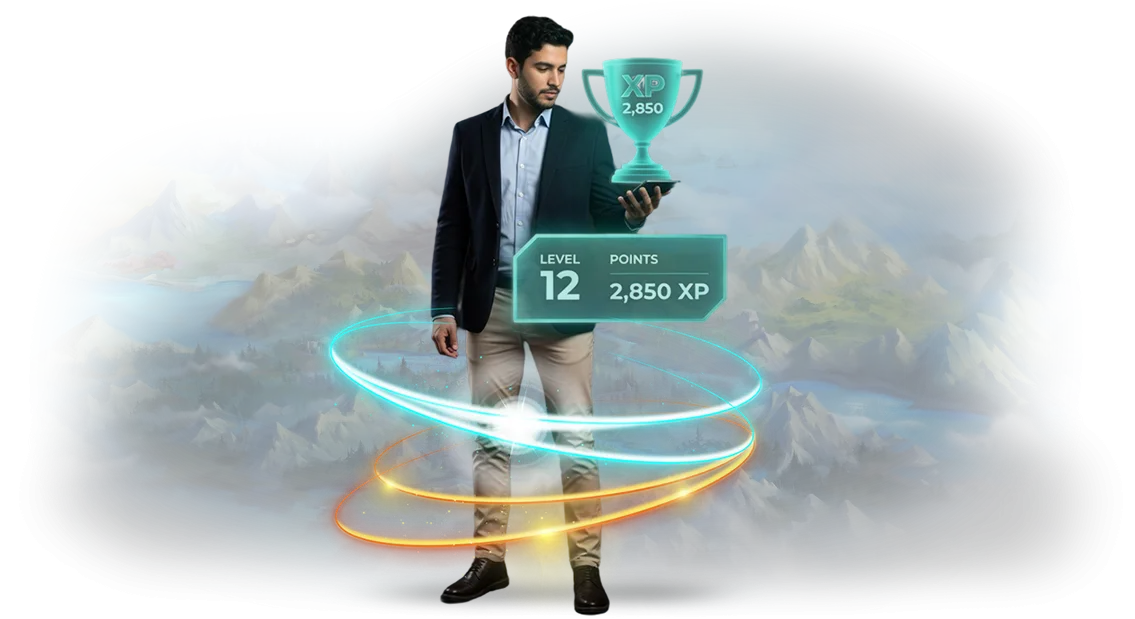
Why Sales Gamification Boosts Revenue and Customer Retention
Every company faces a situation where the sales department starts stalling: managers lose interest in routine, conversion drops, and customers defect to competitors.
Established metrics and bonuses stop working — employees formally complete the plan instead of actually engaging with the process.
Sales gamification solves this problem by turning work tasks into an engaging system with goals, levels, and feedback. It's not a game for the sake of a game, but a tool that strengthens team motivation and channels efforts toward results.
Employees see their achievements clearly, compete with each other, and receive recognition for their accomplishments.
When team engagement grows, so does the quality of customer interactions. Managers negotiate more actively, process leads faster, and pay closer attention to customer needs.
As a result, conversion to sale increases and the average ticket size rises — delivering direct revenue growth.
Gamification also works for customer retention. Transparent bonus programs, loyalty levels, personal challenges, and rewards for repeat purchases build a habit of coming back to you again.
Customers get drawn into the game, feel an emotional connection to the brand, and defect to competitors less often.
Thus, motivation gamification is not a one-off entertainment but a systemic solution that aligns the interests of the team and the business. It helps overcome sales slumps, boost department productivity, and build a stable base of loyal customers. Which means — steadily growing revenue and maintaining market leadership.
What Gamifying Business Processes Delivers to Your Team and Customers
Gamifying business processes is not entertainment but a working tool that links employee and customer actions to company goals. Instead of abstract "we need to work better," a clear system emerges: tasks, points, levels, rewards. Employees see their progress and understand that their efforts produce concrete results.
The first effect managers notice is KPI growth. The team closes more sales, handles leads faster, and processes objections more effectively — because every step brings them closer to a personal goal.
The competitive spirit and public recognition of achievements work more powerfully than bonuses paid once a quarter.
The second effect is employee engagement. When work becomes a game, people show up not to "sit through a shift" but to achieve results. This reduces turnover, shortens onboarding time for new hires, and makes the team more cohesive.
The manager spends less effort on control — the system itself highlights who is falling behind and who is ready to take on new challenges.
The third effect is customer loyalty. Gamification works in external processes too: loyalty programs with levels, quests, and action-based bonuses.
Customers return not because you have a "5% discount" but because they find it engaging to progress through levels, earn statuses, and unlock new benefits. This increases brand trust and the number of repeat purchases.
The result is growth across the entire system: sales go up, the team works cohesively, and customers come back. We develop such solutions for your specific business needs — from a small mechanic for one department to a comprehensive system embedded in your processes. With us, you get not just a game but a manageable increase in performance metrics.
Sales Gamification Formats: From Competitions to Training Quests
Gamification for a sales department only works when the format matches the task. A competition lifts revenue over a short period, a training quest changes manager behavior for months, and a team marathon unites adjacent departments.
Before choosing a mechanic, we identify the growth point: lack of motivation, weak skills, or team fragmentation.
| Format | Who It's For | What It Delivers to the Business |
|---|---|---|
| Sales competition | A department that needs to quickly increase turnover during peak season | Short-term revenue growth, healthy competitive drive, clear winners |
| Training quest | New hires and experienced managers who need to master the product and sales techniques | Managers reach target metrics faster; knowledge is applied in real deals |
| Team marathon | Adjacent departments — sales, marketing, support | A shared goal without manual oversight; joint results through experience exchange |
| Negotiation simulator | Managers before launching a new product | Practicing objection handling without risking the customer base; confidence in client communication |
Each of these sales gamification formats is not merely a game but a tool with specific business metrics. We don't impose a single turnkey scenario: we tailor the mechanic to your numbers.
Need to quickly hit the plan — we run a competition; want skills to stick long-term — we build a training quest. Most often we combine two or three formats in one program to achieve both immediate results and team development.
How We Implement Gamification: Stages of Working on Your Project
Sales gamification is not a one-off campaign but a system embedded into work processes. We've completed dozens of projects and structured our implementation stages so that at every step you understand what's happening and what result you'll get. Below is our proven framework: from the gamification brief to gamification support.
- Gamification brief and task analysis. We immerse ourselves in your product, study the sales department, the team's current motivation, and pain points. We identify which actions should become habits: calls, meetings, closing deals, handling objections.
- Gamification plan and alignment. We propose the mechanics, scenarios, and the points-and-rewards system. We show how the project will fit into existing processes and what results you'll achieve at each stage. After approval, we lock in timelines and budget.
- Building the game environment. We design the visuals, interface, and competition logic. We prepare a prototype — you see how tasks, progress, and prizes will look and can make adjustments before implementation begins.
- Project delivery and configuration. We assemble the solution on a professional platform, connect it to your tools, and configure it to your specific needs. We run tests to prevent disruptions in employee workflows.
- Launch and training. We engage your managers, explain the rules and benefits. We help you present the gamification to your team so it generates excitement from day one rather than resistance.
- Gamification support and evolution. We monitor metrics, collect feedback, adjust rewards, and add new scenarios. The system stays alive and continues driving sales after launch.
What's Included in the Deliverable: A Complete Launch Kit
Sales gamification only pays off when the team has a clear launch kit. We don't deliver a "raw" project but a working system: scenarios, rules, manuals, and motivation tools. You receive everything ready to use — all that's left is to assign roles and start the game.
Here's what's included in the deliverable:
- Game scenarios and mechanics tailored to your business processes — ready-made storylines, quests, and levels for your sales team, from simple promotions to long-running tournaments.
- Methodology materials for managers — how to set goals, award points, review results with employees, and adjust sales behavior.
- Motivation system and key metrics — a direct link between game points and real sales metrics: volume, conversion, plan attainment. Managers see who is driving the business and how.
- Instructions for participants — cheat sheets, short training videos, and posters so employees quickly understand the rules and jump into the game from day one.
- Admin panel for management — you can change levels, prizes, and team compositions yourself without involving developers. Updating mechanics takes minutes.
- Launch plan and startup support — a step-by-step program for the first weeks: checkpoints, reviews, and error analysis so the game delivers measurable sales growth within the first month.
In the end, you get not a one-off campaign but a scalable sales tool. Mechanics are easy to update, new teams and prizes can be added — gamification results become lasting and grow period over period.
Case Study: How Gamification Increased Revenue and Employee Motivation
A beauty salon network BeautyPro came to us with a typical market pain point: administrators weren't meeting their upsell targets, and staff turnover was rising. Classic motivation — commission and fines — had stopped working: employees saw it as a burden rather than a game.
What We Did
Over four weeks, we audited the sales funnel and launched gamification directly inside their CRM. Employees received personal dashboards with levels, team challenges, and a transparent success ranking.
Every evening, the system automatically summarized the day's results and showed who was closest to a prize and who had grown 10% against their own baseline that week. We didn't add a single new responsibility — we simply turned everyday work actions into a competition.
The first two weeks went into fine-tuning the rules and calibrating difficulty. After that, the mechanics ran on their own: managers spent no more than an hour a day on sales management.
Project Results
- Upsell revenue grew by 31% over two months — without expanding headcount or running ads.
- Repeat-visit conversion increased from 41% to 58%: customers were more willing to come back because employees started offering services that actually fit their needs.
- Staff turnover among frontline employees dropped by half — the game mechanics provided the sense of growth that had been missing.
- Three months in, the client renewed the project for the next period: according to the managers, the system had become part of their daily routine.
Today this practice is being rolled out across other branches of the network.
We don't promise the same results to everyone — much depends on the customer base and the involvement of leadership — but the BeautyPro experience confirms that well-designed gamification pays off and motivates people more strongly than simply raising sales commission.
How to Choose the Right Gamification Format for Your Business Task?
Choosing a gamification format doesn't start with studying trends but with a question: what specific behavior do you want to change — in employees, customers, or visitors.
If the goal is to accelerate onboarding for new sales hires, training quests with feedback and levels work well. If you need to boost motivation among tenured employees, points systems, leaderboards, and rewards for hitting plan targets are the right fit.
And for capturing attention at an exhibition or conference, short interactive experiences that deliver an emotional hook and a reason to approach your booth in a couple of minutes are far more effective.
The criteria for choosing a format can be narrowed down to a few simple questions: who exactly will play, where this happens, and what result we're measuring.
The audience determines the complexity and language of the mechanics: experienced sales managers engage quickly with competitive games, while casual visitors respond better to light challenges with instant prizes.
The communication channel sets the constraints: mobile app, website, messenger, offline venue. And you always need a measurable metric — conversion to deal, number of target actions, increase in average ticket, or repeat visit count.
Only when all three criteria are locked in does the format stop being "just a game" and become a working tool.
The biggest mistake in choosing gamification is copying another company's successful case or embedding an overly complex mechanic with no connection to the process. The game then lives a life of its own: participants have fun, but business metrics stand still.
That's why the second step is an internal audit: we look at how your sales or marketing event currently works, what motivation points already exist, and where attention is being lost.
After that, we propose an individualized solution: we tailor the scenario, cycle length, reward system, and evaluation rules to your KPIs — not to abstract standards.
In the end, you get a manageable tool that integrates into existing processes and doesn't require heroic efforts from your team to launch. We handle the mechanics design, advise on how to announce the game, and what to do to keep engagement from fading after the first week.
A responsible approach to format selection is what separates entertainment from real business gamification — the kind that increases sales and brings customers back again.
Frequently Asked Questions About Sales Gamification: Addressing Your Doubts
Implementing sales gamification often raises questions: will it break existing processes, will employees accept the mechanics, when will the effect appear. These doubts are understandable, but with the right approach the risks are manageable and the benefits are measurable.
Below are answers to common concerns. If you don't find your question here, write to us — we'll discuss the details.
Won't employees reject the game?
Gamification amplifies motivation; it doesn't replace it. The mechanics are built on real goals and roles, and we conduct training before launch. Informal leaders get engaged first — the rest of the team follows.
When will results and payback appear?
The first changes are visible within 2-3 weeks: activity rises, the funnel accelerates, conversion improves. When the plan is met, payback typically takes 2-3 months.
What if there are no results?
We work in stages: we launch a pilot with one team, analyze, and adjust. If the pilot doesn't produce growth, we don't scale it. Payment is tied to milestones — you pay for actual results.
Will we need to rebuild our CRM and install complex systems?
No. Gamification integrates with your existing tools: dashboards, leaderboards, messengers. Employees stay in their familiar environment, and management sees activity in real time.
Launch Sales Gamification: Get a Cost Estimate and Action Plan
Sales gamification is a tool that turns a manager's daily routine into an exciting race for results. Well-designed mechanics increase funnel activity, accelerate deal closing, and improve plan attainment.
But for gamification to truly work, you need a calculation based on your company — not template solutions.
Leave a request for a consultation — and we'll prepare a cost estimate and implementation plan tailored to your business processes. Our individualized approach means we first study your situation and then propose mechanics — not the other way around.
What you'll receive after contacting us:
- A gamification cost estimate based on your tasks, number of employees, and process scale.
- A stage-by-stage implementation plan — from brief to launch, with clear timelines and areas of responsibility.
- A selection of mechanics that drive sales: competitions, levels, team goals, and rewards.
- An assessment of the potential effect on key metrics: conversion, average ticket, share of plan attainment.
- Recommendations for integration with your accounting and reporting systems — without extra manual work.
- Expert consultation and answers to questions specific to your situation.
Submitting a request is completely non-binding: you get a preliminary estimate and concrete information for making a decision. We work remotely, so we can launch gamification in any city. Leave a request — and we'll send you a cost estimate and action plan.