

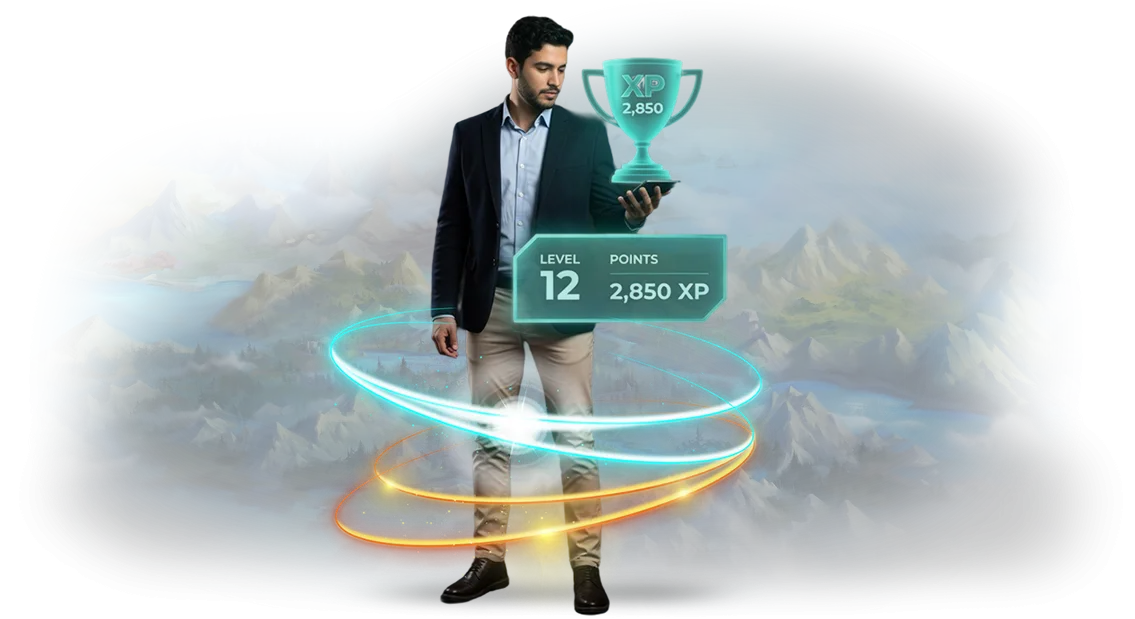
Why B2B sales consultants lose motivation
B2B sales consultants work with a long sales cycle: negotiations stretch over weeks, results are not visible immediately, and the sales plan remains the only benchmark. Day after day — calls, emails, meetings, objections.
When emotional payoff doesn't come, interest fades, and familiar KPIs stop being a source of energy.
Consultant motivation drops not because they have stopped wanting to work. Standard metrics simply long ago became background noise: numbers in a report no longer spark excitement, and the process doesn't give a sense of victory.
This is especially noticeable in a B2B team — long deals without intermediate successes lead to burnout, reduced activity and, as a result, lost revenue.
Sales gamification solves this problem differently. It turns routine into a game with clear rules, visible progress and quick wins: completed steps, closed stages, personal ranking.
The consultant sees how their actions bring them closer to the goal and re-engages in the process — not under duress, but with genuine interest.
For a manager, this means predictable sales plan fulfilment and a team that doesn't burn out after the first quarter.
Implementing game mechanics does not require changing business processes — it integrates into the existing workflow and starts delivering results within the first few weeks.
We help businesses restore consultant motivation through well-designed gamification — simple for employees and transparent for management.
What a game-based motivation system will give your team
The first thing a business owner sees after implementing a game-based system is manageable sales dynamics. Instead of "make more calls," transparent rules appear: every completed stage brings points, status and a tangible result in the overall standings.
This approach directly accelerates the department's KPIs — consultants strive to close more deals on their own because they find it personally interesting.
The increase in employee engagement is visible within the first week. Employees stop sitting around waiting for instructions: natural competition kicks in, along with the desire to take the top spot on the leaderboard.
In B2B, where the deal cycle is long and requires persistence, it is gamification that keeps focus on daily actions — calls, meetings, preparing proposals. As a result, conversion rates and average transaction value go up.
Another advantage is retaining valuable employees. Turnover in sales, especially in complex B2B areas, is expensive: training a new consultant takes months. A game-based system creates a clear growth trajectory for everyone — from novice to expert.
People see where they are heading, receive regular feedback and feel recognised. This reduces the desire to leave for competitors over "just a higher salary."
Finally, the overall efficiency of the department stops depending on "stars." The motivation system levels the whole team: laggards catch up thanks to clear rules and quick wins, while leaders receive new challenges and mentoring opportunities.
The manager sees an objective picture — who is truly driving the plan and who needs support. As a result, you get a resilient sales department that delivers predictable revenue.
Gamification formats for B2B sales: what to choose
There are many gamified mechanics formats to motivate B2B sales consultants, and each addresses its own task. Leaderboards boost the competitive spirit, quests drive specific actions, levels retain engagement over the long term.
The key is not to bundle "everything at once," but to choose a format that fits the current situation in the department and the budget.
| Format | What it affects | When to choose |
|---|---|---|
| Seller leaderboard | Transparent competition, drive to be first | To quickly boost activity, identify leaders |
| Quests and tasks | Specific actions: calls, meetings, closing deals | To direct the team to a weak funnel stage |
| Levels and ranks | Long-term retention, career track | To keep strong employees, show a growth path |
| Team competitions | Mutual support, experience exchange among salespeople | To develop team spirit, support newcomers |
| Points and badges | Consistency, plan fulfilment | To build stable discipline without sharp fluctuations |
| Surprise mechanics | Emotions, excitement, interest in the process | To break routine, create a boost before an important event |
How to choose? If sales are slumping at the meeting scheduling stage, quests with specific steps will help. If your best employees are leaving, choose levels and ranks. If you need to quickly energise the team before a reporting period, go with a team competition.
We help you select the right format for your task and budget and embed it into daily work. Proper mechanics are clear to consultants from day one and deliver measurable results: an increase in calls, meetings and repeat sales, without unnecessary "game fluff."
How the development of a game-based system for your tasks works
We have structured the process so that you always understand what stage the project is at and what you will get in the end.
It is important for us not merely to deliver a system but to deliver measurable sales growth, so every step is aligned with you and based on your business metrics.
Key implementation stages
- Brief and audit of the current motivation system. We study how consultants are currently rewarded, which KPIs matter to the business and what prevents goals from being achieved. We record the tasks the game needs to solve.
- Development of the game mechanics concept. We propose a model: levels, points, quests, team competitions and awards. We align the scenario with you and show how the game will affect sales.
- Prototype and design mock-up. We create a visual interface mock-up so you can see how the system will look for employees. At this stage, we make changes without missing deadlines.
- Development and configuration of the system. We build the game for your tech stack, integrate it with CRM and internal services. You receive a working platform with a clear administrator dashboard.
- Pilot testing. We launch the system with a group of consultants, collect feedback, verify the accuracy of point accruals and user behaviour. Based on the data, we adjust the mechanics.
- Launch and training. We deploy the system for the entire team and hold short training webinars for managers and salespeople so everyone understands the rules and sees their benefits.
- Support and development. After launch, we track activity, analyse metrics weekly and, if necessary, add new levels, quests or awards.
A full turnkey project usually takes four to eight weeks, depending on team size and integration complexity. At each stage, you receive interim reports, and the final result always meets the agreed deadlines.
Thanks to this approach, you control the budget and see how the gamification evolves, rather than simply waiting for a finished product.
What is included in the delivery of the finished system
A ready-made motivation system for B2B sales consultants is not just a game wrapper but a working tool that integrates into your business processes and delivers measurable results. Below is a clear list of what you receive after the project is completed.
- Delivery package — a configured platform with game mechanics adapted to your goals: points, levels, leaderboards, team competitions and a rewards showcase. Everything works in the browser, without installing additional software.
- Project results — clear business metrics: increased plan fulfilment, reduced onboarding time for new hires, increased repeat sales from the active base. You see the dynamics in the dashboard, not abstract "improvements."
- System documentation — a detailed description of all mechanics, point accrual rules and administrative instructions. Your HR manager and sales department head will be able to change settings themselves without developer involvement.
- Team training — a practical session for administrators: how to launch competitions, assign prizes, export reports and handle disputes. Separately, a quick guide for consultants so they can join the game quickly.
- Integration with current processes — connection to your deal tracking system: plan fulfilment data is pulled automatically, and consultants don't waste time on manual entry.
- Analytical report — after the pilot launch, we show which mechanics drove sales growth and which should be adjusted. Based on the report, you decide on scaling.
- Guaranteed support — two months of post-launch support: we fix bugs, answer questions and update the system to reflect your changes.
The entire package is handed over to you as a single product with source materials and rights. You get not "contractor dependency" but an independent tool that continues to operate and evolve inside your company.
Case study: how we improved team performance
How often do sales plans remain on paper? This is especially noticeable in B2B: consultants work with a long sales cycle and complex objections and don't always see the link between their efforts and company results.
It was exactly such a challenge that Alpha-Trade, an industrial equipment distributor, brought to us. Its sales department was hitting only 60% of its plan, turnover among consultants was rising, and managers were spending time on manual control instead of strategy.
We proposed not another financial incentive but a game-based system embedded in daily work. Each consultant received a personal "hero's journey": growth zones, objection-handling quests, team competitions and instant feedback for every move through the funnel.
No "mandatory stuff" — just clear steps and visible progress that both the employee and the whole team could see. Implementation took three weeks: we adapted the mechanics to the specifics of B2B sales, trained managers and launched a pilot in one of the departments.
The results for one quarter exceeded expectations: plan fulfilment grew from 60% to 90%. Qualitative indicators also improved — the average transaction value increased, and the share of repeat client deals grew by a quarter.
Managers stopped being "controllers": the system itself shows where the team is struggling and where more pressure can be applied.
Most importantly, employees themselves got involved in the game: healthy competition raised engagement, and a transparent reward system became the driver of daily wins.
Two months after launch, the department asked to scale the game to all branches, and six months later we received a repeat order for a new game scenario.
The Alpha-Trade case is not a one-off success: in similar projects for other B2B companies, we regularly achieve 30–50% sales growth in the first two months.
That's why we are confident: gamification is not a game for the sake of a game but a working tool that pays for itself through measurable business results. If your team is also struggling to meet plan targets, we'll show you how to implement such a system.
How to choose the right gamification format for your team?
There is no universal gamification format, and that's okay. What motivates a team of five consultants working with a short sales cycle is unlikely to work for a department of forty people with long B2B deals.
So choosing a format starts not with mechanics but with goals: what do you need — to raise conversion, reduce time to close, lower turnover or strengthen plan fulfilment.
Three things influence the choice: team size, sales cycle length and how your motivation system is built. For small teams, leaderboards and quick weekly competitions work well; for large ones, multi-level programs with team and individual goals.
If the deal is long, gamification should maintain interest at intermediate stages, not just at the final result.
If your situation is non-standard — for example, you work with seasonal consultants, combine online and offline teams, or motivate not only sales but also service quality — we will adjust the mechanics to your individual conditions.
Adaptation happens at the level of rules, scenarios and evaluation systems, so you don't need to "break" your current processes for the sake of a game.
Rather than guessing, start with a short consultation: we'll ask a few questions about your team and plan targets and propose a format you can launch without restructuring the department.
It carries no obligation — but you'll get a concrete action plan rather than abstract recommendations.
Frequently asked questions and client concerns
Doubt before launching gamification is common. Clients most often ask the same things: won't the game distract consultants from calls, how difficult is it to implement, and will the result justify the investment.
Below we address these fears — without promising a "magic button," with honest working conditions.
Won't gamification distract from real sales?
Game mechanics are embedded in work processes: the consultant performs familiar actions — calls, meetings, deals — and earns points for results. They are not "sitting in a game"; they see progress in your CRM.
Salespeople perceive this as an incentive, not entertainment. If necessary, we limit the time spent on game elements.
Is it difficult to implement? Will we have to stop department operations?
Implementation is phased: we test on one team, then scale. You don't need to stop sales — the system runs in parallel without restructuring processes. The manager gets a simple control panel to see team activity without having to deal with complex settings.
What if the result doesn't appear?
We offer a guarantee: if metrics don't improve after the agreed period, we refine the mechanics for free or refund part of the payment. At the start, we record current figures and targets. In reports, you see which mechanics work and which should be replaced.
The main risk is not trying while competitors are already motivating their teams and taking away clients. We handle the setup, launch and support. Still have doubts? Ask us directly, and we'll answer based on your scenario.Start your team gamification project
B2B sales mean long deals, constant objections and a high cost of mistakes.
Without a clear motivation system, consultants lose momentum and the plan is met only "every once in a while." Gamification turns routine into a game with transparent rules, quick wins and visible progress — exactly what keeps a team engaged over the long haul.
We have been developing motivation systems for sales departments for over 10 years. We know how to engage consultants, not just hand out bonuses for meeting the plan. To get a cost estimate and a preliminary gamification proposal, take five simple steps:
- Leave a request on the website or write to us in a messenger — we'll schedule a consultation
- Discuss with us your current motivation system and the team's pain points
- Share the numbers you want to improve: sales plan, conversion, deal velocity
- Receive a preliminary proposal with a gamification scenario and an estimated cost
- Approve the plan and launch the pilot project — we take care of further support
We'll prepare the preliminary proposal within two business days. It includes the game scenario, implementation timeline, metric forecast and launch stages. You don't need to understand gamification mechanics: we'll adapt the solution to your team and business processes.
Submitting a request carries no obligation. Even if you decide to postpone the project, you'll get a fresh perspective on motivating your consultants.
Leave a request on the page — we'll get in touch within one business day and discuss how gamification can strengthen your B2B sales.