

Employees forget Docebo courses? Gamification will fix this
Every manager knows the picture: employees enroll in a course, complete the first modules, and a week later forget about it. The budget for corporate training is spent, and the knowledge never reaches everyday work tasks.
The problem isn't laziness—it's lack of motivation. Ordinary courses in Docebo are perceived as an obligation: long videos, tests, no feedback. Staff engagement quickly drops, and training becomes a formal checkbox.
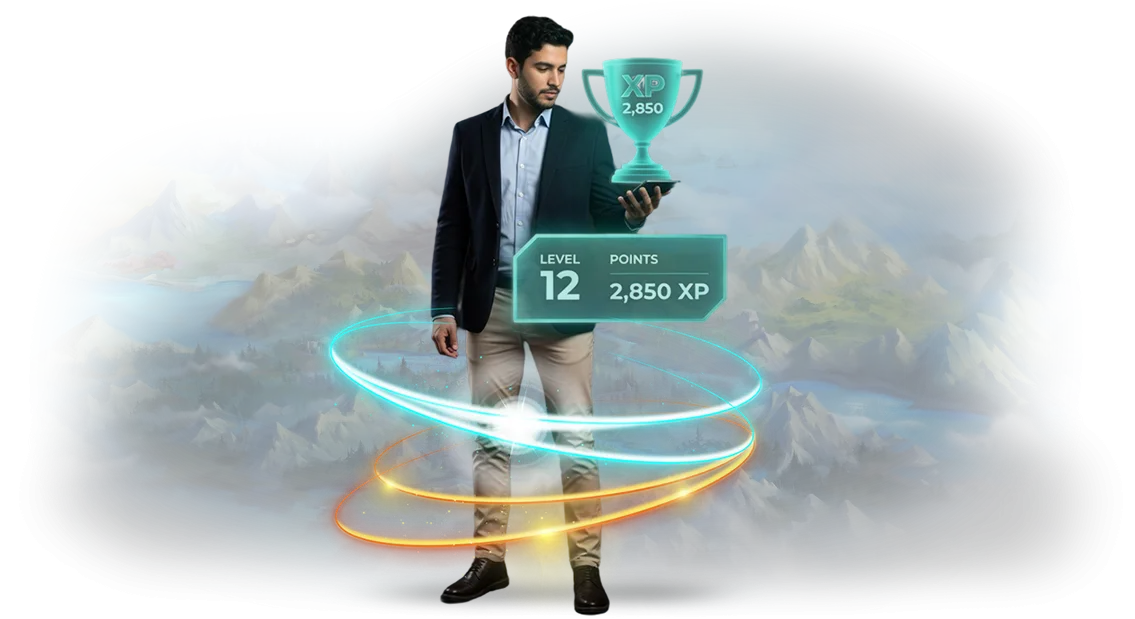
Gamification of training in Docebo solves this problem. We turn the process into a game: points for completed modules, levels, virtual rewards, team rankings, and personal achievements.
The employee returns to the system on their own—to level up, surpass colleagues, or earn a well-deserved prize.
This approach increases course completion rates many times over. People actually absorb the material, apply it at work, and share successes with the team. For business, this means skilled specialists, fewer mistakes, and a higher return on every hour of training.
We build gamification mechanics to fit your company's goals: from simple motivation systems to a full-fledged corporate rewards store. We integrate it into your training portal, tailor it to your processes, and support it after launch.
Learning becomes a habit, not an obligation—and that pays off your investment in talent development within the first few months.
What a corporate rewards store will bring to your business
A corporate rewards store is not just a nice bonus to training, but a working tool that links employee achievements to their real value for the business.
Instead of an abstract "complete a course," a concrete goal appears: earn points, access the storefront, and choose what truly motivates that specific person.
Such a system transforms one-off activity into a consistent habit, and the HR team's task becomes easier and more transparent.
When an employee sees their efforts converted into a tangible reward, engagement no longer depends on mood or seasonal campaigns. Points accumulate for completing programs, completing tasks, participating in initiatives—and this creates long-term interest.
You get not a short-term burst of activity, but steady growth in the number of sessions and the depth of each course completed. This is exactly what classic training systems lack, where motivation ends with initial enthusiasm.
Systematic motivation is favorably different from one-off bonuses or surprises from a manager. The employee sees their own progress, understands how many points are needed for the next reward, and can plan their actions.
The HR team, in turn, gets a clear mechanic that works in the unified Docebo environment—no need to build separate solutions or collect data manually. Everything happens in one place: training, result assessment, point accrual, and reward selection. This saves time and eliminates disputes over who got points for what.
A corporate rewards store is also a powerful tool for strengthening the employer brand. Employees tell colleagues that the company values their development and gives real bonuses for it, sharing purchases and wins in internal communities.
Such stories work better than any HR presentations: they create a reputation as a company where it's interesting to work and there's something to strive for. As a result, you retain strong specialists and attract new ones—even before they step through the office door.
Essentially, you get a self-sustaining motivation ecosystem: training produces results, results bring rewards, rewards strengthen the desire to keep developing. This works for engagement, business KPIs, and team loyalty.
If you want to implement such a mechanic at your company, tell us how exactly you want to motivate employees—together we'll choose a format that fits your processes and starts delivering results immediately after launch.
Gamification formats in Docebo: from points to rankings
In Docebo, an employee stops perceiving training as a duty when they see the result of their efforts. Points, a virtual rewards store, and rankings are three proven gamification formats that turn routine tasks into a recognition system.
Each format solves its own task. Points support regular participation, the reward storefront gives employees a choice, and rankings introduce healthy competition. The choice depends on team size, corporate culture, and the desired outcome.
| Format | Who it's for | What it gives the client |
|---|---|---|
| Points and levels | Teams with daily tasks and training | A clear contribution assessment system, increased engagement, quick launch |
| Docebo virtual rewards store | Young teams and companies with a recognition culture | The employee chooses the reward themselves—the value of the incentive increases |
| Rankings and leaderboards | Sales, support, and competitive teams | Visible leaders, competitive momentum, increased employee activity |
For distributed teams where employees rarely see each other, rankings work worse—points with a reward storefront are more effective. In close-knit teams, rankings become a natural motivator.
Formats can be easily combined: points accumulate, rankings show dynamics, and the rewards store turns points into real prizes.
We will select the optimal format for your team and configure the system in Docebo for the desired result. Tell us about your task—we'll take care of the rest.
Implementing gamification in 6 steps: from brief to launch
For business, gamification works only when it is embedded in processes and understandable to employees. That's why we follow clear implementation stages: from a joint brief to the launch of gamification with subsequent support. Each step ends with a checkpoint—you see the result and make decisions.
Six stages of work
-
Brief and task setting. We define goals, audience, and desired metrics: increased course completion, event engagement, reduced turnover. You receive a document with all agreements.
-
Prototype approval. We create an interactive mockup of the future rewards store. You see how an employee gets points and spends them, and you make edits before programming begins.
-
Rewards store and mechanics development. We design the look, configure the reward catalog and point accrual rules. All mechanics work inside Docebo—no new tools to learn.
-
Portal integration. We connect rewards to events: course completion, passing a test, event activity. Accruals happen automatically.
-
Test launch. We launch a pilot group, collect feedback, and test scenarios. You see initial results and make adjustments.
-
Full launch and support. We open gamification to all employees, hand over instructions to the administrator, and stay in touch after launch.
What's included in the virtual rewards store delivery
After implementation, you get not just scattered elements, but a complete, working motivation tool. The delivery package is designed so the system can be launched immediately, without involving developers or lengthy setup.
- Reward storefront design under your brand — catalog styling in corporate identity that employees immediately recognize. This increases engagement and unifies the storefront with the company's overall image.
- Point earning and spending logic — transparent rules and clear reward cards. The employee understands what they get points for and what they can choose, and you free yourself from the flow of "how does this work" questions.
- Catalog categories and configuration — the storefront structure allows you to quickly add new rewards, change priorities, and announce limited offers without stopping the system.
- Personal status notifications — automatic messages to the employee about point accrual, progress toward a goal, and available rewards. This maintains interest in the program.
- Administrator guide — a simple document that lets your HR or marketing manager independently add products, change design, and manage redemptions. No dependence on the contractor.
- Updates and support after launch — we stay in touch and support the store in its first weeks of operation to guarantee stability and make timely adjustments.
Every delivery item has been tested on real projects, so after handover you don't spend time on "finishing touches" and fine-tuning; you immediately use the store as a full-fledged channel for motivating and rewarding employees.
Case study: how a rewards store increased course completion by 40%
A major client came to us with a typical pain point: corporate training on the Docebo platform exists, courses are loaded, but employees complete them without enthusiasm. The completion rate barely reached a third—content investments were not paying off.
We proposed turning training into a game with a tangible result. Inside Docebo, we deployed a virtual rewards store: for each completed course, an employee earns points that can be spent in the store on real prizes—from branded hoodies to an extra day off. The system itself tracks progress and unlocks new levels to keep interest alive.
Results the client sees
Two months after launch, the share of employees who fully completed a course grew by 40%. Time spent in the learning platform increased on average twofold, and the number of support requests regarding training decreased by a third.
The client was so convinced by the mechanic that they ordered the store rollout for two more of their divisions.
The most valuable part is the reaction of the employees themselves. The client's head of talent development said: "We expected improvements, but not this level of interest. People themselves ask when new courses will appear and accumulate points. This works better than any internal mandates."
Such a system pays off not with a one-off burst, but with a sustained habit of learning. That's why we make gamification not a temporary campaign, but part of the corporate culture.
How to choose a gamification format for your company's goals?
Choosing gamification starts not with game mechanics, but with corporate training goals and team size. If you need to quickly boost activity, rewards for completed courses and tests will work.
If the goal is regular training, levels, scenarios, and accumulative points exchanged for prizes work better. Therefore, selecting a reward format always relies on goals, not on trendy game features.
Team size determines the scale: a small department needs an achievements showcase and ranking, while hundreds of employees require automatic accrual rules, different reward types, and personalized catalogs.
This is where the Docebo corporate rewards store is convenient: employees exchange points for real prizes, and the manager sees what truly motivates.
Gamification for a team should feel light: minimum rules, quick wins, and a pleasant reward. If the mechanic requires extra steps, it quickly gets tiresome.
We recommend starting with one scenario—for example, points for a mandatory course—and adding levels or team competitions based on results.
If you're unsure which format to choose, we can help based on your data: which courses have the lowest completion, which department to engage, what prize budget you have.
We'll find an option that employees accept naturally, and training will deliver measurable results—increased completions and time in the system. The main thing is that gamification serves a business goal, not simply exists for the sake of the game.
Common doubts when launching corporate rewards
Doubts before launching corporate rewards are normal. Managers worry that the store won't handle the load, employees won't understand the interface, or integration with the learning platform will be complicated. Let's address the most common fears—and explain how we eliminate them at the planning stage.
We have worked with Docebo and other corporate LMSs in dozens of projects, so we know where risks typically arise. Below are answers to the questions most often heard before launch.
What if the rewards store is not stable and "crashes" on launch day?
Stability is the result of proper architecture and testing. We calculate peak load in advance, conduct load tests, and use professional equipment, so the store handles hundreds of employees logging in simultaneously. We also build in a safety margin in case activity exceeds expectations.
What if employees don't understand how to use the store?
Adoption begins with a simple interface: the employee sees their point balance, the reward catalog, and a single "Exchange" button. No unnecessary actions.
We accompany the launch with a short guide and in-system hints, so even inexperienced users make their first purchase within minutes.
Is integrating the rewards store with Docebo difficult?
Compatibility isn't a problem—it's part of the design. We build the store as a separate service that exchanges data with Docebo through standard synchronization mechanisms. Point accrual and reward redemption happen automatically, without manual operations or errors. We test the entire integration before launch.
If questions remain—ask us, we'll answer each specific scenario. The main thing is that after implementation you'll have a working motivation tool, not a headache. Employees get a transparent reward system that encourages completing training and fulfilling business tasks.Order gamification implementation — get a cost estimate and plan
A clear process saves your time and money. That's why the gamification implementation process in Docebo is structured so that at the first step you already get a measurable result—a cost estimate and a work plan tailored to your specific business task.
How to quickly get a cost estimate and plan
Leave a request—and within one business day we'll come back with clarifying questions.
Then everything follows a simple chain: you tell us what problem you're solving (increase sales, speed up onboarding, reduce customer churn), and we propose a reward mechanic and corporate store format that delivers a measurable effect.
During a consultation on Docebo, we'll show how gamification will fit your current training structure, which scenarios to run first, and how long it will take.
What you get after reaching out:
- A clear cost calculation based on your user volume and number of courses—no hidden extras.
- An implementation plan with stages, timelines, and outcomes for each step.
- Recommendations on reward mechanics: points, levels, prize storefront, internal currency.
- An integration scheme with your processes: who from the company participates, what data is needed.
- Examples of similar projects in your industry, so you can see use cases in advance.
Even if you're not yet sure whether gamification is needed—that's fine. In 30 minutes we'll analyze your situation and honestly tell you where the mechanic will work and where it will just add unnecessary complexity. Get in touch—we'll prepare the cost estimate and plan.