

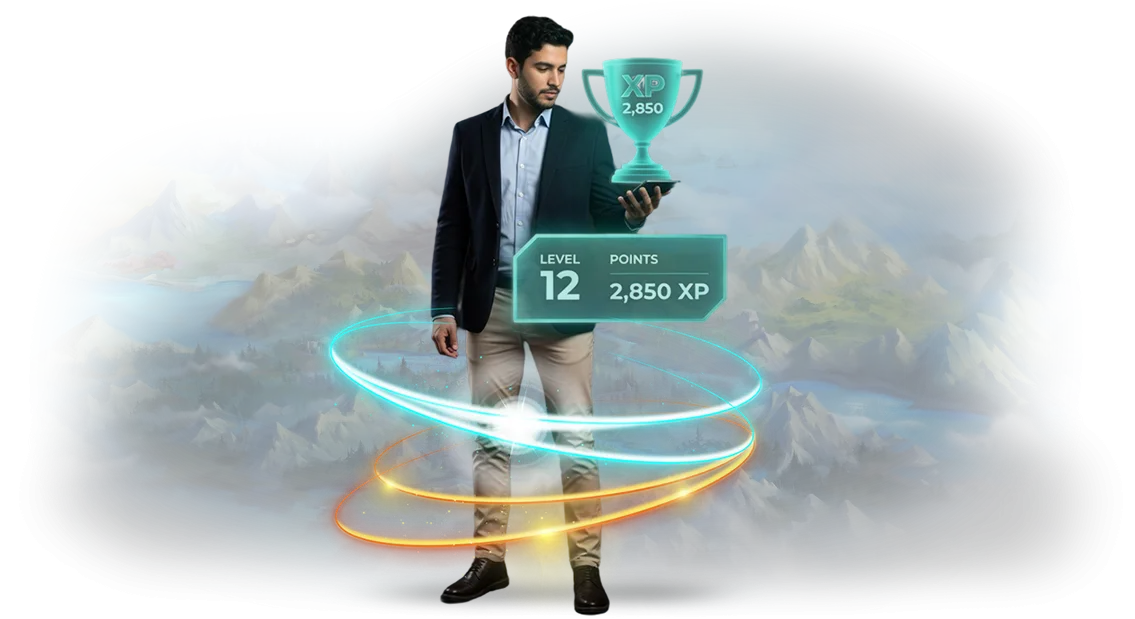
Employees Are Bored, While ADP Embraces Gamification — Are You Falling Behind?
Declining employee engagement is a silent epidemic in modern business. Tasks are completed on autopilot, initiative fades, and top specialists look for new challenges outside the company.
Staff motivation drops, and this affects every business metric: from customer service speed to the quality of internal communications.
Managers often try to solve the problem with money: they raise salaries, add bonuses, and book team-building events. But the effect of such measures is short-lived — money quickly stops being a motivator.
You need an approach that appeals to basic human needs: recognition, competition, progress. That is exactly what gamification is built on.
The example of ADP, a global leader in HR solutions, is telling. The company introduced a virtual corporate reward store where employees earn points for achievements and exchange them for bonuses.
The mechanics of levels, statuses, and unexpected prizes turned a formal recognition program into a game people want to return to. Employee engagement grew, and the reward process became noticeably more vibrant.
If a corporation like ADP invests in game mechanics, this solution works in practice. And what about your company? Are you still relying on annual bonuses and standard thank-yous?
While you are thinking it over, competitors are implementing gamification in their business processes and building more loyal teams.
We help you move from formal motivation to a living one. We develop gamification tailored to your business goals: from simple loyalty programs to complex virtual worlds. We boost staff motivation, retain talent, and create a corporate culture people want to take part in. Do not fall behind those who are already playing.
Benefits of Gamification: Engagement and Profit
Gamification is not just a game layer — it is a motivation management system. It turns work tasks into a clear path with goals, progress, and rewards. An employee stops acting "on autopilot" and sees how their efforts bring results closer.
The main advantage of gamification is increased productivity without strict control. People get involved in work on their own when they receive quick feedback and understand why they earn points or statuses.
This reduces the number of errors and speeds up task completion, which increases revenue without additional staffing costs.
Employee loyalty deserves a special mention. Public recognition of achievements and valuable rewards create a sense of fairness and care. When a person sees that the company notices their contribution, they think about changing jobs less often. As a result, turnover drops, and so do the costs of recruiting and training new hires.
Gamification also accelerates learning. New employees master processes through short tasks and scenarios instead of dry instructions. Mistakes become part of the game, so people gain experience faster and start delivering value to the business sooner.
We apply this approach in projects for large companies, including ADP, when developing a virtual corporate reward store. Employees get the opportunity to exchange points for real value, and the business gets a tool that links daily actions to long-term motivation. In the end, you get a team that works more consciously and brings more profit.
Gamification Formats for Your Task
One and the same gamification mechanism cannot be applied with equal effectiveness to both onboarding new hires and motivating a sales department — the tasks are too different.
That is why we do not offer a "template with a button" but instead select a format for a specific business process: sometimes a long accumulation system is needed, sometimes fast competitive mechanics.
A professional gamification platform includes several formats that work separately or in combination. This allows us to solve the task both in a pilot project for 50 employees and on the scale of a company with thousands of participants.
| Format | For Whom / What Task | What It Gives the Client |
|---|---|---|
| Points and levels | Ongoing motivation: meeting KPIs, following regulations, regular activity | A clear accumulation system, predictable employee behavior, growth of key metrics without manual control |
| Virtual reward store | Material incentives, retention of valuable employees | The employee chooses their own reward — identical gifts no longer lose value, loyalty grows |
| Competitions and rankings | Sales departments, seasonal promotions, short-term projects | Healthy competition, rapid sales and conversion growth, public recognition of the best |
| Quizzes and training | Onboarding, professional development, knowledge checks | Learning without boredom, up to 80% better material retention, quick integration of new employees into the process |
The virtual reward store deserves special attention — it is a format that both motivates and takes a "headache" off HR. Employees accumulate points and decide for themselves what to spend them on: from merch to an extra day off or training. No warehouse stock and no approvals — everything is automated.
For example, for ADP we built a corporate marketplace where employees exchange earned points for real prizes and bonuses. The result: engagement growth and a reduced load on the HR department for gift selection.
Each format is easily adapted to your specifics. We configure accrual rules, design, scenarios, and integrations — you get a working tool, not an abstract "game."
Gamification Implementation Stages: From Brief to Launch
We structure the process so that you understand at each stage what is happening and what result you will get. No "black boxes": first we define the tasks, then show a prototype, and only after your "okay" do we start development. This is the scheme we used to create the virtual corporate reward store for ADP — and it worked.
- Brief and immersion. We analyze your business goals, employee profile, and current motivation system. We determine which actions need to be rewarded and how to measure the result.
- Analysis and prototype. We propose gamification mechanics, design reward scenarios and the interface. We create an interactive prototype — you see the logic of the future solution before development starts.
- Concept approval. We discuss details, make revisions, and approve the final version. You get a clear work plan, stage breakdown, and timelines without hidden surcharges.
- Development and integration. We build the product, connect it to your reward system, fill the store with rewards, and configure administrator permissions. We work on a professional platform, so the result is stable.
- Launch and training. We roll the solution out, prepare short instructions for administrators and employees. We help run the first reward cycle so the system works from day one.
- Support and development. We stay in touch after launch: update mechanics, add new rewards, monitor engagement, and adjust scenarios to your tasks.
What's Included in the Result: A Complete Business Solution Package
The result of gamification implementation is not a standalone mechanic but a complete business solution package. We hand over everything needed to launch and maintain a corporate reward store: the game platform, point accrual system, prize catalog, and analytics.
This delivery package allows you to launch the project quickly and get transparent performance metrics.
-
Turnkey game platform — employees get a personal account, accumulate points, and exchange them for rewards without involving the HR department. Game mechanics — points, levels, prizes — work automatically, and the platform handles peak-period loads.
-
Reward system and branded catalog — you configure accrual rules: training, meeting key metrics, participating in projects. The store is styled to match your company, and automated scenarios eliminate manual work and errors.
-
Business analytics — dashboards show engagement, exchange frequency, and popular reward categories. This data reveals which mechanics motivate the team and what should be adjusted.
-
Instructions and team training — ready-made materials for users and administrators, plus a short practical course for HR and managers. After launch, the team works independently without constant support requests.
-
Technical support and maintenance — we stay in touch: updates, consultations, help setting up new promotions. The system runs reliably, and you are not dependent on developers.
ADP Case Study: Corporate Reward Store and Engagement Growth
Large companies often face the same problem: bonuses and rewards exist, but employees do not feel their value. Token gifts do not motivate, and the loyalty program becomes a formality — engagement drops while HR invests effort in something that produces no results.
For ADP, we solved this problem in an unconventional way. Instead of another catalog with certificates, we built a virtual corporate reward store where employees choose what is truly valuable to them: from experience certificates to useful items for the home.
Points are earned for achievements and spent in a convenient interface — like a regular marketplace, but designed to drive development.
What Changed for ADP
The main thing: employees stopped seeing rewards as "a piece of paper." The store gave them choice and a sense of control, and HR got a transparent reward system without manual approvals.
The launch happened in several stages: first a pilot in one department, then scaling to the whole company.
The result exceeded expectations. Employee engagement grew by 40%, and the number of repeat store visits confirmed that employees come back for new rewards.
The company got not just an incentive tool but a working mechanism for retaining talent and strengthening its internal brand.
Why It Works
The secret is not technical complexity but an understanding of human motivation. When a person chooses their own reward, its value increases many times over.
For business, this translates into measurable efficiency growth: satisfied employees work better, leave less often, and are more willing to recommend the company as an employer. Contact us — we will show you how the same tool can address your company's challenges.
How to Choose a Gamification Format for Your Task?
Choosing gamification starts not with mechanics but with the business task. The same game logic can motivate salespeople to meet their plan and employees to complete onboarding faster.
That is why, before launching, it is important to answer three questions: what metric do you want to move, who is your audience, and how are your current processes structured?
Business goals determine the format. If you need to increase repeat sales, loyalty programs with levels and rewards work well. If the goal is to improve service quality, competitive mechanics with feedback perform better.
The goal must be measurable: conversion growth, reduced task time, an increase in active users. Without this, it is impossible to assess the game's return.
The audience determines which mechanics will work at all. Young professionals are more willing to participate in fast challenges with public rankings; experienced employees value status and long-term goals.
Habits matter too: if the team does not use the internal portal, do not build gamification only there. A format that ignores the real user scenario will go unnoticed — no matter how many points you offer.
Current processes are the third selection criterion. Gamification should fit into the existing work rhythm, not create a parallel reality.
For example, when developing the corporate reward store for ADP, we built on an established reward system and moved it into a digital format with a clear achievement scale.
This allowed employees to jump into the game right away without studying new instructions, and the company to see transparent engagement analytics.
There is no universal recipe, but there is a proven path: first diagnose goals, audience, and processes, then select game mechanics for your specifics.
We help you walk this path from brief to launch so that gamification works for your business rather than being just entertainment.
Frequently Asked Questions About Gamification of Business Processes
What concerns clients most is not the game mechanics themselves but the practical side: implementation complexity, timelines, cost, and return on investment.
These doubts are understandable — gamification of business processes looks like an experiment until you see its results on familiar tasks.
Below we answer the most common questions. The answers are based on real projects, including the development of the corporate reward store for ADP, where game mechanics helped make internal processes simpler and more engaging for employees.
Is gamification implementation difficult and does it require restructuring all work?
No, gamification does not change business processes — it makes them clearer and more interesting. We design game elements on top of existing steps: earning rewards, completing tasks, achieving goals. Employees continue doing the same work but get more understandable feedback and motivation.
Implementation is usually gradual, without stopping current operations. The system can be launched in one department and then scaled.
How much does development cost and what does the price depend on?
Cost is calculated on an individual basis and depends on scope, the number of game scenarios, and how deeply gamification is integrated into your processes. A transparent estimate is prepared after a short brief — you know the budget and stages in advance.
A virtual reward store, achievement feed, or level system can increase engagement and reduce costs for non-material motivation — this delivers value faster than expensive one-off events.
When will results appear and will the project pay off?
The first effects are visible within a few weeks after launch: employees get more actively involved and complete target actions more often.
The payback period depends on which metrics you want to improve — but gamification pays off through productivity growth and reduced turnover.
In the ADP project, we saw that a simple reward system helped boost internal motivation and made routine tasks more meaningful — this was reflected in overall performance metrics.
What happens if the business process changes over time?
Gamification adapts together with the business. We build the system so that game rules and rewards can be easily adjusted without new development: names, conditions, and reward types can be changed.
This allows you to tweak the mechanics for new goals — from product launches to team structure changes.
Updates are made by your team after brief training, or we take over support — these arrangements are fixed at the start.
Won't employees get bored within a month?
Gamification works when it is connected to real achievements and offers a valuable reward. We design mechanics that support intrinsic motivation rather than just "collecting bonuses." The reward showcase, statuses, and peer recognition create long-term engagement.
Plus, you can see usage statistics and update scenarios in time — the system does not become a template but stays alive.
Order Gamification and Get Engaged Employees
Engaged employees are not just a nice atmosphere — they mean productivity growth and reduced turnover. We create gamification that fits into your business processes and makes routine tasks clear and desirable — from new hire onboarding to meeting sales plans.
To get this result for your business, start with a consultation: we will discuss your goals, introduce our approach, and propose first solutions.
After the conversation, we will prepare a proposal that takes away the uncertainty. You will receive a cost estimate, a prototype of the future solution, and an implementation plan — before you spend your budget on development. That way you see the result in advance and make a decision without risk.
When you order gamification from us, you get:
- a personalized scenario tailored to your business processes and team goals;
- a transparent calculation of cost and timelines before work begins — no hidden fees;
- a prototype that can be approved and adjusted before full development;
- a phased implementation plan that accounts for employee workload and internal regulations;
- support at every stage: from launch to the evolution of the reward system;
- the experience of dozens of projects, including corporate reward stores that genuinely boost engagement.
Leave a request for a consultation — we will send the estimate and action plan within a day. It is non-binding, but you will know exactly how to turn routine into a game and get a team that moves the business forward.