

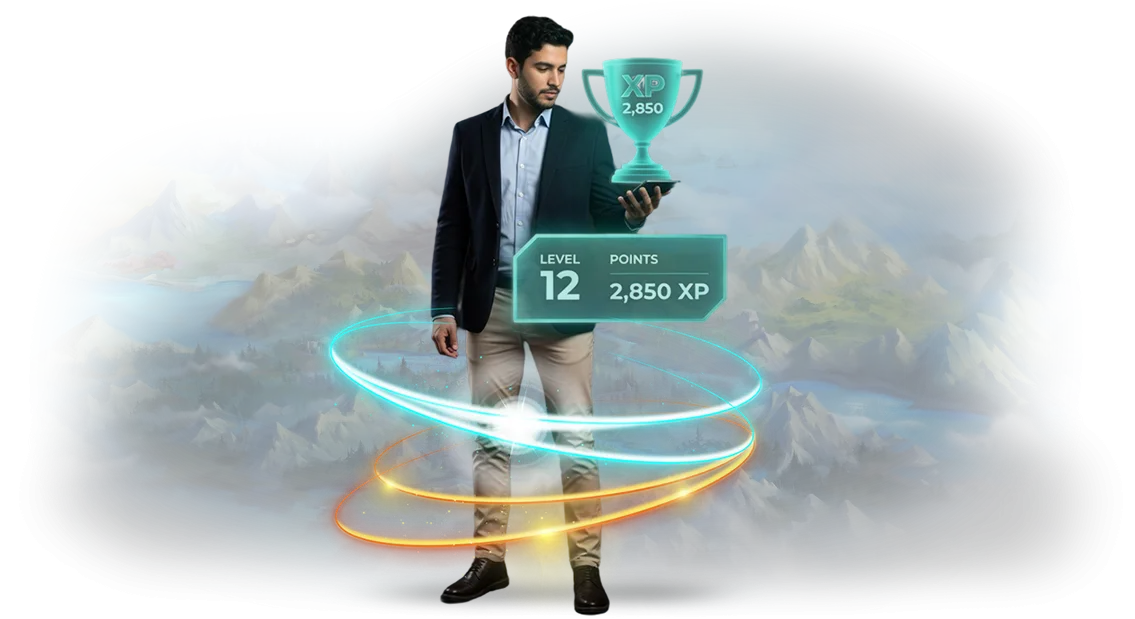
Employees are not engaged in work processes — how to fix it
The problem is almost never with people, but with the lack of feedback: an employee completes tasks, closes deals, helps colleagues — and does not see that anyone notices it.
Over time, employee engagement declines, work becomes formal, and the best performers start looking elsewhere. Recognition that lives in a separate spreadsheet or in someone else's chat simply does not reach the team.
Team motivation rests on three things: clear rules, a quick response to results, and a tangible reward. When all of this is built directly into the work tool where people already spend their day, there is no need to open anything extra or remember anything.
Gamification of work processes in Asana turns ordinary tasks and projects into a source of points, statuses, and corporate rewards — without a separate app or manual tracking.
Here is how we do it: we set up point-awarding rules for your processes, connect a corporate rewards storefront, and surface progress where the team sees it every day.
An employee closed a task — earned points, exchanged them for what they really need: an extra day off, training, hardware, merch, or a donation to a fund.
At the same time, the manager sees the dynamics by department and understands where engagement is lagging and where the system is working at full capacity.
This closes the main pain point — the gap between results and recognition. The shorter the path from action to reward, the stronger the effect: people start taking on tasks more willingly, helping colleagues, and seeing things through to the end.
We take care of setup, launch, and support, while you get a working motivation system inside a familiar tool, rather than yet another loyalty report.
What gamification in Asana brings to your business
Gamification in Asana turns work tasks into a clear game with points, levels, and rewards, while the virtual rewards store becomes the place where an employee exchanges what they have earned for real bonuses.
A manager gets not an abstract "motivation" but a transparent picture: who closed how much, what they received points for, and how this connects to the team's results.
Employee recognition stops depending on the manager's mood — the rules are the same for everyone and visible to all.
The main benefit is a rise in engagement without manual control. When progress on tasks is visible and effort converts into a clear reward, people come back to work on their own and close more than is formally expected of them.
The corporate store adds the excitement of choice: the employee decides what matters to them — an extra day off, gadgets, training, or merch — and this holds interest longer than a one-time bonus.
The second benefit is lower turnover. Recognition and a visible contribution to the overall result directly affect whether a person stays on the team or leaves for those who pay more.
The virtual rewards store makes the contribution tangible: the employee sees that their efforts are noticed and rewarded systematically, not from time to time.
The third is measurability. Gamification in Asana gives the manager numbers: activity on tasks, the share completed on time, dynamics by department. This is the basis for decisions about workload, bonuses, and development — instead of guesswork.
We set up such a system for your processes and goals so that it works for business results, not for the sake of pretty badges.
Corporate rewards store formats tailored to your goals
The rewards store format is selected based on how your employee motivation is already structured.
Some start with a simple points system for completed tasks, others build in levels and achievements from the outset, and some need a full-fledged prize catalog with seasonal campaigns. Below are working formats that we assemble for a specific goal, not "out of the box."
| Format | Who it suits | What it gives the client |
|---|---|---|
| Points system for tasks | Teams where transparency of contribution matters | The employee sees what they earned points for and decides what to redeem them for |
| Levels and achievements | Departments with a long work cycle and routine | Sustained interest for months, not a one-off campaign |
| Rewards catalog with redemption | Companies with distributed teams | A single prize showcase instead of scattered gifts from managers |
| Seasonal campaigns and challenges | Businesses with peak periods and quarterly goals | A surge in activity exactly when the business needs it |
| Rewards store for clients and partners | Companies with a loyalty program | Engaging an external audience with the same mechanics |
How to choose a format for the goal
We start with the question "what employee behavior do you want to reinforce" — both the points system and the set of achievements depend on it.
If the goal is regularity, we work with daily actions and cumulative levels; if you need a push toward a date, we assemble a campaign with a limited timeframe. Formats can be combined: the base rewards store runs continuously, and seasonal mechanics are launched on top of it.
What stays with you
Flexibility matters more than a ready-made template: you change the accrual rules, prize catalog, and visuals yourself, without rebuilding. We build this in from the start so that the rewards store grows with the team rather than hitting a ceiling after a couple of months.
How a project goes: from idea to store launch
A rewards store project is not "setting up a button" but a managed change in how employees receive recognition. That is why we run it in stages: at each one you understand what is happening, what is needed from your side, and when there will be a result. Below is what the path from the first meeting to a working store looks like.
How the stages are structured
- Brief and goals. We figure out why the store is needed: whom we are motivating, which actions we are encouraging, who approves the awarding of rewards. The output is a short description of the task and the criteria by which you will accept the result.
- Designing the mechanics. We think through how an employee earns points, how they see their progress, and what they can exchange them for. We agree on the rules and the catalog content — before work begins, so that nothing has to be redone later.
- Approval and plan. We show what the store and the employee's journey will look like, and we fix the scope, timelines, and roles. You approve the plan and understand what you will get at each step.
- Setup and assembly. We build the store, connect it to your workspace, and configure point accrual according to your rules. We show intermediate versions — edits are made along the way, not at the end.
- Testing on real scenarios. We run through typical situations: accrual, exchange, cancellation, a report for the manager. We make sure that an employee understands it on the first try and that the person responsible for the program has the data they need.
- Launch and training. We open the store to employees, prepare a short guide and in-app tips. We help run the first wave so that people see the point rather than yet another mandatory form.
- Post-launch support. We look at how it is being used and fine-tune it: the catalog, the rules, the notifications. A recognition program is alive — it needs to be developed together with the team.
Timelines depend on the size of the catalog and the number of accrual rules — usually it is weeks, not months. We work remotely and keep you informed at every stage: you always know what has been done and what comes next.
What is included in the delivery: a package for the client
When you work with a contractor, the main question is what exactly will remain with you after the project is completed. Below is the full delivery package: from a configured system to instructions, team training, and reporting. Nothing "hangs in the air" — every item can be accepted and verified.
- A configured gamification system in Asana — a virtual store of corporate rewards, awarding points for completing tasks and achieving goals, a rewards showcase, and clear exchange rules. Employees see their progress and spend what they earn without manual spreadsheets and back-and-forth messages.
- An admin panel for your team — management of rewards, levels, categories, and accrual rules without a developer. A department manager can add a new reward or change the terms themselves, without waiting for the contractor.
- System documentation — a description of the accrual logic, roles and access rights, and an administration guide. A new employee can figure things out from the document, not from colleagues' memory.
- Team training — hands-on sessions for administrators and managers: how to launch campaigns, view statistics, and answer employee questions. After training, the system lives inside the company, rather than being "supported by the contractor."
- Engagement reporting — clear summaries: employee activity, points awarded and spent, popular rewards, and dynamics by department. A manager sees the effect of gamification in numbers, not in words.
- A support and development policy — response times for requests, the procedure for enhancements, and a development plan for the first months. You know in advance whom to contact and how.
- Transfer of access and source materials — the entire system, settings, and materials remain in your environment. No dependence on a single contractor.
Such a delivery package closes the client's main risk: the system does not turn into a "black box" that only the developer understands. Your team manages gamification on its own, and we stay in touch for development and support.
Implementation results: a case with measurable effect
One of our projects is a virtual corporate rewards store built into the client's operational workflow.
A services company with distributed teams complained about the usual: tasks are in the tracker, but there's little activity in them — employees were closing items "for the checkmark," and by the end of the quarter part of the team simply stopped logging in.
We built a rewards showcase where points are awarded for real actions: closed tasks, meeting deadlines, helping colleagues, initiatives.
What changed after launch
In the first two months, activity in the tracker nearly doubled — people started taking on tasks that had previously "been hanging." The share of overdue items dropped by about a third, and turnover in the pilot departments noticeably decreased: employees saw that their contribution turned into tangible value rather than dissolving into reports.
A separate effect is transparency for managers. The rewards store provided a live picture: who is really carrying the direction, where motivation is sagging, which teams burn out ahead of schedule. Previously these conclusions were based on intuition, now — on engagement metrics.
Why the client came back
After the pilot, the company expanded the rewards store to all departments and commissioned a second phase — integration with internal training. For us this is the key indicator: the project didn't end with delivery but became a working tool that is being developed further.
We worked through a similar scenario for Asana as well — the logic is the same: a reward must be visible, achievable, and tied to an action that matters to the business.
If you recognize your situation — describe the task, and we'll come back with an estimate and a plan tailored to your workflow.
How to choose the right format for the task?
You should start not with mechanics, but with the question "what employee behavior do we need to change." If the goal is for people to close tasks in Asana more often and see the result of their work, a light level will do: points for completed tasks, badges for streaks, a rewards showcase within the workspace.
If the task is deeper — building systematic motivation for a department, reducing turnover, highlighting strong employees — you need a virtual corporate rewards store with a clear points economy and transparent accrual rules.
There are few selection criteria, and all of them are about business, not technology. The first is what exactly you want to see in reports a month from now: growth in closed tasks, speed of response to requests, engagement in shared goals.
The second is who participates: one department, several teams, or the whole company, because both the complexity of the rules and the set of rewards depend on scale.
The third is how much employees already live in Asana: if work happens there daily, gamification integrates without resistance, but if the tool is new, it's worth first reinforcing basic habits.
Selecting mechanics is always a compromise between simplicity and depth. The more rules there are, the higher the risk that employees won't figure them out and will lose interest; the fewer there are, the faster they'll get bored.
We usually suggest starting with one or two scenarios, observing people's real behavior, and only then expanding: adding team challenges, seasonal events, exchanging points for bonuses that matter to people.
If you're unsure where to start, describe the task and the current situation, and we'll come back with an assessment and a plan: which level of gamification will deliver results in your specific case and what can be launched first.
Common doubts before ordering gamification
Doubts before ordering gamification are usually the same: "employees won't play," "implementation will eat up managers' time," "what if everything fizzles out in a month." These are normal questions — and we have honest answers to them, without promising that "everything will work on its own."
What happens if employees ignore gamification?
We don't launch mechanics "into a void": first we look at what actions are already happening in your Asana — closing tasks, meeting deadlines, helping colleagues. Rewards are tied to these actions, so participation doesn't require extra effort.
At the start, together with you we choose 2-3 scenarios and launch them on a limited group to see real engagement before scaling to the whole company.
How difficult is implementation — do we need our own developers?
No. We take on setting up the rewards showcase, the point accrual rules, and the connection to your Asana workspace. We need one responsible person on the business side — to approve the list of rewards and priority actions. The rest is our job.
What if something breaks after launch?
We don't leave the project right after delivery. In the first weeks after launch we provide especially close support: we monitor accruals, showcase replenishment, and participant behavior.
After that — support according to an agreed protocol: rule adjustments, adding new rewards, handling non-standard situations. If additional work is needed — we estimate it separately and in advance.
How do we know gamification is working?
We look not at "pretty" metrics, but at business metrics: the share of tasks closed on time, response speed to requests, activity in problematic areas of the process. After a month or two it's clear whether engagement is growing and whether interest is burning out.
If the mechanics aren't delivering results — we adjust the rules rather than waiting for "things to sort themselves out."
We discuss these doubts with every client at the stage of task discussion — before the start, not after. Describe your situation, and we'll come back with an estimate and an implementation plan.
Let's discuss your task and come back with a plan
To launch gamification in Asana, you don't need to stop your current processes or switch your team to new tools.
We embed the mechanics into your existing workspaces: employees continue to manage tasks as usual, while points, levels, and rewards are awarded automatically for real actions. All you have to do is watch engagement grow and routine stages speed up.
When you submit a request, we don't send a templated proposal.
Our engineers analyze your project structure, engagement goals, and current metrics, and then come back with a concrete implementation plan: which processes we'll gamify first, how the rewards showcase will be structured, and which metrics we'll track. You see the logic before work starts and understand what you're paying for.
What you get after the start
- A transparent implementation plan — a step-by-step schedule with checkpoints so you know exactly what stage the project is at.
- A configured corporate rewards showcase — employees see what they earn points for and what they can redeem them for.
- Automatic point accrual — no manual administration and no extra workload for managers.
- A dashboard with engagement metrics — dynamics across teams, departments, and task types in a single window.
- Training for your team — we show administrators how to manage the mechanics on their own.
- Post-launch support — we support the first weeks of operation and adjust settings based on actual data.
How to get started
- Describe your task — tell us which processes you want to bring to life and what result you consider a success.
- A 30-minute call — we'll clarify the details, show similar cases, and answer your questions.
- Plan and estimate — we'll come back with a proposal on timelines, stages, and scope of work.
- Project kickoff — we'll agree on the plan, assign the team, and begin implementation.
Ordering gamification in Asana means getting a working motivation tool, not an abstract presentation. Leave a request, and we'll come back with a plan you can launch.