

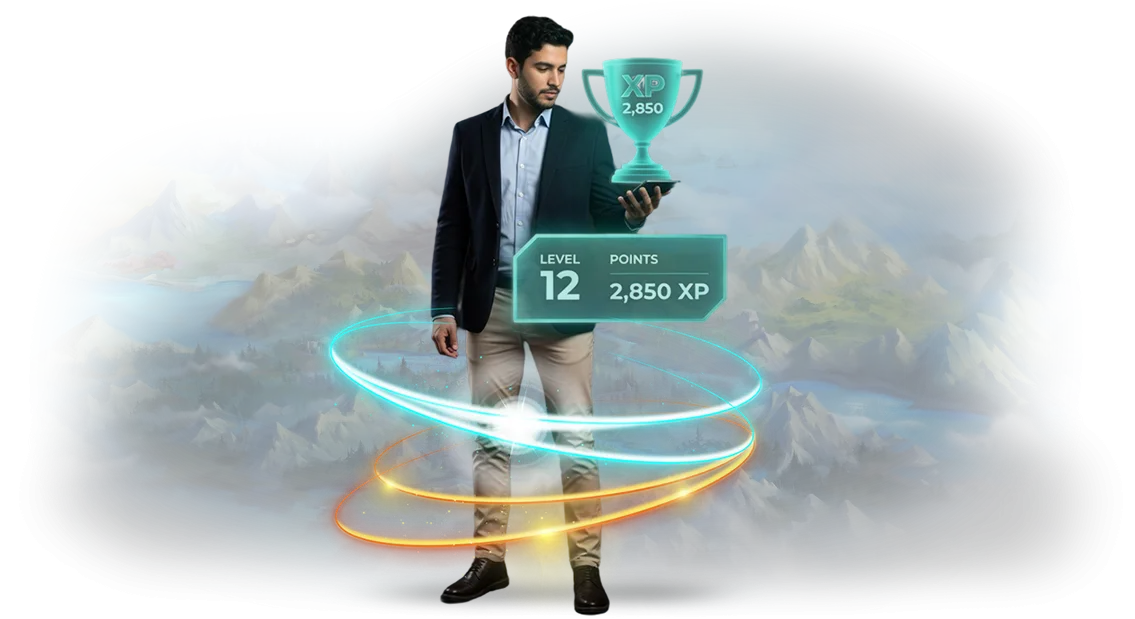
Employees Losing Motivation? The Solution for Cornerstone OnDemand
Employees quickly get used to bonuses if they are given "just for showing up." Engagement drops within a few months after implementing a standard motivation system — people fulfill formal KPIs but feel no excitement. As a result, deadlines, quality, and team atmosphere suffer.
This is where gamification of training and workflows helps. When achievements turn into levels, points, and rewards, the employee develops an inner drive to grow — they want to close goals faster and better on their own.
At the same time, corporate motivation stops being "just a bonus" and becomes part of the culture.
We develop solutions that integrate with your LMS and Cornerstone OnDemand ecosystem. The corporate rewards store is a showcase where employees see what bonuses they have earned, exchange points for real value, and receive recognition from management and colleagues. The entire chain is transparent: from completed tasks to reward delivery.
Learning stops being an obligation. Employees take courses on their own to reach the required level and unlock a new reward. Managers see a live picture of engagement: who is actively learning, who shows initiative, and where the team is struggling. This way, gamification becomes not entertainment but a performance management tool.
We handle the design of the mechanics, the design concept, and configuration for your processes. The result is higher course completion rates, shorter onboarding time, and a noticeable boost in overall motivation.
What Business Gains from Game Mechanics in Training
Training "for the sake of a checkbox" does not change employee behavior. People complete the course and forget the material a week later, while the business gets no measurable effect.
Gamification turns training into a clear game: employees see their progress, compete with colleagues, and earn rewards for real achievements.
This is the exact mechanic we build into corporate portals on the Cornerstone OnDemand platform — and the business gets tangible results, not just "completed courses."
Check which benefits you want to claim:
-
Productivity growth. Employees master work scenarios faster because training runs through practical tasks and instant feedback. Mistakes are addressed immediately, not at the end-of-quarter review. As a result, work operations are completed faster with fewer errors.
-
Lower turnover. Game mechanics create a sense of progress and recognition: employees see their level rising and receive visible rewards. This boosts engagement and loyalty, so people are less likely to leave in search of "something more interesting."
-
Fast onboarding for new hires. New employees join the game from day one: short tasks, clear goals, and mentor support. Instead of three months of "settling in," they reach full working rhythm in a few weeks. Less time to full productivity means lower recruiting costs and less downtime.
-
Consistent quality standards. Gamification sets clear rules and success criteria. Employees strive to complete tasks correctly on their own because points and rewards are tied to it. You don't need to control every step — the mechanic keeps people at the bar.
-
Transparent analytics for managers. You see who truly absorbed the material and who is faking activity. Completion statistics and earned points make it easy to see where additional support is needed and where the team is ready for new challenges.
The key principle is that gamification works not as entertainment but as a result management tool. You get training that employees complete voluntarily, and the business gets growing metrics without expanding headcount.
Ready to discuss which mechanics fit your team? Leave a request — we'll show on an example of your scenario where gamification will deliver quick results.
Gamification Formats in Cornerstone OnDemand: Quests, Points, Rewards
In Cornerstone OnDemand, gamification works not as a set of perks but as an engagement management tool. To make the system deliver results, you need to choose a format that matches your specific business goal: training, KPI performance, or employee retention.
Three formats for different tasks
| Format | Who it's for | What it gives the client |
|---|---|---|
| Quest | Teams that need to master a new process or product | A step-by-step scenario holds attention and drives to results without manager oversight |
| Points | Employees with routine tasks | Instant feedback for every action, higher activity, and a competitive spirit |
| Rewards store | Companies that want to build long-term loyalty | Accumulated points turn into real prizes — employees see the value and stay in the system |
Quests fit when you need to guide an employee through a complex scenario — for example, onboarding, training, or rolling out a new CRM. Points fit when you want to encourage regular actions: filling out reports, completing courses, helping colleagues.
The rewards store works like a showcase: employees accumulate points and choose their own prize, so motivation doesn't fade.
We combine these formats inside Cornerstone OnDemand so that every stage of employee interaction is motivated. The client doesn't need to invent mechanics — just describe the goal, and we'll configure the scenario around your business processes.
How the Implementation Project Works: From Brief to Launch
Gamification is not entertainment but a working tool that must fit into the company's current processes. That's why we structure the implementation project as a transparent route with checkpoints: you always know what stage you're at and what you get at the end.
For projects like a virtual rewards store, including integration with Cornerstone OnDemand, the process is the same — from brief to gamification launch.
-
Brief and discovery. We analyze how motivation, rewards, and recognition currently work. We determine which employee actions need to be supported and what metrics will define success.
-
Concept and plan. We propose the game mechanics, rewards store scenario, visual direction, and timeline. You get the full picture before work starts.
-
Alignment. We confirm the point accrual rules, prize catalog, and participant roles. We capture the agreements in a document — this eliminates misunderstandings from the start.
-
Build and integration. We configure the platform, connect it to your employee records systems, and fill the rewards showcase.
-
Testing and gamification launch. We run a pilot with several teams, collect feedback, and make adjustments. After final approval, we open access to all employees.
-
Support and evolution. We analyze activity and help add new rewards, seasonal campaigns, and levels. Gamification stays alive and keeps delivering results.
This way, you get not a "box" of settings but a managed process where every implementation stage is verified and approved. You see the timeline in advance and the intermediate results at every step.
What's Included in Delivery: A Turnkey Package
After the project is complete, you receive not "bare code" and scattered instructions but a fully ready-to-use package. Everything needed to launch and manage the virtual rewards store daily is handed over in one day together with the final release.
For your convenience, we've grouped all items into a single delivery package. You know what you're paying for and what you get in the end.
- Turnkey virtual rewards store. A fully functional catalog where employees see available prizes, the conditions for earning them, and can place an order in one click.
- Integration with Cornerstone OnDemand. The system automatically pulls employee and event data from your learning portal. No need to duplicate databases or enter records manually — all information syncs on its own.
- Motivation mechanics design. A detailed scheme: which actions earn points, how points are redeemed, what levels and reward categories exist. You get a ready-to-run scenario for your company.
- Admin panel for your team. An HR manager or portal administrator can fill the catalog, change point values, and launch campaigns independently — no developers required.
- Reward approval and fulfillment workflow. A defined process for how an employee orders a prize, who approves it, and how delivery happens. Nothing gets lost or stuck between departments.
- Complete documentation package. Admin and user guides, business process descriptions, point accrual rules, and a launch checklist. All of it stays with you in a convenient format.
- Training session for your team. We run a short workshop: how to manage the store, how to track the rewards budget, and how to handle common employee questions. Your specialists start working independently from day one.
The entire package is delivered after acceptance and full verification. During the warranty period, you can reach out for consultations and refinements — adjustments to mechanics, texts, or reward categories are made at no additional charge.
Case Study: How We Boosted Activity in a Corporate Program
A corporate recognition program was launched in Cornerstone OnDemand, but there was one catch: employees rarely visited the rewards catalog, and those who did took a long time choosing and often abandoned the process halfway.
The bonus mechanic itself worked, but without an engaging process it lost its meaning — managers saw no real traction in the program.
We proposed turning the dull catalog into a virtual store with game mechanics: employees don't just scroll a list — they accumulate points, unlock new levels, and see their progress.
This is gamification that works for retention: the reward selection process became fast and engaging, and users gained a reason to keep coming back to the program.
The results of the implementation were visible within the first quarter: the conversion to reward redemption grew almost 2.5 times, and the average selection time dropped from ten minutes to three.
Visits to the corporate program doubled, and the share of employees who redeemed a second or third reward increased by 42% — people started participating intentionally, not just because they were reminded.
The client was satisfied and continued developing the program on their own — the best proof of value.
If your recognition catalog is sitting idle, use this case as a starting point: the same mechanic adapts to any team size and quickly pays for itself through real activity growth.
Addressing Your Concerns: Security and Support
Any project involving corporate rewards touches employee personal data and internal business processes. That's why security, support, and integration are the questions clients ask before work begins. We answer them directly, without technical jargon.
For us, this isn't a formality but part of our methodology. We develop gamification on the Cornerstone OnDemand platform and know how to address the typical concerns — from data protection to clean integration with your current company infrastructure.
What about employee data security?
We work inside the secure perimeter of your portal and use the platform's native mechanisms. Only authorized specialists get access to information, and all actions are logged. For the client, this means: personal data stays under control, and the risk of leaks is minimized.
How fast will integration with our system be?
The rewards showcase connects to Cornerstone OnDemand through standard tools — no need to change existing processes or migrate data manually. Points, the catalog, and purchase history sync automatically. A typical launch takes 2-3 weeks, including pre-release testing.
Who supports us after launch?
We stay with you after project delivery: we accept requests, monitor stability, and quickly fix issues. We respond to important questions within one business day, and if an incident occurs, we take it on and manage it through to full resolution.
Ready to Discuss Gamification for Your Company? Leave a Request
Let's discuss how gamification will fit into your business processes: employee motivation, training, plan achievement, or a corporate rewards showcase. Leave a request — we'll get back to you within one business day with concrete options and calculations, not generic promises.
What you get after reaching out:
- A consultation on your task: we find the points where game mechanics will deliver measurable results — higher engagement, faster learning, lower turnover.
- Cost and timeline estimate: we fix the scope of work and price upfront, with no hidden fees or "surprises" along the way.
- An idea tailored to your scenario: we show how the mechanic will work with your data and processes — from a loyalty program to a corporate rewards store on your platform.
- A step-by-step implementation plan: stages, owners, checkpoints — you understand what happens at every step and what result you get.
- Post-launch support: we help with configuration, answer your team's questions, and adjust the mechanics if business goals change.
- Result analytics: we show how engagement, goal achievement, and the other metrics you started with have changed.
We have more than 10 years of experience delivering projects like these — from loyalty programs to corporate rewards showcases for large companies. We know how to make gamification useful for business and engaging for employees.
Fill out the form — we'll call you back, answer your questions, and give you a cost and timeline estimate.
How to Choose a Gamification Format for a Specific Task?
The recurring question when launching gamification is "where do we start, and which format fits us?" There's no one-size-fits-all answer: what motivates a sales team is useless for training new hires, and mechanics for building employee loyalty won't increase training conversion. So the goal is defined first, and only then are game tools selected.
If the goal is material rewards and recognition, the corporate rewards store format works. Employees see a concrete result: complete a task — earn points — exchange them for a bonus or gift.
Such a store integrates neatly into an existing ecosystem, for example Cornerstone OnDemand, where points and rewards are automatically linked to training results and employee evaluations.
This format motivates precisely the target actions, making the reward system transparent and easy to understand.
When the task is boosting engagement in corporate training, quests, levels, and competitions work better. Employees complete short modules, earn points, and see their progress on a shared leaderboard.
In this case, gamification drives frequency: people return to learning regularly, not just before assessments. The business gets measurable growth: higher course completion, faster onboarding for new employees, and easier knowledge control.
For team building and soft skills development, team challenges and collaborative scenarios are the right choice. This format creates a competitive spirit without internal rivalry, helping people practice skills in a safe environment. This approach is most effective in leadership development programs and cross-functional projects.
The main selection rule is that the goal itself suggests the format, and our job is to accurately translate the business objective into the language of gamification.
We analyze current processes, define the target audience, and propose a solution that fits your system and your team's expectations.
We select mechanics individually rather than "deploying a template" — which is why the result drives a specific metric: higher completion rates, shorter onboarding time, greater loyalty. And then — support, analytics, and fine-tuning so the game layer evolves alongside your goals.