

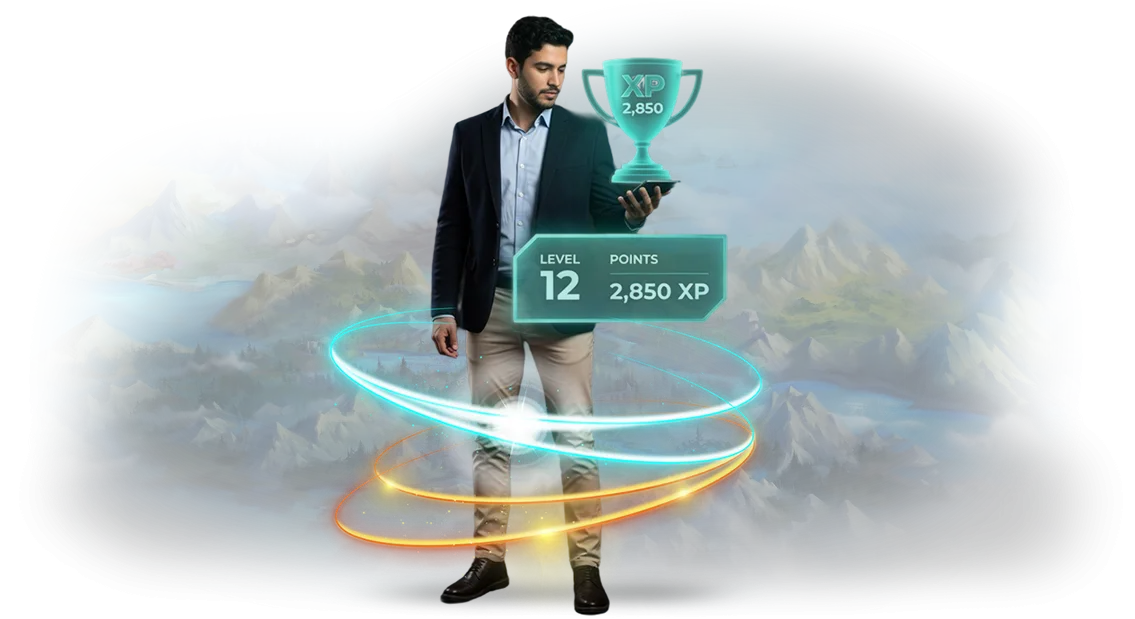
Gamification on 1C: How to Bring Back Employees' Interest in Routine
Routine eats away at the interest of even the most responsible employees: daily reports, approvals, and repetitive operations stop motivating.
Engagement drops, valuable people start to burn out or look for a more interesting position—and the business loses not just workers, but accumulated expertise.
Gamification on 1C solves this problem right where employees already spend most of their day. There's no need to launch a separate portal everyone will forget to open—we embed game mechanics directly into the work system.
Tasks stay the same, but points, levels, rewards, and visible progress appear. Ordinary routine turns into a competition with oneself and colleagues.
As a result, both mood and business metrics improve. Employees close tickets faster, miss deadlines less often, and participate more actively in processes they used to do reluctantly. Managers see an objective picture: who is really pulling the team forward and who needs support. This is transparent motivation without manual control or daily reminders.
We have been doing corporate gamification for several years and know how to combine game mechanics with 1C accounting logic so that they support your work rather than interfere with it. We tailor scenarios to your business processes, not to an abstract template. Employees get clear rules and fair rewards, and the business gets measurable growth in engagement.
If you feel your team is working on autopilot and valuable employees are losing interest, this is exactly the case where gamification on 1C brings back the excitement and reinforces the habit of doing things well. Tell us about your challenge—we'll propose a solution tailored to your processes.
What a Corporate Rewards Store Gives to the Team and the Business
Employees don't leave because of salary; they leave because of a lack of recognition. A corporate rewards store turns one-off bonuses into a clear motivation system where everyone sees why they receive points and what they can spend them on. For the business, it is a performance management tool, not just a nice perk.
Here's what changes after launch:
- Increased productivity. Clear point-accrual rules direct employees' efforts toward tasks that matter to the company. People choose which goals to achieve and see the link between their actions and rewards.
- Lower turnover. Accumulated points and the desire to get a specific gift retain valuable employees longer than one-off bonuses. Replacing an employee costs more than timely recognition.
- Transparency and fairness. Reward criteria are fixed in the system, so subjective management decisions don't affect recognition. This reduces conflicts and disputes, and employees trust the process.
- Greater loyalty and engagement. A branded store with attractive prizes creates an emotional connection with the employer and increases job satisfaction. People feel cared for in the moment, not just at year-end.
- A stronger employer brand. A modern reward system is a strong argument in the war for talent, especially among young professionals.
All of this works right inside 1C: there's no need to set up separate services or move data manually. Employees see the gift showcase, managers award points, and accounting automatically receives closing documents. Implementation takes a few weeks and doesn't require replacing current processes.
The HR team no longer has to manually calculate bonuses and settle disputes—the system handles accounting and analytics. Managers see which employee actions produce results and can adjust reward plans.
For the business, this means a fast return on investment: higher productivity and lower costs for recruiting and onboarding new people.
Gamification formats for different company goals
Gamification is not just points and badges; it's a tool that solves specific business challenges. One motivation program drives sales growth, another improves employee retention, and a third helps train new hires.
You need to choose the format according to your goal—otherwise, even the most vivid mechanics won't produce measurable results.
We build gamification programs inside your work system, for example on 1C, so that employees don't have to switch between windows. Below is a comparison of the formats our clients choose most often. Use the table as a cheat sheet: find your objective and see which format fits best.
| Format | For whom / what task | What it gives the client |
|---|---|---|
| Corporate rewards store | For rewarding employees at the end of periods, bonuses, motivation for regular achievements | A transparent bonus system; employees choose their own gift instead of getting “what they were given”. Lower burden on HR and admins, higher loyalty |
| Team marathons | For sales departments, production groups, project teams | Healthy competition, higher sales and productivity, stronger team cohesion. Clear rules and shared progress keep the excitement going throughout the marathon |
| Ratings and leaderboards | For regular work with KPIs, monthly reports, quick onboarding of new employees | Employees see their place in the overall standings and understand what to influence. Managers get a clear picture of the team without manual reports |
| Learning quests | For onboarding new hires, introducing new procedures, training on how to work in the system | New employees get up to speed 2 times faster, the number of errors decreases, and material is absorbed more easily—through practical scenarios rather than boring instructions |
| Lotteries and random bonuses | For keeping momentum between key activities and unexpected recognition | Emotional boosts, interest in the system, higher activity in the “low season”. The budget for such mechanics is easy to control |
Every format can be combined: for example, run a team marathon and then reward the leaders in the corporate store. This covers both the performance goal and long-term motivation.
At the start, we help you choose the optimal mechanics based on your team size, frequency, and expected impact.
How the implementation of a gamification system on 1C works
Implementing a gamification system on 1C is not buying a ready-made solution; it's a joint project. We work according to a transparent plan: you see results at every stage, understand the timeline, and can influence the details. You always know who is responsible for what and when the next result will be ready.
- Initial brief and audit — we discuss goals, target audience, and integration points with your 1C configuration. We agree on success criteria.
- Prototype for approval — we show how the mechanics, reward system, and showcase will look. You see it before development starts and can adjust the scenario—this rules out expensive rework.
- Work plan and schedule — we set deadlines, team composition, and your areas of responsibility. No hidden stages—everything is transparent.
- Development and configuration — we implement the business logic in 1C: point accrual, rewards catalog, employee roles. You receive interim versions for review and can make adjustments without losing time.
- Testing on your data — we test the system on real scenarios, identify shortcomings together with you, and make fixes before launch.
- Launch and training — we deploy the system, connect users, and train administrators. You receive instructions and are ready to manage the process.
- Support and evolution — we analyze activity, maintain the system, and suggest new scenarios based on data. The project keeps delivering value.
This approach lets you launch gamification without chaos or rework—each stage is approved, and the result is predictable.
What's included in the corporate rewards store delivery
The delivery of the corporate rewards store includes not just a software module, but a fully configured working tool. We launch the showcase on 1C so that it immediately solves your task—turning the motivation system into a service that is clear and accessible to employees.
Here's what you get in the package:
- Showcase customization for your brand: design, reward categories, and the logic for accruing and redeeming points.
- Content filling: ready-made reward descriptions, images, and assortment recommendations.
- Instructions for administrators and employees: how to manage the catalog, award points, and process redemptions.
- Training for your team: an online session for store administrators so staff can start working without hiccups.
- Post-launch support: assistance during the agreed period, help with the first redemptions, and prompt resolution of issues.
- Integration with your accounting system: the showcase works in the familiar environment, so employees don't have to learn new programs.
Each item is a step toward getting the new motivation system working within the first few days. You won't need to spend a long time figuring out settings: we hand over clear guidelines, and you keep full control over the process.
Training and support are included in the delivery, so the technical side stays with us. As a result, you get a tool that increases employee engagement, speeds up reward distribution, and reduces the load on the HR department.
If you need to adjust the accrual logic or update the catalog, you simply tell us and we make the changes. This approach guarantees a launch of the rewards store without surprises and without hidden details.
Case study: How a retail chain boosted engagement by 40%
The retail chain Severny Veter faced a typical retail pain point: staff turnover in stores was eating into profits, and employee engagement was falling every quarter.
Cash bonuses and certificates no longer motivated anyone—salespeople and cashiers were changing jobs every six months. They needed a format that would turn a reward into an event and give employees a reason to stay.
Virtual rewards store on the 1C platform
We developed a corporate merchandise store that employees access from their personal account. Points accrue automatically for hitting targets, tenure, and helping colleagues. They can be spent on household appliances, training certificates, or branded souvenirs.
The platform runs on 1C and is fully integrated with accounting and payroll, so the finance team didn't have to do double work.
Results
Three months after launch, we measured the results. Employee engagement rose by 40%: the number of voluntary initiatives increased, and missed scheduled meetings dropped by half.
Staff turnover fell by 30%—for the first time in two years, the chain closed a quarter without mass resignations. Meanwhile, 70% of employees visit the store every month and choose rewards, which means the tool is actually being used.
Most importantly, the project wasn't a one-off. A year later, the chain ordered platform enhancements from us: team challenges and seasonal promotions. This confirms that gamification pays off and supports retention rather than just temporarily boosting statistics.
How to choose a gamification format for your company's specific needs?
Companies differ not only in size—their processes, recognition culture, and ways of monitoring results also differ. What works well in a sales team may not work for analysts or production staff.
So the question “which format to choose” arises not out of curiosity, but from the need to precisely match employees' interests without creating unnecessary complexity.
The answer starts not with mechanics, but with three criteria: what behavior we want to reinforce, who will use the system, and what performance data already exists.
If the goal is regular recognition for achievements recorded in the accounting system, a personal rewards format fits. If you need to raise team results for a quarter, competitive mechanics work. For quick onboarding of new employees, training tracks with step-by-step tasks are best.
Below is a typical mapping of formats to business goals. This is not a rigid scheme, but a reference point for an initial choice.
| Format | For whom | What it gives the client |
|---|---|---|
| Rewards store | For regular recognition of employees based on metrics from the accounting system | Transparent point accrual, automatic redemption for gifts, minimal manual work |
| Quests and competitions | For sales departments and team-based areas | Revenue growth and healthy competition within the plan |
| Training tracks | For onboarding new hires and professional development | Faster integration into work, visible progress for each employee |
| Ratings | For transparent performance metrics across departments | A clear picture of results, fewer disputes about performance evaluation |
We don't force processes into a fashionable mechanic. First, we do a diagnostic: which results are already digitized, how recognition currently works, and where the bottlenecks are.
Then we choose a format that fits into the existing infrastructure without extra refinement—for example, in 1C for automatic reward accrual based on actual data. This lets you launch gamification quickly without creating a separate system that no one maintains.
Frequently asked questions about introducing gamification into work processes
The main concerns clients have before implementing gamification are not technical details but consequences for the company: will we lose data, will the team resist the new system, and will work stop during the launch.
These are legitimate questions, so we answer them directly—based on experience from dozens of projects for businesses of various sizes.
How safe is this for corporate data?
Gamification is embedded into your existing system on 1C—without transferring information to third-party servers and without the risk of leaks. All operations with rewards and points happen inside your infrastructure, and employee access is restricted according to their roles. You get full control over who sees, who accrues, and who redeems.
Won't employees see the game as extra burden?
We design the scenario so that it simplifies routine rather than adding tasks. Game mechanics are introduced gradually: first a clear rewards showcase, then challenges and competitions.
Training happens inside the system in the form of short tips, so even employees who are far from technology adapt in minimum time.
Will work processes stop during implementation?
The launch is phased: first a pilot group, then rollout to the entire company. Your business processes continue to run as usual, and the new rewards showcase is enabled in parallel—without a “day X” or shutting down sales or production. At each stage, you see interim results and can adjust the settings.
If you still have doubts, ask us, and we'll show how a similar project went for a client in your industry. We'll respond within one business day and prepare a preliminary implementation plan tailored to your scale.Launch gamification in your company within a month
Gamification doesn't have to become a lengthy IT project. If you take ready-made, well-tuned modules and configure them for your task, you can launch within a month—with clear metrics and without stopping your current processes.
Corporate rewards integrated with 1C show results immediately: employees see the showcase, earn points, and start changing in the direction you want.
Here's what you get right after the project starts:
- Corporate rewards store in your 1C — employees see prizes and points in a familiar interface, without downloading new programs.
- Personal launch plan — you know the stages, deadlines, and responsible parties in advance, while we manage the process.
- Point accrual rules tailored to your motivation — we configure mechanics around company KPIs, not an abstract template.
- Integration with your current structure and employees — data is pulled automatically, so HR doesn't have to update lists manually.
- Pilot launch with a group of employees — we test and adjust settings before you roll out the program to the whole company.
- Training for your administrators and a guide for the team — launch doesn't get stuck on “how do we use this” questions.
- Post-launch support — we adjust the reward set, add new prizes, and review metrics together with you.
Leave a request for a consultation—we'll discuss your task, show implementation examples, and agree on a launch plan. The first result will appear within a month, and then you can scale the mechanics to any department or office.