

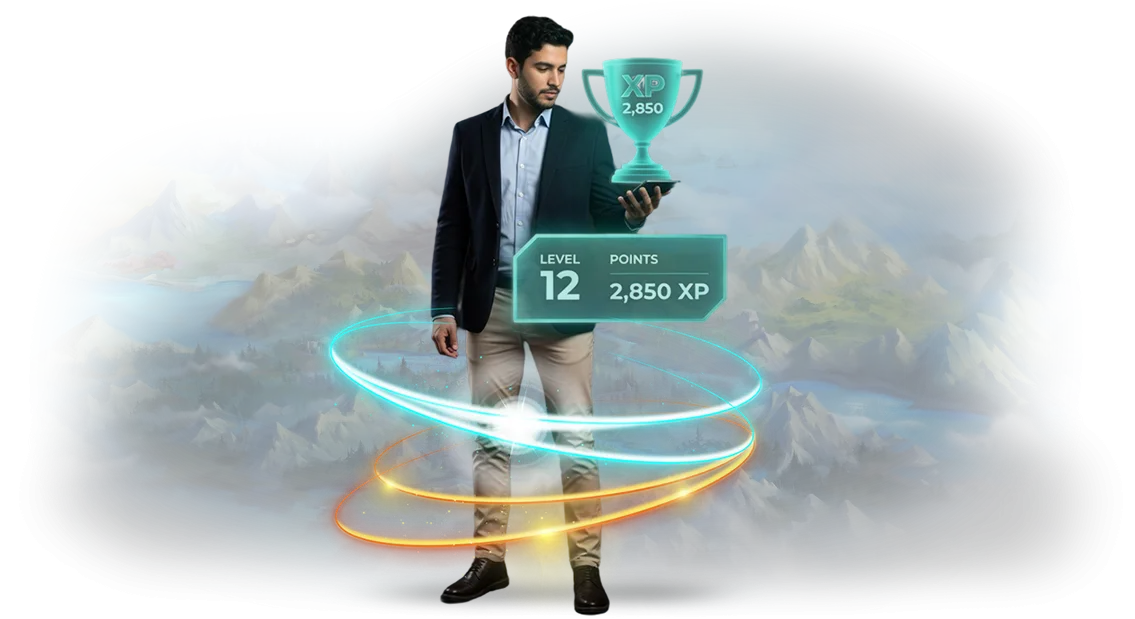
Gamification of processes for video game studios: talent retention
Employees of a video game studio create immersive worlds, but their own work is often far removed from a game. Task reports, stand-ups, internal content reviews, approvals — routine devours the energy the team could direct toward creativity.
The more routine processes there are, the faster engagement drops: a talented specialist stops seeing the point in what they do.
For the studio, this translates into a direct loss of productivity and rising turnover. Developers and artists do not leave because of pay — they leave when the sense of progress and achievement disappears.
Every departure of a key employee means weeks of searching for a replacement, onboarding a newcomer and restoring the team's pace. Talent retention becomes a task not only for HR but for the entire company.
The irony is that video game studio teams understand game mechanics better than anyone, but barely apply that experience to their own business processes. Internal tools remain "grey" task lists, and motivation keeps falling. Yet the very same principles — progress, levels, rewards, competition — work inside the studio too.
Gamification of business processes for a video game studio closes this gap. We turn routine into a clear system with goals and feedback: an employee sees their growth, receives recognition for achievements and stays engaged. The team works faster, and key specialists stay with you longer.
What changes after implementing gamification: 5 key results
Implementing gamification changes not the interface, but the team’s behavior. For video game studios, where employees themselves know a lot about mechanics and rewards, a properly built system turns routine processes into competition with clear rules and measurable results. Here are five key changes our clients record after launching a game portal.
- Increased engagement. The team gets involved in tasks on its own: the number of active participants in internal initiatives grows severalfold, and discussions about who will get the next level become part of the work culture.
- Faster processes. Tasks that used to take weeks due to approvals and reminders are closed in days. Gamification removes bottlenecks in task handoff between departments — especially during polishing and testing stages.
- Lower turnover. A transparent achievement system shows employees their growth and prospects. Key specialists stop looking for work elsewhere because they see how their progress affects the overall result.
- Motivation through game design. Instead of carrot and stick — clear goals, fast feedback, and rewards for mastery. This works on intrinsic motivation, which keeps people longer than any bonuses.
- Measurable results. A manager sees from the system which processes have accelerated, which teams are stalling, and where support is needed. Decisions are made based on data, not intuition — this reduces risks when scaling.
“After launching the gamification portal, turnover was cut in half, and task completion times by a third. People really look forward to new seasons and compete for rewards,” shares the studio producer Winterlight Games.
These are the five results we build into every project, tailoring the mechanics to your business processes and team. Gamification for video game studios is not a game for game’s sake, but a tool that makes work faster and more enjoyable.
Gamification formats for video game studios for different tasks
Dozens of specialists with different tasks work in a game development studio — game designers, artists, programmers. It is not so much walls of fame as a correctly chosen gamification format that helps hold their attention and maintain the pace.
It can address a specific task — for example, closing bugs faster — or become a permanent motivation system built into the workflow.
We divide formats by scale and complexity of implementation. Below is a table of gamified system types: from simple ratings to a comprehensive web portal that brings together the studio's tasks, rewards, and internal communications.
Gamification formats for studios
| Format | Which studio tasks it fits | What the client gets |
|---|---|---|
| Ratings and leaderboards | Quickly show results for a specific project or stage, competition between teams | Transparency, easy implementation within a few days, a rise in engagement over the short term |
| Achievements and rewards system | Encouraging rare skills, regular actions, helping colleagues | Retaining experts, building a culture of recognition without manual control |
| Challenges and quests with rewards | Launching new directions, onboarding newcomers, teaching tools | Fast immersion in processes, lower turnover during the probation period |
| Comprehensive web portal for gamedev | A permanent motivation system: tasks, levels, rewards, internal currency, team events | A single point for managing motivation, analytics by team, repeatable metric improvement |
The choice of format depends on which task you are solving right now and which one on an ongoing basis. Simple ratings work well as a one-off tool, but long-term motivation requires a full-fledged web portal.
We help you choose the type that does not overload the team and delivers a measurable result within the first months.
Gamification launch stages: from brief to support
Launching gamification in a video game studio is not "putting points on a portal" but embedding mechanics into daily processes. So that you stay in control of the result, we have built a transparent six-stage gamification implementation process. Each step addresses a specific task — from brief to support, with no surprises for the business.
Gamification implementation stages
- Gamification brief. We study your goals, the portal audience, and bottlenecks in processes. We define measurable success criteria — you understand what result you will get.
- Mechanics prototype. We design levels, rewards, team tasks, and engagement scenarios. We show the logic on mockups before development starts — you see in advance how it works.
- Portal development. We create the interface, events, and administration. In short iterations we show working versions — you make edits quickly and do not wait for a "big release."
- Launch preparation. We test scenarios on real data and configure the reward balance. Your administrators receive instructions and confidently manage the system from day one.
- Gamification launch. We onboard the team, monitor the first sessions, and respond quickly to questions. The system starts motivating employees immediately, without a slow start.
- Support and evolution. We analyze activity, adjust the mechanics, and add seasonal events. Gamification remains alive — engagement grows rather than fades after a month.
This way of working makes it possible to launch gamification with minimal risks and a clear schedule. You always know what stage the project is at and what you will get as a result.
What you get in the package after process gamification
When you order business process gamification, you get not just a flashy prototype, but a full-fledged working tool built into the daily life of your studio. We deliver a comprehensive result — from the game portal to team training. This lets you launch the system immediately and quickly see changes in employee engagement.
Here is what is included in the gamification delivery for video game studios:
- Gamified portal — an environment where employees see tasks, levels, rewards, and their progress. Managers get a clear picture of activity without manual reports.
- Admin panel for gamification — you change the rules, rewards, and tasks yourself. There is no need to involve developers: the interface is understandable to a manager or HR specialist.
- Employee training — we conduct short practical sessions: we show how to use the portal, go through typical scenarios, and answer questions. The team starts confidently, without a long ramp-up period.
- Project documentation — we leave clear instructions on setup, administration, and system development. Everything we made stays with you and can be used after the project is completed.
- Integration with the studio's work tools — we connect the portal to the systems you already use. Data is pulled automatically, and nothing needs to be transferred manually.
- Post-launch support — for the agreed period, we stay in touch: we fix issues, help with setting up new mechanics, and advise on how to scale gamification as the team grows.
The entire package is assembled so that the effect becomes noticeable in the first weeks: tasks look clearer, employees get engaged in the game, and management gets transparent feedback. You receive not “code on a disk,” but a working system that your studio can develop independently.
Case: how gamification doubled studio productivity
A game development studio came with a typical pain point: projects dragged on, and the manager spent hours on oversight instead of product development. A team of 25 people lost motivation on routine tasks — testing, bug fixing, internal documentation. We proposed introducing gamification of business processes directly into the corporate portal.
Instead of boring task lists, employees received a system of levels, rewards, and team competitions. Each completed task brought points, streaks of successful days unlocked bonuses, and team results were reflected on a shared scoreboard.
The mechanics turned out to be simpler and clearer than any planning tables — people started engaging on their own, without reminders.
Two months later, we recorded the following results: task completion speed doubled, the share of overdue tasks decreased by 40%, and regular employee activity in the portal rose by a third. According to a team survey, motivation increased among 80% of participants.
GameDev Studio is an example of how a properly designed game changes work habits more powerfully than administrative control.
The studio manager summed it up: “I expected an entertainment element, but I got a tool that saves weeks of deadlines. Gamification has become part of our planning process — and we are already scaling it to other departments.”
This case shows: gamification works not as a game, but as a system for managing attention and motivation. For the studio, this means predictable deadlines, fewer crunches, and a living culture in which people want to stay.
How to choose the right gamification format?
Choosing a gamification format starts not with trendy mechanics, but with the question of which business task you are solving.
For video game studios, this could be engaging employees in training, accelerating onboarding for newcomers, increasing activity in the sales department, or product testing.
A clearly formulated goal immediately narrows the range of suitable solutions: a one-off campaign is one thing, a permanent motivation system is another.
The second important factor is the audience. Game designers and programmers will respond to some scenarios, managers and administrators to others. Think about how many people will use the system and how familiar they are with game mechanics.
If the team already has a habit of competitiveness, ratings and competitions will work well; if not, soft mechanics with rewards and progress will help people get involved without the fear of losing.
The budget determines scale and complexity. For quick tasks — for example, running a survey, training employees on a new regulation, or collecting feedback — a light quest or quiz is enough.
For long-term engagement — systems of levels, missions, internal currency, and team competitions — you will need a full-fledged web portal with a personal account, role configuration, and analytics.
It is important to understand: the investment must pay off with a measurable result — speed of learning, reduced turnover, or the number of completed tasks.
We help clients decide on the format before development begins. In a short consultation, we discuss goals, audience, and budget, then propose a scenario that delivers maximum return.
This saves time and money: you don't overpay for unnecessary mechanics, and you don't end up with a system that is too simple to hold attention. We find the balance between cost and effect — tailored precisely to your task.
As a result, you get gamification that solves the studio's actual task, not just a "pretty interface with bonuses." If you're unsure which format suits you, start with a gamification consultation: it will help you choose a solution that fits your budget and goals without rework at the start. We will propose specific options, and you will make a well-considered decision.
Common doubts about gamification and answers to them
Gamification is a working tool that often raises doubts: what if nothing changes? Or the mechanics break down at the height of rollout? We answer the three main fears — so that you understand how we work and what guarantees we provide.
What happens if gamification does not deliver the expected result?
We do not rely on luck. Before launch, we lock in target metrics — increased activity, task completion speed, team loyalty. Then we run a pilot phase on real data and see what works.
If the metrics do not move, we change the mechanics rather than saying “wait.” You receive a step-by-step adjustment plan and work continues until the system starts benefiting the business. This is stipulated in the contract.
Employees will be skeptical of the game. What then? Skepticism is a normal reaction if mechanics are implemented without preparation.
That is why we do not just program a portal, but build a scenario for your audience: test prototypes, find internal ambassadors, explain how this will simplify their work.
We make the interface intuitive, without overload. We engage through easy tasks — and gradually increase complexity. This way gamification is perceived as help, not as a “forced obligation.”
Who will maintain the system after launch? The system requires attention: updating tasks, configuring rewards, technical support. This is not one-off work. We stay in touch after delivery — update content, monitor stability, and refine mechanics when new tasks arise.
If the portal is already developing without us, we hand over documented processes and train your administrator. You are not left alone with the code — you have your usual communication channel with the developer.
Submit a request — we'll calculate a format for your studio
A game studio lives on the audience's emotions — but internally, work often gets bogged down in dry reports, routine, and "get it done by the deadline." Gamification turns these processes into an engaging system: employees complete tasks faster, players return to the project, and metrics grow.
This is especially important for video game studios, where the team itself must be at peak engagement.
Submit a request — we'll calculate gamification based on your tasks, audience, and current processes. We'll send a demo using a real scenario so you can see the result before launch and make a decision without risk.
We'll tailor the format to your studio — from a simple leaderboard to a full-fledged portal with quests and rewards.
What you get right after submitting a request
- A gamification request and feedback — we'll respond on the day you reach out.
- A gamification calculation for a video game studio: mechanics, scenario, engagement points.
- A gamification demo based on your scenario — see how it works in action.
- The start of a gamification project with a clear plan: stages, timelines, owners.
- Feedback at every step — you always know what is happening with the project.
Submit a request right now — and in a few days you'll receive a ready gamification model for your studio. We'll start by calculating the format, and the demo will show the value before you invest in development.