

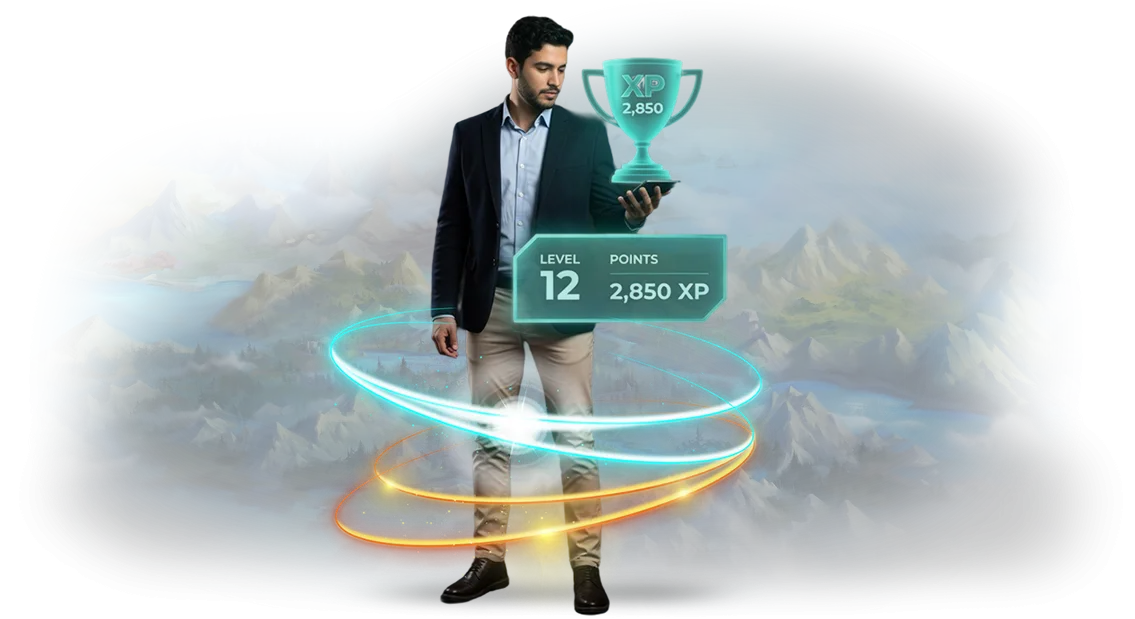
Gamification for Car Dealers: Why Customers Leave
Every car dealer faces the same problem: a customer comes in for a test drive, shows interest in a model, but leaves to a competitor.
Regular discounts and promotions no longer work — buyers have stopped responding to uniform offers, and managers are burning out working from scripts without feedback. As a result, sales decline, staff turnover grows, and the loyal customer base melts away.
The reason is not price or assortment. A buyer remembers not the car's specifications but the emotions from interacting with the dealer. If the selection and purchase process is no different from a dozen other showrooms, the customer sees no reason to return.
Similarly, a manager sees no point in pushing themselves when their efforts are neither rewarded nor measured.
Sales gamification turns routine into a game with clear rules and rewards. For managers, it's a system of points, levels, and competitions that directly links their activity to compensation.
Staff motivation no longer depends on mood or an "once-a-quarter bonus" — every call, test drive, and add-on sale earns points that can be exchanged for real bonuses.
For customers, game mechanics work differently: the loyalty program becomes an extension of the visit. Every step — from booking service to buying an accessory — earns points, unlocks new statuses, and provides tangible privileges.
Customer retention is built on the fact that leaving you is simply unprofitable: accumulated bonuses and personalized offers work better than any general sales.
We develop gamified portals specifically for car dealers — taking into account the specifics of your business, customer behavior, and your team's motivation.
We integrate game mechanics into existing processes so that the result is visible in sales figures and repeat visits, not just in reports. If customers leave — it's not a verdict, but a matter of the right motivation system that can be built right now.
What Gamification Will Bring Your Dealership
In a dealership, motivation matters a lot: a manager who cares about results sells more and serves customers better. But when work becomes routine, enthusiasm drops, and with it — the average check and the customer's desire to return.
Gamification restructures processes so that employees themselves engage in achieving goals, and buyers come back for status, bonuses, and clear privileges.
After launching a gamified portal, you get three key effects. Staff engagement: transparent challenges, ratings, and rewards for exceeding the plan.
Sales growth: managers are motivated to take the customer further, not stopping at the initial contact — to select add-on equipment, invite for a test drive, offer service and trade-in exchange.
Increased loyalty: the customer sees progress, receives personalized gifts, and feels valued, so they return for a new car and recommend the dealership to friends.
our team uses proven tools and professional server architecture for such projects. We don't just make a game, but a working tool that integrates into current processes and CRM — without data chaos or delays in reports.
The portal runs stably during peak hours: on sale days, new model launches, or mass promotions, when the system load is maximal.
The result is goals that every manager understands, healthy competition in the team, and measurable growth in key indicators. The number of calls, test drives, issued insurance policies, and loans increases, which means revenue and profit from each deal.
Gamification pays for itself within the first months and gradually turns your dealership into a market leader that both customers and employees want to return to.
Gamification Formats for Car Dealer Tasks
Car dealers have different objectives: increase sales of additional equipment, quickly onboard newcomers, or revive the customer base.
There is no universal gamification — the format must match the goal, otherwise employees will perceive it as entertainment rather than a working tool.
We select mechanics for a specific task: from a simple quest to a full dealer portal. The table lists three typical formats that cover most requests.
| Format | For whom | What it gives the client |
|---|---|---|
| Quest for employees | Sales department, service area, new staff | Rapid engagement with procedures and products, team spirit, results in 1-2 weeks |
| Points and ratings | Sales managers and heads of sales department | Transparent motivation, healthy competition, growth in add-on service sales |
| Dealer portal | Entire dealership network, marketing, HR | A single window for training, motivation, and communications, statistics for each participant |
All formats are easily scalable: you can launch a quest in one department, evaluate the effect in a couple of weeks, and roll out a full portal for the entire dealer network. This approach reduces risks — you invest gradually and pay for a working tool.
We handle the entire cycle: scenario, game mechanics, configuration for your business processes, and support after launch. As a result, you get increased engagement and concrete indicators: employee coverage, activity, and sales dynamics by department.
How a Gamification Project Proceeds: Stages and Timelines
Gamification for car dealers is not just a set of mechanics, but a project that must fit into the business: from manager training to customer loyalty programs.
To make the result predictable, we work according to a transparent scheme: brief → plan → implementation → launch → support. We set timelines at the start — on average, a project takes 2–4 weeks, and at our team you can see what has already been done at each stage.
- Brief and analysis. We study the tasks of the sales, service, and marketing departments, current motivation, and growth points. We agree on the goal: sales growth, increased loyalty, or employee training.
- Game scenario design. We define the plot and reward system. We show which actions will be rewarded and how the mechanics will fit into the dealer's website or internal portal.
- Interactive prototype. We create a mockup of key screens showing the game logic. You make edits before development starts — this saves budget and eliminates rework.
- Implementation and integration. We build the portal on a professional stack, connect it to the customer database and sales records. We test scenarios: registration, tasks, bonus accrual.
- Launch and training. We launch the portal and conduct training for administrators and participants. We provide clear instructions for managing the game and setting up rewards.
- Support and development. We monitor activity, collect feedback, and suggest improvements: new levels, giveaways, and loyalty program integration. The mechanics scale easily as your tasks grow.
What’s Included in the Delivery: A Complete Launch Package
After the project is delivered, you get not just a web portal but a ready-made solution that immediately goes to work. We provide the full package: from a configured product to instructions and startup support — so that launch takes days, not months.
Here's what's included in the delivery:
- Working gamified portal — adapted to your business processes, ready to connect employees.
- Admin panel — you can change tasks, levels, prizes, and rules yourself without involving programmers.
- Methodological materials — game mechanic scenarios, examples of motivation programs, and implementation recommendations for managers.
- User instructions — simple guides for sales managers and administrators so training takes minimal time.
- Team training — a short training session showing how to manage the portal and use it to increase sales.
- Technical support — at the launch stage and during the warranty period: we help with setup and answer questions.
- Analytics and reports — see which employees are participating, how metrics grow, and where motivation needs to be strengthened.
The methodological materials are practical developments from our projects for car dealers. You don't need to reinvent the wheel: we provide ready-made scenarios that have already worked on similar tasks and adapt them to your specifics.
Technical support is not a "standby number just in case." We stay in touch after launch, respond quickly to requests, and help if something goes wrong. The warranty period and support terms are fixed in the contract, so you know what to expect.
The entire package is delivered as one bundle. Documentation and access are in a clear form; training takes place at a convenient time. You get a tool that pays for itself through increased engagement and sales, not a "draft for refinements."
Case: How Gamification Increased Sales at a Dealership
We launched sales gamification for a dealership network where managers were losing interest in routine tasks and management couldn't see a unified picture of the funnel. The task was simple: revive the department's work and turn plan execution into a process everyone understands.
Our team developed a gamified web portal: every step of the salesperson — from call to test drive — became a mission with points, levels, and rewards. The internal rating showed successes in real time rather than at the end of the month. Employees could see for themselves what to do to become leaders.
Results for one quarter: car sales revenue grew by 22%, the number of completed tasks rose from 63% to 94%, and the average deal cycle shortened by 6 days. For the first time in two years, departments met their plan three months in a row.
Six months later, the client ordered a second stage — the service area and parts department were connected to the game.
Engagement indicators also speak for themselves: daily login to the portal became a habit for 87% of employees, and the time to complete a standard operation halved. That's why the client recommended us to their partners — two other dealerships have already joined the platform.
What This Means for Similar Businesses
Gamification works not as entertainment but as a sales management system. It gives the manager transparent analytics, the salesperson clear goals and motivation, and the business measurable revenue growth.
How to Choose a Gamification Format for Your Task?
A gamification format is never "just good" — it can be suitable for a specific task. A quiz that engages exhibition visitors well is useless for increasing sales in a department, and a bonus program for regular customers won't bring new ones.
So first we determine what business problem you're solving: training employees to work with a new model, motivating managers to meet the plan, driving traffic to the showroom, or retaining customers after a purchase.
From there, we choose the mechanic. If the task is to quickly train staff, interactive scenarios and tests with error analysis are suitable: they are remembered better than instructions.
If you need to increase sales — a competition between managers with a transparent rating and rewards. If the goal is to bring people to the dealership, contests with prize draws, quests, and interactive promotions involving visitors work.
And for retaining car owners — loyalty programs with bonuses and statuses that motivate them to return for service.
The second important criterion is the audience. Employees want to see honest evaluation and clear rules of the game; customers want easy participation and immediate benefit.
The format should account for how much time a person is willing to spend: a manager has five minutes between calls, a website visitor has a couple of clicks, a customer in the showroom has waiting time during paperwork. If the mechanics are more complex than the task itself, gamification loses its meaning.
The third criterion is the funnel stage. At the top, mechanics that capture attention and collect contacts work: surveys with prizes, tests, and game-based benefit demonstrations. In the middle — engagement and progress: accruing points, levels, and personal challenges.
At the end — status confirmation and reward for action: certificates, discounts, special terms. Choosing the right format for the task saves budget and gives a measurable result within a few weeks, not "a game for the sake of a game."
We choose the format for your situation before development starts: we analyze the goal, audience, and constraints, offer 2–3 options with an effect forecast, and help you pick the one that will work for you. That way, gamification becomes a business tool, not just entertainment.
Answers to Frequently Asked Questions About Gamification
Before launching gamification, managers ask the same questions: will the team engage, will we waste budget, will the mechanics turn out to be unnecessary. We answer the main ones — directly, without technical details.
What if employees don't get involved in the game?
The system starts with quick wins: simple actions give instant feedback, and the team sees results in the first week. The mechanics account for different roles — from the sales department to service engineers — so everyone has their own path to success.
How do you guarantee results?
At the start, we set measurable indicators: plan fulfillment, repeat inquiries, response speed to leads. We track them in real time and adjust the scenario if a mechanic doesn't work. The responsibility lies with us, not your team.
How long will the launch take?
Usually a few weeks — the exact timeline depends on the portal's scale. The first behavioral changes are visible after the first game cycle. After that, you receive regular analytics: which mechanics boost sales and which should be adjusted.
If you still have doubts — ask us directly. We'll explain how gamification will work in your specific business processes.Launch Gamification and Get Results Within a Month
Gamification pays off only with a quick launch — when the chain "idea → prototype → launch" takes weeks, not months. We set up the process so that you see the first result within a month: no long approvals, unnecessary meetings, or inflated technical specifications.
Immediately after your inquiry, you get not just a commercial proposal but a concrete action plan for your business.
To help you make an informed decision, after a short conversation we will prepare:
- Analysis of current employee and customer motivation — where exactly gamification will deliver a noticeable boost.
- A scenario based on real business tasks: increasing repeat visits, growing sales conversion, engaging audiences.
- Cost evaluation: how much the implementation will bring and over what period the project will pay off.
- A five-week roadmap with clear stages and understandable results for each step.
- A commercial proposal with timelines, scope of work, and guarantees.
- Priority launch queue: your project goes into production without waiting in the general queue.
- Support at launch — we stay in touch after the launch and fine-tune the mechanics together with you for the first period.
This is non-binding. You either get a ready launch plan and a clear cost calculation, or you understand that now is not the time — but with full clarity and numbers.
Call us or leave a request on the website. We'll discuss your task, calculate the cost of gamification, and offer an option for your budget. Start with a short conversation — and within a month you'll see the first results in numbers.