

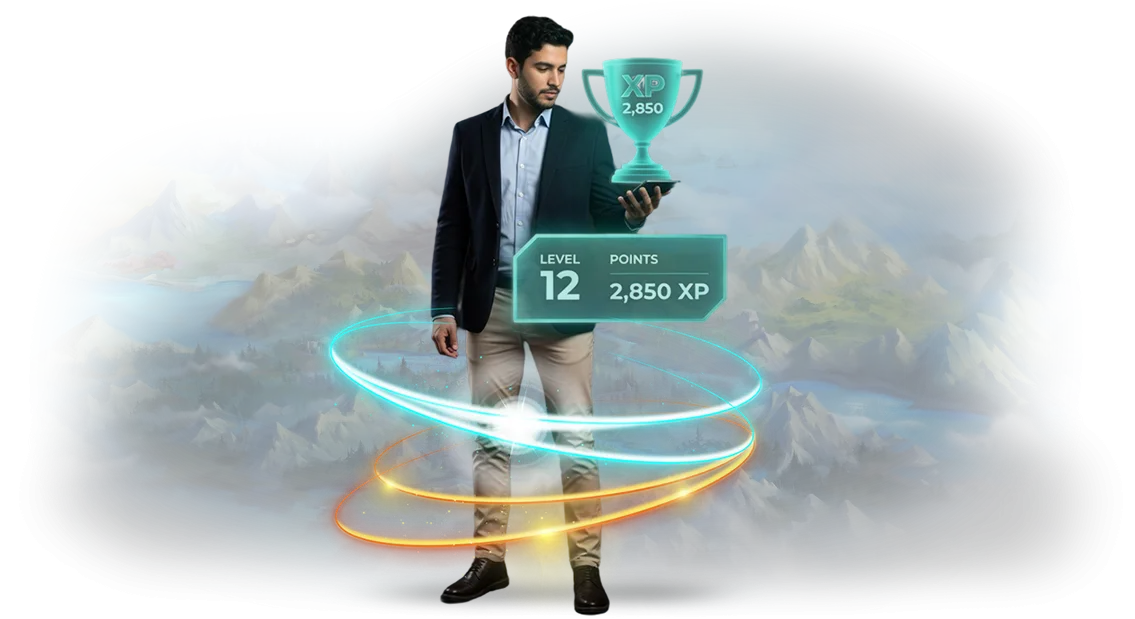
Why Hotel Chains and Inns Lose Guests Without Gamification?
For a hotel chain, each guest is not just a night in a room, but a choice: to come back again or try the hotel next door. Today, service in different places has become almost identical: a comfortable bed, breakfast, Wi-Fi — all of this is taken for granted.
When there are no emotions or a reason to remember the trip, the guest quickly forgets your brand and, at the next booking, compares only price. That's exactly why chains lose guests — not because of room quality, but because of a lack of engagement and experiences.
Without a vivid in-hotel experience, repeat bookings decline, and attracting a new guest costs several times more than retaining an existing one.
A guest stays loyal only when they have a personal interest: collecting points for activities, unlocking a new level, getting a nice bonus for completing a task.
This changes the attitude toward the hotel — from a "place to sleep" it turns into a space where guests want to stay longer and return again.
Hotel gamification solves exactly this problem: it holds the guest's attention from check-in to check-out, involves them in hotel life, and creates an emotional connection with the brand.
For example, guests are offered a property quest, a healthy-habits challenge, or a points-based program for reviews and event participation. Every action produces a clear result, and the guest sees that the hotel values their time and offers an engaging way to communicate.
For a hotel chain, this is also a way to build loyalty across all properties at once: a guest who earns status in one city gets benefits in another. This forms a habit of choosing your chain rather than opening a competitor's app.
The key is that this happens not through discounts that eat into profit, but through game mechanics that increase the value of every visit.
Implementing gamification doesn't require changing the hotel physically — a digital layer that accompanies the guest at every stage, from booking to a return stay, is enough.
We help hotel chains launch such mechanics turnkey: we design scenarios, configure the system, and hand the tools over to the hotel team.
As a result, the chain gets not just a loyalty program, but a working guest-return mechanism — with clear metrics and a growing share of repeat bookings.
What Gamification Gives Hotels and Inns: Loyalty Growth
Guests choose a hotel not only for the room and breakfast — they return to places where they received emotions. Discounts and loyalty cards no longer create an advantage: competitors copy them within a month.
Gamification changes the very principle of guest interaction — turning every visit into a light adventure worth returning for.
Emotional Attachment and Brand Recognition
When a guest doesn't just stay in a room but takes part in a game — earning points for check-in, unlocking new status levels, completing tasks at the spa or restaurant — the hotel stops being a "place to sleep." It becomes part of the client's personal story. These are the moments guests photograph, tell friends about, and post on social media.
As a result, the hotel chain gets something advertising money can't buy — genuine word-of-mouth recommendations. Each engaged guest brings in 2–3 new clients. Brand recognition thus grows not through reach, but through personal experience, which people trust more than any banner.
Repeat Visits and Higher Average Check
Gamification mechanics are built so that continuing the interaction benefits the guest: a new level is about to unlock, just a couple of nights to the next status, double points for ordering dessert.
This gently, without being pushy, nudges them toward choosing your chain for business trips and vacations.
At the same time, the average check grows: a guest is more willing to order additional services when they see it brings them closer to a game goal.
For a hotel chain, this means stable occupancy on weekdays and in the low season — repeat bookings don't depend on external advertising campaigns.
This approach turns one-time visits into a loyal audience ready to return again and again. We design gamification that drives the chain's business metrics — from the first touchpoint to regular repeat stays.
Gamification Formats for Your Business Goals
Different guest segments react to games differently. A business traveler values speed and recognition, a family values shared experiences, and a repeat guest values the benefit from every visit.
That's why we select a gamification format for the chain's specific goal — from increasing loyalty to driving engagement with new services. For example, in a business-travel hotel chain, we focus on statuses and privileges: late checkout, room upgrade, lounge access. In a family resort hotel — quests with tasks for children and parents.
We don't offer one-size-fits-all solutions — every format is tailored to your brand and guest profile. Below are the core mechanics we adapt to your hotel or chain:
| Format | For Whom | What It Gives the Client |
|---|---|---|
| Guest quest | Families, tour groups, corporate events | Increases time spent at the hotel, encourages exploring the property and services, creates photo opportunities for social media |
| Loyalty program with statuses | Business travelers, frequent guests | Builds the habit of choosing your chain, increases booking frequency and the share of direct bookings |
| Competitions and leaderboards | Active guests, event participants | Creates excitement and emotional attachment, motivates return visits to improve results |
| Points accumulation and exchange for services | A wide range of guests, including occasional ones | Increases the average check, encourages extra spending at restaurants, spas, and excursions |
In most projects, we combine 2–3 mechanics: for example, a guest earns points and statuses with every visit, and reaching a new level unlocks access to an exclusive quest. This creates long-term engagement, not a one-off promotion.
Importantly, all mechanics integrate into the hotel's existing business processes: booking, registration, service ordering. The guest doesn't notice the technical complexity — they simply receive bonuses or interesting tasks. And you get data on guest preferences and the ability to influence their behavior.
Describe your task — we'll suggest the right format and show how it will impact the chain's key metrics.
How We Launch Gamification: 6 Steps to Results
For gamification to deliver measurable results, the implementation must be predictable. We've structured the project stages so that at every step you understand what's happening and what you'll get as a result. Below are the six steps your portal goes through.
-
Brief and task immersion. We study your business, audience, and the processes you want to activate — check-in, repeat visits, upselling, employee motivation. We lock in goals so that gamification implementation solves exactly your tasks.
-
Plan and strategy. We propose a concept: scenarios, reward types, progress logic, and how the portal will integrate with the hotel's existing services. We agree on timelines and performance indicators — you know in advance what we're responsible for and what you'll receive.
-
Prototype and approval. We show screen mockups and the logic of user scenarios. Before development starts, you see how guests and staff will interact with the mechanics and can make changes without extra costs.
-
Implementation and testing. We build the portal on a professional platform and connect the necessary integrations with your booking and management systems. We test on real scenarios — from registration to receiving a reward.
-
Portal launch. We run final testing, configure access, and train your team. We support you in the first days of operation to ensure a smooth start.
-
Post-launch support. We stay in touch: monitor stability, help with updates, and analyze how the mechanics affect your metrics. If needed, we adjust scenarios for a growing audience.
What's Included in the Gamified Portal Delivery
The delivery includes not just a link to the portal, but a ready-made solution that immediately works to your advantage. We structure the project scope so that every hotel in the chain gets a clear tool for increasing guest loyalty and growing direct sales.
- Well-designed game mechanics. Tasks, levels, and rewards that motivate guests to book more often, leave reviews, and use additional services. You get a mechanism that increases repeat visits without discount wars.
- Responsive interface. The portal is equally convenient on a smartphone, tablet, and computer. Guests don't waste time learning the system, and staff don't spend time on training for every new task.
- Dashboard. You see guest activity, campaign effectiveness, and each hotel's metrics in real time. No need to wait for reports — data for decisions is always at hand.
- Instructions and staff training. We don't hand over the portal "as is." Your administrators and frontline staff receive concise, clear materials and practical sessions to work confidently with the system from day one.
- Transparent project scope. You know in advance which modules are included, how the work stages are distributed, and what happens at each step. No hidden work or unexpected additional payments.
- Built-in analytics. The system shows which game mechanics drive real booking growth and which ones should be adjusted. You rely on numbers, not assumptions.
- Post-launch support. We stay in touch, answer questions, update the portal, and help scale it to new hotels in the chain.
You get not just a web page, but a working system that boosts brand recognition and delivers measurable results. The rest is our concern — from first sketches to launch and ongoing support.
Case Study: How Gamification Increased Repeat Bookings
For the Meridian hotel chain, the main goal was to bring guests back after their first visit. Despite a well-developed loyalty program, most guests didn't return, and only 8% of guests used the cards.
The problem wasn't the service — it was the lack of a clear, engaging journey that would turn an ordinary stay into a game with a reward.
We built a gamified web portal where every guest step earned points: from booking and e-registration to reviews and referrals to friends. Guests saw their status, unlocked new levels, and received real privileges — late checkout, room upgrade, welcome drink. The goal was not just to entertain, but to give a reason to come back.
What Changed in the First Six Months of the Portal
| Metric | Before Implementation | After Implementation |
|---|---|---|
| Repeat bookings | 12% of guests | 19% of guests |
| Loyalty program participants | 8% of guests | 27% of guests |
| Booking requests from the portal | 5% of traffic | 34% of traffic |
| Average check on repeat visits | — | +23% |
The portal became part of the customer infrastructure: the main website and booking system remained unchanged, but a motivation layer was added that connected to existing processes.
The chain's management got clear analytics — which game mechanics genuinely work and which ones guests grow tired of. Within a few months, the hotels saw a wave of reviews mentioning the new portal, and the share of guests returning a second time grew by 58%.
This case confirms: gamification of business processes pays off not through entertainment content, but through measurable growth of key metrics. If your loyalty program runs "on autopilot" but doesn't motivate guests to return — we have a solution proven in practice.
How to Choose a Gamification Format for Your Goals?
Choosing a gamification format starts not with mechanics, but with the problem you want to solve. For a hotel chain, this could be growing direct bookings, increasing guest loyalty, motivating staff, or training employees in service standards.
The same mechanic works differently in each of these scenarios, so first we define the business goal and only then select the tools for it.
If the main goal is to engage guests and increase repeat visits, quests, levels, statuses, and accumulation bonuses work well. The guest sees progress: "two visits left to silver level" — and that becomes a reason to return to you specifically.
If the goal is to motivate staff to work more actively, team competitions, public achievements, and a transparent reward system work better. Employees see their contribution to the overall result, and the manager gets healthy competition without manual oversight.
The second important criterion is the touchpoint: where the guest or employee encounters the gamification. This could be the booking website, a mobile app, the front desk, or an internal portal.
This determines how deep the mechanics can be: in a browser, simple scenarios with quick feedback work better; in an app — multi-step programs with a long lifecycle. We consider how often the user returns to the system and don't overload the interface with unnecessary actions.
The third factor is the audience. Families with children and business travelers react differently to competitive and collectible mechanics. We don't impose universal solutions; instead, we offer 2–3 options for your guest profile and show how each one affects behavior.
After a short process audit, you receive an evidence-based recommendation — what to launch first and what's better to postpone.
The bottom line is simple: the right format is chosen based on your business situation, not on trendy fads.
We help you decide before you even submit a development request — during a consultation we break down your goals and advise which mechanics will deliver measurable results in your specific case. Describe your situation in the request — and get a personalized format recommendation.
Frequently Asked Questions About Business Process Gamification
Most often, clients doubt not the idea itself, but how gamification will behave in the real operation of a hotel or hotel chain.
They worry that the mechanics will become outdated, that the system won't handle high-season load, or that the portal will be difficult to adapt to their brand identity. These concerns are addressed at the design stage — here's how it works in practice.
What happens to the portal if we experience a technical failure?
Stability is built into the architecture from day one: the server infrastructure is designed for peak loads during check-in waves and holidays. We monitor portal uptime around the clock and respond to critical situations within an hour.
For your team, this means one thing — guests don't notice the technical side. They simply get bonuses, take part in promotions, and come back to you again.
Who will update the mechanics and make sure they don't get boring?
Gamification gets tiresome if left unchanged. We design the portal so you can change scenarios without involving developers: launch new promotions, adjust levels and rewards through an easy-to-use dashboard.
If you need a fresh idea, we jump in ourselves. We propose concepts that keep guests engaged season after season and help implement them within a few days.
Will the portal look "like everyone else's" or will it be adapted to our brand?
Full adaptation to your brand identity is the standard, not an option. Colors, fonts, tone of communication, scenarios — everything is tailored to your brand, so guests recognize the hotel even in the small details.
We work on professional infrastructure and refined tools, so the portal looks and works like a natural extension of your service. Guests don't feel they're taking part in a "loyalty program" — it feels like part of their stay.
What guarantees do we have that the portal will work and deliver results?
We've been developing gamification for business for over 10 years, and we take financial responsibility for results — this is written into the contract. Before launch, we test the system on real scenarios so everything works flawlessly from day one.
After launch, we don't abandon the project: we analyze guest activity, provide clear reports, and suggest improvements. You always see which mechanics drive repeat bookings and which ones should be adjusted.
Let's Discuss Gamification and Prepare a Plan for Your Business
We know how gamification works in hospitality: it increases guest loyalty, engages staff, and directly affects repeat bookings. But every hotel chain is unique — different guest flows, geography, seasonality, and business goals — so standard templates don't work here.
To help you make an informed decision, we'll analyze your situation and show where gamification will deliver quick results and where it will require a longer setup. This isn't a presentation of general capabilities, but a practical review of your business.
What You'll Get During the Consultation
- An assessment of current processes: where gamification will strengthen guest motivation and where it will strengthen staff motivation.
- A launch plan: stages, timelines, and the team — what we do at each step and when to expect the first results.
- Cost estimate for your scale — from a single hotel to a chain with dozens of properties, calculated after an audit.
- Specific mechanics for your scenario: loyalty program, staff training, guest competitions.
- Examples of completed projects in hotels and inns, with numbers on engagement and repeat bookings.
- A clear answer on how to measure the effect of gamification after 3–6 months.
After the consultation, you'll know exactly whether gamification suits your chain and what results you can realistically expect.
Leave a request on the website — we'll reach out within one business day, answer your questions, and prepare a preliminary plan. This is not binding, but you'll get a ready foundation for deciding whether to launch the project.