

The Main Pain Point of Training Centers — Loss of Attendance
Attendance at training centers directly depends on how engaged participants are in the process. If training comes down to lectures and repetitive exercises, attendees lose interest midway through the session and stop coming back after the first day.
As a result, groups don't fill up, repeat sales drop, and the center's reputation gradually erodes — competitors offer more dynamic formats.
This is especially acute in corporate training, where managers pay for results and quickly notice that employees are attending just to tick a box.
When participants don't engage with the process, new skills aren't reinforced, and the client sees no reason to extend the partnership. This is why training centers lose up to 30–40% of clients after first contact — simply because the training feels boring and useless.
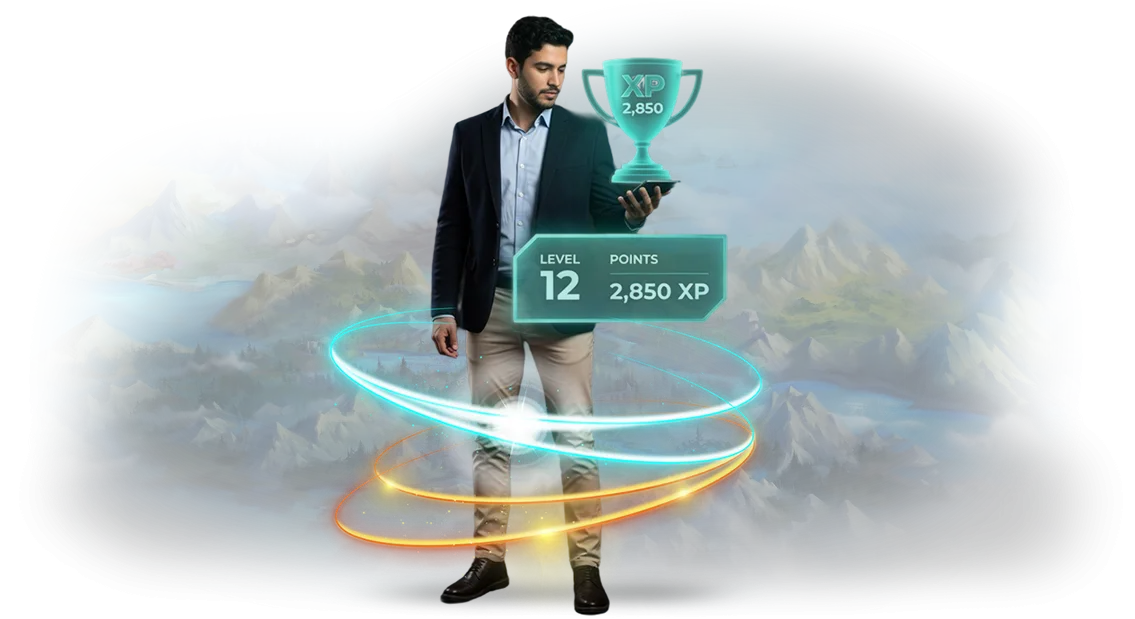
We solve this problem through gamification of business processes. We turn training into an engaging scenario with clear goals, levels, and feedback — participants themselves strive to complete the program rather than just attending the session.
This approach holds attention, increases engagement, and creates positive emotions that connect the client to your brand.
For a training center, this means higher attendance, a larger share of repeat bookings, and organic referrals from participants. People share vivid impressions with colleagues, and you don't have to spend budget on constant advertising.
We handle the development of mechanics, platform setup, and support — you get a ready-made tool that pays for itself within the first training cycle.
What Benefits Your Center Will Get from Gamification
A training center lives by participant results: if they are engaged, the material is absorbed, and emotions turn into loyalty. Gamification transforms training into a game format where every step is visible, rewarded, and remembered.
For your center, this isn't just "interesting" — it's working mechanics that address specific business objectives.
Here's what you get in practice:
- Increased participant engagement. People complete the training, return to the materials, and compete with each other. An active audience means more completed programs and a higher average check.
- Brand recognition. A gamified portal sets your center apart from competitors. Participants themselves talk about it, share results on social media — and you become known far beyond your current audience.
- More leads. Mechanics with prizes and contests motivate participants to bring friends. Each participant becomes a carrier of your advertising, and you get a stream of qualified inquiries without additional spending on classic marketing.
- Repeat sales. Progress, points, and achievements give a reason to come back. Participants see their own journey, want to continue it, and more readily agree to the next program or course.
- Data for growth. Gamification shows what exactly interests the audience and where it drops off. You understand more precisely which products to offer next and how to improve programs.
At our team we design such mechanics for training centers: from simple points to full-fledged portals with leaderboards and learning stages. You get a tool that motivates participants, generates leads, and increases repeat inquiries — without diving into technical details.
Gamification Formats for Training Centers
Training centers work with different audiences: from new employees to executives. Each group has its own motivation, skill level, and goal. That's why we don't offer a single "universal" format — instead, we tailor gamification to the specific objective of the training.
Here are three basic formats that cover most objectives:
| Format | For which tasks | What it gives the client |
|---|---|---|
| Open quiz | Warming up the group, checking knowledge, engaging with the training topic | The audience immediately gets involved, the trainer sees the level of preparation and weak spots of participants |
| Quest | Practicing hands-on skills, team interaction, learning through action | Participants apply knowledge in a simulated situation rather than just listening to theory |
| Competition | Boosting motivation, identifying leaders, reinforcing results | Healthy competition increases engagement, and the reward for winning is remembered for a long time |
Each format can be adapted to the training format: in-person, online, or hybrid. For example, a quiz can be easily launched on participants' phones right in the classroom, while a quest can be run through virtual rooms with tasks.
We help you choose mechanics that fit your timeline, the number of participants, and the group's level of technical readiness.
As a result, the client gets not just a "game for the sake of a game," but a tool that solves a business problem: training goes faster, the material is absorbed more deeply, and participants leave with a positive impression of the training.
How Gamification Launch Works: From Brief to Result
We've structured the launch so that at every stage you understand what's happening and what result you'll get. No "black box": you participate in key decisions, see progress, and control the budget.
our team's experience in projects for educational centers makes the process well-tuned and predictable.
-
Brief and interview. We discuss the goals of gamification — which business processes we're accelerating: onboarding, sales, service. We determine who will use the portal and what should change in participant behavior.
-
Plan and estimate. We formalize the timeline, stages, result, and cost. You receive a document where every item is tied to your objectives rather than abstract wishes.
-
Approval of mechanics and design. We show prototypes: how tasks, levels, and rewards look. You make edits before development starts — this saves time and budget.
-
Implementation and checkpoints. Every 1–2 weeks we show intermediate results. You adjust details along the way, not when changes become expensive.
-
Launch and training. We deploy the portal, connect participants, and hold a short session for administrators. You get everything you need to start working right away.
-
Support and growth. After launch, we stay in touch: we analyze initial results, help with settings, and suggest improvements. Optionally — ongoing support and addition of new modules.
This process provides predictability: you know the dates, budget, and readiness criteria at every step. If you only have a general idea — we'll start with a brief and propose the optimal scenario for your training center.
What's Included in the Gamification Project Delivery
Project delivery isn't just "here's a link to the portal." For a training center, it's important that gamification works as part of the business: understandable to the team, measurable by results, and manageable without involving developers.
That's why the delivery includes a complete package covering all stages from launch to daily operation.
Delivery Package: What You Get
Closing documents and access. Certificates of completion, administrator rights, and logins for key employees — you own all materials and can hand the project over within your team without intermediaries.
Instructions for all roles. Separate guides for the owner, portal administrator, and trainer: how to create an event, add participants, set up point accrual rules, and award prizes. No technical complexity — just step-by-step actions.
Training for your team. We run a short workshop where your specialists immediately try configuring the portal in real scenarios from your training center. After the session, the team keeps a recording and a cheat sheet — the launch will go smoothly without stress.
Metrics and dashboards. You see how the portal affects the business: training attendance, active participation time, share of repeat bookings, and conversion to target actions. Metrics are presented in clear reports — no need to request anything from developers.
Technical support. After launch, we stay in touch: we fix bugs, update the system, and consult your team when you want to add a new gamification mechanic or scale scenarios.
Additionally — free support during the warranty period. If any questions arise about how the portal works, you get an answer within one business day.
Optionally, we can extend support on an ongoing basis — then any refinements will be completed faster and without searching for a new contractor.
Case Study: How Gamification Increased Training Attendance
A training center approached us with a typical pain point: registrations for programs exist, but only a fraction of participants show up when the course begins.
The organizers were spending budget on advertising while halls were half-empty — this ate into margins and demotivated the instructors.
We proposed not just reminders, but a full-fledged gamified portal for participants. Every registered person received a personal account with points for completing pre-training tasks, a group rating, and team challenges.
Participants saw each other's progress, shared results, and got involved ahead of time — the training began before its official start.
The effect was felt from the very first cohort: attendance grew by 40%, and the share of participants who reached the finish line reached 92%. Bookings for subsequent courses increased by a third — graduates themselves talked about the unusual preparation format. The center's quarterly revenue grew by 25% without additional advertising investment.
The center's director assessed the collaboration this way: "SmartSkills — for the first time we saw that we can influence client motivation before the training even begins. Participants arrive prepared, and we get stable groups and satisfied graduates."
This case study isn't about fancy cards — it's about measurable business results. Gamification solves the training center's main challenge: turning a casual registration into conscious participation, and a participant into a repeat client.
How to Choose the Right Gamification Format?
The gamification format is chosen not by "what's trendy right now" but by the specific task at hand. For a training center, this could be increasing engagement in classes, practicing skills between lessons, or motivating students to finish the course. The more precisely the goal is formulated, the easier it is to select the right mechanic.
If you need to quickly reinforce knowledge, we recommend quizzes and levels — they provide instant feedback. Competitive scenarios work well for teamwork, while cumulative points and statuses are suited for long programs, sustaining interest throughout the entire training.
When selecting a format, we always rely on the participant profile and the timeframe in which you want to see results. For one audience, a public rating will be motivating; for another, a personal trajectory without comparison to others.
These same considerations form the basis of our recommendations, which we discuss with you first and only then propose a ready-made solution.
The main advice: don't start with the question "which format should we buy" — start by describing the task. This way you'll avoid the scenario where the game looks nice but brings no business value.
Describe your situation to us — we'll help you choose a format and show how it will work specifically for your training center.
Answers to Frequently Asked Questions About Gamification
We understand: before implementing gamification in training, you want to be sure it will work with your audience and won't disrupt current processes. Below are answers to the questions clients most often ask before the project starts. If your question isn't here — just contact us and we'll discuss your case.
What if gamification doesn't suit our specific audience?
We don't use templates: before development, we study your participants' profile, their motivation, and typical objections. We select mechanics for specific learning scenarios — from onboarding newcomers to increasing engagement among experienced employees.
To reduce risks, we offer a pilot launch with one group. Based on the results, you see real engagement numbers and feedback, and only then make a decision about scaling.
Will implementing gamification disrupt the training center's current operations?
Integration happens in stages: first we connect the module to the existing system, then we move part of the materials into game formats. All processes are supported by our specialists, and your employees receive training and instructions.
In the end, you're not restructuring your business but strengthening it — without downtime or loss of training quality. The main load falls on us, not on your team.
How long will development take and when will the first results appear?
Timelines depend on the scope and complexity of the tasks, but we always formalize them in the contract. At the start, you get a plan with checkpoints — you know when the prototype will be ready, when testing will happen, and on which day the launch will occur.
The first effects — increased engagement and participant activity — are visible within the first week of use. For educational metrics, it's important to complete at least one full learning cycle.
What guarantees do you provide?
The guarantee is in the contract: we're responsible for system functionality, meeting deadlines, and achieving agreed-upon metrics. If something goes wrong — we fix it at our own expense.
After launch, we stay in touch: we maintain updates, refine mechanics per your requests, and help you use data to improve programs. You won't have to deal with technical details.
We're always open to dialogue: we'll show examples of similar solutions, calculate timelines for your tasks, and propose an implementation format that suits you. Start with a short phone conversation — that's enough to resolve the main doubts.Order Gamification for Your Task
For training centers, every new cohort of participants is a challenge: how to hold attention, deliver results, and keep motivation from fading by the end of the program.
Web portal gamification turns learning into an engaging process where participants themselves strive to complete tasks, track progress, and return to the materials. We develop such solutions for the specific needs of each center and are ready to get started with you right now.
When you reach out to us, you'll get:
- Consultation on your task — we'll figure out which game mechanics fit your format: courses, trainings, corporate learning.
- Cost and timeline estimate — we'll prepare a clear estimate with stages and results, no hidden work or technical jargon.
- Prototype of the future portal — before development starts, you'll see how gamification works in practice and can influence key decisions.
- Implementation plan — a step-by-step outline: what we do, when, who's responsible for what, and when the portal will go live.
- Post-launch support — we'll help with refinements, analyze learner participation, and adjust the mechanics if something goes wrong.
Leave a request on the website — we'll call you and discuss your task. If gamification can help, we'll show you the estimate and prototype within a few days. If not — we'll honestly say so and suggest an alternative way to achieve your goal.