

Why construction companies see low lead conversion
In construction, clients make decisions slowly — not just with their heads, but with their hearts. They compare offers, study estimates and timelines, but choose the one who presents a clear and appealing image of the future project.
Ordinary tenders with tables, blueprints, and dry figures don't create that feeling — they don't build trust and are easily forgotten.
As a result, the construction company receives leads, but conversion into actual deals stays low. Managers spend hours on negotiations, and at the last moment the client leaves for a competitor who explained the benefits more simply and addressed their concerns.
Each such loss is not only missed revenue, but also a disappointed client who will tell dozens of others about their experience.
A distinctive feature of construction sales is the high cost of a mistake. Clients fear risks and look for guarantees. They need to feel understood — that the project will be exactly what they dream of. Dry presentations and template emails can't convey that confidence.
But interactive formats — a virtual tour of the property, a visual benefit calculation, a game-like presentation of work stages — help the client experience ownership before the purchase. This removes objections and accelerates the decision.
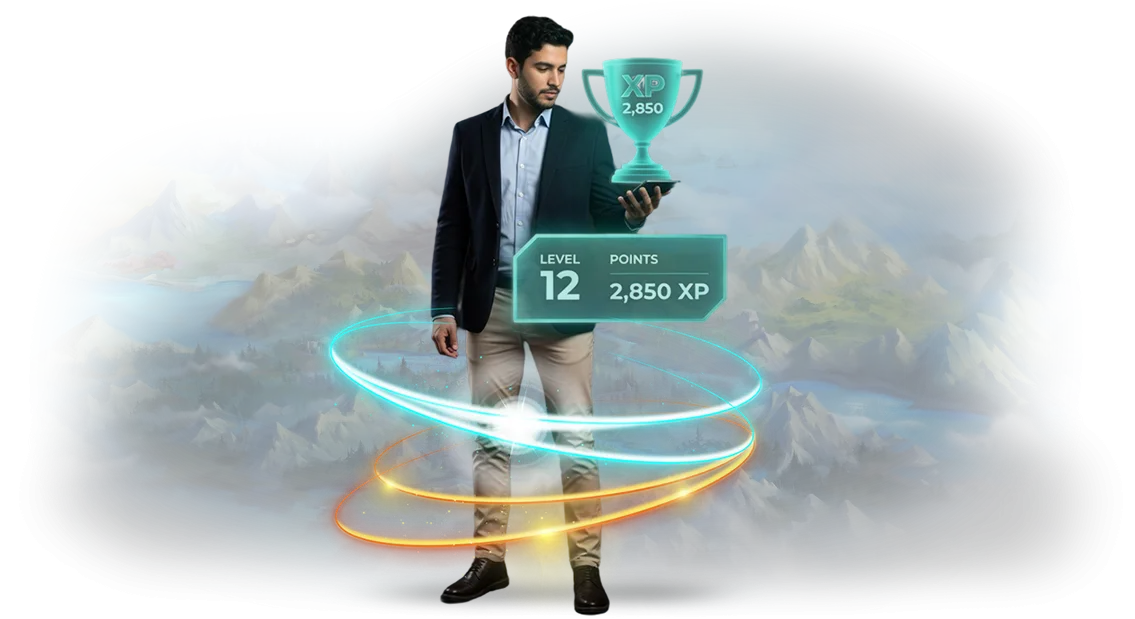
We address this pain point through gamification of business processes.
Construction companies get a tool that turns the tedious proposal review process into an engaging journey: the client sees transparent stages, bonuses for timely payment, compares options, and reaches the deal faster.
The result — higher lead-to-sale conversion, a shorter sales cycle, and greater profit without extra advertising spend.
What gamification of business processes gives a company
For a construction company, business process gamification is not just points and rewards, but a working tool that turns routine into a clear game. Employees get motivation, clients get engagement, and the business gets measurable results.
Client loyalty
When a client sees progress on their project, marks milestones, and earns bonuses, they come back. Gamification makes interaction transparent and emotional: the client isn't just waiting for handover — they participate in the process.
After launching its portal, the company "Stroy-Alliance" noted a one-third increase in loyal clients.
Higher sales
Game mechanics nudge clients toward the next step: consultation, cost estimate, contract signing. At each stage, the client is shown their benefit, which speeds up decision-making. Sales grow without aggressive pressure — through engagement.
Brand recognition
A gamified portal is easy to remember and makes people want to share it. Clients talk about it on social media, take part in promotions, and tag the company. The brand becomes relatable and modern — and therefore gets chosen more often over competitors.
Lead flow
With game elements — quizzes, checklists, future-home calculators — you collect contacts from interested visitors. Each participant leaves their data, and the company gets warm leads for its sales team. This is a steady source of new inquiries without overpaying for advertising.
Gamification pays off not only in money, but also in reputation. It turns one-off deals into long-term partnerships and gives the business clear growth metrics.
Gamification formats for construction companies
Gamification for construction companies is not a single template, but a set of formats that solve different tasks: from training crews to engaging dealers and partners. To maximize the effect, the format is matched to the specific audience and business goal.
We help you choose it before development begins, so you don't pay for unnecessary functionality and get results quickly.
| Format | For whom | What it gives the client |
|---|---|---|
| Web portal | Employees of all departments, contractors, partners | A single entry point for training, competitions, and task control. Suitable for ongoing programs and large projects. |
| Mobile app | Site supervisors, crews, field staff, sales representatives | Engagement right "in the field": quick tasks, ratings, recognition. Improves discipline and the desire to perform better. |
| Quizzes | Sales managers, new hires, tender participants | Quick consolidation of product and standards knowledge. Engaging and simple — suitable for short campaigns and assessments. |
| Corporate games | All employees, large teams, team building | Build team spirit and healthy competition. Especially effective when introducing new procedures or driving change. |
Each format boosts motivation in its own way, and often the best result comes from combining them. For example, a portal for ongoing training programs plus a mobile app for field staff.
We design the system so that it aligns with your business processes and doesn't require employees to navigate complex interfaces.
How the project proceeds: from brief to launch
To ensure gamification delivers measurable results rather than remaining just a game, at our teamwe have built a transparent development process. It has been refined across dozens of projects in various industries, including construction companies.
At every stage, you understand what is happening and how it affects your goals — from engaging site supervisors to monitoring compliance with procedures.
- Brief and discovery — we define goals, audience, and success metrics.
- Analysis and scenarios — we study processes (work orders, occupational safety, quality control) and find opportunities for game mechanics.
- Prototype — we approve the portal structure and the logic of tasks, levels, and rewards.
- Design — we create a clear interface in your corporate style, convenient for employees at construction sites.
- Development — we build the portal on a proven platform, connect integrations with accounting systems, and provide test access.
- Project launch — we deploy the portal, train administrators, and help announce the start among employees.
- Gamification support — we track metrics, update scenarios, and add new mechanics.
In the end, you get not just a technical solution, but a business tool: higher engagement, fewer violations, faster onboarding for new hires. And clear development stages eliminate surprises in timelines and budget.
What's included in the delivery: a conversion growth kit
You receive not just a game module, but a ready-made sales tool that works from day one to attract and retain clients. The entire package is built around a single goal — increasing lead-to-sale conversion and repeat inquiries for your construction company.
The delivery includes:
- A gamified web portal — an interactive game or a series of mechanics that engages visitors: cost calculation, layout selection, loyalty points for actions. Everything that holds attention and drives users toward a request.
- Admin panel — you change promotions, terms, prizes, and portal content yourself, without involving programmers. New offers go live in minutes.
- Instructions and procedures — clear materials on how to use the game in sales, advertising, and on the website. No guesswork: every step is documented.
- Employee training — we conduct a workshop for your managers and marketers: how to answer client questions, how to guide them toward a request, and how to use accrued points in negotiations.
- Per-visitor analytics — you see who played, which options they chose, how much time they spent, and at which stage they stopped. This data automatically tells you whom to call and what to offer.
- Results guarantee — we set launch timelines and key performance indicators in the contract. If something goes wrong, you get fixes at our expense.
- Technical support — we answer employee questions, monitor system stability, and update the solution free of charge as your services change.
Every element of the package is tied to a specific stage of the funnel: the game attracts attention, the admin panel speeds up campaign launches, training improves conversation conversion, and analytics provides data for the next touchpoints.
As a result, you get not "a game for its own sake," but a working system that pays for itself from the first weeks.
Case study: gamifying the dealer network of a construction holding
Construction holding "StroyLeader" approached us with a problem: regional dealers were losing motivation, standard bonuses had stopped working, and repeat orders were declining.
They needed a tool that would engage the network in daily work without extra oversight and reminders.
We proposed a gamified web portal: each dealer sees their own progress, compares results with colleagues, and earns points for targeted actions — sales, training, client work. Competition between branches added excitement: sales became a game, not a chore.
Implementation took just 2.5 months — the team worked remotely without disrupting dealer operations.
Within six months, repeat orders were up 40%, and dealer activity on the portal reached 85% — previously, barely a third of the network used internal systems. Management gained a clear picture of every point of sale and could work precisely with those who were lagging. Engagement became manageable rather than accidental.
This success confirmed that well-designed gamification changes partner behavior without harsh penalties. After the initial results, the holding ordered a rollout of the portal to all branches and a motivation program for its own team — another sign that the solution paid off.
How to choose a gamification format for your business goal?
Choosing a gamification format starts not with picking mechanics, but with answering the question: what specific business problem are you solving?
Increasing employee engagement, speeding up onboarding for new specialists, reducing worksite injuries, boosting sales, or making training a regular practice — each goal has its own approach.
For example, knowledge checks work best with quizzes and leaderboards, sales targets — with team competitions, and long-term training — with a points system and level unlocking.
Budget also shapes the format, and here it's important to understand: gamification doesn't always require a complex portal. To start, a simple tool is enough — for example, a leaderboard and regular challenges that launch quickly and show first results within a couple of weeks.
But if the business needs systemic motivation for years — we design a full web portal with a personal account, scenarios, rewards, and analytics. In either case, you get a transparent cost and a predictable effect.
The specifics of construction companies are a separate factor in the choice. Your employees work across different sites, often remotely, with varying levels of digital literacy.
That means the mechanics must be simple, accessible from a phone, and not dependent on a stable internet connection.
That's why we avoid bulky solutions: we use short tasks, instant feedback, and visible rewards so that participants see their results immediately and managers see a summary across the company.
In the end, a smart format choice is a joint effort: you describe the goal and constraints, we propose a scenario that fits your budget and your team's specifics.
We don't push a single universal template — we build a solution for your task, with phased rollout and clear performance metrics.
This way, you get not "a game for its own sake," but a tool that pays off through higher engagement, faster learning, or reduced losses — in numbers you can see within a month.
Common questions from clients before starting a project
Before a project starts, clients from construction companies wonder: will gamification interfere with work, how will it integrate with their CRM, and when will it pay off? Here are answers to the four most common questions — they remove the main concerns.
What if gamification doesn't suit our particular construction company?
We start with a pilot area — for example, the sales department or lead processing. On a limited group, you can see which mechanics work. Only then do we scale the solution across the company. The risk of a major mistake is minimal.
How will gamification work with our CRM?
We connect to your CRM through standard tools. Points and ratings are calculated automatically from your data — nothing needs to be entered manually. The integration doesn't interrupt current processes.
Won't employees resist the new system?
The interface is simple, and training happens in stages: first managers, then teams. Within a few days, employees see it as a game, not surveillance. We keep support available for the first weeks.
When will the project pay off?
Before launch, we define target metrics: growth in leads, fewer errors, onboarding speed. After the first weeks, we show the trend and adjust the mechanics if needed. Results are visible as the project progresses.
Request a gamification quote for your business
A construction business is dozens of people working toward a result: site supervisors, crews, the procurement department, and clients. When everyone sees their contribution to the overall outcome, work moves faster and missed deadlines become rarer.
Gamification turns routine into a clear motivation system — and we build such portals specifically for construction companies.
You don't need to understand the mechanics of quests and points: we'll propose a scenario for your task ourselves.
Leave a request to order gamification for your business — you'll get a consultation, an accurate cost calculation, and access to a portfolio with construction industry examples.
With a single inquiry, you get:
- a preliminary cost and timeline estimate for development;
- an analysis of your business processes and growth points for gamification;
- format options: crew ratings, site competitions, a portal for contractors and clients;
- a selection of portfolio projects for the construction industry;
- an implementation plan with stages and responsible parties;
- answers to questions about integrating with your accounting system.
We work remotely and cover the entire cycle — from brief to launch and support. You communicate directly with the team, without intermediaries, and always know what's happening at every stage.
Fill out the form below or message us — we'll respond within one business day. Tell us how many people you plan to engage, and we'll prepare a quote for your task.