

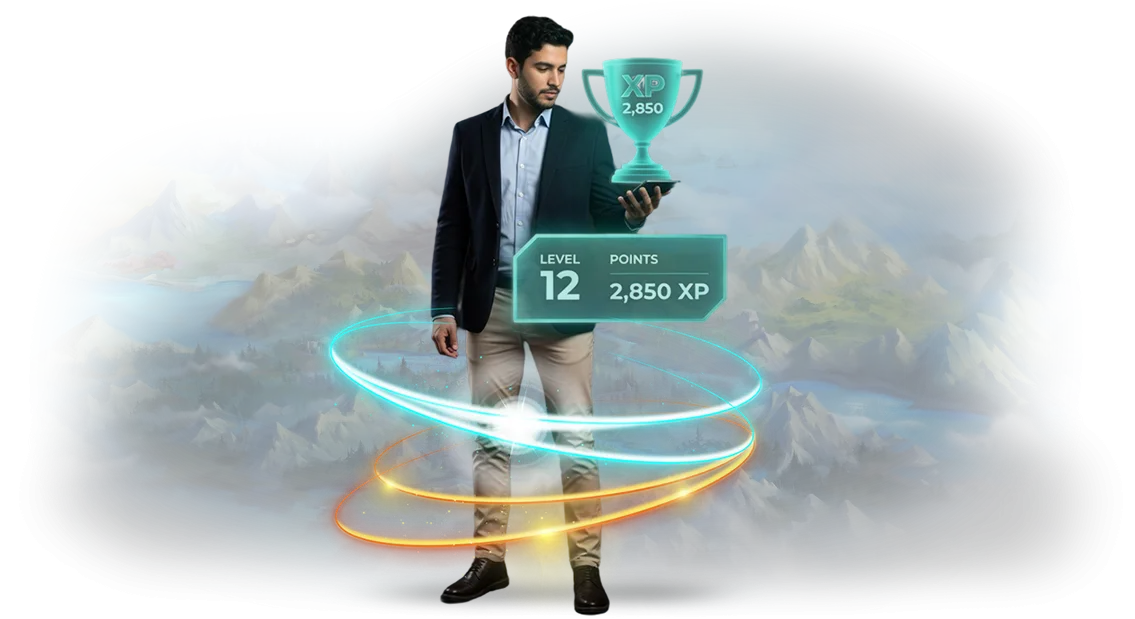
Customers Leaving? Gamification for Food Retail
Customers leave because in grocery retail the choice is huge, and the difference between stores often comes down to a couple of dollars on the receipt.
Discounts and promotions give a short-term spike, but do not create the habit of returning to you specifically — the shopper switches to a neighboring store as soon as they see a better deal. As a result, margins melt and loyalty remains illusory.
The problem is not absent customers, but the absence of a reason to stay. A person chooses a store not only with their mind but also with emotions: they need a sense of choice, progress, a small victory.
Ordinary loyalty programs have long become background noise — bonuses accumulate but do not engage. Customer retention requires mechanics that turn the grocery trip into an interesting scenario, not a routine.
Gamification for food retail solves this through game elements on the portal and in the customer app. This is not "just points": the customer completes tasks, passes levels, receives personal challenges and sees their progress.
For example, build a basket of X or more — get a bonus and a status upgrade. Or a seasonal "hunt" for new products: tried a product — unlocked an achievement. Each mechanic is tied to real customer behavior and increases visit frequency.
For a store chain, this means a working retention tool: growth in repeat purchases, an increase in the average check, and a steady flow of customers who do not leave for a competitor at the first temptation.
In addition, you get data on customer preferences and activity — targeted offers are built on it without aggressive spam. And all this pays for itself through additional sales, not through discounts that eat away profit.
We have already helped food retail chains implement such portals turnkey: from scenario development to launch and support. We take on the mechanics, design and integration with your accounting system — all you have to do is watch customers return and bring in more revenue.
Retail gamification is not entertainment, but a strategic tool that turns random visitors into regular customers.
What Food Retail Gamification Gives You
A food retail chain lives on frequent purchases and customer trust. But competition eats away margins, staff lose motivation, and ordinary discounts no longer hold attention.
Food retail gamification turns the routine grocery trip into a game that benefits the business: higher revenue, stronger loyalty, more active staff.
Revenue Growth and Bigger Average Check
Game mechanics encourage the customer to build a larger basket: points for "companion products", bonuses for purchase volume, mini-quests like "build a set from three categories".
As a result, each visit brings more than usual, and the customer perceives this not as pressure, but as an interesting game.
Repeat Purchases and Loyalty
A reward system for regular visits builds the habit of returning specifically to your store. The customer sees progress, receives personal offers and achievement prizes — this works stronger than a one-time discount because it keeps attention week after week.
Staff Engagement and Brand Recognition
Game elements for employees — competitions, levels, recognition of achievements — increase engagement, reduce turnover and improve service.
And unusual mechanics at the checkout or in the app trigger emotions: customers photograph the process and tell friends about it, expanding brand reach without an advertising budget.
Reliable Implementation
Wehave been designing such portals for business needs for 10+ years. We build on a modern web stack — Python and PostgreSQL — so the portal works reliably even during peak hours and easily integrates with your checkout system and loyalty programs. This gives peace of mind: the mechanics generate revenue rather than create technical failures.
Gamification Formats: Solutions for Different Business Tasks
In food retail, gamification solves several tasks at once: quickly train staff, retain customers, increase team motivation. Instead of scattered promotions and instructions, you get a unified game mechanic that works toward a result.
We select the format for the business task, not the other way around. Below are the main formats that cover the typical needs of retail chains and individual stores.
| Format | Who It’s For | What It Gives the Customer |
|---|---|---|
| Staff training | New employees, cashiers, sales assistants | Fast onboarding to standards, fewer mistakes, clear knowledge assessment |
| Loyalty program | Regular customers | Higher purchase frequency, bigger average check, repeat visits |
| Team motivation | Frontline staff, store managers | Transparent KPI system, competition between locations, lower turnover |
| Customer quests | Family audience, young people | Engagement through play, more time in store, viral reach |
Each format can be adapted to scale: from a single store to a federal chain. Mechanics are configured to your metrics — for example, number of receipts, compliance with display standards, or share of repeat purchases.
The main thing the customer gets is a measurable result. After launch, you see which scenarios work best and can adjust the program without stopping business processes. Tell us about your task — we will suggest a format that will cover it faster and cheaper than classic methods.
How Gamification Implementation Works in 6 Steps
We have structured the process so that at each stage you see what is happening and can influence the outcome. No "black box" — only clear steps with specific deadlines and responsible people.
-
Development brief — a short questionnaire or meeting where you describe the task: what you want to change in employee or customer behavior. We clarify goals, target audience and success metrics.
-
Concept and plan — we propose gamification mechanics for your task: competition, point accumulation, levels, team challenges. We agree on how this fits into your current business processes.
-
Project approval — we fix deadlines, budget and scope of work. You get a precise plan showing when the test version will appear and when the launch will happen.
-
Development and testing — we create the interface and logic on a professional platform. Inside the team, we run through all scenarios so that everything works without failures by launch.
-
Launch of gamification — we connect your employees or customers, conduct a short training if needed, and start the pilot. From the first day, you can see how the audience reacts to the mechanics.
-
Post-launch support — we analyze data: how many people joined, what activity looked like, what worked best. If necessary, we adjust rules and rewards to make the result grow.
As a result, you get not just a "game", but a tool that manages motivation and measurably affects indicators. Each stage takes from a few days to a couple of weeks — depending on scale. And at all stages you stay informed.
What Is Included in the Project: Full Delivery Package
The delivery package is a ready-made solution for food retail, not a set of scattered documents. You get everything needed to launch and develop gamification: from strategy to measurement system. Here is what exactly is included in the project.
- Gamification strategy. A document with goals, scenarios and rules. Shows how mechanics connect to purchases, bring back regular customers and increase the average check.
- Game web portal. Works in the browser without installing apps. Visitors get access to promotions, points and tasks immediately, and you get management over the entire system.
- Game content. A set of scenarios, quests, quizzes and rewards. Keeps customer interest and is regularly updated so the mechanics do not get boring.
- Performance analytics. A personal dashboard with engagement and repeat purchase data. You see which mechanics deliver results and adjust them along the way.
- Integration with your accounting system. We set up the connection between the portal and your product/customer database — points are awarded automatically, without manual staff work.
- Training and support. We hand over instructions for the team and support the project after launch, helping with refinements.
As a result, each element of the package works toward increasing loyalty and revenue. You don’t need to search for separate contractors for strategy, development and analytics — one team covers everything.
Case: 22% Revenue Growth for a Grocery Store
The grocery store chain Svezhiy Ryad came to us with a clear task: customers were leaving for competitors because they did not feel a difference between stores.
We developed a gamified web portal that turned ordinary grocery trips into a game with levels, bonuses and personal challenges.
Instead of boring discount cards, a mechanic appeared where each customer decided for themselves how to accumulate benefits: build sets, complete tasks or take part in seasonal promotions.
The key was that the game was built around real purchasing habits — rewards for familiar product categories encouraged people to add fresh produce and dairy lines to their baskets more often.
The portal worked as a personal account where the customer saw their achievements and next steps, and the store understood which mechanics produced results. The launch took only 6 weeks: we conducted an audit, configured the portal for the assortment and trained the staff.
The results for the first six months speak for themselves: the average check grew by 18%, repeat purchase frequency by 35%, and the chain’s total revenue rose by 22%.
Moreover, the growth proved stable — customers kept coming back even after the promotions ended because they had already gotten hooked on the system.
For the store, this means a predictable cash flow and a loyal audience that comes not only for discounts, but also for the game itself.
After the first quarters, the client ordered a new stage: we added team competitions between districts and delivery integration, which increased online orders by another 15%. Now "Svezhiy Ryad" renews support annually and develops the portal together with us.
If you want similar growth — tell us about your tasks, and we will select gamification for your format.
How to Choose a Gamification Format for Your Task?
Choosing a gamification format starts with the business task, not with trendy mechanics. In food retail, this means growing the average check, purchase frequency, staff training or attention to new products.
By answering what needs to change in customer or employee behavior, you cut out half of the unsuitable options.
If the goal is customer retention, a portal with points, levels and personal offers fits well. For training staff on service standards, quizzes and competitions between stores are effective. For launching a new product — promotions and contests with reward accumulation.
Choosing a solution depends not only on the task, but also on the audience. Private visitors value simplicity and instant rewards — a discount or a gift, while employees are motivated by ratings and recognition.
We analyze the participant profile, goals and processes so that the format fits into daily work without overloading the team.
Budget determines scale, but does not limit the start. You can begin with one mechanic — a seasonal quiz or a loyalty program on a web portal — and expand based on results.
A step-by-step approach allows you to test a hypothesis with minimal risk and scale only what brings a measurable result.
Bottom line: the format is selected according to the task, audience and budget. If you don’t know where to start, send a description of your situation — we will offer two or three options with an effect forecast. Non-binding.
Frequently Asked Questions About Gamification of Business Processes
Even after a detailed project description, customers still have doubts: deadlines, reliability, data security and support formats. Most worries go away when you see a clear plan and clear commitments.
We have collected answers to four main questions — without technical details, only what matters for your business.
What guarantees do you provide?
All agreements are recorded in the contract: deadlines, stages, cost and responsibility. We work transparently — you see intermediate results and control quality.
If something goes off plan, we fix it at our expense or refund the payment, and in difficult cases we complete the project to a successful result.
How long does development take?
We determine timelines after the brief — usually from two weeks to two months. The contract includes a plan with dates and stages: you understand when the prototype will be ready, when the test version, when the launch. No surprises — all dates are fixed.
How do you protect data?
Data is stored on secure servers, access is restricted and available only to employees who need it. Confidentiality is included in the contract and we comply with personal data legislation. So security is not just words, but a contract clause.
How does post-launch support work?
After launch, we stay in touch: we fix errors, advise employees, help add new mechanics. We offer several support packages — from basic to extended, with clear response times to requests. You choose the one that matches your load and budget.
This is only part of the questions we hear from customers. If yours is not on the list or you need a consultation — write to us, we will respond within one business day.Launch Gamification: Next Steps
A consultation request is not an obligation to buy, but an opportunity to get a project cost estimate for your food retail business. We will ask a few short questions about traffic, assortment and goals, and then propose a gamification scenario that fits your budget and timeline.
The next step looks like this:
- Consultation request: you leave your contacts, and within one business day we contact you to understand the portal’s goals.
- Cost and plan estimate: we prepare a transparent cost estimate and a calendar schedule showing what you are paying for and when you will get the result.
- Concept demonstration: we show how gamification will engage customers and encourage repeat visits to your stores.
- Turnkey development: we take on the entire process — from logic and design to content and testing. You get a ready portal, not a set of intermediate files.
- Launch and support: we deploy the solution, train your team and stay in touch to refine mechanics based on customer activity results.
After launch, we don’t disappear. You get a tool that can be scaled to new locations and strengthened with new loyalty scenarios. Submit a request — the next step is ours.