

Clients lose motivation: how Canvas LMS restores engagement
Employees go through training formally: they click through pages just to check the box and quickly forget the material. For business, this is a silent loss — time is spent, skills don't grow, processes don't speed up.
Employee motivation drops not because of laziness, but because of a lack of feedback and meaning in each step. People see neither personal progress nor recognition, so interest fades by the middle of the course.
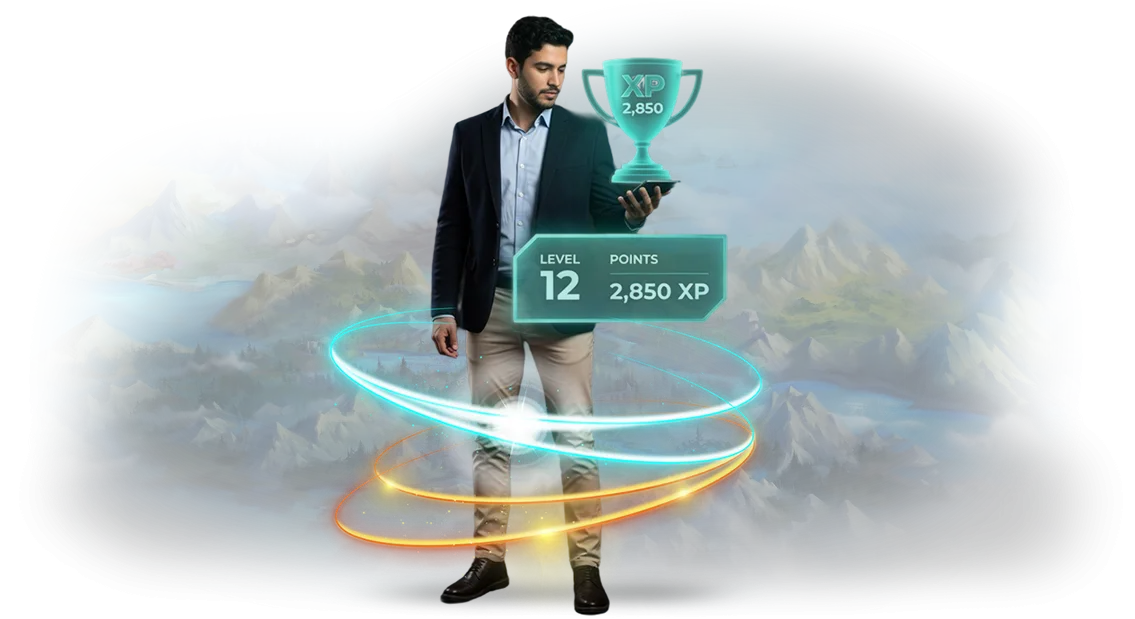
Gamification of learning turns routine into a game with goals and rewards. When a person sees progress and recognition, natural competitive drive kicks in. Staff engagement grows, knowledge is applied in practice — learning becomes a development tool, not a chore. That's why business gamification pays off through growth in real team skills.
Canvas LMS makes it possible to embed game mechanics without restructuring your IT infrastructure: points, badges, leaderboards, and team challenges.
Employees start competing and return to the system even after finishing the course — that's the sustained engagement Canvas LMS delivers. At the same time, learning materials and tests stay exactly where they are, so implementation doesn't require pausing training.
We use Canvas LMS as our base and design motivation around your company's objectives. Game scenarios adapt to your business processes, and managers see a transparent picture of progress.
The result — higher training metrics, lower course dropout, and knowledge converted into real outcomes.
What gamification of corporate training brings to business
Implementing gamification in Canvas LMS turns corporate training from a formal obligation into an engaging process that employees complete with genuine interest.
This isn't just game mechanics — it's a performance management tool: it changes attitudes toward learning and delivers measurable results for business.
Higher engagement — the first and main benefit. Employees compete, earn points and rewards, and therefore finish courses several times more often. Tasks presented in a game format are remembered better, and corporate culture becomes more vibrant and growth-oriented.
Time savings — the second benefit, noticeable right away. Gamification structures learning: employees choose their own pace, but the system guides them toward the goal, reducing the average time to complete a course. Less time on training — more hours for work tasks.
Transparent analytics — the third benefit, which makes processes manageable. Managers get clear statistics: who is learning, which topics cause difficulty, which modules need improvement. Based on this data, it's easy to adjust the program and increase training effectiveness.
As a result, gamification solves three problems at once: it boosts engagement, saves resources, and gives leadership the data they need for decision-making. This turns training from a cost item into a source of business growth.
Formats of game mechanics for business objectives
Ordinary courses and presentations are increasingly failing to hold employees' attention. Gamification solves this problem: it turns routine tasks into a game with a goal, progress, and reward. But choosing mechanics "at random" means risking budget and time.
That's why we first define the business objective, then select the format to match — from competitions to story-driven quests.
Game mechanics for business work in three key directions: motivating regular action, accelerating staff training, and boosting team cohesion. To make it easier to navigate, we've put together a table of popular formats and scenarios, each delivering measurable results.
All the formats listed can be embedded in Canvas LMS — an employee takes the course and immediately sees their points, levels, and badges without having to switch to external services.
| Format | For whom | What it delivers to the client |
|---|---|---|
| Competitive leaderboard | Sales and support departments, contractors | Healthy competition and revenue growth through visible result comparison |
| Quests and missions | New employees, interns | Fast immersion into processes without stress or fear of mistakes |
| Levels and roles | Development programs, talent pool | Clear growth trajectory, retention of high-potential specialists |
| Team challenges | Cross-functional departments | Better communication and experience sharing across teams |
| Badges and rewards | Regular training in Canvas LMS | Building a learning habit, validating achievements |
Competitive formats work best for short activities and operational tasks: they engage quickly and provide instant feedback. Narrative and level-based mechanics suit long training programs where it's important to sustain interest over weeks. In our practice, we often combine 2-3 formats to cover both the objective and employee motivation.
The main result isn't the points themselves, but behavioral change: employees complete courses more willingly, get to work faster, and get distracted less.
If we select the right format for your objective, you'll get exactly these metrics — without unnecessary technical complexity.
How a gamification implementation project works
A clear process is half the success. We guide you from the initial meeting to launch, showing checkpoints at every stage. You always know what's happening, what results are ready, and what comes next.
-
Brief and task immersion. We gather the goals: who needs to be engaged, which actions should be reinforced, which metrics matter. We document expectations and define the criteria by which the gamification project will be considered successful.
-
Scenario design. We propose game mechanics and a narrative, linking them to the business process. This is where the scenario is approved — you clearly see how routine turns into a game and make adjustments before development begins.
-
Design concept. We present the visual style, interface, and mood of the future game. We align on it so the result matches your brand identity and audience expectations from the first pass.
-
Game development. We build a prototype, filling it with content and logic. We work with professional tools, so the finished product runs reliably on any device and requires no special knowledge from users.
-
Canvas LMS integration. We embed the game mechanics into your learning system and configure the transfer of results, progress, and points. An employee or student completes everything in one window, without extra navigation or complexity.
-
Testing and launch. We test scenarios with real users, fix any issues, and launch. After launch, we stay in touch and help during the first days so the rollout goes smoothly.
This stage-by-stage implementation order ensures the project doesn't drag on and you get a working tool that genuinely changes audience behavior, not just a "pretty toy."
What's included in the game solution delivery
When you order gamification from our team, you get not a "game for the sake of a game," but a ready-to-use work tool embedded in your Canvas LMS that solves a specific problem: faster learning, greater engagement, and processes driven to results. The delivery package is assembled so your team can launch the system without developer involvement.
What's included in the delivery:
- A game scenario tailored to your business processes: goals, levels, rules, and a clear motivation system for users.
- Canvas LMS integration: courses, groups, and roles sync automatically — no manual operations or extra effort.
- Visual design in your brand style: the interface looks cohesive, not like a third-party module.
- Analytics dashboard: you see who's engaged, who's falling behind, and which mechanics deliver the most impact.
- Ready-made instructions for administrators and users, plus a knowledge base for a quick start.
After launch, we train administrators: in one or two sessions, your team will learn to manage scenarios, rules, and levels without reaching out to programmers.
Technical support is included in the cost and stays with you after project delivery — we'll help adjust point balances, add a new role, or handle an unusual situation.
In the end, you get a working system, not a "black box." All we need from you is to set the task, accept the result, and use the data to improve business processes.
Case study: how Canvas LMS helped increase course completion
Fewer than a third of employees completed the corporate course: the content was useful but monotonous. Participants lost motivation after the first modules, and the HR department spent time on manual tracking and reminders.
The client came to us with a task — to bring the training to life and make employees return to the material on their own.
We designed the gamification and integrated it with Canvas LMS. Levels, points for completing tasks, and visible progress appeared in the course. Employees competed in a team score, while managers tracked activity in real time. Launch took two weeks — no need to pause the learning process.
First-month results: course completion rose from 32% to 71%, and completion time dropped by a third. Support requests regarding training fell by half — participants were figuring things out on their own because they were engaged. Six months later, the company extended the project and added gamification to the next two courses.
For business, this means: employees reach the required competency level faster, and the HR department no longer manually controls every step. We've already replicated this approach in other companies — it consistently delivers at least a two-fold increase in completion rates.
How to choose the right gamification format?
There's no universal format — the choice of gamification is driven by the business goal. Do you need to raise course completion, increase practice regularity, or build a competitive spirit in the team? The answer immediately cuts away half of the candidate mechanics.
The second criterion is the audience: younger employees connect more with leaderboards and public achievements; experienced ones prefer scenarios with branching paths and real-world problem solving.
The third is technical compatibility: if training runs through Canvas LMS, the format must fit into that environment and not force employees to switch to external services.
Below is a simple table for initial navigation. It doesn't replace an audit, but it helps you frame your request before talking to a vendor.
| Format | Your scenario | Result you get |
|---|---|---|
| Points and leaderboards | Large audience, need to quickly boost activity | Higher course completion and healthy competition within the first weeks |
| Badges and levels | Long-term training, need to sustain interest | Systematic progress through material, more employees reach the finish |
| Scenarios and quests | Need to apply knowledge in real situations | Employee practices the skill without the risk of errors in the workflow |
| Team competitions | Uniting departments and learning together | Team engagement and experience sharing among participants |
When choosing a vendor, pay attention to whether they ask these questions at the brief. If the conversation starts with mechanics instead of goals and metrics, that's a reason for caution.
We work the other way around: first we break down the task, then we match a format to your audience, integrate it into Canvas LMS, and show first results within two to three weeks.
Frequently asked questions about gamification implementation
We're regularly asked about gamification implementation — the concerns are almost always the same.
Clients worry that game mechanics will break the established learning process, that implementation will drag on, and that without a methodologist there will be no one to design stories and levels. Below we address these three gamification questions and show that all the risks are covered.
Will gamification break Canvas LMS?
No. We connect the game module through standard interfaces without touching the system core. Courses, tests, and materials keep working exactly as before, and all rewards and levels are stored separately.
Before launch, we run testing on a limited group to confirm the mechanics work reliably. If the module is disabled, no traces remain in employee data.
How long does implementation take?
A typical project takes two to four weeks: brief, scenario design, mechanics configuration, content creation, and a test launch. If you need to cover an urgent task, we build a pilot module within a week and then scale after evaluating results. Exact timelines are fixed in the contract, so delays are unlikely.
What if we don't have a gamification methodologist?
Take us on a turnkey basis. Our team includes methodologists who turn dry regulations into quests with levels, points, and rewards.
You provide a description of your business processes and target audience, and we propose ready-made scenarios — from simple rewards to multi-stage narratives with role selection.
The entire process is built as a dialogue: we show the scenario, incorporate changes, and hand over a simple guide for managing employee motivation.
If your question about LMS implementation remains unanswered, write to us. We'll send examples of completed projects and a tailored plan for your system.Leave a request — we'll calculate a scenario for your task
Tell us about your task — we'll calculate a gamification scenario for your business process and its integration with Canvas LMS. The request carries no obligation: within 1-2 business days we'll get back to you with a clear plan, cost range, and timelines.
We are a team— over 10+ years we've launched dozens of game mechanics for business and education, so we speak the language of results, not abstract ideas.
After reaching out, you get:
- Gamification consultation: we'll review where and how mechanics can increase engagement among employees, students, or clients.
- Cost estimate for your scenario: a transparent cost range with justification — no hidden fees or asterisks.
- Game format selection: quests, levels, leaderboards, rewards — only the ones that solve exactly your task.
- Canvas LMS compatibility check: we'll show how the mechanics integrate with your current system and what's required for launch.
- Turnkey implementation plan: from brief to launch, including configuration, testing, and handover to your team.
- Metric recommendations: how to track activity, reach, and gamification's impact on business KPIs.
Leave a request — in response, we'll send a scenario estimate, timelines, and cost. Then it's up to you: we launch the project or stay in touch. Either way, you'll get an expert perspective on gamifying your process and understand what impact it can deliver.