

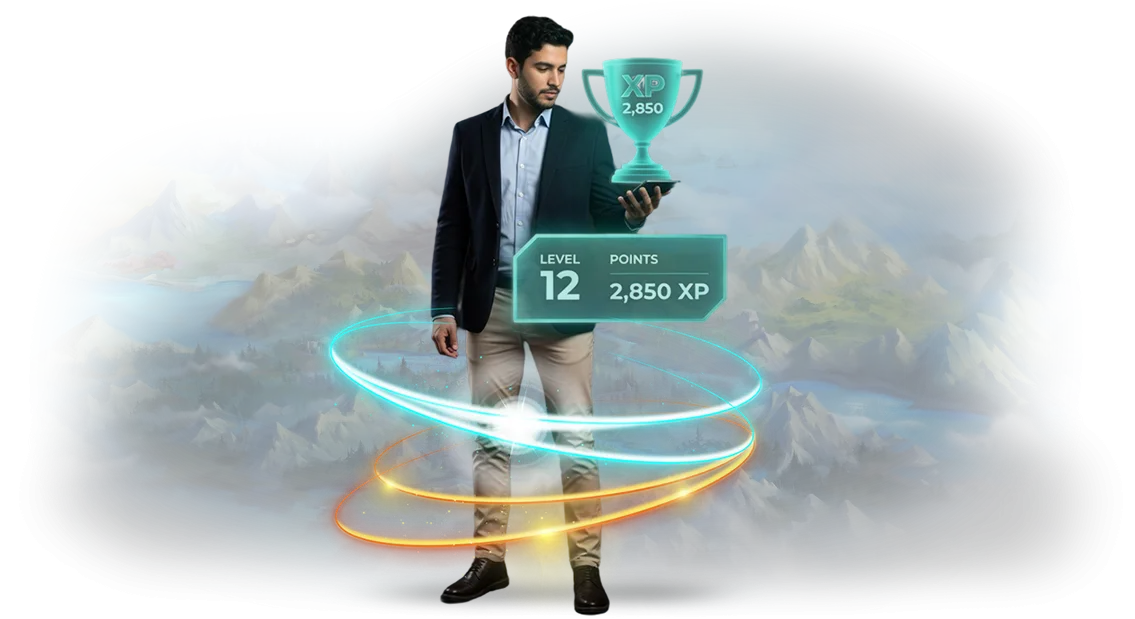
Why Gamification in Docebo Increases Employee Engagement
Employees increasingly go through training formally: they open a course, flip through slides, and close it without absorbing the material.
The company invests time and budget in development, but the knowledge doesn’t work for the business — mistakes repeat, skills aren’t retained, and learning engagement drops with each module.
The problem isn’t laziness; it’s a lack of motivation. Ordinary courses on a corporate portal rarely give a sense of progress and victory, so training feels like routine.
When an employee has no clear goal other than “have to complete,” interest fades by the second or third lesson.
Gamification bridges this gap. The built-in game mechanics in Docebo turn learning into an engaging process: points, levels, badges, leaderboards, and team competitions create healthy competition and a desire to return to the course. Employees want to complete the next module on their own, not under duress.
The result is higher engagement and real business metrics: higher course completion rates, more regular learning, and better material retention. That means faster onboarding for new hires, up-to-date knowledge across the team, and fewer errors on the job.
Corporate gamification in Docebo turns training from an obligation into a habit and a driver of growth.
We help implement gamification in your learning system: we design mechanics around your company’s goals, set up scenarios, and support the launch. You get training that employees engage in with genuine interest, while managers see measurable results.
What Results Gamification of Learning Delivers
Employees rarely finish online courses, and when they do, they forget the material within a week. Businesses spend money on training but see neither engagement nor measurable results. Traditional formats like “watch a video and answer a test” stopped working long ago.
Gamification turns training from a boring obligation into a game with goals, levels, and rewards. Employees want to return to the material on their own, compete with colleagues, and receive recognition for their achievements.
This isn’t “entertainment for entertainment’s sake”; it’s motivation management through proven game mechanics.
For business, this delivers three key outcomes. First, higher staff motivation: employees take courses more willingly, and the share of completed programs increases noticeably.
Second, speed: new hires reach working proficiency faster because training engages them from the first minutes. Third, quality: knowledge is reinforced through practice and repetition, so errors on the job become fewer.
All results can be conveniently tracked in Docebo, a platform where learning and game mechanics work within a single loop. Managers see each employee’s progress, and the team gets a transparent reward system without manual tracking or extra spreadsheets.
In the end, it’s not just HR that benefits but also customers: competent staff solve tasks faster and create a positive experience with the company. And that’s a direct path to repeat inquiries, referrals, and revenue growth.
Gamification Formats in Docebo for Different Business Goals
Gamification in Docebo is not a one-size-fits-all template but a set of formats tailored to a specific business challenge. Some mechanics help onboard new hires faster, others boost sales, and still others keep interest in recurring courses. The format is chosen based on your audience and the metric you want to change.
| Format | For Whom | What It Delivers to the Client |
|---|---|---|
| Quizzes and tests | New employees, frontline staff | Fast knowledge checks, fewer errors on the job, clear material-retention statistics |
| Employee competitions | Sales departments, customer service | Revenue and business metric growth through competitive spirit and team morale |
| Leaderboards | Teams and departments | Transparent visibility of results, motivation for underperformers to catch up with leaders |
| Rewards and badges | All user categories | Repeatable behavior: take an action — get recognition and status |
Quizzes and tests are best at revealing knowledge gaps and enabling immediate feedback — employees see exactly what they need to improve. Competitions and leaderboards create healthy excitement, especially in departments where results are habitually measured.
Rewards reinforce regular actions: submitting a report on time, completing a course, closing a deal.
We don’t just plug in a module; we tailor it to your business logic. We select formats for different user categories, set rules for earning points and levels, and link achievements in Docebo to real work outcomes.
Gamification becomes part of the motivation system, not a standalone “game for its own sake.” Formats are easy to combine: start with one or two, gauge employee response, and expand the mechanics without lengthy approvals or rework.
How a Gamification Project Works: From Brief to Launch
We structure our work so a gamification project isn’t a “black box” for you. Over ten years, we’ve completed dozens of implementations and refined a process where every stage is clear and the result is predictable. You always know what’s happening, what decisions are being made, and when the launch will occur.
-
Gamification brief. We interview you and key employees to identify goals, metrics, and target audience. You receive a document that captures expectations, constraints, and success criteria — this eliminates disagreements at the start.
-
Audit and plan. We examine current business processes and find areas where engagement is lost. We design scenarios: tasks, levels, rewards, and a feedback system. After that, you approve a detailed plan with stages and timelines.
-
Mechanic approval. We show prototypes based on approved scenarios. You see what the interface will look like for an employee or customer and can make edits before development begins — saving budget and time later.
-
Docebo integration. We connect gamification to your learning system. Course completion, achievement, and level data sync automatically, so progress is visible without manual oversight.
-
Testing and pilot launch. We roll out gamification to a control group, collect feedback, and refine details. Only after a successful pilot do we launch for all teams.
-
Support and analytics. After launch, we don’t disappear: we monitor activity, learning conversion, and goal achievement. We prepare regular reports and suggest scenario refinements so results last.
This is what gamification implementation looks like in our delivery: from a short brief to a working system that employees adopt and use. You get not just a tool but also partner support at every step.
What’s Included in the Deliverable When Developing Gamification
We deliver gamification as a complete solution, not just a set of buttons in an interface. You receive a package you can put to work immediately after handover: from instructions to analytics reports and content tailored to your business processes.
This matters if you’re implementing gamification for learning through Docebo and want the system to actually increase engagement rather than remain a test option.
The deliverable includes:
- Usage and administration instructions — you can add tasks, change rewards, and manage scenarios on your own without constantly contacting developers.
- A configured reward system: points, levels, badges, and prizes — employees see a clear goal and understand what they’ll get for results.
- Docebo integration: course completion data automatically flows into the game mechanics and generates rankings, so managers don’t have to gather information manually.
- Learning and engagement analytics — reports that show which topics are easy, which are challenging, and where employees lose interest.
- Ready-made gamification content: scenarios, quizzes, and practical tasks adapted to your goals and company specifics.
- Updates and technical support — for the duration of the contract, we monitor system stability, release fixes, and help with any questions.
This package lets you launch gamification quickly and avoid depending on developers for day-to-day work. Analytics and a clear reward system turn training into a growth driver: employees get engaged, complete courses, and apply knowledge on the job more often.
Case Study: Gamification in Docebo Increased Engagement by 40%
For a retail chain with 1,200 employees, the Docebo platform was the primary training channel, but less than a third of the team completed courses. The head of the training center wanted not “another update” but measurable results: higher engagement and knowledge retention.
We proposed gamification of business processes — not a separate application, but a motivation layer on top of the familiar LMS, so employees wouldn’t have to relearn.
What Changed After Launch
Courses became a competition: points for completing modules, team leaderboards, and prizes for consistency. Within two months, course completion rose by 40%, and the average learning session length increased from 12 to 25 minutes.
The gamification case showed that people return to the platform on their own when they see their progress and comparison with colleagues.
“We expected activity, but not this kind of growth: 40% is a number even the CFO noticed. At the same time, employees themselves asked for new levels and rewards,” noted the head of the training center.
Why the Result Was Sustained in Docebo
Integration took three weeks and didn’t interrupt the learning process. All game mechanics — points, levels, badges — are pulled from Docebo data, so managers didn’t have to fill in anything manually.
Six months later, the client ordered a second phase: we added gamified scenarios for onboarding, which delivered another 30% engagement growth among new hires.
We use this Docebo case as a benchmark for corporate learning projects: gamification works when it’s embedded in an existing process rather than requiring a separate login.
Teams quickly adapt to the competitive format, and learning outcomes become visible in reports within the first month.
What to Do If Training Is Already Set Up in Docebo?
If training already works in Docebo, you won’t need to change platforms — gamification is built on top of the existing system.
We add motivational mechanics to the courses and programs you’ve already configured: progress, points, levels, and competition appear where employees are used to learning, with no need to switch to a different interface.
This removes the main fear businesses have — losing time and data during migration. Integration with the learning platform preserves all accumulated content, grades, and completion history, while gamification in Docebo simply adds a game layer on top.
Employees keep working in a familiar environment but get extra incentives to finish courses and improve results.
For the company, this means a fast launch without stopping training processes. There’s no need to retrain staff, rework content, or roll out a parallel system — training setup stays the same, and the effect is amplified through engagement.
Managers see course completion and new skill acquisition rise, while all analytics remain in Docebo’s familiar reports.
We handle the integration and configure gamification for your business goals: sales motivation, onboarding, or regular professional development. We’ll advise which mechanics work best with your audience and show how they’ll fit into the current training structure. Just send us access to the system — we’ll assess the data volume and propose a connection plan.
The answer is simple: Docebo doesn’t hinder gamification; it becomes its foundation. If you’d like, we’ll conduct an audit of your learning portal and show where adding game elements will deliver the greatest engagement growth.
Common Concerns: How Complex Is Gamification Integration?
Clients ask: will gamification break processes, will timelines slip, and who will support the system after launch? These are expected risks with any integration. We address them with a clear work plan.
A typical timeline looks like this:
- Audit and brief — we study the task and motivation.
- Prototype — we show the mechanics without changing the system.
- Docebo integration — we configure rules and synchronization.
- Testing — we validate on real scenarios.
- Launch and training — you receive a ready-to-use tool.
- Support — we monitor performance and update mechanics.
This sequence removes the main fears: changes don’t affect stability, and issues are found before launch.
What if gamification breaks a process?
Integration only goes live after testing. A backup is created before we start, so changes can be rolled back at any time to restore the system to its original state.
Who supports the system after launch?
We stay in touch: answer questions, fix issues, and help update mechanics. Quality assurance is documented in the contract.
How long does integration take?
A basic project takes two to three weeks. We set the exact timeline at the start and work according to it.
In the end, you get a motivating layer inside your learning platform that doesn’t require constant IT attention. Employees complete courses more willingly, completion metrics rise, and you focus on business rather than technical details.Get a Project Estimate for Your Gamification Task
“Leave a request for gamification — and get a clear plan instead of abstract promises. We understand how difficult it is to estimate budget and timelines when it comes to engaging employees or customers through game mechanics.
So after a short brief, we come back with a project estimate: stages, timeframes, investment, and expected impact — all in one document.
We’ll discuss your specific task: training, sales, internal communications, or onboarding. If you use a corporate LMS such as Docebo, we’ll build gamification integration directly into your workflow. You won’t have to switch between systems or lose user performance data.
What you get after contacting us:
- A gamification consultation — an expert will break down your task and suggest suitable mechanics.
- A project estimate with clear stages, timelines, and budget — no hidden conditions or surprise surcharges.
- An audience profile and selection of engagement scenarios — for employees, partners, or customers.
- An integration proposal for your learning platform, including Docebo, so the process is unified.
- Clear result metrics: conversion, activity, repeat inquiries, course completion time.
- Implementation options — from pilot launch to full turnkey deployment.
You don’t need to prepare a perfect technical specification. Leave a request for a project estimate — we’ll ask the right questions ourselves and prepare a proposal.
Fill out the form or write to us in a messenger — we’ll discuss the details within one business day and show how gamification works in your scenario.