

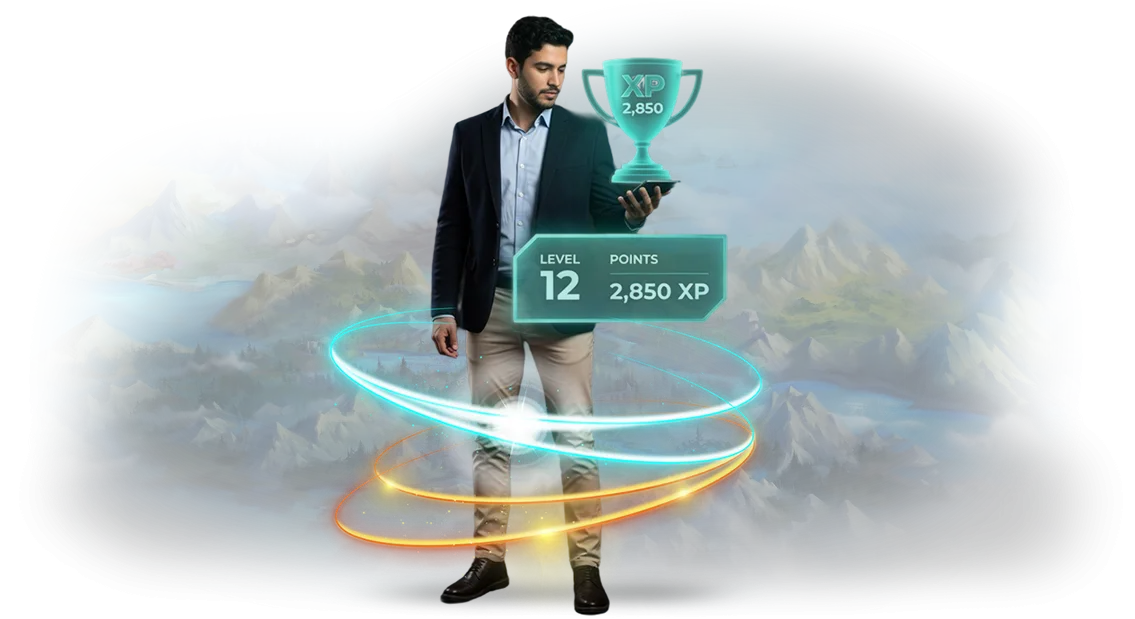
Employees lose interest in their work — gamification of business processes changes that
Routine tasks quietly erode staff motivation: requests, approvals, and reports keep flowing, but the employee never sees the result.
Within a few months this turns into falling employee engagement, missed deadlines, and rising staff turnover — even though, formally, all processes are working. People leave not because the work is hard, but because of the feeling that their efforts change nothing.
Gamification of business processes brings a visible result back into the routine. An employee sees progress on their tasks, receives recognition for requests closed with quality, and understands how their contribution affects the team's overall result.
This is not "toys for the sake of fun" — it is managed staff motivation built into the tools people use every day.
We build the system so that it works toward your metrics rather than living separately from them: request processing speed, the share of tasks completed on time, employee activity in the service system.
Our engineers set up integration with the company's working environment, so the employee doesn't need to learn yet another service — the mechanics are built into familiar screens and scenarios.
We separately address what most often kills such projects: the rules must be transparent, and the rewards must be achievable. If points are awarded for unclear reasons, interest fades within a couple of weeks.
That is why we first analyze your processes and the points where motivation is lost, and then assemble the mechanics around them — with clear logic, fair levels, and feedback for the manager.
As a result, you get not a one-off campaign but a working engagement environment: employees take on tasks more willingly, less often delay closing requests, and turnover in routine roles stops growing.
Gamification of business processes works here as a retention tool — it makes daily work meaningful and visible, rather than simply adding points to requests.
What you get: increased engagement and managed motivation
Increased employee engagement
When an employee sees progress, points, and a clear goal for the week, routine work stops being "gray." Engagement grows not from one-off campaigns, but from daily feedback: a person understands that their contribution is visible and affects the overall result. A manager gets a team that monitors its own pace rather than waiting for reminders.
Process transparency
All actions, stages, and statuses are recorded in a single picture — you can see where a task is stuck, who is overloaded, and where there is spare time.
Transparency eliminates manual summaries and arguments like "I thought this wasn't my area." Decisions are made based on facts, not feelings, and this saves a manager hours every week.
Reduced turnover
People leave not because of workload, but because of the feeling that their efforts are invisible. Clear rules of the game, recognition of achievements, and a fair reward system retain strong employees.
Clients note that teams lose key specialists less often, and the costs of finding and onboarding new people stop growing.
Faster work
When progress is visible and there is motivation to move faster, tasks go from start to result noticeably more efficiently. Employees take the next steps themselves because they see the benefit in speed, not just in reporting. This speeds up the work of departments without pressure from above and without overtime.
Managed motivation
You set the rules: what points are awarded for, which goals matter, how results are rewarded. Motivation becomes a tool, not a lottery — it can be configured for a season, for a new goal, or for a specific department.
We deliver this so that the system works for your business objectives rather than living a life of its own.
Gamification formats for your business objectives
Gamification formats differ not by "level of complexity" but by whose problem they solve: retaining newcomers, speeding up routine work for experienced employees, or improving service quality in client-facing teams.
That is why we begin choosing a format not with mechanics, but with the question of what result you want to see a quarter from now.
Below are typical scenarios that clients come to us with. The same business often takes two or three formats: for example, a light start for newcomers and seasonal challenges for the whole team.
| Format | For whom | What it gives the client |
|---|---|---|
| Onboarding quest | New employees | Faster path to working independently, less load on mentors |
| Points and levels for routine work | Line teams | Faster task processing, fewer "burned-out" areas |
| Team seasonal challenges | Departments and business units | Engagement and healthy rivalry between shifts and branches |
| Expert reputation and badges | Experienced employees | Recognition of contribution, retention of strong people, knowledge sharing |
| Client missions and cashback mechanics | External users | Repeat interactions, loyalty, growth in average order value |
| Internal idea contests | All employees | A flow of process improvement suggestions from the teams themselves |
How to choose a format for the objective
We look at three things: which process you want to speed up, who is involved in it, and how you will know that things have improved. If the goal is to reduce newcomer turnover, one set of mechanics works; if you need to ease the load on the support service, another does.
The result for the client is always the same in essence: employees or users come back into the process on their own, and you see the dynamics through clear metrics. Let's discuss your objective — we'll come back with an estimate and a plan for your segment.
How a project works: from brief to support
We run the project transparently: you always understand what stage the work is at, what has already been done, and what comes next. Below is the typical path that gamification of business processes with integration into your request management system follows.
- Brief. We discuss the task in the language of business: which processes you want to bring to life, whom we engage — employees or clients, which metrics should change. You answer the questions, we record the goals and constraints.
- Work plan. We come back with an estimate, timelines, and team composition. You see what you are paying for and when you will get the result — with no hidden stages and no "surprises" along the way.
- Approval. We sign off on the mechanics, scenarios, and integration points with your request system. Edits at this stage are the least expensive — so we go through it carefully.
- Implementation. We build the system, connect it to your processes, and fill it with rules and rewards. We show interim results so that you can influence the product as it goes, not only at the end.
- Launch. We put it into operation with a limited group, look at how people actually behave, and fine-tune the balance of difficulty and rewards. Then we open it up to the whole team.
- Support. After launch we stay by your side: we monitor the metrics, update the scenarios, help with new rules, and answer your team's questions.
What you get at each step
A clear plan instead of a "black box," agreed timelines, and a single person accountable for the result. We do not disappear after delivery — ongoing support is part of the project, so the system keeps working and evolving along with your tasks.
What is included in the delivery: a launch kit
The delivery is put together so that gamification gets put to work, not left on slides. You receive ready-made mechanics, scenarios tailored to your processes, and clear reporting — the team just has to work by them, while you see the result.
- Gamification mechanics tailored to your processes. Points, levels, achievements, and ratings tied to real employee actions: closing tickets, meeting deadlines, service quality. Not abstract points, but an incentive to do the right things more often.
- Scenarios for each role. Separate rules for frontline employees, managers, and the support service — so everyone has their own goal and a clear reward, rather than a shared table for unclear reasons.
- Integration with your work system. Gamification is embedded into current processes and pulls work data automatically, without manual spreadsheet keeping and disputed calculations.
- Instructions and regulations. Short, clear documents for employees and managers: how points are awarded, how to read the rating, how to dispute a contested case.
- Employee training. We train the team and those responsible for the launch, show the mechanics with live examples — people start using it right away, without a long ramp-up.
- Reporting for management. A dashboard on activity, engagement, and metric dynamics: you can see which mechanics work and which should be strengthened.
- Development plan. Recommendations on what to add at the next stage so that interest doesn't fade after a month and the system keeps bringing value further on.
Each item is a result that can be shown to the team and management. Let's discuss your task — we'll come back with an estimate and a delivery plan tailored to your processes.
Case study: how gamification accelerated processes in a retail chain
A retail chain approached "Sportmaster" with a classic pain point: point-of-sale maintenance tasks and internal employee requests were being completed with delays, and staff engagement was falling.
Management wanted not "another motivational program," but a working tool that would make routine processes faster and more visible to employees.
What we did
We analyzed the chain's processes and identified where time was being lost: closing requests, reporting on points, and task handover between shifts.
We layered a game mechanic onto these areas — points, levels, and team ratings for real work actions, not for abstract "achievements." An employee could see their progress and the team's results in a single window, while a manager could see the dynamics across the chain.
Result metrics
- Growth in employee engagement in work processes — noticeable already in the first weeks after launch.
- Faster completion of typical point-of-sale tasks thanks to transparency and healthy competition between shifts.
- Reduced turnover: people began to see the return on their work and their progress, not just a stream of requests.
- Repeat order: the chain expanded gamification to new areas after the first results.
The gamification case study showed the main thing — the game layer works when it is built into real processes, rather than living separately from them.
The result metrics here are not about "pretty numbers," but about what a manager sees: tasks are closed faster, teams are engaged, and staff stay longer.
How to choose the right format for the task?
A gamification format is not chosen "for looks" — it is selected for the goal you want to achieve in a specific process. Therefore, the first step is always the same: articulate exactly what should change.
Requests get closed faster, the share of issues resolved on first contact grows, employees stop putting off routine operations, clients return more often — each of these goals is served by its own format, and there is no universal "best" among them.
Next, we look at the process and the people involved in it. Where reaction speed matters, points for promptness and a visible rating within the team are appropriate. Where accuracy and quality are needed — achievements for the absence of returns and repeat requests.
Where the task is stretched over time — levels, progress, and clear intermediate rewards so that interest does not fade halfway through. If different roles are involved in the process, formats are combined: what motivates one team may look like unnecessary reporting to another.
It is also worth checking separately how well the format will fit into your current tools. Gamification works when the data for it is pulled from the system automatically, and the employee does not need to maintain parallel spreadsheets.
We integrate the mechanics with the customer's work services — including service desk systems — so that progress, points, and achievements are calculated based on actions actually performed, rather than manual input.
A practical recommendation: do not launch a complex construction all at once. Start with one process and one or two formats, watch the dynamics over several weeks, and only then expand.
That way you get a measurable result on a small area and understand what to scale to the whole team.
We help you go through this path: we analyze your goals and processes, propose suitable formats, assemble the solution, and provide support after launch — so that the mechanics take hold rather than remain a pretty add-on.
Common customer doubts before starting
Doubts before starting are normal: a manager is responsible for the result, not for experiments. Below are the questions asked most often, and honest answers without embellishment.
What happens if the system breaks down or freezes in the middle of work?
A failure in the workflow is the customer's main fear, and we address it at the launch stage. The system is deployed with a backup loop: if the primary node is unavailable, employees keep working and no data is lost. After launch, we stay in touch and support the project — you are not left alone with the problem.
Employees won't participate — how do we get them involved?
Engagement doesn't appear on its own just because the mechanics are switched on. We design scenarios for real roles: clear goals, visible progress, recognition of results.
During the pilot, we see which mechanics resonate with your team specifically and strengthen them — instead of imposing someone else's template.
Is integration with Freshservice needed, and what does it provide?
If you already work in Freshservice, integration eliminates double entry and manual reconciliation. Tickets, statuses, and employee actions are pulled into the gamification system automatically — the manager sees the whole picture, and the team doesn't waste time on reporting. If the service isn't used, we build the logic on your current tools.
How long will implementation take, and when will the effect be visible?
First — a short brief and a plan with clear stages, then a pilot on one team. The first shifts in activity are visible already during the pilot, and scaling to the remaining departments follows a proven scheme. We give exact timelines after we understand your task — no promises of "in three days."
Who will support the system after launch?
Support is part of the work: we maintain the system, update scenarios for changing processes, and answer the team's questions. You don't need to keep a dedicated specialist — we are responsible for stability and development.
Describe your task — we'll come back with an estimate, a plan, and an honest view of the risks.
Let's discuss your task and come back with a plan
Tell us what task you're solving: increasing employee engagement in work processes, speeding up request processing, or reducing team turnover. We'll dig into your scenario and come back with a clear implementation plan — no generic words or template solutions.
Gamification of business processes only works when it's based on your real metrics and people's behavior, not on a pretty game wrapper.
After the discussion, you get a project estimate with timelines and stages, as well as a prototype where you can see the mechanics in action before full development starts.
Then comes support: we don't disappear after launch, but help configure the rules, monitor results, and evolve the system for new tasks.
- Implementation plan — a step-by-step route from current processes to a working system with clear timelines at each stage.
- Project estimate — a transparent scope of work and team composition, with no hidden "along the way" refinements.
- Prototype — a working version of the key mechanics that can be shown to management and the team before full development.
- Support — post-launch assistance: adjusting rules, responding to employee feedback, evolving functionality.
- Immersion in your context — we study how processes are structured and who is involved in them before proposing mechanics.
- Accountability for results — we focus on measurable indicators: engagement, processing speed, retention, not on the number of screens drawn.
Describe the task in any format convenient for you — a short message or a detailed description of processes. We'll come back with a plan, an estimate, and a prototype proposal so you can make a decision based on facts, not promises.