
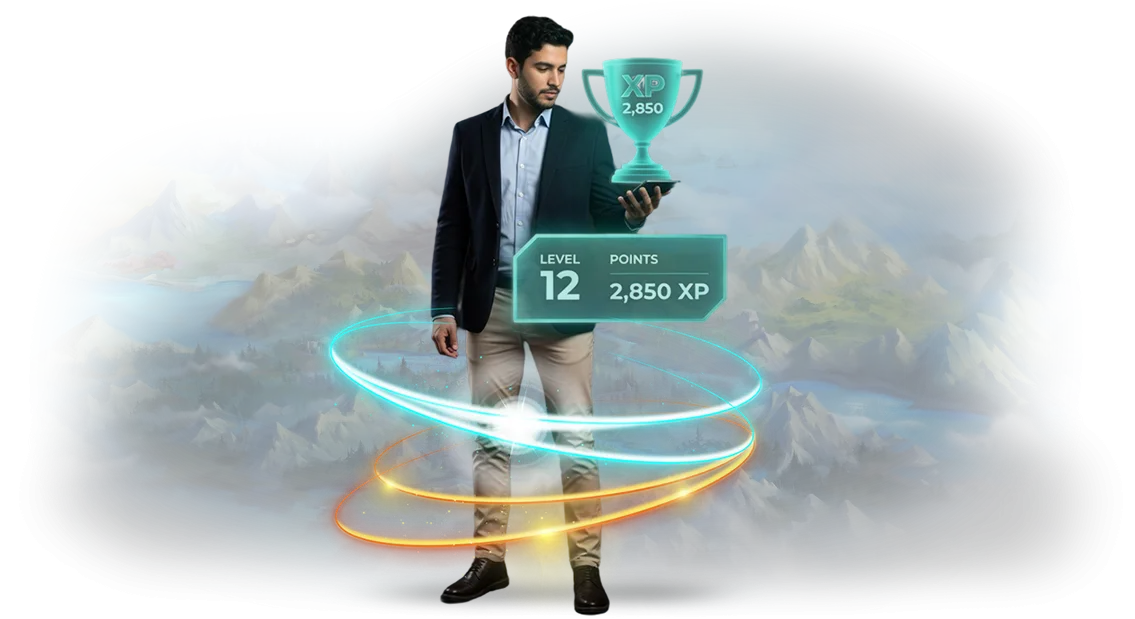
Procore isn't working: employees don't want to use it
Implementing Procore means investing in licenses, training, and integration. But often after launch it turns out: the system exists, yet almost no one enters data into it.
Foremen go back to paper logs, managers return to messaging in chats, and reports are put together "from memory" at the end of the week. Formally, Procore is implemented; in practice, it does not work.
The cause is usually not technical but human. The platform feels inconvenient to those who don't see any benefit for themselves: filling out reports takes time, gives nothing in return, and receives no feedback.
The result is employee resistance, low adoption, and with them—missed deadlines, costs for fixing errors, and zero transparency across projects. The manager loses control, and the money spent on implementation turns out to be wasted.
To make Procore work, you need to change people's behavior, not polish the interface. Gamification solves exactly this problem: points for filling out reports, crew ratings, rewards for speed and data quality.
The employee gets quick feedback and a sense of challenge, while the company gets reliable data in the system and process controllability.
We design such motivation around your business process and help implement it so that engagement grows and Procore becomes an everyday working tool.
Turning routine into a game: 5 business benefits
Routine in Procore—general reports, document checks, closing out work orders—drains employees' energy and time. Gamifying business processes turns these duties into a game with goals and rewards. The client gets a team that works faster and more willingly.
Higher productivity. Clear progress and levels motivate people to complete tasks right away instead of putting them off. The team gets more done each day without expanding headcount.
Employee motivation. Points, ratings, and badges give people the chance to compete and earn recognition. This replaces coercion with an inner desire to do better.
Fewer errors. In-game feedback keeps attention on details. Employees are less likely to skip fields and review stages, so documentation in Procore is more accurate and doesn't require lengthy rework.
KPI growth. Game statistics show which processes have accelerated and which need support. You see trends in timelines and quality and make decisions quickly.
Team spirit. Shared competitions bring departments together and reduce turnover. People help each other, and the company becomes more attractive to new specialists.
We tailor gamification rules to your processes: integration takes a few weeks and doesn't interfere with current operations. In the end, you get measurable efficiency growth without strict control.
Gamification formats for Procore: choose yours
Every construction company has already appreciated the convenience of Procore in planning and schedule control.
But even a perfectly configured process doesn't guarantee engagement: people perform tasks mechanically, lose interest in details, and fail to notice their own contribution to the overall result.
Gamification turns work with Procore into a living system: goals appear, progress becomes visible, and healthy competition takes hold—the team begins to strive on its own to complete stages faster and with higher quality.
We select a format based on your scale and business specifics. It doesn't matter whether you work with a single site or a dozen projects—the options below show how gamification fits into Procore and what benefit it brings to your particular project.
| Format | For whom | What it gives the client |
|---|---|---|
| Crew competition | Projects with multiple contractors or sections | Healthy competitive spirit: crews see the task completion rating in real time and pull up lagging sections without your involvement |
| Individual specialist rating | Medium and large teams with clear roles | Each employee sees their contribution to the overall project—this reduces turnover and improves the quality of documentation in Procore |
| Quests and milestone challenges | Complex sites with long work cycles | A long project is broken into a series of small achievements: the team avoids burnout and always understands the next step |
| Badges and rewards | Companies that want to strengthen a culture of recognition | A habit forms of recording results in Procore—points and insignia are awarded for it, which people genuinely value |
| Shared progress board | Managers who need to see the big picture | The entire construction site on one screen: which projects are ahead of schedule, where help is needed. You make decisions based on data, not guesses |
These are not toys for entertainment—each format solves a specific business problem. Competition shortens timelines, ratings increase accountability, and quests simplify managing complex projects. You can combine formats or start with one to see the effect quickly.
The main thing is that integration with Procore happens invisibly for employees: the mechanics are embedded into the familiar workflow, do not require switching between programs, and create no extra bureaucracy. You simply get the result—a more motivated team and transparent control at all levels.
How we will implement gamification in 5 steps
We have structured the process so that at every step you understand what is happening and how it brings you closer to a business result.
Gamification implementation is not installing a "boxed product" but changing the team's working habits, so the stages are logical and transparent.
Implementation stages
- Brief and goals. We get on a call, discuss the tasks, the audience, and the metrics that matter to your business: number of completed tasks, reporting regularity, approval speed. We record the goals and draw up a plan with deadlines—you see the entire project before it starts.
- Scenario alignment. We develop the game mechanics: points, levels, rewards, team challenges. We agree on the logic and rules with you and with department heads, so gamification doesn't conflict with internal processes.
- Integration with working tools. We set up the system so employees continue working in their familiar environment—including Procore, if they run projects there. Data is pulled automatically, and employees earn points for real actions, not for "simulating activity."
- Launch and training. We present the mechanics to the team, explain the rules, and show how to see their progress. We launch in working mode and support them during the first few days so that everything is clear and runs without issues.
- Support and development. We analyze engagement, see which mechanics work and which should be adjusted. We prepare reports on results and propose new levels, rewards, or competitions—so the team's interest doesn't fade.
We fix deadlines in advance and meet them: most projects go from brief to launch in 2–4 weeks. We approve all key decisions personally with you and with those responsible for results inside the company, so you get a clear system on the output, not a "black box."
What's included in the delivery: a ready-to-run package
Turnkey, you don't get separate modules but a complete system that can be shown to employees right away and put into operation. We connect the mechanics, interface, and Procore integration ourselves—all you have to do is set goals and monitor results.
Here's exactly what's included in the delivery:
- Game mechanics tailored to your business processes — points, levels, missions, and rewards are already configured for how your work is organized. No need to invent rules from scratch.
- Interface for employees and managers — everyone sees their progress, achievements, and position in the overall rating. Managers see who is actually engaged.
- Procore integration — data from the system automatically participates in motivation scenarios. No need to manually transfer numbers or keep parallel records.
- Configurable motivation scenarios — you can change rewards, point weights, and levels through an easy-to-understand dashboard, without involving programmers.
- Training materials — step-by-step instructions for administrators and short cheat sheets for employees. Everything is written in plain language, without technical details.
- Operational documentation — settings, procedures, and typical scenarios are documented. Any new employee gets up to speed quickly.
- Startup support — we help you launch the system, carry out the first configurations, and answer the team's questions. You are never left alone with the system.
This package saves time: you don't have to look for separate contractors for each part, wait for them to coordinate with each other, or figure out someone else's solutions. You get a working tool, support, and confidence that it will be used from day one.
Case study: how we doubled engagement
How it happened
A construction holding with 14 sites worked in Procore, but key processes were slowing down: foremen put off closing out work orders, and checking statuses took days. The project manager understood—the problem was not the system but team motivation.
We suggested turning routine actions into a competition: specialists earn points, levels, and see the crew rating for completing tasks in Procore.
Integration took three weeks and did not stop work at the sites. Within two months, we recorded steady growth: the number of active system users doubled, and assignments that used to be completed late are now delivered on time in 94% of cases.
The most valuable part—healthy competition between crews began: they remind each other about tasks and move the overall project faster.
Result
Team engagement doubled—this is noticeable not only in the numbers but also in the speed of resolving issues on site. After the pilot, the client expanded gamification to all their sites and ordered an additional module for training new employees. A repeat order is the best proof that the mechanics really changed people's behavior.
"At first we were skeptical, but after a month we saw crews competing on their own for leadership in the rating. Work order closing times decreased, and there were fewer questions. This is the first tool that truly engaged the team,"—construction department manager.
How to choose the right format for your task?
There is no universal gamification format—what motivates foremen to hand over projects on time is unlikely to suit a project office or sales department.
The choice comes down to the business problem you are solving: speeding up deadlines, improving documentation quality, reducing injuries, or engaging employees in regular training.
We look at three criteria: who your participants are, which actions need to be strengthened, and what result you want to measure.
A competition format is good when you need to quickly boost activity; a quest—when you need to guide an employee through several stages or train them in a new process; and accumulating points—when you need to maintain daily discipline without constant supervision.
That's why we don't offer ready-made templates. First, we analyze the specific process, find bottlenecks, and only then choose a format that will work in your particular situation.
When integrating with Procore, data on completed tasks can be automatically pulled into the game mechanics—employees see their progress immediately, and you don't have to waste time on manual entry.
A properly chosen format gives quick results: within the first weeks, you see growing engagement and changed behavior. And when priorities shift, the mechanics can be adapted to a new task—without restructuring the whole system or additional time costs.
The main thing is not to look for a universal scheme but to start from your own situation. Tell us which process you want to improve, and we will offer a format that suits you.
Frequently asked questions and client concerns
Any gamification project starts with questions like "won't the launch fail?" and "how will this fit into existing processes?" That's normal: you are responsible for the result, and we build it into the contract. Below are answers to what clients worry about most before starting.
What guarantees do you provide?
We put guarantees in the contract: we fix deadlines, scope of work, and the key metrics the system must achieve. If something doesn't work during the testing stage, we fix it at our expense.
After launch, we stay in touch and take the system into maintenance, so gamification works steadily in your business process.
How long does implementation take?
The typical timeframe is two to five weeks, depending on the number of tasks and participants. We don't restructure your processes: integration with Procore happens at the data level, so employees continue working in their familiar interface, and game mechanics are added on top. This eliminates the risk of downtime and a long adaptation period.
Won't employees see the "game" as childish?
That's why we don't create a "game for the sake of the game." Tasks are tied to real work operations: completed tasks, deadlines, quality. Participants earn points and statuses for achievements that the business needs anyway.
Plus, we run a short training webinar and give out a cheat sheet—within a couple of days, the team works without questions.
How is the cost calculated?
The cost depends on the scale: the number of participants, the number of game scenarios, and the depth of integration with your systems. We prepare a transparent estimate before work begins—you can see what you're paying for and at which stage you'll get the result.
No hidden payments or "mandatory" adjustments along the way: all changes are approved in advance.
If you still have doubts, send us a description of your task, and we'll propose a solution for your process. The consultation is free, and you'll receive an answer within one business day.Ready to launch gamification? Get your estimate in 1 day
When work runs in Procore, results depend on how quickly crews enter data, close work orders, and sign documents. If employees do it "just for show," deadlines slip and managers waste time on manual oversight.
Gamification changes behavior: people get involved on their own because they see their progress, compete, and receive recognition.
We have already integrated game mechanics with Procore at construction sites of various scales. So we don't offer abstract "stars" but tie every task to your regulations and current goals.
All we need is to discuss your scenario—and within 1 day you'll receive an estimate with clear deadlines and scope of work.
What you get right after your inquiry:
- Cost and timeline estimate for your business process—no hidden conditions or manipulation.
- A breakdown of the gamification scenario for Procore: what motivates your specific employees on site.
- Metric recommendations: how you will measure growth in delivery speed, quality, and engagement.
- An integration plan with your processes: from a pilot on one crew to full coverage of all sections.
- A free consultation with an expert who analyzes your task rather than reading generic presentations.
- A concrete entry point: where to start so that first results appear within 2–3 weeks.
Leave your request in the form below or write to us in any convenient messenger—we'll call you back within one business day, clarify your task, and prepare an estimate within 1 day.
You'll get not "just a pretty game" but a tool that helps you close project stages faster and increase productivity.
Translate the above into English. Preserve structure exactly.## Procore isn't working: employees don't want to use it
Implementing Procore means investing in licenses, training, and integration. But often after the launch it turns out: the system is there, but almost no one enters data into it.
Foremen go back to paper logs, managers go back to messaging in messengers, and reports are compiled "from memory" by the end of the week. Formally, Procore is implemented; in reality, it doesn't work.
The reason is usually not technical but human. The platform seems inconvenient to those who don't see any benefit for themselves: filling out reports takes time, gives nothing in return, and gets no feedback.
Hence—employee resistance, low engagement, and with them—missed deadlines, costs for fixing errors, and zero transparency across project sites. The manager loses control, and the money spent on implementation turns out to be wasted.
To make Procore work, you need to change people's behavior, not refine the interface. Gamification solves exactly this problem: points for filling out reports, crew ratings, rewards for data speed and quality.
The employee gets quick feedback and a sense of challenge, and the company gets reliable data in the system and manageable processes. We design such motivation for your business process and help implement it so that engagement grows and Procore becomes an everyday working tool.
Turning routine into a game: 5 business advantages
Routine in Procore—general reports, document checks, closing out work orders—drains employees' energy and time. Gamification of business processes turns these responsibilities into a game with goals and rewards. The client gets a team that works faster and more willingly.
Increased productivity. Clear progress and levels motivate people to complete tasks right away rather than put them off. The team closes more tasks per day without expanding headcount.
Employee motivation. Points, ratings, and badges give people the opportunity to compete and receive recognition. This replaces coercion with an inner desire to work better.
Fewer errors. In-game feedback keeps attention on details. Employees are less likely to miss fields and review stages, so documentation in Procore is more accurate and doesn't require lengthy fixes.
KPI growth. Game statistics show which processes have accelerated and which need support. You see dynamics in timelines and quality and make decisions quickly.
Team spirit. Shared competitions unite departments and reduce turnover. People help each other, and the company looks more attractive to new specialists.
We configure gamification rules for your processes: integration takes a few weeks and doesn't interfere with current work. As a result, you get measurable productivity growth without rigid control.
Gamification formats for Procore: choose yours
Every construction company has already appreciated the convenience of Procore in planning and schedule control.
But even a perfectly configured process doesn't guarantee engagement: people perform tasks mechanically, lose interest in details, and don't notice their own contribution to the common result.
Gamification turns work with Procore into a living system: goals appear, visible progress, and healthy competition—the team itself starts striving to complete stages faster and better.
We choose a format based on your scale and business specifics. It doesn't matter whether you work with one site or a dozen projects—the options below show how gamification integrates into Procore and what benefit it brings specifically to your project.
| Format | For whom | What it gives the client |
|---|---|---|
| Crew competition | Projects with several contractors or sections | Healthy competitive spirit: crews see the real-time task completion rating and pull up lagging sections without your involvement |
| Individual specialist rating | Medium and large teams with clear roles | Each employee sees their own contribution to the overall project—this reduces turnover and improves the quality of documentation in Procore |
| Quests and milestone tasks | Complex sites with a long work cycle | A long project is split into a series of small achievements: the team doesn't burn out and always understands the next step |
| Badges and rewards | Companies that want to strengthen a culture of recognition | A habit forms of recording results in Procore—points and insignia are awarded for this, which people genuinely value |
| Shared progress board | Managers who need to see the whole picture | The entire construction site on one screen: which projects are ahead, where help is needed. You make decisions based on data, not guesses |
These aren't toys for entertainment—each format solves a specific business task. Competition shortens timelines, ratings increase accountability, and quests simplify managing complex projects. You can combine formats or start with one to see the effect quickly.
The key point: integration with Procore happens invisibly for employees—mechanics are embedded into the familiar workflow, don't require switching between programs, and don't create extra bureaucracy. You simply get the result—a more motivated team and transparent control at all levels.
How we implement gamification in 5 steps
We've structured the process so that at each step you understand what's happening and how it brings you closer to a business result.
Gamification implementation isn't installing a "boxed solution"; it's changing the team's work habits, so the stages are logical and transparent.
Implementation stages
- Brief and goals. We have a call, discuss tasks, audience, and the metrics important to your business: number of completed tasks, report regularity, approval speed. We record the goals and create a plan with deadlines—you see the whole project before it starts.
- Scenario alignment. We develop game mechanics: points, levels, rewards, team challenges. We align the logic and rules with you and with department heads, so gamification doesn't contradict internal processes.
- Integration with work tools. We configure the system so employees continue working in their familiar environment—including Procore, if they run projects there. Data is pulled automatically, and employees get points for real actions, not for "simulated activity."
- Launch and training. We present the mechanics to the team, explain the rules, and show how to see their progress. We launch into production mode and support the team during the first days so everything is clear and works without issues.
- Support and development. We analyze engagement, see which mechanics work and which should be adjusted. We prepare result reports and suggest new levels, rewards, or competitions—so the team's interest doesn't fade.
We set deadlines in advance and meet them: most projects go from brief to launch in 2–4 weeks. We approve all key decisions personally with you and with those who will be responsible for the result inside the company, so you get a clear system rather than a "black box."
What's included in the delivery: a ready-to-launch package
Turnkey, you receive not separate modules but a complete system that can be immediately shown to employees and launched into operation. We ourselves connect the mechanics, interface, and integration with Procore—all you need to do is set goals and monitor results.
Here's exactly what's included in the delivery:
- Game mechanics tailored to your business processes — points, levels, missions, and rewards are already configured for how your work is structured. No need to invent rules from scratch.
- Interface for employees and managers — everyone sees their progress, achievements, and position in the overall rating. Managers see who is genuinely engaged.
- Integration with Procore — data from the system automatically participates in motivation scenarios. No need to manually transfer figures or maintain parallel records.
- Configurable motivation scenarios — you can change rewards, point weights, and levels through an easy-to-understand dashboard, without involving programmers.
- Training materials — step-by-step instructions for administrators and short cheat sheets for employees. Everything is written in plain language, without technical details.
- Operational documentation — settings, procedures, and typical scenarios are documented. Any new employee quickly gets up to speed.
- Startup support — we help launch the system, handle initial configurations, and answer the team's questions. You're never left alone with the system.
This package saves time: no need to find separate contractors for each part, wait for them to coordinate, or figure out external solutions. You get a working tool, support, and confidence that it will be used from day one.
Case study: how we doubled engagement
How it was
A construction holding with 14 sites worked in Procore, but key processes were slowing down: foremen delayed closing work orders, and checking statuses took days. The project manager understood—the problem wasn't the system but team motivation.
We proposed turning routine actions into a competition: specialists earn points, levels, and see crew ratings for completing tasks in Procore.
Integration took three weeks and didn't stop site operations. Within two months, we recorded steady growth: the number of active users doubled, and assignments that previously closed late are now completed on time in 94% of cases.
The most valuable part—healthy competition started between crews: they remind each other about tasks and move the overall project faster.
Result
Team engagement doubled—this is visible not only in numbers but also in the speed of resolving issues on site. After the pilot, the client expanded gamification to all their sites and ordered an additional module for new-hire training. A repeat order is the best indicator that the mechanics truly changed people's behavior.
"At first we were skeptical, but after a month we saw crews competing on their own for the top of the rating. Work order closing times decreased, and there were fewer questions. This is the first tool that really got the team engaged," — construction department manager.
How to choose the right format for your task?
There is no universal gamification format—what motivates foremen to deliver sites on time is unlikely to suit a project office or sales department.
The choice boils down to the business task you're solving: accelerate timelines, improve documentation quality, reduce injuries, or engage employees in regular training.
We look at three criteria: who your participants are, which actions need to be reinforced, and what result you want to measure.
A competition format is good when you need to quickly boost activity; a quest is good when you need to guide employees through several stages or teach a new process; and accumulating points is good when you need to maintain daily discipline without constant supervision.
That's why we don't offer ready-made templates. First, we analyze the specific process, find bottlenecks, and only then choose a format that will work in your situation.
When integrating with Procore, data on completed tasks can be automatically pulled into the game mechanics—employees see their progress immediately, and you don't waste time on manual entry.
A correctly chosen format gives a quick effect: within the first weeks, growth in engagement and behavioral change are visible. And when priorities change, the mechanics can be adapted to a new task—without rebuilding the entire system or additional time costs.
The main thing is not to look for a universal scheme, but to start from your own situation. Tell us which process you want to improve—and we'll suggest a format that suits you.
Frequently asked questions and client concerns
Any gamification project starts with questions like "won't the launch fail?" and "how will this fit into already working processes?" That's normal: you're responsible for the result, and we include it in the contract. Below are answers to what clients most often worry about before starting.
What guarantees do you provide?
We specify guarantees in the contract: we fix deadlines, scope of work, and key metrics the system must achieve. If something doesn't work during the testing stage, we fix it at our expense.
After launch, we stay in touch and take the system under maintenance, so gamification works steadily in your business process.
How long does implementation take?
The typical timeline is two to five weeks, depending on the number of tasks and participants. We don't restructure your processes: integration with Procore happens at the data level, so employees continue working in their familiar interface, and game mechanics are added on top. This eliminates the risk of downtime and long adaptation.
Won't employees perceive the "game" as childish?
That's why we don't make a "game for the sake of the game." Tasks are tied to real work operations: completed tasks, deadlines, quality. Participants earn points and statuses for achievements that the business needs anyway.
Plus, we conduct a short training webinar and provide a cheat sheet—within a couple of days, the team works without questions.
How is the cost calculated?
The cost depends on scale: the number of participants, the number of game scenarios, and the depth of integration with your systems. We prepare a transparent estimate before work begins—you can see what you're paying for and at which stage you'll receive the result.
No hidden payments or "mandatory" modifications along the way: all changes are agreed in advance.
If you still have doubts—send us a description of your task, and we'll offer a solution for your process. The consultation is free, and you'll receive an answer within one business day.Ready to launch gamification? Get your estimate in 1 day
When work runs in Procore, the result depends on how quickly crews enter data, close work orders, and sign documents. If employees do this "just for show," deadlines slip, and the manager spends time on manual control.
Gamification changes behavior: people become engaged on their own because they see their progress, compete, and receive recognition.
We have already integrated game mechanics with Procore at construction sites of various scales. So we don't offer abstract "stars"; we tie every task to your regulations and current tasks.
All that's left is to discuss your scenario—and within 1 day you'll receive an estimate with clear deadlines and scope of work.
What you get immediately after your inquiry:
- Cost and timeline estimate for your business process—without hidden conditions or manipulation.
- Gamification scenario analysis for Procore: what motivates your specific employees on site.
- Metric recommendations: how you'll measure growth in delivery speed, quality, and engagement.
- Integration plan with your processes: from a pilot on one crew to full coverage of all sections.
- Free consultation with an expert who analyzes your task rather than reading generic presentations.
- A concrete entry point: where to start so that first results appear within 2–3 weeks.
Leave a request in the form below or message us in any convenient messenger—we'll call you back within one business day, clarify the task, and prepare an estimate within 1 day.
You'll get not "just a pretty game" but a tool that helps close stages faster and increase productivity.
