

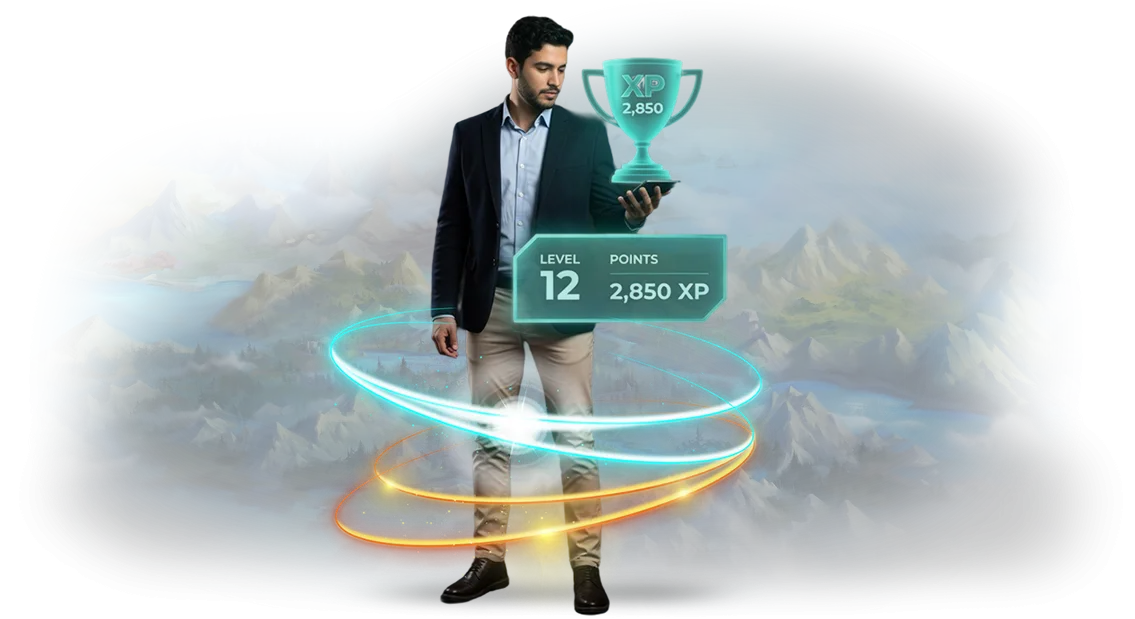
Low engagement in Successfactors slows down business processes
The company implemented SuccessFactors, but employees log into the system once a week "just to check a box." They fill out profiles with errors, skip training, and don't set goals. As a result, HR gets incomplete data, and managers make decisions based on outdated information.
This is a typical picture: outdated HR processes don't disappear after automation. The platform is there, but habits remain. Employee engagement drops, staff motivation is held together by manual control, and the business loses time on reminders.
Every missed review is a deferred risk: incorrect personnel decisions and a growing workload for the team.
The problem isn't the tool — it's that the system is perceived as an obligation rather than a helper. People don't see personal benefit in filling out data and look for workarounds: they duplicate information in Excel or go through the motions. The HR department turns into a controller instead of developing the team.
CRM tools taught salespeople to work with the funnel, while HR platforms are losing the battle for attention. Gamification in Successfactors changes the dynamics: routine becomes clear tasks with immediate feedback, competition, and recognition. Instead of coercion, interest appears — and with it, accurate data and processes closed on time.
We help bring Successfactors to life through game mechanics. We design a system that is simple for employees and transparent for managers. This solves the low-engagement problem — without coercion and without additional administrative burden.
What gamification in Successfactors delivers for business and team
Employees don't want to act "by the book" — they need to see meaning, progress, and recognition. Gamification inside Successfactors turns routine processes into a clear scenario: every step gets a response, the goal becomes visible, and the result — measurable.
For business, this is healthy engagement without coercion, extra control, or manual "nudging" from managers.
Productivity growth starts with motivation. When training, goal-setting, and performance reviews are built as an engaging system with levels, points, and rewards, employees get involved faster and procrastinate less on important actions.
KPIs improve naturally: faster task completion, higher quality results, and better plan fulfillment rates.
Gamification directly strengthens team loyalty. Visible progress and regular feedback reduce stress and burnout, which in turn reduces employee turnover.
For the company, this means stability and predictability: no constant need to search, hire, and train new people — valuable employees stay and grow within.
Employer brand reinforcement is another tangible effect. Employees share their impressions of the company, and a modern motivation system becomes a strong argument for candidates.
A business where it's interesting to work and where there's a clear growth system wins the attention of talented specialists even before the first interview.
We configure gamification in Successfactors to fit your business processes: from onboarding to regular performance reviews.
This isn't a one-time campaign but a continuously working system that measurably improves team metrics and delivers results you can see in numbers within the first months of use.
Game mechanic formats for company tasks
Gamification formats aren't just "toys for motivation." Each business task requires its own mechanic: to boost sales — competition with a transparent leaderboard; to quickly train newcomers — game quests with feedback; to retain valuable employees — a mixed format with levels, statuses, and rewards.
We match the mechanic to a specific metric: revenue, time-to-productivity, employee turnover. Below is a summary of the main gamification formats we use in business projects.
| Format | For whom | What it gives the client |
|---|---|---|
| Competitive | Sales departments, service teams, contractors | Revenue and key metric growth through healthy competition: public leaderboards, challenges, instant recognition of top performers |
| Learning | New employees, interns, training centers | Shorter onboarding time, knowledge checks without interrupting work, automatic tracking of each employee's progress |
| Mixed | Companies that need to simultaneously develop and motivate their staff | Development and motivation in one: employees complete training, earn points, and see how they affect rankings, rewards, and career growth |
All formats are adapted to your industry and team size. If your company already uses Successfactors, we configure the integration so game results flow into the HR system automatically — managers see progress in real time, and reports are generated without manual data collection.
You also get clear business reporting: which mechanics deliver the biggest gains, where employees lose interest, and what should be adjusted.
How the integration project works: from brief to support
Integrating gamification with Successfactors is a structured process from business objectives to support. Below are the stages of a gamification project, so you get a result — not a "game for the sake of a game."
- Brief and audit. We analyze the team's tasks, current motivation, and engagement drop-off points. We define goals and success metrics — this is the foundation of the gamification brief.
- Scenario development. We design game mechanics for your processes: rewards, levels, collaborative tasks. We account for the HR system's logic so events are based on real data.
- Approval. We present a prototype and point-accrual rules. You approve — we lock it in and move to implementation of the game mechanics.
- Implementation. We set up integration with your HR management system: goal and achievement data automatically flows into the game. The system keeps working without downtime.
- Employee training. We run short practical sessions: what it is, how to use it, why it matters. The team quickly gets on board.
- Project support. After launch, we stay in touch: answer questions, adjust the scenario, analyze dynamics. If needed, we evolve the mechanics for new tasks.
- System evolution. Based on data, we suggest seasonal competitions and enhancements — gamification stays alive.
As a result, you get a transparent process where every stage is clear and measurable.
Delivery package: what you get after implementation
After implementation, you don't get a "project for the shelf" — you get a working tool employees use from day one. The package includes everything needed to launch, support, and evolve gamification: from game mechanics to analytics in SuccessFactors. Below is the complete delivery scope.
- Game scenario and rules — tailored to your business processes and company values. We align mechanics with department heads so they motivate the right behaviors, not just formal participation.
- Technical integration with SuccessFactors — rewards, levels, and tasks work inside the familiar system. Employees don't need to learn a new interface: all gamification appears where they already complete training and set goals.
- Gamification documentation — clear instructions for employees, guidelines for administrators, and mechanic descriptions for future development. You won't have to figure out "how this works" — everything is documented and handed over to your team.
- Training for employees and administrators — we run short sessions for users and separately prepare those who will manage the system. Your specialists will be able to configure events, add participants, and adjust rules on their own.
- KPI reporting — you see real numbers: engagement, goal completion, learning dynamics, and process speed. Reports are generated automatically, so oversight doesn't require manual effort.
- Technical support after launch — we're available during business hours and answer questions from users and administrators. If something goes wrong, we connect remotely and resolve the issue quickly.
- Updates and mechanic refinements — after the first weeks, we analyze data and propose adjustments: change task difficulty, add new rewards, and adapt the scenario to evolving business needs.
This way, you get a closed loop: setup, launch, training, support, and system evolution. All that's left for you is to collect results and see how gamification affects your team's work.
Case study: how we boosted sales department productivity
A large hypermarket chain, TechnoLine, came to us when its sales department was consistently hitting only 70% of plan. Managers complained: sales reps had lost interest in calls and meetings, routine operations were done carelessly, and sales conversion was stagnant. Standard KPIs and quarterly bonuses no longer worked — they needed systematic motivation.
We proposed gamifying processes right inside their working CRM. Instead of gray task lists, employees saw a game space: a personal level, points for each call, deal, or contact-card update, a ranking among colleagues, badges, and weekly competitions.
The team was skeptical at first, but within a week the competitive spirit kicked in: sales reps started planning their day on their own to overtake a rival in the leaderboard.
What this delivered for the business
Two months after the pilot launch, we measured the results: sales rep activity increased by 34%, and sales conversion grew 1.5 times.
Beyond the numbers, the company gained healthy competition within the team and transparent analytics: managers could see who was actually managing clients and who was just going through the motions.
The pilot was so well received that the client expanded gamification to the service and procurement departments, then extended the contract for ongoing support.
This case is a clear example of how gamification turns dreary routine into a game with measurable results.
If your sales department is stalling and motivation relies only on carrots and sticks — we'll help you build a system that drives productivity growth within the first months.
How to choose the right gamification format?
There's no one-size-fits-all game scenario: what motivates sales managers won't work for accounting or a warehouse.
Choosing a format starts with the business objective — what exactly needs to improve: onboarding speed for new hires, consistency of report submissions, data quality in Successfactors, or sales plan fulfillment. The mechanics, complexity, and campaign duration all depend on the answer.
We don't choose based on trends — we choose based on an audit of your processes. We look at where employees lose interest, at which stage tasks stall, what motivation already exists, and what's missing.
After this analysis, it becomes clear which scenario will deliver results: competition, team play, levels with rewards, or a mixed format.
For example, if a new team takes too long to get up to speed, a scenario with short steps and quick wins works well — it creates a sense of progress. If routine operations in the system are done with errors, quests with hints and accuracy bonuses are more effective.
For boosting sales, team competition with a shared leaderboard and public dynamics usually works best.
The main principle is that the format adapts to the task, not the other way around. That's why we always start with an audit and goal discussion, and only then propose specific mechanics.
If you're unsure about the choice, come for a consultation — we'll review your process and suggest 2-3 options with an impact forecast.
Answers to common implementation questions
When implementing gamification, clients tend to ask the same questions: timelines, integration complexity, training, risk of failures. We've gathered answers to the most frequent ones — short and to the point.
How long will implementation take?
A typical project takes 4 to 8 weeks from the moment objectives are approved. The timeline depends on the number of processes and the need for HR system integration. At the start, you receive a plan with control checkpoints.
Is integrating gamification with Successfactors difficult?
Integration with HR systems is a familiar task for us. We use standard data exchange mechanisms, so HR data is pulled automatically. You don't need to change your current processes — the system fits into them.
Do employees need training?
Training takes no more than an hour per group. We explain how to use the mechanics and where to see results. Self-study materials stay with you, and employees quickly get engaged.
What happens if the system fails?
The solution is designed so a failure in one module doesn't halt overall operations. Critical processes are backed up, and after launch we support the system and resolve issues quickly. Fallback scenarios let employees continue working.
Is gamification compatible with other systems?
Yes. We connect gamification to your tools without replacing infrastructure. The module receives data from Successfactors and delivers results to any analytics platform. This preserves your software investments.
Discuss your task with an expert — get an implementation plan
To order gamification, you don't need to work out all the details in advance or prepare a technical specification. Just describe the business task: what employees should do more often or better, where engagement is lost, which process you want to strengthen.
An expert will review your scenario, see how it works in Successfactors, and propose the optimal solution.
You'll get more than general words — a concrete implementation plan and a gamification cost calculated after audit. The consultation is non-binding — you'll decide on starting the project after seeing the numbers and stages.
What's included in the initial expert review:
- Analysis of current business processes and the points where gamification will deliver measurable growth.
- Practical employee motivation recommendations — without unnecessary theory.
- Implementation plan with stages, timelines, and areas of responsibility.
- Gamification cost calculated after audit, tailored to your scope and format.
- Successfactors integration assessment: what's required and how to speed up the launch.
- A clear list of changes that will affect the team and HR processes.
Submit a request through the form — we'll call you back within one business day, ask clarifying questions, and prepare a personalized plan. It takes no more than 15 minutes of conversation and saves weeks of searching for solutions. Start with a consultation — the rest will be easier.