

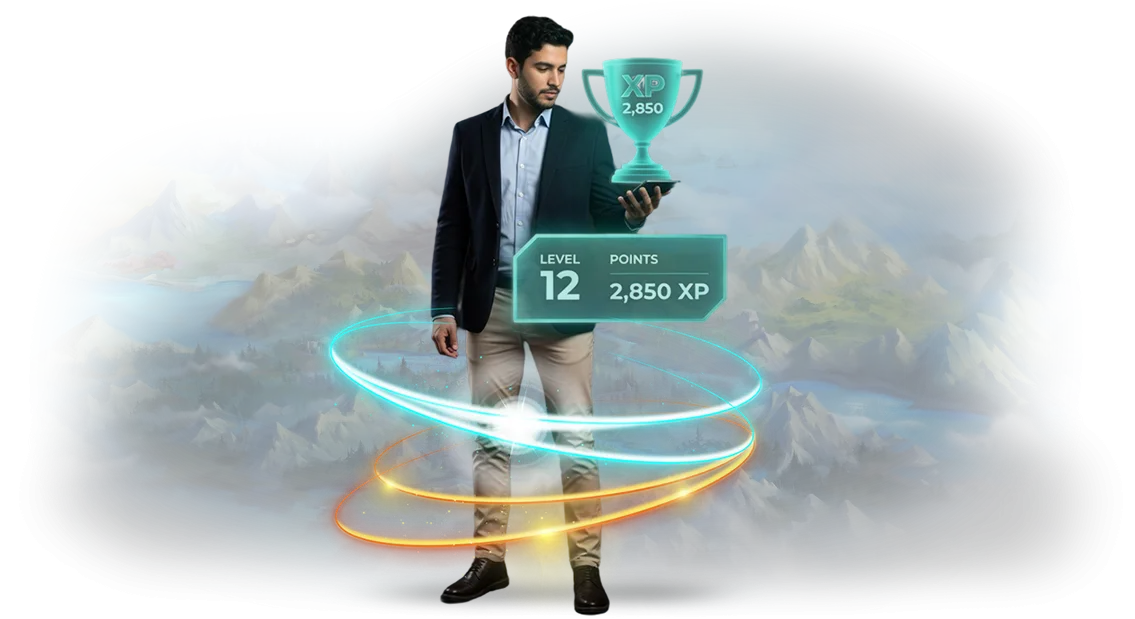
Why soft skills development programs fail without gamification
Every manager invests in team training, but a month later is surprised to discover: the skills didn’t stick, and employees work the way they always did. The reason is not the quality of the program, but the fact that adults rarely change behavior without emotional involvement.
Regular lectures and tests provide knowledge, but they do not build the habit of acting differently.
This is where the main pain point appears: time and budget are spent, while business metrics stand still. Clients lose money on courses that don’t pay off and begin to doubt training as a tool. Meanwhile, employees simply lacked engagement — they listened to the material, but never lived it.
Gamification of business processes turns training from passive viewing into active practice. Game mechanics create a situation where the employee makes decisions themselves, makes mistakes in a safe environment, and immediately sees the consequences. This is how soft skills are developed: communication, teamwork, leadership, conflict management.
When training is built around a game, engagement grows naturally: people get involved in competition, track progress, and want to finish the level. This isn’t entertainment for its own sake, but a tool that pays off through the speed of applying skills in real work. The manager gets a team that starts acting differently within a week, not a year.
We design gamification around your business objectives — from short trainings to long-term soft skills development programs. In 10 years of experience, we have repeatedly seen how a properly designed game turns formal training into a driver of results. We’ll close this pain point for your company — and show you how it works on your example.
What you get from gamification of business processes
Gamification of business processes turns soft skills development from a boring obligation into an engaging experience. Employees don’t just complete a program — they live it: they solve tasks, receive instant feedback, and see their progress. For business, this means measurable changes in team behavior and real productivity growth.
Employee engagement
Game mechanics — points, levels, rewards — keep participants interested throughout the entire training. Employee engagement grows: employees themselves want to finish the course, compete with each other, and reach the final with deeper knowledge.
Managers notice that the team becomes more active in work processes and voluntarily takes on new tasks, which directly improves productivity.
Speed of skill acquisition
Learning through games is a safe environment for practicing communication, conflict management, and leadership. Participants try different behavior patterns, get feedback, and reinforce successful strategies.
This format helps master soft skills faster because knowledge immediately moves into practice instead of remaining theory.
Reduced turnover
When employees see that the company invests in their development and they enjoy the process, they are less likely to leave. Gamification becomes a powerful HR tool: it increases loyalty, reduces turnover, and cuts the cost of hiring new people. A stable team means sustainable growth and retention of expertise inside the business.
Gamification formats for business tasks
Each training direction solves its own problem: introducing the team, practicing negotiations, accelerating onboarding, or uniting departments.
That’s why gamification formats cannot be applied the same way to everyone — otherwise you get formal participation instead of engagement. We select mechanics around your goal, not the other way around.
Interactive training only works when the format reinforces the business task. Below are typical scenarios we use in soft skills development programs.
| Format | For whom | What it gives | When to use |
|---|---|---|---|
| Business game | HR, cross-functional teams | Practice on real scenarios without risk to the work process | When you need to increase engagement in training and immediately see employee behavior |
| Quest investigation | Sales, support, logistics departments | Development of communication, finding non-standard solutions | When you need to improve interaction between departments |
| Competitive tournament | Departments competing on KPIs | Increased activity, healthy competitiveness, and team spirit | When you need a quick visible spike in results |
| Role-playing simulation | Line managers and talent pool | Development of management skills in a safe environment | When you are preparing managers from within the company |
| Interactive simulator | Young employees, mass hiring | Fast assimilation of standards and regulations | When you need to train a large group without disrupting work |
This approach to gamification for HR avoids wasting budget on universal “games for the sake of games.” Each format is designed around your task, and the result is higher engagement, precise application of skills, and clear analytics.
How a gamification implementation project works
We start with a brief and an immersion into your business situation: we break down the goals of the soft skills development program, the target audience, and growth areas.
It’s important to understand exactly what needs to change in employee behavior — the entire mechanics of the future game are built around that. As a result, you receive a plan where each stage is tied to a measurable outcome.
- Brief and audit of the current system — we record the objectives, gather information about the team and training formats, and define success criteria.
- Design of game mechanics — we create the scenario, roles, and game rules that engage and gently develop the needed skills: communication, leadership, conflict management.
- Development of game balance — we adjust difficulty and pace so participants stay in the zone of interest without becoming overloaded. It’s important that progress is visible to everyone.
- Assembly and testing — we build the training platform and run a pilot launch on a control group. We fix errors and refine the scenario to a stable result.
- Program launch — we roll out gamification to the whole team, train administrators, and help run the first game cycle.
- Support and development — we monitor engagement, collect feedback, adjust the balance, and add new levels when the game starts losing momentum.
The entire project runs in short iterations: you see intermediate results every 1–2 weeks, not just at the end. This reduces risks and allows quick adaptation of mechanics to the real dynamics of the team.
The final result is not just a “delivered game,” but a working system that integrates into your training program and delivers measurable growth in employee soft skills.
What’s included in the gamification delivery
When we say “gamification,” you get not an abstract idea, but a working package that can be implemented immediately after handover.
Everything needed to launch a soft skills development program is already packaged and ready to use — from game mechanics to instructions for your team.
- Game mechanics tailored to your tasks. Designed rules, levels, reward and feedback systems that motivate employees to develop soft skills — from communication to conflict management.
- Training content. Scenarios, practical assignments, cases, and mini-games embedded directly into the soft skills development program. Participants practice skills in a safe environment, and you see how it affects work results.
- Admin panel for process management. You track participant progress, task results, and can adjust settings without involving developers or diving into technical details.
- Training materials for trainers and managers. Methodological recommendations, analysis of typical situations, and quick reference guides for working with a group, so your specialists can confidently run game sessions.
- Launch instructions. Step-by-step procedures, checklists, and templates for a quick start inside the company — no need to reinvent the process from scratch.
- Training for your team. We run a short workshop for trainers and HR so they understand the logic of the game and can independently adapt it to different groups of employees.
- Post-handover support. We answer questions, help modify scenarios for new tasks, and support the first game sessions until you feel confident.
This gamification delivery package makes it possible to measure training results and turns the game into a working tool rather than a one-time entertainment.
You don’t get a “box with a game” — you get a system your team can use repeatedly, increasing engagement and developing employee skills.
Case: doubling employee engagement
For the retail chain Territoriya, we developed a soft skills development program for line managers. The task was simple: employees went through training formally and forgot the skills a month later.
We needed to turn the course into a process that captures attention and delivers measurable results.
We proposed gamification of the training business process: instead of lectures — a story-driven game with roles, ratings, and team competitions. Each module ended with a practical assignment in quest format, and progress was displayed on a shared scoreboard. The company received not just a course, but a tool that employees opened on their own every day.
Implementation results
Within two months, engagement in training doubled: 87% of managers completed all modules to the end, compared with about 40% before.
The average score on skill knowledge tests increased by 22%, and the time employees spent in the training system rose from 25 to 50 minutes per week.
The main indicator — application of new skills at work. According to an internal audit, the number of managers using the learned techniques at weekly planning meetings tripled.
The client was so pleased with the result that six months later they ordered the expansion of gamification to the entire onboarding cycle for new employees.
This successful project shows: properly designed game mechanics solve business problems, not just entertain. We design the game around your goals, and we embed performance metrics at the brief stage so you can see the return on your training investment.
How to choose a gamification format for your task?
There is no universal “best format” — the right option depends on three parameters: what competency is needed, how many people are involved, and the mode in which the program runs.
We start from these parameters when choosing a format, so gamification solves a business problem rather than being just a flashy addition.
If we are developing soft skills — communication, leadership, teamwork — role-playing scenarios and simulations work well. Participants find themselves in a realistic situation, learn to negotiate, and receive immediate feedback.
When you need to energize routine or motivate people toward metrics, competitive mechanics with progress, levels, and rewards are suitable — they deliver a quick visible result.
The second criterion is the audience. For a forum or conference with several hundred people, light formats are needed: quests, quizzes, competitions without lengthy training.
For a management team or a department of 10–15 people, a multi-stage game is more effective, where everyone sees the impact of their decisions on the overall result.
If employees work remotely, we choose an option with simple navigation and clear rules that don’t require the constant presence of a facilitator.
The third criterion is timing and program stage. A one-off intensive and a long-term development program over several months are different tasks.
We integrate the format into the work rhythm so the result is measurable: changes in employee behavior, increased engagement, and the quality of internal communications.
In practice, you describe the task, we propose two or three suitable formats with examples from your industry, and explain which one is better in terms of launch speed, coverage, and depth of development. This way you choose consciously — for a specific business task, not for beautiful mechanics.
Frequently asked questions about gamification of business processes
Introducing gamification into soft skills development programs raises questions before it even starts. Let’s collect the most common ones so you understand how the work proceeds, how long it takes, and how it will affect current processes.
How long does it take to implement gamification into a soft skills development program?
Timelines depend on the complexity of the scenario and the size of the audience. On average, one game mechanic takes from two to four weeks: first we brief the client, then we design the story and rules while preparing materials in parallel.
A full course with several modules fits into 1.5–2 months, and quick formats — quizzes and team challenges — can be launched within two weeks.
We don’t drag out the process: you will have a calendar plan with dates for each stage. We fix the timeline at the start and do not deviate from it later — otherwise the client won’t have time to prepare internal communication.
Is it difficult to integrate gamification into existing business processes?
Gamification doesn’t require breaking what already works. We embed game scenarios into current training programs: we supplement LMS, corporate portals, or offline trainings.
The structure stays familiar to employees; only the engaging part changes — points, levels, story, competition between teams.
It’s important to us that the launch doesn’t put extra load on the IT department. That’s why we use proven tools that connect quickly to your system, or we work through simple web formats accessible from any device. We take care of all the technical side: you get a ready-to-use module.
How much does gamification development for business processes cost?
The cost consists of three parameters: the number of game mechanics, the complexity of the story, and participant coverage. The range is wide — from a light motivational game to a multi-level system with analytics.
At the consultation, we select an option that fits your budget and goals, so there is no “arbitrary price” — you pay for the result.
It’s important to understand: gamification pays off through increased engagement and the share of participants who complete the training. If only 30% of employees completed the course before, after implementing game mechanics the completion rate increases several times over. This saves budget on repeated trainings and increases the real benefit of learning.
What guarantees that gamification will work in our company?
We rely on game balance that we test in practice. Before launch, we run a short pilot on a small group — we measure how interesting participants find the training and which mechanics work best. Based on the pilot, we make adjustments, and only then launch the full version.
In addition, all mechanics are protected against abandonment: the system gradually raises difficulty, provides feedback, and sends reminders. If something goes wrong, we refine the scenario within the first weeks of operation.
You don’t get a static product, but a tool that adapts to your audience and delivers measurable indicators: increased completion, participant activity, and changes in team results.
Having doubts is normal. To remove them completely, at a consultation we’ll show examples from your industry and calculate timelines and cost for your specific tasks. We’ll discuss how gamification will fit into your soft skills development programs and what is needed to get started. Simply leave a request — our team is ready to talk.Launch your own soft skills development program
You already know: team performance depends not only on professional skills, but also on the ability to communicate, negotiate, and work under uncertainty.
Yet classic soft skills training is often forgotten within a week — employees fall back into old habits, and the invested budget doesn’t produce visible changes.
Gamification solves this: it turns learning into continuous practice, where new behavior patterns are reinforced in real work situations.
We develop game mechanics that integrate into your soft skills development program — from short simulations to multi-stage team scenarios.
Game mechanics give employees a safe environment for mistakes, instant feedback, and visible progress — exactly what motivates them to apply new skills in everyday work.
What you get by ordering gamification development from us:
- a program adapted to your business objectives and corporate culture, not a “boxed template”;
- a full cycle: from game concept and balance to implementation and support;
- measurable development metrics: participant progress, engagement, behavior change;
- a format that is easy to scale to new teams, branches, and generations of employees;
- over 10 years of experience: we know how to turn training into an event people talk about.
Start with a consultation: we’ll discuss your current program, growth areas, and suggest which game mechanics will deliver quick results. There is no obligation — you’ll receive concrete recommendations even if you don’t become our client.
Leave a request for a consultation — and within a few days you’ll have a clear plan for launching a gamified soft skills development program that truly changes employee behavior and affects business results.