

Why Employee Onboarding Programs Don't Retain New Hires
A new hire is the most expensive employee. Weeks go into searching, interviewing, and onboarding, yet many leave within the first months without covering even half of that investment.
Employee turnover eats the budget, overloads mentors, and demotivates the existing team: experienced people spend energy training those who have already decided to leave.
The company loses not only money and management attention — it loses promising specialists who could have become the backbone of the business in a year or two.
A standard onboarding program usually comes down to welcome presentations, instructions, and office tours. It gives the new hire reference information but doesn't integrate them into the life of the company.
The person gets access and a meeting schedule but is left alone with stress, uncertainty, and the fear of making a mistake.
The main mistake is focusing on knowledge transfer instead of building engagement and the feeling of "I'm needed here": within a couple of weeks, the newcomer feels like an outsider, and even a high salary doesn't keep them.
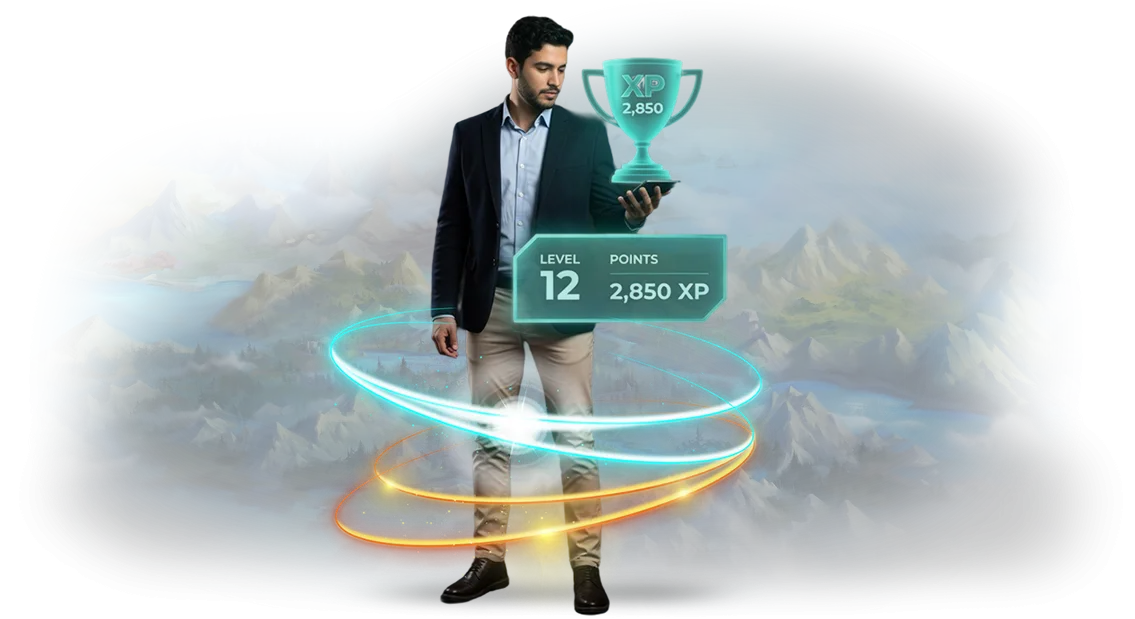
We solve this through gamification of the onboarding program. We design onboarding as an engaging game: clear goals, short stages, achievements, a mentor, and a feedback system.
Gamification gives the new hire visible progress from the very first days, reduces turnover, and helps them stay with the company long-term.
What Results Gamification of Business Processes Delivers
Employee onboarding programs often stall: new hires lose interest in monotonous lectures, and the business loses time and money on a long path to target performance.
Gamification turns learning into a game: there is a goal, progress, and clear rewards — and the employee wants to complete the stages themselves.
Employee Engagement
Instead of a boring set of rules, there is a scenario with a storyline, levels, and quests. The new hire isn't "serving time" but solving real tasks in a game-like format, so the material is absorbed more deeply.
Not only does interest in learning grow, but the overall mood improves: people come to work with enthusiasm, not under pressure.
This engagement is immediately visible in the numbers: higher course completion rates, fewer absences, and more active participation in corporate events. For the business, this means that onboarding investments don't go up in smoke.
Faster Ramp-Up to Planned Performance
Gamification can reduce the onboarding period by 20–30%: the new hire picks up processes faster because practice is delivered through game simulations and checks. They don't wait for someone to explain — they try and get instant feedback.
As a result, the new employee starts adding value earlier: handling tickets, serving clients, meeting KPIs. For the manager, this is a direct saving on payroll and less strain on mentors.
Increased Loyalty
Onboarding through a game shows the new hire that the company cares about their development and is willing to invest in them.
This creates a sense of belonging and reduces turnover: people are less likely to leave in the first months, which is usually when they decide whether to stay.
A loyal employee is also a brand advocate: they recommend the company to friends, speak positively on social media, and stay for years. For the business, this means lower recruiting costs and a stronger team.
Gamification Formats for Employee Onboarding
New hires get up to speed faster when learning feels like a game rather than a lecture. The ideal format depends on your goals: introduce processes, practice skills, or build team dynamics.
We select a format for your onboarding program — from a simple quest to a deep simulation. Below is a guide to how mechanics solve typical tasks.
Comparison of Formats
| Format | Who it's for | What it gives the client |
|---|---|---|
| Onboarding quest | New hires with no industry experience | Getting familiar with the company and processes in a game-like format, less fear of mistakes |
| Business process simulation | Roles with high risk of errors | Safe practice on real scenarios before moving to live tasks |
| Competition for new hires | Groups of trainees | Fast path to productivity through healthy competition and mentoring |
A quest helps quickly immerse newcomers in the corporate culture and key rules. A simulation provides experience without consequences: the employee tries, makes mistakes, corrects themselves, and doesn't disrupt the workflow. A competition fuels engagement and builds a habit of delivering results.
Combined Onboarding Route
Formats can be combined. For example, the first two weeks — a quest, then a simulation of typical situations, and the finale — a team competition with a results review.
For each format, we tune the game balance: difficulty increases in a way that keeps interest without demotivating. Onboarding takes less time, and turnover among new hires drops.
How Gamification Implementation Works: Project Stages
To ensure gamification delivers measurable value rather than turning into a one-off game, we've built a transparent six-stage process.
It has been tested on onboarding programs for companies across various industries — you understand what's happening at every step and control the project approval.
- Brief and task immersion. We study your company, onboarding process, and new hire profile. We define goals: shorten time to full performance, improve retention, speed up feedback.
- Game design and balance development. We create a scenario: levels, tasks, rewards, roles. We select mechanics that fit the corporate culture so they don't feel artificial.
- Concept approval and refinement. We show a prototype and discuss it with you and future participants. We make changes before the main development begins.
- Prototype development and testing. We build a working sample and test it on a group of employees. We check engagement, clarity, and completion time; we fine-tune the balance.
- Integration and launch. We embed the program into your corporate portal or learning management system and set up automated scenarios. We launch a pilot and train the HR team.
- Support and evolution. We collect metrics, analyze results, and adjust the balance. We help scale gamification to other departments.
What the Delivery Includes: A Complete Launch Package
You don't get an abstract "game for the sake of a game" but a ready-to-launch onboarding tool. Everything needed for implementation is packaged into a single set: from design and scenarios to training for your team. No "finish it later" — just take it and launch.
- Game design document — a description of game mechanics, rules, targeted employee actions, and the motivation system. This is the foundation that shows you exactly how the game guides the new hire from day one to full performance.
- Scenarios and game materials — storylines, tasks, dialogues, visual elements, and a reward system. Every onboarding stage becomes clear steps with feedback and achievements.
- Balance requirements — a mathematical model of progress and difficulty: how quickly the level grows, how many tasks are needed to advance, how to maintain interest throughout the onboarding period.
- Integration with your learning management system (LMS) — the game works inside your familiar platform: employees complete scenarios in one window, and HR sees results in a single report. This eliminates manual data entry and confusion between systems.
- HR dashboard — clear statistics for each new hire: progress, time spent, achievements, and "stuck" points. You see who is struggling and can bring in a mentor in time.
- Training for your team — a workshop for HR specialists and mentors: how to launch the game, moderate the process, respond to questions, and adjust the scenario without involving developers.
- Operation guide — reference materials, instructions, and checklists for the system administrator. Everything you need to update content and manage participants on your own.
This package delivers a clear result: the onboarding program stops being a "paper policy" and becomes a manageable process with measurable indicators. You get an engaged employee faster, and the HR team gets a ready-made tool without a long learning curve.
Real Case: How We Retained Employees Through a Game
Most companies lose new employees in the first weeks: motivation drops, standards aren't absorbed, and mentors are overloaded.
In the retail chain Pixel, the problem was acute — every third new hire quit before the end of the probation period, and budgets and the time of experienced employees went into retraining.
We built a gamified onboarding program: the trainee follows the path "newcomer → trainee → specialist," earns points for real work tasks, unlocks levels for completed checklists, and the mentor sees progress in a personal dashboard.
The game mechanics were embedded into daily processes — employees didn't have to learn a new tracking system.
Numbers That Speak for Themselves
After the first quarter of implementation, the results changed dramatically:
- Turnover during the probation period dropped by 43%: instead of 12–15 people leaving per month, only 5–6 leave.
- Probation completion increased from 68% to 91% — the company retains more employees.
- Ramp-up to planned productivity accelerated from 6 to 3.5 weeks.
- Mentors spend 20% less time on supervision — automated prompts replace manual checks.
Within six months, Pixel ordered a similar program for warehouse staff and the customer service department. The head of HR noted that new hires no longer feel abandoned, and mentors no longer feel overloaded.
This project is a clear example of how gamification of employee onboarding turns into a measurable business result. You don't get entertainment quests but a management tool: reduced turnover, higher retention, and faster time to results.
How to Choose a Gamification Format for Your Task?
There is no universal gamification format — the choice depends on which onboarding challenge you're solving. If you need to quickly introduce the newcomer to the product and company history, short guide-style quests work well.
If it's more important to practice practical skills, simulations and role-playing scenarios are a good fit. For building team cohesion in a new department, team competitions are effective, and for regular onboarding plan completion — systems of points, levels, and achievements.
Industry and company size also influence the format. In retail and services, where turnover is high and many new employees join daily, simple mechanics with quick wins and instant feedback work best.
In IT and manufacturing, where onboarding lasts longer, you need longer storylines with real product tasks and a mentor.
For remote teams, digital formats with ratings, individual tracks, and shared challenges are more convenient — they keep employees in different cities connected.
The main selection criterion is the measurable goal of the onboarding program. If your goal is to reduce the time to full productivity, choose formats with difficulty levels and feedback from the manager.
If you want to retain new hires in the first months, focus on achievements and team events. If you want to increase engagement in learning, use competitive mechanics and public ratings.
We select gamification after analyzing your goals, onboarding timelines, and corporate culture specifics. Together with you, we determine the entry point, cycle length, and difficulty balance so that the mechanics don't distract from work but strengthen the program.
It's important that the format is easy to implement without special training for employees and supports the processes already accepted in your company.
The bottom line is simple: choose a format based on your onboarding goal, not on trends. Properly chosen gamification delivers a measurable business result — faster integration into work, higher engagement, and fewer terminations during the probation period.
If you're unsure or need a fresh look at your current program, we'll analyze your situation and offer an option tailored to your tasks.
Frequently Asked Questions About Gamification and Onboarding
Doubts before launching gamification usually concern practical issues rather than the idea itself: how much it costs, when results will appear, and whether it will disrupt current processes. Below are answers to the questions our clients ask most often before starting.
How much does gamification development for onboarding cost, and what does the budget depend on?
The cost depends on scale and format. A short onboarding quest for 2 weeks and a full-fledged program with levels, a mentor, and team stages are very different budgets.
The final number is affected by the number of scenarios, the complexity of the balance, and the degree of integration with your HR system.
We always fix the exact cost estimate after the brief and don't add "surprises" along the way. You get a transparent plan: what's included in the fixed price and what can be added later as modules — for example, a new level for the sales department. This approach lets you fit the project into your budget without losing quality.
What are the implementation timelines? Won't the project drag on for six months?
A typical project takes 3–5 weeks. During this time, we manage to design the mechanics, tailor the balance to your business metrics, and prepare materials for launch. Companies that want deep integration with an internal portal or mobile app usually wait longer.
Importantly, we work remotely and don't block your employees. You don't need to allocate a dedicated team for implementation: we take on all the development and preparation work. You receive a ready-made program with clear launch rules.
How quickly will gamification pay off, and how can the effect be measured?
Gamification in onboarding pays off not directly in money, but in reduced turnover and faster employee ramp-up to target metrics. If a new employee starts adding value 2–3 weeks earlier, that's already a measurable result.
Built-in analytics shows at which stage new hires face difficulties, and the HR team sees where onboarding needs to be strengthened.
Practice shows that after implementing gamification, employees integrate into processes faster and are less likely to quit in the first months. We help set up metrics before launch so you see the effect in numbers, not in vague statements.
If you still have questions about your scenario, send us a description of the task, and we'll offer a solution that fits your timelines and budget.Ready to Discuss Your Project? Leave a Request
Gamified onboarding is not a one-time activity but a systematic tool that accelerates a new hire's path to full effectiveness and reduces turnover in the first months of work. If you've read this far, you already see the potential for your team. One step remains — discuss the project details with us.
Leave a request, and within one business day we'll provide a consultation on gamification. We'll review your current onboarding program, suggest suitable game mechanics, and honestly tell you where they will deliver results and where they aren't needed.
Based on the brief, we'll prepare a cost estimate for your scale and timelines, with no hidden fees. We'll also show a demo version of one of our solutions so you can see how it works before launch.
What you get after contacting us:
- Gamification consultation — we'll analyze your onboarding processes and advise where game mechanics will deliver the maximum impact.
- Individual cost estimate based on the number of new hires, timelines, and program complexity — only what you need, no unnecessary options.
- Demo version — we'll show how the chosen mechanics will work on your scenarios so you can try them out before purchasing.
- Implementation plan with stages and timelines — you'll know when the team will start using the system and what results to expect.
- Metric recommendations: how to measure reduced onboarding time, new hire retention, and engagement after launch.
- Fixed deadlines and guarantees in the contract: if we delay the launch, we'll provide compensation. We work remotely and are accountable for the result.
We've been delivering gamification for businesses in retail, finance, manufacturing, and services for 10+ years. We don't need to sell abstract "gamification" — we'll show a concrete project tailored to your task. Leave a request, and together we'll figure out the most effective way to onboard new employees.