

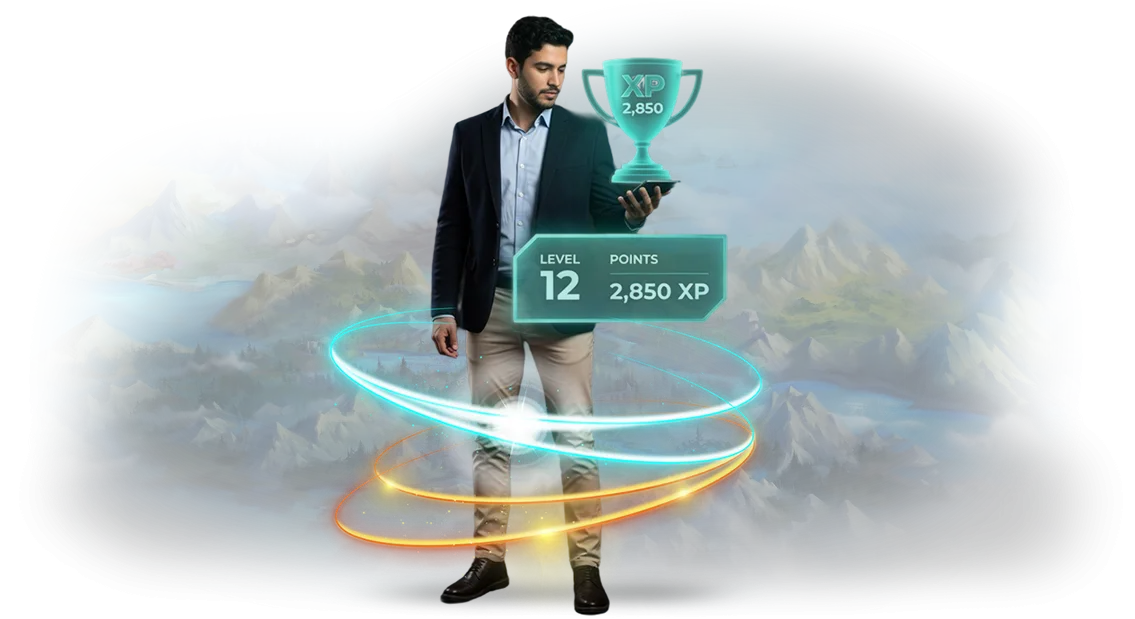
Employee Loyalty Programs: Why They Don't Work
Standard employee loyalty programs usually follow the same template: collect points — exchange them for a gift or a small bonus. On paper it looks like caring for staff, but in practice employee motivation quickly fades.
Points lose value, gifts stop delighting, and daily tasks remain routine that no one wants to go the extra mile for.
As a result, staff engagement drops even with a stable salary and a good benefits package. People perform their duties "from clock-in to clock-out," show no initiative, and key employees start looking for another place.
Staff turnover grows — and the business spends resources on constantly searching for, hiring, and training newcomers instead of developing the team it already has.
Why does this happen? Because classic loyalty programs do not account for the main thing: people need emotions, recognition, and tangible progress. They need to see their achievements, compete, receive feedback, and understand how their efforts affect the overall result.
Gamification addresses exactly these needs — we design game mechanics inside work processes that turn routine into an exciting scenario with goals, levels, and rewards.
We create programs where employee motivation works not because of expensive prizes, but because of genuine interest and healthy competition.
Staff engagement becomes a measurable metric, and staff turnover drops because people don't want to leave a place where their development feels like an exciting game.
Our experience shows that a well-designed game balance holds a team's attention longer than classic bonus schemes. So if you're ready to replace the formal approach with something that actually works — let's discuss your task.
What Gamification of Business Processes Will Give Your Company
Routine is the main killer of motivation. When tasks repeat day after day, interest fades and employees work on autopilot. Gamification shifts their attention: goals become clear, progress is visible immediately, and every completed step brings a tangible reward. Engagement grows because work begins to resemble a game you want to win.
This directly increases productivity. Instead of vague indicators, an employee sees a concrete path: complete a task — get points, reach a level — unlock a privilege. Fast feedback makes the brain work more actively: people do more in the same time and do it with pleasure. The need for constant control disappears — the team works on its own because it is interested.
Staff loyalty also grows. Employees stay where their contribution is valued. Game mechanics make it possible to reward achievements regularly, not once a year during performance reviews.
A person gets recognition right away — this creates emotional attachment to the company and reduces turnover. Valuable specialists don't leave for competitors and readily recommend the company as an employer.
Team spirit deserves a separate mention. Joint tasks, common goals, and even healthy competition between departments unite the team. People start helping each other, sharing experience, and feeling part of one strong team.
This is especially important for companies with remote work, where interaction between employees is limited.
As a result, gamification of business processes delivers a comprehensive effect: productivity goes up, valuable employees stay, and corporate culture becomes a competitive advantage. The employee loyalty program works not on paper, but in real business metrics. You get a predictable team aimed at results.
Gamification Formats for Employee Loyalty Programs
There is no universal game scenario: what sparks a sales department may not work in accounting. That is why we choose mechanics for a specific business task — whether you need a burst of activity for a product launch, stable plan fulfillment, or smooth onboarding of new hires.
Below are four basic formats and the situations where each one delivers maximum results.
Format Comparison
| Format | For whom | What it gives the client |
|---|---|---|
| Competitions | Teams with high competition: sales, support, branches | Growth in target metrics, healthy competition, quick wins |
| Quests | New employees, training programs, launching changes | Involvement in processes, teamwork, learning material through action |
| Levels | Long-term motivation, career track, skill development | Transparent growth path, retention of valuable employees |
| Rewards | Regular actions: reports, service, cost consciousness | Habit of the desired behavior, recognition of merits, reduced burnout |
These are not rigid frameworks: a strong loyalty program usually combines several formats. For example, levels create an overall structure, competitions drive a quarterly sprint, and rewards reinforce daily routines. We design mechanics so that they reinforce each other and do not overload employees.
How We Create Gamification: Project Stages
We follow a transparent process — you always know what is happening at every stage and what result you will get. No "black box": concrete steps, fixed deadlines, and sign-offs at key points.
This way you avoid surprises and unnecessary costs, and the employee loyalty program launches exactly as planned.
- Brief — we dive into your business tasks, study your current loyalty program, and find out what really motivates employees. We record the goals: higher engagement, sales growth, or better teamwork.
- Design — we create the game concept: mechanics, levels, and the balance for awarding points and rewards. We show how game scenarios will fit into work processes and which employee actions will be rewarded.
- Approval — you receive a clear document with the game rules, the economy, and the motivation logic. We make edits before technical implementation begins — this saves project time and budget.
- Development — we build the mechanics on a professional platform, connect it to corporate systems, or make a standalone solution. At intermediate stages, you see working versions, so there are no surprises at the finish.
- Launch — we roll out the system to employees, train administrators, and prepare materials for the internal announcement. We help run the first game sessions and make sure everything works without glitches.
- Support — we analyze participant activity, collect feedback, and adjust the balance or rules when needed. You receive regular performance reports and recommendations on how to develop the program further.
This approach has already helped our clients launch loyalty programs that truly engage the team and contribute to business results. The process is proven, all stages are clear, and support continues after launch.
What You Get as a Result: Delivery Package
The key task of this section is to remove uncertainty: you get not "an idea on paper," but a ready-to-use working package that can be implemented and verified — rather than something you have to finish on your own for the contractor. Below is the full composition of the result we deliver for an employee loyalty program project.
Game Design and Game Balance — What Employees Will Play
- Game Design Document — a description of the game mechanics, story, roles, and rules. It is clear what an employee does, what they receive points for, and how that affects their status.
- Game Balance — tuning of difficulty, reward frequency, and "ceilings" so that activity does not fade after the first week and interest lasts for months.
- Program Economy — how many points are issued for actions, how they expire or accumulate, and which prizes truly motivate rather than annoy.
Instructions and Documentation — So Your Team Works Without Us
- Administrator Guide — how to change program settings, add employees, and adjust rules without contacting developers.
- Participant Guide — a short and clear reference on how to earn and spend points, and what to do in a disputed situation.
- Technical Documentation — a description of all settings and parameters so your IT specialist can understand the logic in one evening.
- Support Regulations — what we do after launch, which metrics we track, and how quickly we respond to requests.
What Is Included in the Delivery Package
- game design document describing all mechanics and rules;
- game balance with point economy and levels;
- program administrator guide;
- participant guide;
- documentation on settings and integration with your HR system;
- technical support regulations after launch.
The entire package is delivered in a convenient format and remains your asset: you can develop the employee loyalty program yourself or order the next stage from us.
The main thing is that you receive a transparent, manageable tool — not a "black box" that works only when the contractor is around.
Case: 40% Engagement Growth at Company N
We turned to gamification when the company "StroyTorg" noticed that its internal loyalty program covered only a third of employees. Motivation was declining: accumulated points did not create excitement, and participation became a formality.
The management did not just want to "hand out bonuses" — they wanted people to strive to meet plans and help their colleagues on their own.
In two months, we designed game mechanics based on existing performance indicators: personal levels, team competitions, and seasonal events. Employees received badges for completing tasks, privileges for regular success, and teams competed for a shared result.
The system required no new resources from the company — it used existing reports and internal communications.
Three months after launch, activity in the program grew by 40%: the number of employees participating weekly doubled, and the number of tasks completed above plan increased by a quarter.
A repeat order confirmed the value of the solution — the company extended the program for the next period and rolled it out to related departments.
What Helped Achieve the Result
The key was the combination of game balance and transparent rules. We tuned the difficulty so that a beginner quickly got the first reward, while an experienced employee saw their status grow. This approach keeps interest alive and creates healthy competition without burnout.
Numbers That Speak for Themselves
- Engagement growth — 40% in the first quarter.
- Number of active participants — twice as many.
- 85% of employees noted that the program became motivating.
- The company extended the contract for the next period.
Frequently Asked Questions About Gamification Implementation
Before launching an employee loyalty program, the same doubts almost always come up: will the team accept it, how long will the launch take, how do we fit the game into current processes, and what if the result does not appear.
We have collected answers to these questions — briefly and to the point, as we discuss them with clients at the brief stage.
Won't employees perceive gamification as "manipulation"?
Only if you make a game for the game's sake. We design mechanics so that they reinforce real work goals: the employee sees their progress, clear rules, and an honest connection between actions and rewards. When participation is voluntary and the results board is shared, perception becomes positive.
How long does implementation take?
A typical project takes anywhere from two weeks to two months, depending on scope. A first version with basic mechanics can be launched quickly, and then the balance can be fine-tuned based on the team's reaction. The key is not to drag out the "perfect" design, but to start with a working scenario.
Is it difficult to integrate the game with our current processes?
We embed gamification into actions that already happen in the company: completed tasks, training, feedback, and meeting plans.
Integration does not require a revolution in tools — most often we use existing communication channels and add a game layer on top of familiar procedures.
What guarantees are there that the effect will appear?
At the start, we set down the metrics that matter to you: engagement, learning effectiveness, reduced turnover, and speed of task completion. We run a pilot on one team, measure the changes, and only then scale up to the whole company based on the results.
If the mechanics did not work, we adjust the balance — we do not force the team to "play through" a scenario that is not working.
How to Choose the Right Format for Your Task?
The choice of gamification format depends directly on the goal you set for the program: increase engagement, speed up onboarding, stimulate exceeding the plan, or simply strengthen team spirit.
The same mechanics will not work equally for a sales department and a production site, so your first step is to determine the priority business metric.
If your main goal is to increase the frequency of repeat actions, a step-by-step point accumulation system with bonuses will work. If you need to motivate the team toward a specific quarterly result, a team competition format with a clear checkpoint works better.
The second selection criterion is the specifics of your team and its working format. For remote employees, digital quests and interactive tasks that open from anywhere in the world are convenient.
For office teams, you can mix online activities with offline promotions and mini-challenges where personal contact and live participation matter.
Consider the number of participants: if the program has more than a hundred people, the focus should be on automatic leaderboard generation and transparent statistics, so that everyone has access to their results in real time.
Another important criterion is ease of participation. The format should not become "one more work task": if joining the game requires employees to study complex rules and learn a new interface, engagement will fall before the start.
Choose mechanics that can be explained in a minute: "get points for what you do at work, and exchange them for nice perks." The lower the entry threshold, the faster the program gains participants — and the sooner you see an impact on metrics.
Finally, consider the duration of the program. Short-term sprints of 1–4 weeks are great for urgent tasks and building a new habit — they create excitement and quick results.
Long-term employee loyalty programs are better built as a system of changing seasons and levels: this way participants do not get accustomed to one scenario and maintain interest for months.
At the same time, every game should remain manageable from an administrative point of view: you need a simple way to reward, change rules, and respond to feedback without involving developers.
If you still do not know which format is right for your team, it is important at this stage to check against reality: do a quick reconnaissance among employees, look at what activities they discuss and what they play in the work chat.
This gives direct hints about the group's preferences. Then, based on your goals and company specifics, we will select mechanics that will work, not just look good.
Ready to Strengthen Your Team's Motivation?
Employee motivation is not one-time bonuses — it is systematic work. We help build a loyalty program that involves the team in everyday tasks and turns work processes into a game with clear rules and valuable outcomes.
Such a program works as a catalyst: employees become engaged on their own, compete, and achieve shared goals.
Send us a request — briefly describe your task. During a consultation, we will look at which mechanics are suitable for your team and suggest first steps. If we see value, we will make a plan and agree on the start timeline.
Experience from dozens of projects across different industries helps us find a solution quickly and without unnecessary experiments.
What you get after placing an order:
- A complete turnkey project: from idea and game mechanics to implementation into work processes.
- A ready-made employee loyalty program with levels, tasks, and rewards.
- A clear motivation system that increases engagement and reduces turnover.
- Tools for managers: they see team activity and can praise or help in time.
- Administrator training and materials for a quick launch.
- Support after launch: we adjust the reward balance so that interest does not fade.
- Guarantee for the result and revisions after launch.
We work remotely, with all documents and a guarantee. We can start as early as the coming weeks — we just need to agree on the details.
Leave a request on the website, and we will contact you within one business day, answer your questions, and show examples.