

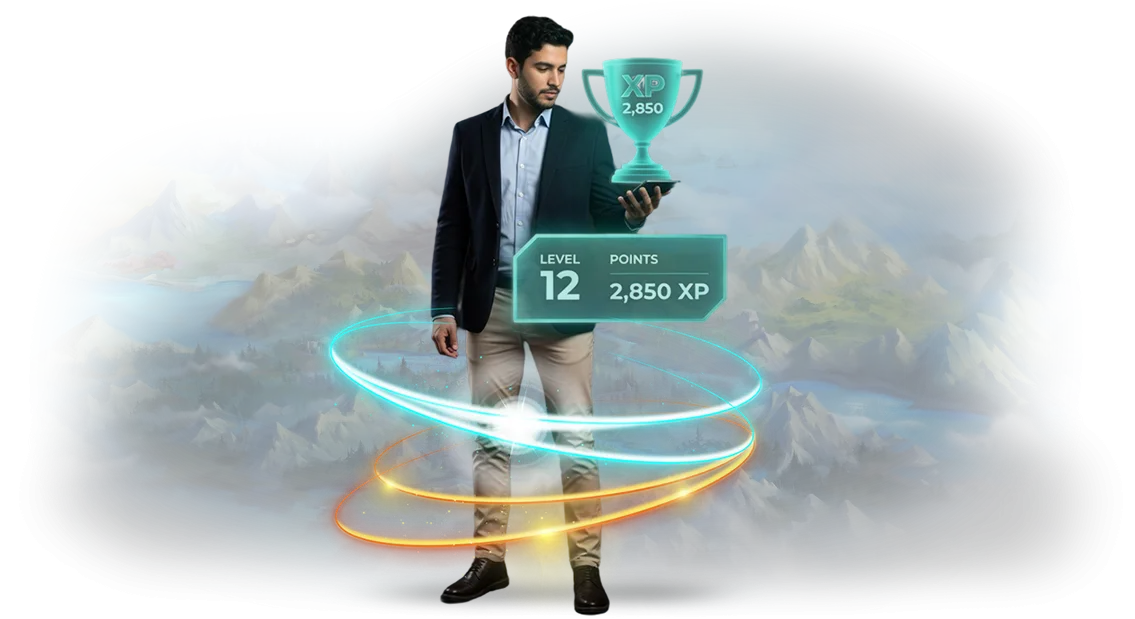
Gamification of Professional Development Programs: How to Hold Attention
Employees sign up for professional development, but lose interest within a week. The course is completed formally, just to check a box, and the knowledge gained sits as dead weight.
The company spends budget and working time, while training effectiveness remains low — this is the main pain of most professional development programs.
Why does this happen? Ordinary lectures and tests do not hold the attention of an adult who is used to interactivity and fast results. Without a clear goal and constant feedback, motivation drops as early as the first module.
This is where gamification of learning changes the picture: it turns a boring course into an engaging process where the employee themselves wants to keep moving forward and reach new levels.
We develop game mechanics specifically for professional development programs: storylines, levels, points, team competitions, and scenarios based on real work situations. Employees see their progress, receive recognition from colleagues, and get rewards for achievements.
Employee engagement grows without coercion — knowledge is absorbed naturally, through action and positive emotions, rather than through rote memorization.
Retaining attention throughout the course delivers tangible business results: more employees reach the finish line, actually apply the skills, and benefit the company.
You get a professional development program that pays for itself through growth in competencies, not formal reporting. Gamification of learning is a way to turn obligation into interest and guarantee that your investments in team development truly work.
Key Benefits of Gamification for Training and Qualification
Training adult employees is often perceived as a formality: sit through the hours, get a certificate. Gamification changes the very attitude toward the process, returning the money invested in training back to the business.
Increased Engagement and Interest
Employees begin the program not “just to check a box” but for the result. Game mechanics — goals, levels, rewards — hold attention even on complex topics. The company gets a team that wants to learn, rather than waiting for the webinar to end.
When learning becomes a game, the fear of making a mistake disappears. An employee tries, fails, tries again — and ultimately masters the material at a deeper level than through passive listening. This directly accelerates the implementation of new skills in work processes.
Improved Training Efficiency
Game scenarios simulate real work tasks, so knowledge is immediately applied in practice. Material is absorbed faster, and results last longer — instead of “learned and forgot,” the business gains truly working competencies.
A manager sees the progress of each employee: who has grasped the topic, who is lagging behind, who needs additional explanation. This makes it possible to adjust the program before falling behind becomes a problem.
Increased Motivation and Reduced Turnover
Competitiveness and public recognition of achievements are strong drivers. An employee sees their ranking and strives to grow. For the person, this adds meaning to work; for the company, it reduces the outflow of key specialists.
Measurable Results for Business
Gamification provides transparent learning statistics: activity, success rate, time per module. You see the real picture — what works and what needs refinement. This turns training from a hard-to-evaluate process into a manageable tool for personnel development.
At our team, for over 10 years we have been building training programs that employees complete with interest and managers see with clear metrics. Tell us about your task — we will select the format and mechanics for your goals.
Gamification Formats for Your Training Goals
Each gamification format serves a specific purpose: one holds attention, another builds skills, a third unites the team.
It is important that the game mechanics match the goals of your particular professional development program; otherwise, training becomes entertainment without measurable benefit.
We select the format for a specific business result: fast onboarding of new employees, sales growth, adoption of new procedures, or regular knowledge maintenance. Below is a matching table we use when designing your program.
| Format | Suitable for | What the client gets |
|---|---|---|
| Quest navigation | Immersing new employees in company processes and corporate culture | Shorter time to full productivity, systematic understanding of procedures without boring lectures |
| Dialogue simulation | Practicing sales, negotiation, and objection-handling skills | Confident employee behavior in real situations, higher conversion and average check |
| Team tournament | Team building and knowledge sharing between departments | Higher engagement, peer-to-peer mentoring, lower turnover |
| Knowledge marathon | Periodic review of material and learning assessment | Regular knowledge updates without interrupting work, transparent progress dynamics |
These are basic scenarios; in real projects, we often combine formats — for example, we launch a quest for initial immersion, then add simulations and a marathon for reinforcement.
The key is that every element has a measurable indicator: time to mastery, share of successful scenarios, number of help requests.
Describe the task of your professional development program, and we will suggest a format that delivers a clear result for the business.
How Gamification Development and Launch Work
Developing gamification for a professional development program is a path from task to measurable result. We walk it together with you so that at every step you understand what is happening, why it is needed, and what effect you will get. Below is the standard process we use to launch such projects.
Stages of Implementing Game Solutions
-
Task immersion and brief. We study the program, audience, and learning goals. We determine which processes need to be accelerated or made regular, and we agree on success criteria.
-
Gamification concept and scenario. We propose mechanics: points, levels, team competitions, or a storyline. We discuss the participant experience and approve the overall idea.
-
Game balance design. We tune task difficulty, reward value, and feedback frequency. It is precisely a balanced system that keeps adult professionals engaged in the course without letting motivation fade.
-
Integration into the professional development program. We place game elements in the learning environment, prepare instructions for instructors and learners, and link the mechanics to the schedule and result assessment.
-
Test launch. We run a pilot on a small group, collect feedback, and adjust the balance before gamification is rolled out to all participants.
-
Full launch and support. We launch the project for the entire audience, monitor engagement and module completion, and make targeted adjustments. After completion, we provide analytics on key program metrics.
What Is Included in the Gamification Project Delivery
A gamification project is delivered not as an “idea on 20 slides” but as a ready-to-launch package — take it and run the professional development program. Below is exactly what you receive in the delivery, so that the team and participants see results from day one.
- Game design concept — game mechanics selected for your business goals: engage employees, improve material retention, accelerate skill practice. You understand how the game works and which metrics it moves.
- Story and scenario — a narrative, characters, tasks, and decision points. Participants experience the training as an engaging quest rather than “just another course” — which is why they complete it to the end.
- Game balance — rules for awarding points, difficulty levels, reward and penalty mechanics. Everything is calculated so that participants stay in the zone of interest, do not burn out, and see progress.
- Methodological materials for instructors — lesson scripts, instructions, feedback templates. You don’t need to understand game design to run the program — everything is ready to use.
- Technical part — ready-made game mechanics integrated with your learning platform or operating as a standalone module. No setup hassle: upload, connect, launch.
- Analytics dashboard for managers — you can see which employees are active and where they are stuck, how much time is spent on tasks, and what percentage reaches the end. This allows you to adjust the program in time and see the return on investment.
- Post-launch support — team support, answers to participant questions, and balance adjustments if you see something going wrong. You are never left alone with problems.
The entire package is organized into clear documents and files that remain your property — you can make edits or scale the game to other departments at any time.
Case Study: How Gamification Improved Corporate Training Results
For the Atlant retail chain, we developed a gamified professional development program for store managers. The client faced the classic pain: courses were completed “just to check a box,” fewer than a third reached the finish line, and knowledge faded within a couple of weeks. We turned the training into a team competition with roles, levels, and a public rating.
The game mechanics were embedded into the work itself: points were awarded for real actions in the store, not for watching lectures. Checklists, resolving conflict situations, mentoring — all of this was verified in practice. This connection between training and operational results explains why gamification worked.
Project Results
Completion of the professional development program increased from 61% to 92%, and the average score on the final test rose by 18 percentage points. After three months, 78% of employees retained their skills compared to 45% in the control group. Knowledge stopped being forgotten.
The client also gained a business effect: internal store audits improved by 11%, and the time needed to prepare a new store manager was reduced by a third. Employees themselves asked for more — training became a status element.
After the pilot, we launched two new modules for neighboring departments, and then an updated format for the entire company. The client confirmed success with a repeat order.
If you want your professional development program to deliver measurable results, let’s talk about your task.
How to Choose the Right Gamification Format?
Choosing a gamification format starts not with trendy mechanics but with the goals of the professional development program.
It is important to understand what result you want to achieve: higher engagement, better scores on certification, skill practice in a safe environment, or group cohesion.
This determines whether it will be a story-driven game, a business simulation, a team quest, or a point-and-level accumulation system.
The second criterion is the audience. Experienced managers and young specialists react differently to competition, scenarios, and feedback.
We analyze the group’s composition, motivation, level of preparation, and even typical objections — so that game mechanics enhance learning rather than distract from the material.
It is important that the game balance is comfortable: tasks are neither too easy (otherwise boring) nor too difficult (otherwise stressful).
The third point is constraints: course duration, number of participants, format (in-person or remote), and technical capabilities. The right format must fit within these limits without losing quality.
For example, a short program benefits from quick scenarios with instant feedback, while a long program needs a system with cumulative progress that holds interest over weeks.
That is why choosing a format is always individual work, not a catalog selection. We help you define learning goals, ask the right questions, and offer 2-3 gamification options with forecasts for engagement and learning outcomes.
Together we choose the one that delivers maximum business value and is comfortable for employees. This way, you get not just a game, but a tool that solves a specific professional development task.
Frequently Asked Questions About Gamification Implementation
Before launching gamification in a professional development program, clients often have similar concerns: “What if employees don’t appreciate the game?”, “How much time does implementation take?”, “Who is responsible if the result doesn’t meet expectations?” These are normal questions — we hear them at every meeting. So we collected the three most common ones and answered honestly.
What if gamification doesn’t work in our program?
We don’t offer “game for the sake of game.” First, we analyze your program: goals, audience, pain points. We select mechanics that solve a specific task — from simple points to story scenarios.
If we see that gamification doesn’t fit the task, we’ll say so and propose an alternative. At the pilot stage, we build in metrics to understand in advance what works and adjust the mechanics without losing time.
What guarantees are there that the result will come?
We work in stages: brief → prototype → test version → launch. At each stage, you see the intermediate result and can influence it. We record success criteria in the contract — for example, participant engagement, module completion, and feedback.
We also provide post-launch support and fine-tuning of mechanics based on initial data. So risks are minimal, and the responsibility is ours.
How long will implementation take?
Timelines depend on scope — from two weeks to a month and a half for a professional development program. Throughout this time, a single project manager works with you, aligning the stages and preventing the process from dragging on.
You receive a turnkey solution ready to use: with methodology, instructions, and support at the start.
Gamification implementation is a managed process, not a lottery. Our team have been supporting professional development programs for over 10 years and are used to being accountable for results. Contact us — we will analyze your task and honestly tell you whether gamification will help you specifically.Discuss Learning Gamification with Our Expert
A professional development program rarely holds the attention of adult learners — they come for practical value, not for a “reward” in the form of points. Gamification turns training into a series of clear goals and tasks that people want to complete. But every program is unique, and there are no universal solutions.
That is why we don’t sell a “boxed product” — we offer a consultation.
During the consultation, a game design expert will analyze your specific situation: who your learners are, what prevents them from finishing, and which mechanics will bring results rather than being just a game for the sake of game. You can discuss the gamification project before making a decision to order.
During the consultation, we are ready to consider:
- the current structure of the professional development program and the points where learners lose motivation;
- learning goals: what knowledge and skills should be firmly established by the end;
- audience profile: age, experience, engagement level, and familiar formats;
- mechanic options: points, levels, scenarios, team tasks — what will suit your particular learners;
- turnkey development stages: from concept and balance to technical implementation and result analytics;
- effectiveness evaluation criteria: how to understand that gamification has genuinely improved performance and satisfaction.
We work remotely and have been creating game solutions for business for over 10 years — from corporate portals to full-fledged training courses. There is no need to look for a contractor who first makes things look “pretty” and then it turns out there is no one to launch them.
We handle the entire cycle: design, development, testing, and support. All you need to do is participate in discussions and accept the results.
To request a consultation or discuss the gamification project for your professional development program, leave a request on the website. An expert will contact you within one business day, ask a few clarifying questions, and suggest a convenient time to talk.
This is not binding — you will receive concrete recommendations and understand whether to move forward. A good training program deserves mechanics that truly motivate. Let’s discuss how to do this for your learners.