

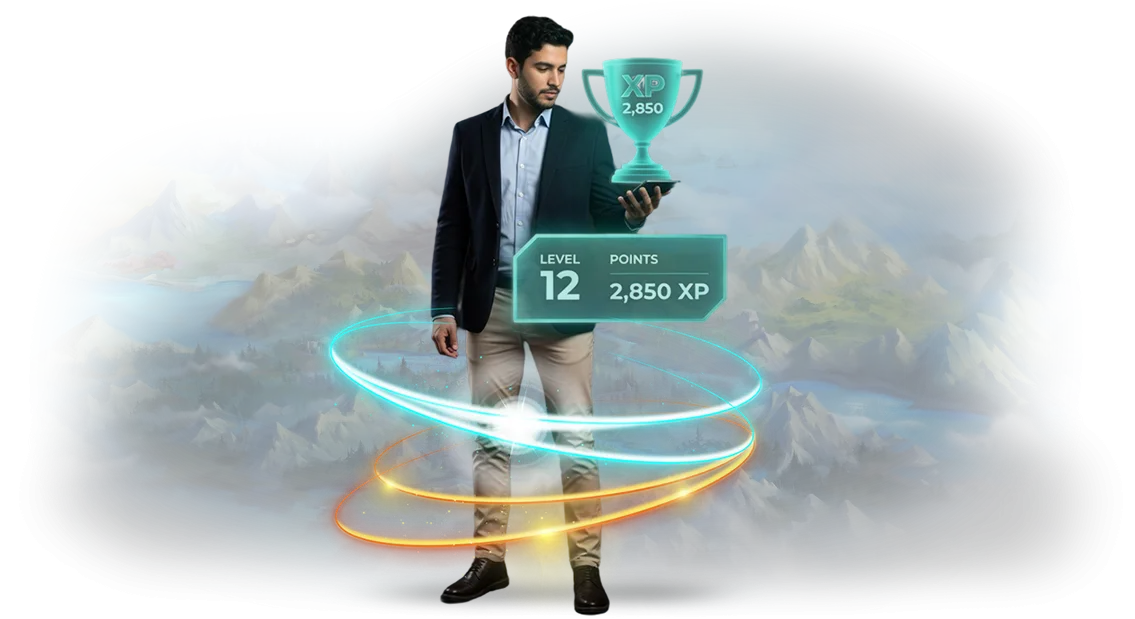
Simulations of professional processes: where engagement is lost
Classic employee training has long stopped holding attention. Lectures, tests, and briefings turn into a formality: the employee mechanically listens to the material, but a week later doesn't remember even half of it.
Employee engagement drops, and with it — both learning outcomes and overall staff motivation. Business spends time and money, but in practice the knowledge isn't applied.
The problem is that the traditional format doesn't let a person act. The brain remembers through experience and mistakes, not through reading slides. When an employee passively absorbs information, their interest fades within the first few minutes.
This is exactly where engagement is lost — and this is exactly where simulation of business processes changes the game.
Simulations of professional processes are scenarios that are as close as possible to real work situations. The employee makes decisions, sees their consequences, and learns from their own mistakes — but in a safe environment, without risk to clients or revenue.
This format brings interest back to learning because it turns the process into a living challenge that you want to solve.
A properly built simulation holds attention, forces you to analyze and try different approaches. Staff motivation grows because a person sees their progress and understands how new skills will help them in real work.
As a result, learning stops being an obligation and becomes a development tool — and this directly affects the efficiency of the entire team.
We design simulations of professional processes for the specific tasks of your business: from practicing service standards to complex negotiations and decision-making in crisis situations.
You get a format that genuinely engages employees, not just a "checkmark" of completed training.
What business gamification delivers: benefits for the company
Business gamification is not entertainment, but a tool that turns training and routine processes into a system with measurable results. Simulations of professional processes deliver an immediate effect: fewer mistakes, faster onboarding of new hires, higher team engagement.
Training effectiveness
An employee learns from their own actions, not from theory. In a simulation of professional processes, they go through scenarios as close to reality as possible: make decisions, see consequences, correct mistakes.
As a result, the skill is reinforced 2-3 times faster than with classic instruction and transfers into daily practice without lengthy mentoring.
Staff engagement
Game mechanics — points, levels, feedback — trigger healthy competition and interest in work. Employees stop perceiving training as an obligation: they return to simulators on their own to improve their results.
This reduces turnover and increases loyalty, because a person sees their progress and growth within the company.
Productivity growth
Business gamification accelerates operational processes. When employees have practiced scenarios to the point of automation, they spend less time on tasks and make fewer mistakes.
A manager gets data on the speed and quality of work, which means they can distribute workload more precisely and reach target KPIs faster.
These effects are not promises but numbers you see in the report: reduced training time, increased plan fulfillment, lower losses. We build in such metrics from day one so that gamification works for your business.
Simulation formats for different tasks
Simulations of professional processes are not a single format, but a set of tools for a specific task. Some need skill practice in a safe environment, others need decision assessment during hiring, others need to engage the team in new work standards. We match the format to your request, not the other way around.
| Format | For whom | What it gives the client |
|---|---|---|
| Business game | Teams that need to learn to negotiate and allocate roles | Practiced interaction without real losses — employees see how their decisions affect the overall result |
| Process simulator | Employees who need to quickly master a new procedure or product | Reduced time-to-competence: mistakes are made in the simulation, not while working with a client |
| HR simulation | Recruiters and managers during hiring | Objective assessment of competencies based on actions, not answers to questions — fewer hiring mistakes |
| Corporate quest | The whole company when launching changes | Engagement in new values through emotions, not orders — employees remember the meanings and pass them on |
Each format is built around your specific context: we use your business processes, real cases, and procedures.
That's why the result is not a "game for the sake of a game," but a working tool that solves a measurable task: from reducing turnover to accelerating new-hire onboarding.
Stages of creating gamification for your project
Gamification of business processes is not buying a ready-made application, but sequential work where every decision affects the result.
We structured the process so that you understand what happens at each stage, can make edits, and see how investments turn into a measurable effect. Below are the typical implementation stages, which we adapt to your project.
-
Brief and immersion in the task. We collect the input: who your audience is, what actions need to be practiced, what's getting in the way right now. The output is a clear understanding of goals and growth areas, not an abstract "let's make it interesting."
-
Scenario and game mechanics design. We determine how participants interact with the simulation, what decisions they make, and how this affects the final outcome. You get a concept you can show the team before development even starts.
-
Project preparation and prototype. We gather the content: cases, rules, roles, assessment criteria. We create a prototype to test engagement and usability of the mechanics at an early stage — before major resources are invested.
-
Development and customization to your specifics. We build a working product and integrate it into training, a corporate event, or a business process. You see a complete scenario and logic, not a "black box" that can't be evaluated.
-
Test launch and debugging. We run a pilot with a small group of participants, collect feedback, and make adjustments. This reduces the risk of a failed main launch and makes the simulation truly functional.
-
Launch and results analysis. We roll out gamification into ongoing operation and track metrics: engagement, skill practice speed, repeat usage. Based on the data, we suggest improvements so the project evolves together with your business.
What's included in the delivery package
The delivery package includes everything needed to launch and grow a simulation of professional processes in your company. You get not "developer artifacts," but ready-to-use working tools for training, assessment, and employee engagement.
- Training scenario — a step-by-step simulation storyline adapted to your business tasks and employee roles.
- Game mechanics — clear rules, levels, a points system, and feedback for participants.
- Interfaces and visual solutions — screen mockups and interaction logic, ready for use in training.
- Project documentation — administrator guides, methodological materials for trainers, and cheat sheets for participants.
- Analytics and reports — clear data on completion, team progress, and employee growth areas.
- Launch methodology — a pilot plan, recommendations for integrating into current training, and checklists for the first sessions.
- Trainer training — a workshop for your internal facilitators, after which they run sessions independently.
The assembled package covers the full cycle: from the first briefing to review of the results. You get a transparent document that makes it easy to assess how the simulation affects onboarding speed, sales quality, or compliance with procedures — depending on your task.
If needed, we demo each block to your team and adapt the materials to corporate standards. This allows you to launch the simulation within the next few weeks without diving your employees into technical details.
Case study: how gamification improved team efficiency
We love talking about gamification through numbers — for business, that's the only language that works. One notable example is a project for a large tech distributor, TechnoSnab. Our task was to quickly train new sales managers without losing work quality.
The client's pain point was obvious: employees only reached target KPIs after two or three months, and during all that time the company paid salaries but didn't get full value in return. Classic scripts and lectures didn't deliver the needed effect — knowledge remained theory.
We developed a simulation of professional processes where a manager trained on virtual deals: handling objections, building dialogue, working with customer doubts.
We measured the results three months after the simulator went live. The time a manager needed to reach target revenue was cut by nearly half, the conversion rate into successful deals grew by a third, and the number of document errors dropped by 40%.
But the most important thing — new employees stopped fearing complex negotiations because they had already gone through those scenarios in the safe environment of the simulation.
Management felt the effect too: mentors spent 20% less time on oversight, and staff turnover in the first year of work decreased. After the project was completed, the client came back to us for a second simulation — for the service department.
We consider that the best validation: when a business keeps investing in gamification, it means it delivers real value.
How to choose the right format for your task?
Choosing a simulation format for professional processes starts not with the question "which tool is cooler," but with the question "what should change after the training." If the task is to practice a skill to the point of automation, give an employee the right to make mistakes without consequences for the business, and measure progress in numbers — you need an interactive simulation with branching scenarios.
If the goal is to unite the team and see how people negotiate under stress, a role-playing business game where participants act in real time is a better fit.
The next criterion is the project's audience. Top managers engage faster with competitive formats featuring visible ratings and time limits, because they value the thrill and public recognition of results.
For line staff, step-by-step scenarios with hints and clear feedback work better, so an employee can see their path from mistake to the right solution.
For mixed groups, a "layered" format works well: a shared storyline, but different roles and difficulty levels for each category of participants.
Also consider the scale of the event. A simulation for 20 people with detailed dialogue and economic model design is deep work that takes several hours.
For a forum with 300 guests, short 15–20 minute "challenges" are a better fit, where everyone can quickly jump in and get an instant result.
This isn't a compromise on quality, but a deliberate fit to the context: in one case we create transformation, in another we manage the attention of a flow.
Finally, look at the resources available to the team. A simulation of professional processes can be integrated into current training and reused, covering the need for regular staff assessment.
Or it can be a one-time activity to package key messages and create a news hook — then we build a bright, event-driven mechanic with photo and video zones.
Choosing the right simulation always starts with a short brief: goals, participant profile, expected outcome. We help with this on the first call — in 30 minutes we determine the format with the highest chance of success.
You'll get not an abstract recommendation, but something tied to your specific task, timeline, and budget.
Frequently asked questions about gamification implementation
Implementing gamification often raises questions among business owners: is it too complex, will the project fail, when will the return come. We address the key concerns — from risks to technical support.
Isn't implementation too complex?
Implementation is entirely on our side: we analyze tasks, design scenarios, and launch. For employees, it looks like familiar work with game elements — clear goals and rewards. You won't have to change existing processes — we integrate into them.
How are the risks of failure reduced?
We start with a pilot launch on one team, collect feedback, and adjust the mechanics. Only after we see results do we scale to all departments. That's why the probability of failure is minimal, and the effect is predictable.
When will the investment pay off?
The first effects are visible within a few weeks: growth in engagement, learning speed, and plan fulfillment. For example, a client in the service industry noted an increase in repeat orders after staff started applying new skills on the job. The payback period is directly tied to your business metrics.
Who is responsible for technical support?
We support the project after launch: we monitor stability, update scenarios, and add new levels and rewards based on your needs. You can always reach out to us for refinements — this is included in the warranty period.
Shall we discuss your project? Book a consultation
Shall we discuss your project? Book a consultation — it's a meeting where we review your task and propose initial solutions. You'll receive a cost calculation and an action plan, even if you're not ready to start development yet.
At the meeting, we speak the language of your business: training scenarios, employee engagement, performance metrics.
You leave with an understanding of how gamification and simulations of professional processes will help you achieve your goals — without unnecessary technical details, only practical value.
What you get after reaching out:
- A meeting with an expert who has delivered dozens of projects across various industries.
- An analysis of your task and recommendations on which formats suit you best.
- A preliminary cost and timeline estimate — transparent, with no hidden conditions.
- Examples and case studies from your industry, so you see the result before starting.
- A clear plan of next steps — from defining the task to launching the pilot project.
- Support at every stage: from idea to implementation and results analytics.
We work remotely and adapt to your schedule. Leave a request for the project via the form or write to us in a messenger — we'll respond within one business day and schedule a convenient time for the meeting.