

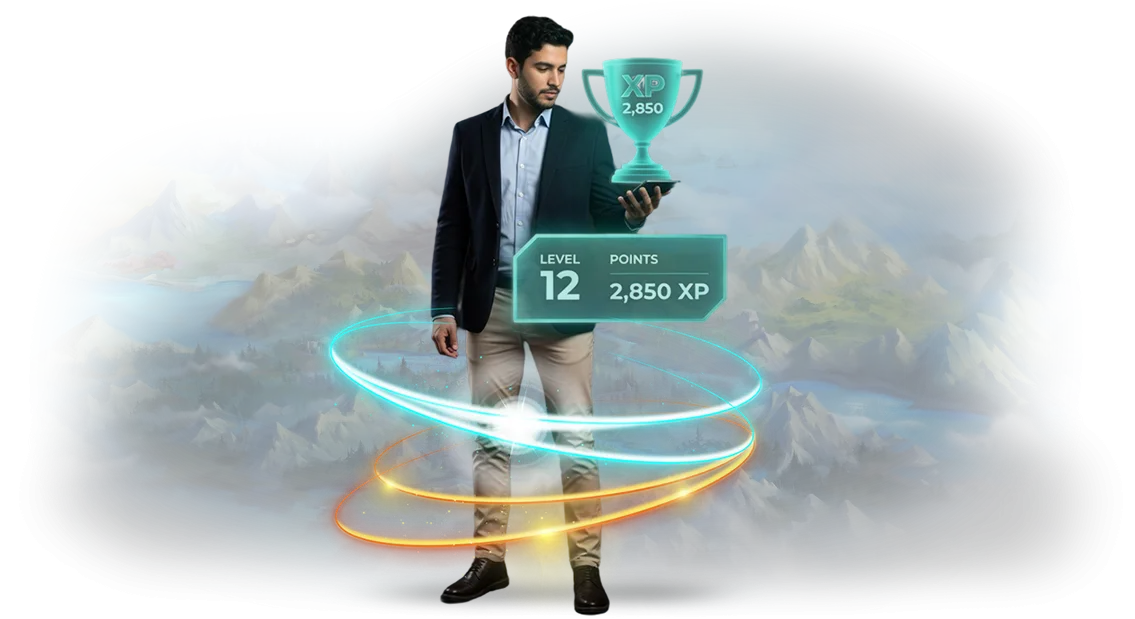
Gamification of business processes: the team works for results
When processes rely only on control, the result is predictable: employees perform the steps formally, metrics stay flat, and the manager spends time on checks instead of developing the direction.
Employee motivation drops, staff engagement turns into reporting for the sake of reporting, and any initiative from above fades within a couple of weeks.
Gamification of business processes solves this differently: we turn work tasks into a clear game with fair rules, visible progress, and rewards for real contribution.
The employee sees what they get points and status for, and the manager sees how this affects labor productivity rather than the number of checkmarks in a report.
The key difference from "medals for the sake of medals" is that the game economy is built around your business metrics.
We design the balance so that it is beneficial to do exactly what moves the direction forward: closing tasks faster, helping colleagues, guiding clients to results.
Then staff engagement grows not because of pressure, but because the employee themselves is interested in moving forward.
We are a team with experience in development and digital services: we have dozens of projects behind us where game mechanics were embedded into real work processes.
Our engineers and game designers select tools for the task — from lightweight systems with points and levels to full-fledged game platforms with team ratings.
What this gives the client: employee motivation stops depending on constant supervision, routine is perceived as a path to the next level rather than a duty. Labor productivity grows through internal interest rather than through new overseers.
Let's discuss your task — we'll come back with an estimate and a plan for how to embed this into your processes.
What a business gets from game mechanics
Gamification is not "a game for the sake of a game," but a tool that changes people's behavior in work processes. When an employee sees a clear goal, progress, and recognition of contribution, routine operations stop being perceived as a chore.
We design the mechanics so that they work toward your business metrics, rather than distracting from them.
The first thing a client notices is the growth of employee engagement. People start tracking their own results, take on tasks more willingly, and less often "hide" behind general wording.
The second is transparent performance evaluation: instead of a manager's subjective opinions, an objective picture of each person's contribution appears, which can be relied upon in decisions about bonuses and promotions.
The third benefit is reduced staff turnover. When a person has visible progress and recognition, they less often look for it elsewhere. The fourth is the acceleration of routine operations: the mechanics nudge people to close recurring tasks faster and without reminders.
And the fifth, the most valuable for a manager, is a managed culture of results: the team focuses on achievements rather than on process, and you set these benchmarks through the system itself.
We build all five effects in at the stage of designing the mechanics — for your processes, metrics, and type of team. You get not an abstract "game," but a working tool that is visible in the numbers: engagement, contribution, retention.
Gamification formats for your team's tasks
Gamification formats are selected not by the beauty of the mechanics, but by how the work of a specific department is structured.
In some cases, personal results and the excitement of competition matter; in others, it's the coordination of a shift and the absence of downtime; and in yet others, it's the speed of response to a customer.
That's why we first analyze processes and metrics, and then propose game mechanics, a point system, levels, and achievements that specifically strengthen your performance indicators.
| Format | For whom | What it gives the client |
|---|---|---|
| Sales competition | Sales department | Increased activity during "dead" periods, a transparent rating, more deals without tighter control |
| Team shift quests | Manufacturing, warehouse, logistics | Reduced downtime and defects, engagement of frontline staff, lower turnover |
| Levels and achievements for milestones | Project teams | Visible progress on tasks, fair assessment of contribution, fewer missed deadlines |
| Points for service quality | Customer support | Faster responses and higher customer ratings, clear motivation without manual supervision |
| Seasonal campaigns | The entire company | Shared excitement around a common goal, awareness of internal initiatives |
How to choose a format
Focus on what hurts right now: low activity, fragmented teams, or slow feedback. For each task, we select our own set of mechanics — from a simple point system to a multi-level game with seasons and rewards.
What you keep
A ready-made performance evaluation system that can be developed and reused: point-awarding rules, level scales, achievements, and reporting for managers. Describe your task — we'll come back with an estimate and a plan for your team.
How a project works: from brief to a functioning system
Implementing gamification is not buying a ready-made product, but a project tailored to your processes. That is why we run it in stages: at each one you understand what is happening, why, and what you will get as a result.
Below is what the path looks like from the first conversation to a system that employees actually use.
- Brief and goals. We discuss the task: which processes are stalling, whom we are engaging, and what result we consider a success — increased activity, lower turnover, faster routine. We fix the criteria by which you will later accept the work.
- Process audit. We look at how tasks live right now: where motivation is lost, which metrics the team already tracks, and what can be strengthened without breaking habits. The output is a map of growth points.
- Designing mechanics and balance. We select game mechanics for your metrics and build the balance: rewards must be attainable but not devalued. We agree on the logic before development starts.
- Approval and prototype. We show how the system looks and feels in action before employees enter it. Edits at this stage cost the least.
- Implementation. We build the system, connect it to your data, and launch it on a limited group — to catch rough edges on a small sample.
- Team training. We train employees and managers: how to use it, how to read the results, how to answer the question "what's in it for me." Without this, even a good mechanic does not take hold.
- Support and development. After launch, we monitor the metrics, adjust the balance, and add mechanics for new tasks.
Each stage ends with a clear result and your decision to "move on." This way, implementing gamification remains a manageable project rather than an experiment on the team.
What is included in the delivery
The delivery is assembled so that the system can be launched inside the company without us — and further developed on your own or with our support. Below is what exactly you receive at the output and why the head of the department needs it.
- Process and motivation point map — where employees "sag", which actions need to be strengthened and how this will affect the department's metrics. The document is agreed with you before development starts, so that the result matches expectations.
- Design document of mechanics — a description of all game elements: points, levels, tasks, rewards, statuses. You see in advance how the system will look and work, rather than learning about it at the launch stage.
- System of rules and game balance — calculated thresholds and weights at which the task remains achievable but does not turn into a formality. The balance is tuned to your team: a newcomer does not fall out of the process, and a strong employee does not lose interest.
- Manager panel — a summary of the team: who is at the top, where the dip is, how the dynamics change over the period. Management decisions are made based on data, not on feelings.
- Instructions for the team — clear materials for employees and managers: how to participate, what points are awarded for, how to dispute a result. Reduces resistance and the number of questions to you.
- Support regulations — who responds to failures and how, how changes are made to the rules, how the balance is updated. The system does not "freeze" after launch.
Each item is a working artifact, not a presentation. You receive a kit that the team can work with independently, and we stay in touch on the agreed terms.
How to choose the right format for the task?
Choosing a format starts not with mechanics, but with the question "what employee behavior should change." If the goal is for managers to log deals in the system more often, you need one set of rules and one scoring system.
If the goal is improving service quality, different signals and different reward logic work. Until the goal is formulated in measurable terms, any gamified layer turns into entertainment that the team will abandon within a month.
Next, we look at the team itself: size, age, digital maturity, attitude toward control. Some need a simple progress counter and a public leaderboard, others need team quests and seasonal goals where the group's contribution matters, not individual ranking.
We select mechanics based on the real portrait of the people, not a beautiful concept: what motivates a sales department may demotivate engineers or support staff.
System complexity is the main source of failure. The more rules, currencies, levels, and exceptions there are, the higher the chance that employees will stop understanding what they are being rewarded for, and the manager will stop being able to measure the result.
We deliberately start with a minimal set of mechanics, test it on a pilot group, and add complexity only when the simple version works consistently and delivers a measurable effect.
Adaptation to the team happens along three axes: which actions we reward, how often we give feedback, and how publicly we show progress.
Some perceive an open leaderboard as excitement, for others it is stress — and in that case we shift the emphasis to personal progress and team results. This kind of format selection takes less time than subsequent rework, and immediately gives the system a chance to take hold.
The bottom line is simple: the format is chosen for the goal, the people, and the acceptable level of complexity, not for fashion. Describe the task and the team — we will come back with a proposal on mechanics and a pilot plan.
Results in numbers: a performance evaluation system implementation case study
We implemented a performance evaluation system with game mechanics for a retail chain — over 400 employees across 30+ locations.
Before the launch: frontline staff turnover held steady at 38% per year, and routine operations — receiving, stocking, inventory — were performed with an average delay of 20% from the standard. Managers spent time on manual control instead of developing their locations.
What we changed
We broke work processes down into clear tasks with progress, levels, and a team rating for locations. An employee could see their contribution to the overall shift result, rather than an abstract plan handed down from above.
We calibrated the balance so that tasks were achievable but not simply "given away" — otherwise interest fades within a week.
What we got in numbers
- Frontline staff turnover dropped from 38% to 22% in the first year of the system's operation.
- Time spent on routine operations decreased by 18% — thanks to transparent standards and shift self-monitoring.
- The share of employees consistently meeting the plan grew from 54% to 79%.
- Engagement in daily tasks — 84% active participants versus 41% at the start.
Six months later, the chain extended the system to two new regions without rebuilding the logic — the mechanics scaled to other locations.
We applied a similar approach in a project for Skillbox, where a game-based evaluation system helped sustain employees' interest in routine tasks over the long haul.
The main takeaway from the case study: gamification doesn't work on its own — it works when the mechanics are tied to real business metrics: turnover, speed of operations, plan fulfillment. That's when an evaluation system becomes a management tool rather than entertainment.
Common customer doubts before starting
Doubts before launch are a normal part of a project, and almost all of them boil down to three questions: will the system break, will employees accept it, and will the work turn into a show for the sake of points.
Let's go through each one — these are the implementation risks we close at the design stage, not after launch.
What happens if the system breaks or freezes?
We build reliability into the architecture from the very beginning: backups, monitoring and failure alerts, a clear recovery procedure. If something goes wrong, we find out about it before your employees do and fix the cause, not the symptom.
After launch, system support remains — updates, enhancements for new tasks, and answers to the team's questions.
The team resists — "this is surveillance and a circus"
Team resistance most often stems from two things: it's unclear why this is needed, and there's a fear that points will become a tool of pressure. That's why we design the rules to be transparent: an employee sees what they earn points for and how it affects their results.
We tune the game balance so that the system highlights real achievements rather than turning work into competition for competition's sake.
Won't the work turn into a show for the sake of points?
Gamification works when the reward is tied to business value, not to activity for activity's sake. We check scenarios in advance: where employees would start "farming points" while bypassing the point, and we remove such loopholes.
The system's metrics align with your work performance indicators — that way the game reinforces results rather than substituting for them.
What if the rules become outdated in six months?
Business processes change, and the system must change along with them. We build in the ability to revise levels, rewards, and conditions without rebuilding the entire project. You get a tool that lives and evolves, not a frozen set of rules.
If you still have your own doubts — let's discuss the task and show how similar risks were closed in other projects.
Let's discuss your challenge and come back with a plan
Describe the challenge in two or three paragraphs: which processes you want to strengthen, who is involved in them, and what result you consider a success. That is enough for us to come back with a substantive breakdown rather than generalities.
A gamification request does not require a ready-made technical specification — we will put it together jointly.
After you reach out, you receive a specific set of materials, not a commercial proposal "for everything at once." We analyze the processes, show where game mechanics will deliver an effect and where they will get in the way, and capture this in a clear plan.
- Process breakdown — we look at how the work is going now, where employee engagement is being lost, and in which areas the game layer will pay off.
- Draft mechanics — which scenarios, rewards, and levels will suit your team specifically, with examples from similar projects.
- Timeline estimate — how long each stage will take and when the first measurable result will appear.
- Implementation plan — a step-by-step sequence: what we launch first, what we connect next, and how we embed it into current processes without stopping the work.
- Answers to questions — on budget, workload on employees, integrations with your systems, and post-launch support.
- Success criteria — by which metrics we will jointly assess that gamification has worked.
We work remotely and select tools to fit the challenge, not the other way around.
The team has more than ten years of projects behind it where game mechanics helped hold the attention of employees and clients — and we say upfront if we see that the challenge can be solved more simply and without gamification.
Describe the challenge in whatever way is convenient — we will come back with a timeline estimate and an implementation plan.