

Customers leave, average check falls: how to strengthen restaurant management
Today, guests easily switch restaurants if they don’t receive vivid impressions and attention. The average check is falling, regular visitors are leaving for competitors, and persuading them to “come back” via SMS no longer works.
Restaurant management turns into a fight for every guest, where the winner is not the cheapest but the most memorable.
Often the reason lies in the staff: waiters are not interested in upselling, the administrator maintains discipline through persuasion, and training comes down to a briefing. Without internal motivation, the team works formally, the guest feels indifference and leaves. The manager spends time on control instead of strategy — but the result does not change.
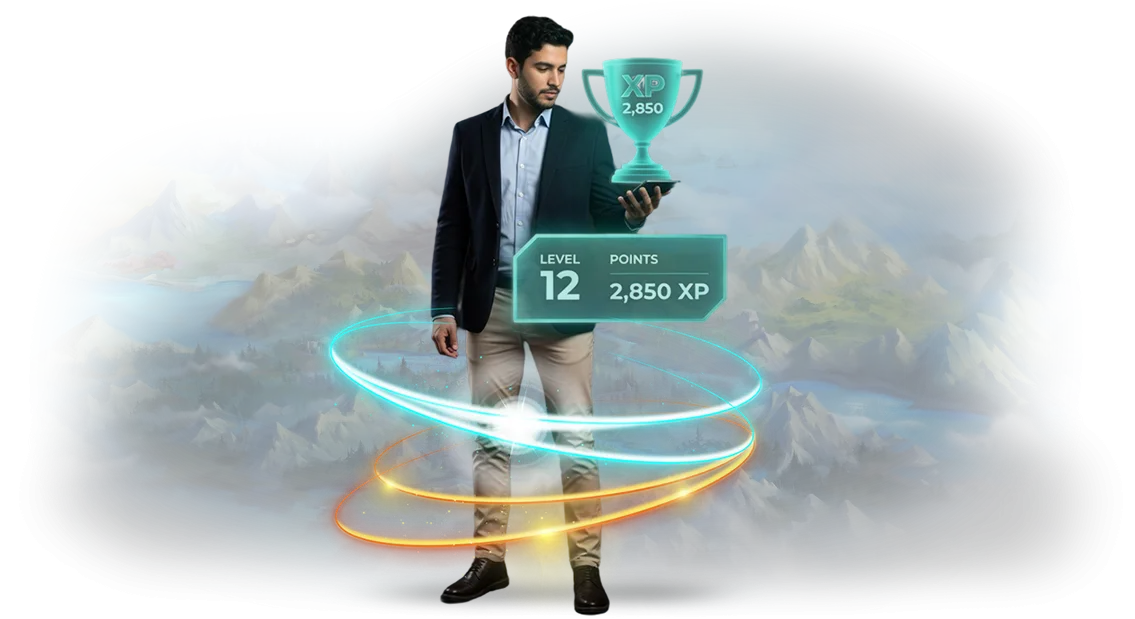
Gamification in a restaurant solves both tasks at once. Game mechanics turn staff routine into competition: waiters offer desserts and wine on their own, increasing the average check, while the administrator sees progress in real time.
Quests, accumulative prizes, and unexpected bonuses are launched for guests — this creates an emotional attachment that ordinary loyalty cards do not provide.
This makes restaurant management predictable: you see which employees are growing, which dishes are more often ordered in pairs, and what makes a guest return.
The mechanics are easy to scale to different halls, the bar, and delivery — they integrate into existing processes without revolutions.
We help implement exactly the gamification that works for your result: higher average check, guest return, and stable team motivation. We design game scenarios for your format so that restaurant management becomes simpler and profit becomes more noticeable.
What gamification of business processes gives your establishment
Staff without spark — a familiar picture: waiters slog through shifts, the average check stays flat, and onboarding new hires takes weeks. Gamification of business processes turns routine into a game where every employee has a goal, clear rules, and fast feedback.
This is a systemic solution that addresses three key pain points of a restaurant: engagement, revenue, and speed of staff training.
Employee engagement grows immediately: instead of abstract KPIs, levels, bonuses, and team competitions appear.
Waiters themselves strive to meet the target because they find it interesting, not because they "have to." The result is lower turnover, a better atmosphere in the dining room, and more predictable service for guests.
Average check growth is another effect of the game. When achieving goals directly affects an employee's status or a pleasant bonus, staff more actively offer desserts, drinks, and additional items.
Guests feel cared for, and you get a steady increase in the average check — in our projects it reaches 15-20% through engagement, not pushiness.
Staff training stops being a "burden." A new employee goes through quests and test drives instead of boring lectures, sees their progress, and quickly reaches working level.
This shortens adaptation time and reduces the likelihood of mistakes on the floor — especially during peak hours. Gamification also works as a quality control tool: staff actions become transparent, and weak spots are visible immediately.
A separate bonus is establishment recognition. Game mechanics in front of guests create a reason to return and tell others about you on social media. Plus you get data on which mechanics actually influence sales and can quickly scale them.
We have been helping with this for 10 years: our team builds gamification for the tasks of a specific establishment — from concept to results analytics.
Game Mechanic Formats for Food Service Objectives
Gamification in a restaurant works only when the mechanic is tied to a specific business objective: increase the average check, improve guest loyalty, or motivate staff.
We select the format for your situation — from short games while waiting for an order to a long-term rewards system.
Below are three basic formats that we most often use in food service projects. In each case, you get not “a game for the sake of a game,” but a tool with a measurable result.
| Format | For whom | What it gives the client |
|---|---|---|
| Guest quests | Restaurants and cafes where it is important to hold guest attention and increase visit duration | The guest gets involved in the process, orders more items from the game menu, and returns to complete a new level |
| Waiter ratings | Chains and standalone venues where they want to improve service quality and staff motivation | A transparent evaluation system: employees themselves strive to meet standards, and the manager sees whom to reward and whom to train |
| Bonus programs | Venues with regular guests or a highly competitive location | Repeat visits and average check growth: accumulated points work as a “magnet,” bringing the guest back specifically to you |
In each format, we design the rules so that a guest understands them in 10 seconds and does not distract staff with questions. You get clear metrics: how many guests joined the game, what percentage reached the end, how the average check and return frequency changed.
These numbers become the basis for developing your venue — and you see the return from gamification, not just “activity for activity’s sake.”
How the game mechanics implementation project works
We start with a short brief: we discuss goals, format, and audience to understand which game mechanics will genuinely impact restaurant management. Then we structure the project in stages — you see what happens at each step and when you will get the result.
- Brief and business immersion. We examine how the restaurant's processes are structured: service, staff training, guest loyalty. We identify the points where game mechanics will deliver measurable benefit.
- Concept and game design proposal. We present 2-3 game scenario options with a description of how they integrate into management. We explain what changes for staff and guests and which metrics will improve.
- Approval of mechanics and balance. We work through the rules, levels, rewards, and difficulty in detail. You approve the game logic before development begins — no surprises after launch.
- Development and integration. We build the mechanic and connect it to the restaurant's existing processes. We work so that staff can use the system easily and you can monitor results.
- Testing and tuning. We run the scenarios on real data, adjusting balance and interface. The goal is stable operation and clear rules for all participants.
- Launch and team training. We activate the mechanic and conduct a short introductory briefing for staff. We make sure the manager sees the necessary reports and metrics.
- Support and development. We stay in touch: we track indicators, make targeted adjustments, and propose new levels and events as the restaurant grows.
As a result, you get a working game system that is managed as easily as a shift task for waiters or a loyalty program for guests.
All implementation stages are fixed in a plan with clear timelines — you always know what step the project is at and when the first results will appear.
What is included in the gamification delivery package
Gamification delivers results only when every employee understands the rules and sees their own benefit. That is why our delivery package includes not just a "game", but a ready-to-launch system: from the rules to training materials and reports for the manager.
You get everything you need to launch the restaurant management mechanic within the first weeks, without involving outside specialists.
- Game rulebook for restaurant management — clear rules, roles and the point-awarding mechanic. Staff will quickly figure out what earns a point, and you will be able to control the entire process.
- Operating manual for the manager — a step-by-step guide: how to launch, change the conditions, tally the results and announce them. No programmers or game designers are needed to run it.
- Employee training program — short practical materials and a launch scenario. Run the training in a single evening: the rules are shown through examples rather than abstract texts.
- Area decoration and printed materials — player cards, leaderboard posters, stickers for uniforms. Everything is adapted to your restaurant's style and makes the game more visual.
- Reporting dashboard for the manager — summary tables with results: participant activity, metric dynamics (average check, upsell conversion), identification of leaders. You see the effect of gamification, not just the number of points.
- Recommendations for motivation and game development — a methodology for sustaining interest after 4–6 weeks, with rotating goals and the introduction of new tasks. The package already accounts for how to keep the game from "getting stale".
The entire package is delivered in electronic and paper form, and if needed we conduct on-site training for the staff. You pay once and get a system you can use for years.
Case study: a coffee shop chain increased its average check by 20%
Regular guests get used to the same offers, and baristas lose interest in recommended items.
For the coffee shop chain Доброе утро, we developed a gamification system that turned routine service into a game with clear rules and real prizes — and achieved a 20% increase in the average check.
First, we conducted a process audit: analyzed the "coffee to go", "breakfast", and "business lunch" scenarios and identified where revenue growth potential was being lost.
Then we launched an internal quest for baristas and cashiers: for offering a dessert, a second drink, or a hearty breakfast, employees earn points, unlock new levels, and receive prizes — from an extra day off to corporate merch.
The game balance was configured so that the focus was not on "selling at any cost", but on recommended items with high margins. Within two months, the average check at 14 locations of the chain increased by 20%.
Result: repeat orders increased by 12%, revenue of one location rose by 18% without expanding the menu or advertising investments. Moreover, the effect does not disappear after launch — the mechanics adapt to the season, new events and levels are added.
Restaurant management stops being daily employee control: the team gets engaged in the game itself and works to increase the check.
That is why clients come back to us: more than 60% of gamification customers request new scenarios after the first project. We stay in touch after launch, adjust the balance, and make sure that both guests and business owners benefit.
How to choose the right format for your business?
There is no universal game format for restaurant management — the right choice depends on the specific business challenge. Some need to increase the average check, some need to retain regular guests, and some want to train new waiters faster and reduce turnover.
Each task requires its own mechanics, so our first questions are not about "I want gamification" but about what should change in the metrics.
Take loyalty, for example. If a guest stops coming back, programs with levels, rewards, and statuses work, where every visit becomes a step toward a pleasant bonus.
If the problem is in internal processes — for example, service standards are followed inconsistently — training scenarios with feedback for staff are more effective.
That is how we connect gamification not to a "fashionable trend" but to the operational results of the restaurant.
To offer a suitable format, we conduct a short audit. We listen to the owner's task, look at how processes are organized in the dining area and kitchen, study the guest profile and the employee motivation model.
As a result, we provide one or two options with a description of what exactly will change in restaurant management and what effect can be expected.
This approach protects against buying a solution that looks impressive but does not affect revenue or speed of work. You get not an abstract idea but a clear scheme: which format we choose, what actions it triggers in a guest or employee, and how we will measure the result.
If after the audit it turns out that gamification is not right for you, we will honestly say so and offer an alternative within our expertise.
Frequently asked questions before launching gamification
Most often, before launching gamification in a restaurant, people ask about the same things: how much it costs, how quickly it will pay off, and what happens if employees don't engage. These are normal questions — we answer them directly, without fine print or abstract promises.
How much does it cost to develop gamification for a restaurant?
The cost depends on the scope and goals: implementing one game mechanic into staff motivation is cheaper than launching a comprehensive loyalty system with a mobile scenario for guests.
We prepare an estimate before the project starts and fix it in the contract. The budget becomes predictable: you know in advance what you are paying for at each stage. Staged payment lets you avoid risking the entire sum at once.
How long does it take to launch gamification? On average, from brief to launch takes from two to four weeks — depending on the complexity of the mechanics and whether integration with your accounting system is required.
At the start, we define milestones and deadlines for each stage. You see the schedule and understand when gamification will begin to bring benefits.
What if the mechanic doesn't work in my restaurant? We don't launch everything at once. After development, there is a pilot period: you assess the reaction of staff and guests on a live audience.
If something goes wrong, we adjust the balance and rules before the full launch. You get a working tool, not a "pig in a poke."
Will staff perceive this as a game or as an additional workload? Gamification is created to reduce routine, not add to it. The mechanics are built on intrinsic motivation: employees see their progress, receive instant feedback, and have clear goals.
We train the management team and prepare instructions so that implementation goes without sabotage and misunderstanding.
Are there guarantees that the investment will pay off? Any gamification pays off through growth in key metrics: average check, number of repeat visits, service speed, and staff engagement.
We do not give false guarantees, but before the start we fix measurable goals. Together we define the metrics by which you can evaluate the effect. And after launch, we help with analysis and fine-tuning of the mechanics.
Ready to strengthen your restaurant management? Let's discuss your task
Restaurant management is a constant balance between service quality and average check growth. Gamification shifts this balance in your favor: guests return more often, try more items, and bring friends.
But for the mechanics to work and not remain "just a game," they need to be designed for your format — and that's where the conversation begins.
Submit a request — during the consultation, we'll discuss your restaurant's current metrics, growth points, and suggest which game mechanics will deliver a quick effect. After that, we'll prepare a calculation of cost, timelines, and expected business results. You'll receive a transparent proposal.
What the order includes:
- Audit of the current loyalty system and guest journey.
- Game mechanics that increase visit frequency and average check.
- A storyline and rewards built into your brand and menu.
- Adaptation to your format: lunch menu, bar, delivery, or banquets.
- Staff training — managers and waiters understand how everything works.
- Technical support and launch assistance.
After launch, you see measurable changes: tables are booked more often, the check includes more items, guests return and tell acquaintances about you. We don't abandon the project after handover — we adjust the mechanics so the results are maximum.
Taking the first step is simple: fill out the request or call us. We'll respond within one business day, ask the right questions, and offer an option that will strengthen your restaurant management. Right now is the best moment to implement gamification and gain an advantage over competitors.