

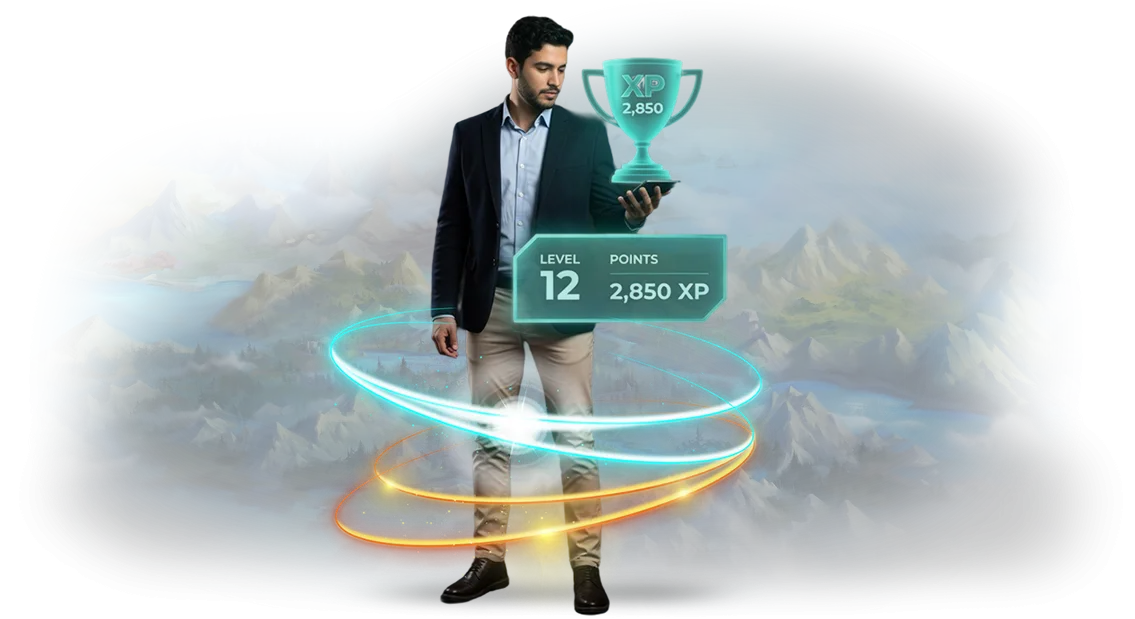
Retail Store Management Tools: Gamification vs. Chaos
Retail store management is a constant battle with routine: shifts, sales plans, discipline control. Without staff engagement, salespeople lose interest, work "from bell to bell" (just putting in their hours), and the best employees leave for competitors.
This causes service quality to drop, customers to walk away, and every lost customer makes the store less predictable. As a result, the store loses revenue and suffers from high turnover, while the manager drowns in chaos.
Gamification of business processes turns routine into a game. When salespeople have clear goals, levels, rewards, and competition, they develop enthusiasm and a desire to grow.
Sales staff motivation stops depending on mood or arbitrary bonuses — it's built into the daily workflow.
Gamification in retail works at a systemic level: every employee sees their own progress, understands what impacts the store's results, and receives real-time feedback.
This reduces turnover because people find their work interesting, and increases revenue because staff attention is focused on key actions. Salespeople stop waiting for instructions from above — they know themselves what to do to achieve the overall result.
We help you implement game mechanics into your specific processes — from simple competitions between shifts to a full-blown motivation system. We analyze your store's pain points, design a scenario that is clear to salespeople, and support you at every stage. As a result, store management becomes predictable and the team becomes engaged.
What Gamification of Business Processes Delivers: 5 Measurable Benefits
Routine in retail silently eats away at profits: salespeople lose interest in everyday tasks, customers don't feel a difference between stores, and the store manager constantly has to remind staff about simple actions.
Gamification turns familiar business processes into an engaging system with clear goals and rewards — and delivers measurable results that are visible within the first months after launch. Here are five benefits the store owner or manager gains.
Increased sales — the first thing you notice after implementing game mechanics. Employees start more willingly offering upsells, participating in promotions, and meeting the plan, because every action brings them visible progress and bonuses.
Meeting KPIs stops being an abstract number in a report: staff themselves can see how much is left to reach the goal and what needs to be done to achieve it.
As a result, the store meets its plan more often, and the average ticket grows without additional investment in advertising.
Reduced turnover — the second important benefit, especially for retail, where every departed employee is costly. When work feels like a game with levels, achievements, and recognition, people get more satisfaction from their duties.
They burn out less often, see growth opportunities, and stay with the company longer. This lowers the cost of recruiting and training new staff and retains experienced salespeople who directly influence customer loyalty.
Increased customer loyalty — the third component that works for the long term. Gamified loyalty programs, in-store quests, or interactive promotions create an emotional connection with the brand. The customer returns not only because of the assortment but also because they enjoy the experience.
The fifth, hidden benefit — management transparency: you see which employees are truly moving the store forward, which processes work better, and you can make decisions based on data rather than guesswork.
In the end, gamification pays for itself through revenue growth, team stability, and repeat customer visits.
Gamification Formats for the Retail Tier: From a Single Location to a Chain
Retail store management is daily routine: merchandising, consultations, sales plans. Monotony lowers staff engagement, and with it, the average ticket and customer loyalty.
Gamification translates work tasks into game mechanics, but it's important to choose the right format for the scale of your business: what motivates a single location's team may not work for an entire chain.
We design game systems for a specific goal — from short quests for new hires to long-running tournaments between stores.
The format choice depends on the number of participants, shift frequency, and the expected outcome: quick revenue growth, skill practice, or systematic service improvement.
Main formats for the retail tier
| Format | For whom | What it delivers to the client |
|---|---|---|
| Quests and mini-challenges | A single retail location, small team | Fast onboarding of new hires, script practice, higher average ticket per shift |
| Competitive tournaments | Retail chains, multiple teams | Healthy competition, meeting the plan, team bonding |
| Levels, ranks, and rewards | Permanent staff | Systematic motivation, reduced turnover, higher employee loyalty |
| Team games between departments | Stores with different zones | Improved collaboration, meeting overall sales targets |
Every format can be easily adapted to your business processes. We design the mechanics so they deliver results at a pilot location first, and then scale to the entire chain — taking into account each store's specifics and your management goals.
How Gamification Implementation Works: 6 Steps from Brief to Support
Here's how gamification implementation in a retail store works: six sequential stages that don't require stopping operations and don't disrupt existing processes. You approve every step with us, so the result always matches expectations.
- Brief and analysis. We record the store's goals: higher average ticket, repeat visits, staff motivation, service speed. We identify growth areas and the metrics we'll influence.
- Plan and game balance. We design the mechanics, rewards, difficulty levels, and rules. We show how employees and customers will join the game and which business metrics it will affect.
- Scenario approval. We discuss the rules, interface, and reward logic. We make adjustments before launch — you see how everything will work before programming even begins.
- Implementation without stopping operations. We integrate gamification into the store's current processes. Staff continues working as usual; changes are rolled out gradually, without downtime or stress for the team.
- Launch and training. We conduct staff orientation, provide clear cheat sheets, and launch the game mechanics. We support the process in the first days to quickly adjust the balance if needed.
- Gamification support. We analyze metrics, refresh scenarios, add new levels, rewards, and seasonal events. The game stays interesting for employees and customers, and the business gets consistent results.
What's Included in the Delivery: Complete Gamification Package
When you order gamification development for retail store management, you get not scattered ideas but a complete package, ready to launch. Every detail is covered — from rules to control tools — so the system can be implemented quickly and without hiring developers.
What's included in the gamification package:
- Game rules and scenarios — clear rules you can implement immediately. Every employee knows how to earn points, which actions are rewarded, and what they'll get for the result.
- Mechanics configured for your store — we adapt the system to your goals: higher average ticket, lower shrinkage, better service, or faster merchandising. You influence the metrics that matter to you.
- Training materials for staff — short instructions, posters, and cheat sheets. We explain the rules without complex presentations, so every employee understands the game from day one and doesn't ask unnecessary questions.
- Manager dashboard — you see in real time who's participating, what results the team has, and where your support is needed. Control without extra reports or manual summaries.
- Regulations and templates — bonus policy, point accrual scenarios, and a procedure for resolving disputes. Everything is ready for legally clean operation and clear to your accounting department.
- Set of motivational materials — badges, stickers, certificates, and other elements that keep the excitement alive and help quickly engage staff.
This isn't abstract theory but a working tool for store management. You get everything you need to launch gamification as early as this week and influence key business metrics.
Case Study: Gamification Increased a Retail Chain's Sales by 18%
A large retail chain approached us with a typical pain point: salespeople were meeting only 70% of the plan, staff turnover was high, and upsells were barely growing. Managers had tried standard bonuses and fines — motivation didn't change. We suggested looking at retail store management as a game with clear rules and fast feedback.
For the household goods chain "Fortuna", we designed a gamified system: team competitions between locations, individual salesperson ratings, levels, and rewards for consistently meeting key metrics.
Every employee could see their position in the ranking at any moment and understood which specific actions brought them closer to the goal. No coercion — the excitement and visible progress made work more engaging.
The effect showed in the first quarter. The chain's revenue grew by 18%, the average ticket increased by 9%, and employee engagement reached 92% — nearly all staff participated in the game and met the plan. Turnover also dropped: salespeople saw growth opportunities and stopped quitting.
Six months later, the chain ordered an expansion of the system to all new locations.
The category head noted: "We got a manageable tool that works through employee engagement, not through pressure." This case shows that gamification is not entertainment but a way to systematically improve key retail metrics. This approach scales to any chain — from two locations to a hundred.
How to Choose a Gamification Format for Your Specific Goal?
Choosing a gamification format for retail store management starts not with picking mechanics but with a question: what does the business actually need — a one-off spike of activity or systematic work with staff and customer behavior?
If the goal is to quickly draw attention to a new product, a one-time promotion with a competitive element will deliver instant results.
When it comes to increasing regular sales, training employees, or retaining regular customers, you need a long-term program built into everyday processes.
Long-term gamification works on habits: it turns routine actions into a clear system of goals, levels, and rewards. Such a program is useful when you want to consistently motivate staff to meet service standards or increase the average ticket without one-off discounts.
In retail, this is especially noticeable: employees adapt to new scripts faster, and customers return for accumulated bonuses. The downside — it takes more time to launch and requires regular maintenance of the mechanics.
A one-time promotion wins on speed and excitement: a limited timeframe and a clear prize drive action here and now. It's a great choice for sales events, opening a new location, or launching a new product on the shelf.
But it's important to understand: the effect of such a burst is short-lived, and it barely changes long-term behavior. If nothing remains after the promotion, customers and the team quickly slip back into old habits.
How to avoid mistakes with mechanics? First, define a measurable goal: revenue growth, reduced write-offs, increased repeat purchases. Then look at your audience — what truly motivates them: status, prizes, competition, or collective results.
In retail, simple and transparent rules that can be explained in 30 seconds work best; otherwise, the mechanics will remain misunderstood. It's better to test the idea on a small group than to roll it out across the entire store at once.
We help you choose a format for your goal and design a game that relies on real business metrics. We'll analyze your situation, propose suitable mechanics, and configure them so you see results in sales and engagement numbers.
Frequently Asked Questions and Concerns Before Launching Gamification
Before launching gamification, retail store managers most often fear three things: that the investment won't pay off, that implementation will be too complicated, and that staff will resist the new initiative. Let's look at these concerns — and what we do to make sure they don't materialize.
Will gamification pay off?
Gamification pays for itself through measurable results: higher average ticket, meeting sales plans, reduced turnover. The first shifts appear within the first month, and we adapt the cost to your scale — you can start with a pilot store.
Is it hard to implement?
Implementation is done in stages, without stopping store operations. We handle the setup, training, and launch — the team gradually adapts to the new format without fire drills or distraction from customers.
What if staff doesn't accept the game?
Employees see personal benefits: recognition, clear bonus criteria, interesting tasks. We design the mechanics in advance and support the launch with training, so engagement replaces resistance.
What if the mechanics stop working after a couple of months?
Any system requires tuning. We build in regular analysis and adjustment: we change difficulty levels, rewards, or formats if we see interest declining. Support is included in the project — you're never left alone with a problem.
Get a Gamification Plan for Your Retail Location
For gamification to deliver real results — higher average ticket, repeat purchases, staff engagement — it must be based on your store's specifics, not universal templates.
An individual implementation plan turns game mechanics into a working retail management tool that pays for itself from the first months.
Leave a request, and we'll prepare such a plan for your retail location. You'll receive a payback calculation, recommendations on game mechanics, and an expert consultation. No obligations: first you see the value, then you make the decision.
What's included in the individual implementation plan:
- Audit of current business processes and growth areas — we determine which tasks gamification will solve for you specifically.
- Selection of game mechanics for your niche and audience — from customer loyalty systems to salesperson motivation.
- Step-by-step implementation plan with stages, timelines, and areas of responsibility — clear on what to do and when.
- Payback and expected impact calculation — you see the numbers before the start, not after.
- Launch and staff training scenario — so the team starts working in the new system right away.
- Consultation based on the plan — we answer questions and fine-tune details.
How to get the plan: fill out a short form on the website — we'll contact you within one business day, clarify your goals, and prepare a plan for your store. It takes no more than 10 minutes of conversation, and the result is a clear route to higher sales and loyalty.
Leave a request right now and take the first step toward manageable growth for your retail location.