

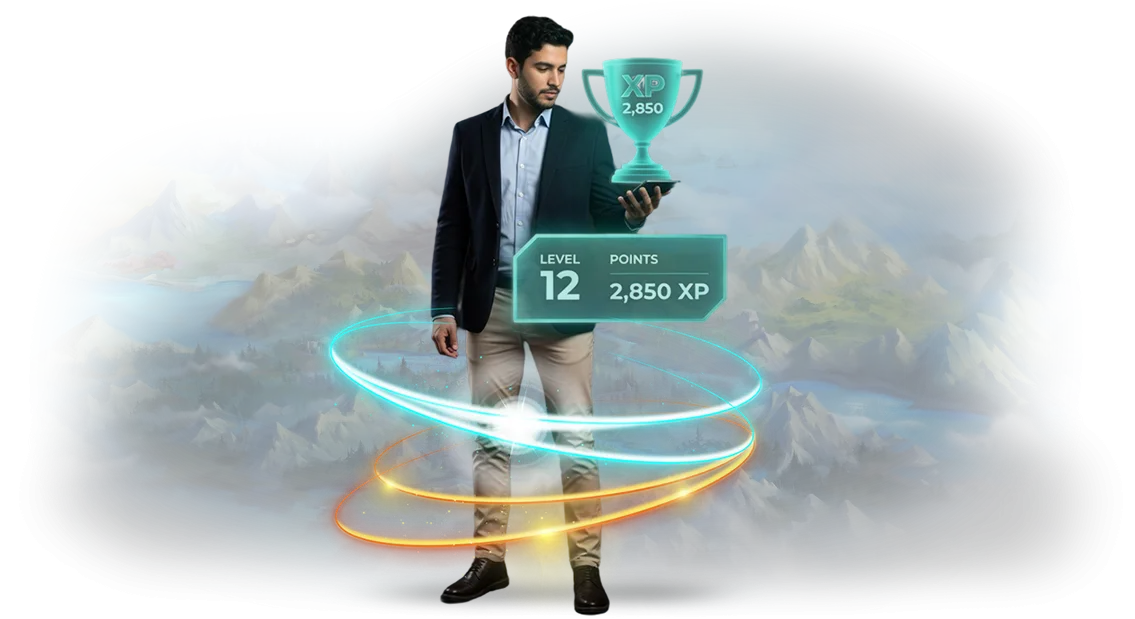
Goal Management (OKR): Why the System Stalls Without Gamification?
OKR implementation often turns into a formality: goals are written down, numbers are approved, but the team sees them as yet another reporting exercise.
Managers observe that the system only works on paper — quarterly plans fail to inspire, employees don't feel a connection between their tasks and the company's results.
The problem isn't the methodology but a lack of motivation: without clear and honest feedback, goals remain abstract spreadsheets.
Game mechanics solve exactly this problem — they turn OKR achievement into an engaging process where every step is visible and progress is backed by a tangible result.
An employee stops thinking "I need to hit the plan" and starts seeing how their contribution moves the overall metric. Gamification adds a competitive element, visible dynamics, and a sense of victory that naturally drives the team toward results.
When a team understands that behind a goal isn't just a checkbox but a level, a badge, or a new step in overall progress, intrinsic motivation kicks in. People want to finish what they started, help colleagues, and surpass their own results.
This is exactly what classic OKRs lack: they describe "what to do" but don't answer "why should I care."
We close this gap by embedding game mechanics into your goal management system.
Without changing the essence of the methodology, we make it come alive: each employee sees their contribution, gets quick feedback, and understands how their actions bring the team closer to shared success. As a result, OKRs stop being a document — they become the driver of everyday work.
What Gamification of Business Processes Brings to Your Team
Gamification turns goal achievement from a boring obligation into an engaging process. The team itself strives to accomplish more, and the manager gets a clear picture of progress. Here's what this delivers to the business:
-
Employee engagement. When tasks become part of a game, people get emotionally involved in the process. They burn out less often and take on responsibility more willingly — which means higher productivity and lower turnover.
-
Progress transparency. Every participant sees how their actions move the team toward the overall result. Managers don't need to compile reports manually: the system itself shows which goals (OKRs) are moving faster and where support is needed.
-
Team motivation. Points, levels, rewards, and leaderboards create healthy competition and regular reinforcement. Employees receive recognition for their achievements, and this sustains them over the long haul.
-
Higher goal achievement. As a result, the team consistently completes more ambitious tasks. From our experience, implementing gamification increases the share of achieved OKRs by an average of one-third — and this isn't a one-off campaign but a systemic effect.
We help companies implement such a system turnkey: from game design to integration with your processes. In the end, you get a team that is genuinely invested in the outcome.
Formats for Implementing Game Mechanics for Different Tasks
Gamification of goal management (OKR) only delivers results when the format matches the company's culture and pace of change. Some need a quick start without lengthy preparation, others need deep customization of mechanics to fit unique business processes. That's why we offer two implementation paths and help you choose the one best suited to your task.
| Format | For Whom | What It Delivers |
|---|---|---|
| Off-the-shelf solution | Companies that need launch within 2–3 weeks and a clear result | Ready-made game mechanics for OKRs, quick setup for departments, minimal load on the team |
| Custom game design | Businesses with complex goal structures or non-standard processes | A unique game model built into the existing management system, high employee engagement |
The off-the-shelf format works when you need to quickly engage the team in achieving quarterly goals without spending budget on lengthy research. Custom game design is chosen when goals span multiple departments and require a balance between team and individual motivation.
In that case, we design the mechanics from scratch: from goal-achievement scenarios to a system of rewards and feedback.
In both options, you get not just a "game" but a goal management tool (OKR) that is clear to employees and transparent for managers. We stay in touch after launch, help adapt the mechanics to new periods, and adjust the balance if we see engagement declining.
To choose the right format, a short brief is enough — based on it, we'll propose the optimal solution and show how it will work specifically in your company.
How the Project Unfolds: From Brief to Launch
We structure the project in short, clear stages — you always know what's happening and what you'll get as a result.
No "black box": from the first brief to the launch of gamification, goal management (OKR) passes through transparent steps, and at each one you see an interim result.
- Brief and immersion in the task. We gather the inputs: how goal work currently functions, what motivates the team, which business processes need to be accelerated. The output is a document with gamification goals and success criteria.
- Game mechanics design. We determine how employees see their tasks, which actions are rewarded, and how progress works. We present the concept in clear diagrams — no technical jargon.
- Balancing rewards and levels. We tune the game "economy" so motivation lasts for months, not just the first week. Task difficulty matches the real workload — goals don't turn into mush.
- Pilot and calibration. We launch the mechanics on a control group, collect feedback, and fine-tune the settings: reward frequency, level difficulty, and progress visibility.
- Integration into working tools. We embed gamification into existing, familiar processes — employees don't need to learn a new system; they work as before, just seeing their OKRs in a game format.
- Launch and training. We give a short presentation to the team, provide a quick-reference guide, and answer questions. From day one, everyone understands how to participate.
- Monitoring and fine-tuning. We track real engagement and goal achievement metrics. If something stalls, we adjust the balance and mechanics to match your dynamics.
After launch, you get a working goal management system built into the team's daily work. We stay in touch so gamification delivers results not only at the start but becomes a lasting part of your business processes.
What's Included in the Delivery: Launch Kit
Once development is complete, you don't receive scattered files but a ready-made goal management system. All materials are gathered into a single package — you don't need to improvise or search for anything.
The kit includes documents, tools, and dashboards that describe the game from a business perspective. Each element covers a specific task: clear rules for employees, control for managers, and transparency for business owners.
- Game design document. A detailed description of the game scenario, characters, and mechanics. It explains how an employee progresses from novice to leader — and what they receive at each stage.
- Game balance. Tables for awarding points, levels, rewards, and the conditions for earning them. Employees always see which action brings them closer to a better result, and managers see how motivation affects performance.
- OKR configuration. Game mechanics are tied to company goals. Completing in-game tasks is automatically reflected in achieving key business metrics.
- Manager dashboards. Clear analytics of team and individual employee progress. You see where engagement is growing and where support is needed — and make data-driven decisions.
- Team instructions. Short guides on how to use the game: rules, useful tips, FAQs. Launch happens without long training sessions or employee resistance.
- Administrator manual. Clear steps for setup, balance adjustments, and adding new employees. You'll be able to manage the system with your own team.
- Launch support. We accompany you for the first few weeks: help roll out the game, adjust the balance based on initial results, and answer team questions.
All documents are structured and available in your personal account. You get a working motivation system with transparent rules and clear results — all that's left is to launch the game and watch engagement grow.
Case Study: 32% Growth in OKR Achievement After Gamification
A large retail chain with 40 stores set ambitious quarterly goals for its teams: increasing the average check, growing repeat purchases, and reducing checkout losses.
Half of the employees saw these OKRs as "another top-down initiative" — plans fell through, reports were filled out formally, and managers spent time on oversight instead of development.
We proposed turning goal achievement into a game. Instead of boring spreadsheets, team quests, levels, badges, and a shared progress screen appeared.
Each department could see how its results affected overall success, and meeting OKRs now earned not just points but real perks: an extra day off, company-paid training, and schedule flexibility.
We measured the effect after one quarter: OKR achievement grew by 32%, and the share of employees actively participating in goal attainment increased from 45% to 87%. The number of initiatives proposed by teams tripled, and turnover among line staff dropped by 18%.
Managers noted that planning meetings were no longer about "cracking the whip" — teams themselves offered solutions.
"For a year, we tried motivating staff with bonuses — the effect lasted two days. After launching OKR gamification, we saw for the first time how sales associates and cashiers themselves discuss goals and compete to achieve them.
The 32% growth is our best result in five years," — Commercial Director, Retail Chain "Vybor".
This case is not isolated: OKR gamification consistently delivers 25–35% growth in goal achievement at companies with 50 to 500 employees.
We don't just tack on points — we design mechanics that integrate into daily processes and deliver measurable business results without increasing the motivation budget.
How to Choose a Gamification Format for Your Specifics?
There's no universal "best" gamification format — it always grows out of a business's specific characteristics. The same mechanics work in a small sales team but fail in a distributed structure with a long deal cycle.
So the choice begins not with game mechanics but with questions: how often do you update goals, who is responsible for results, and what actually motivates employees right now.
The first thing to assess is the rhythm of working with goals. If OKRs are reviewed quarterly, formats with long storylines, levels, and intermediate achievements work well.
If the cycle is short — weekly or monthly sprints — you need lightweight mechanics with fast feedback so employees see progress without waiting for a "finale." The second criterion is team size and remote distribution: for ten people in an office, live leaderboards and team events work; for a distributed network of hundreds, automated trackers and personal accounts do.
It's also important to consider how your company is used to being managed. In a strict hierarchy, competitive formats with clear rules and transparent rankings work.
In a flexible culture that values horizontal connections, collaborative quests and team-result bonuses are more effective.
A common mistake is choosing gamification just because "it's trendy" or "competitors do it": mechanics that contradict the corporate style will be perceived as a toy rather than a management tool.
Getting it right is a compromise between business goals and employees' daily routine. Good gamification doesn't require changing processes — it fits into them: it marks progress, connects actions to results, and adds no extra burden. Managers get visibility into intermediate steps, and the team gets a clear path to the goal.
We help you choose a format after a short audit: we look at your business specifics, team structure, and current motivation system. Then we propose 2–3 mechanics options with an engagement forecast and adapt the chosen one to your OKRs. As a result, gamification works toward achieving goals rather than existing for its own sake.
Common Concerns When Implementing Gamification
Implementing gamification into goal management means new rules of the game. And as in any game, questions come first: will things break, how long will it take, how do we know it's working? We hear these at every discussion — and we're ready to answer right away.
Will the system break down?
We build the system on a proven server architecture and professional equipment, so it withstands peak loads even when all employees work simultaneously.
We run testing before launch and support the project afterward: we monitor stability and respond quickly if anything goes wrong. Your team won't be left without support at the most critical moment.
How long will implementation take?
The standard cycle is four to six weeks. It depends on the number of goals and employees to be onboarded. We put together a clear plan with defined stages: from the overall task to launch. At each stage you see an interim result — and we can adjust course without missing deadlines.
How do we measure results?
Gamification doesn't replace your OKRs — it helps you achieve them. So we determine in advance which metrics to track: goal completion rate, employee engagement, task closing speed.
We regularly present reports in an easy-to-understand format so you can see the link between game mechanics and business results.
This kind of approach removes doubts before you even start: you know the system won't let you down, timelines are transparent, and the effect is measurable. Let's discuss the rest on a short call — just reach out to us.Take the First Step: Book a Consultation
To order gamification, you don't need to spend a long time studying theory or comparing proposals. One step is enough — a consultation with our team.
We'll review your goal management system, show where game mechanics can strengthen team motivation, and prepare a cost calculated after audit to fit your scale.
This isn't a hard sell but a working session: we ask questions, estimate the economics, and show what will actually deliver results. You get value from the very first step — even without placing an order.
After you reach out, you'll receive:
- An analysis of your current goal system and the point where gamification will deliver maximum impact.
- An implementation plan: suitable mechanics, timelines, and responsible owners.
- A cost calculated after audit with no hidden payments — you know your budget before the start.
- Project examples from your industry with real results.
- Recommendations for integrating with existing OKR processes.
- A roadmap: from defining the task to launch and results evaluation.
- A clear understanding of how gamification will affect your team's productivity.
The consultation comes with no obligation. Even if you decide not to order gamification, you'll still have an action plan and clarity on your budget. Leave a request — we'll get back to you within one business day and answer all your questions. We typically respond within a couple of hours during business hours.