

Employees get lost in their first month: how to fix it
A newcomer doesn't reach results in a week but in months, and all that time the team works while keeping an eye on them.
Mentors spend their energy on repetitive explanations instead of their own tasks, and by the end of the probation period the employee still doesn't understand how their work affects the overall result.
It is precisely at this stage that most departures happen: a person doesn't feel a connection with the company and leaves for a place where onboarding is set up more clearly.
Turnover during the probation period hits the business twice. First — through losses on hiring and training that can no longer be recovered, then — through the load on the team, which once again has to cover the gap.
The longer onboarding relies on the enthusiasm of individual mentors, the more the result depends on who happened to be next to the newcomer rather than on the company itself.
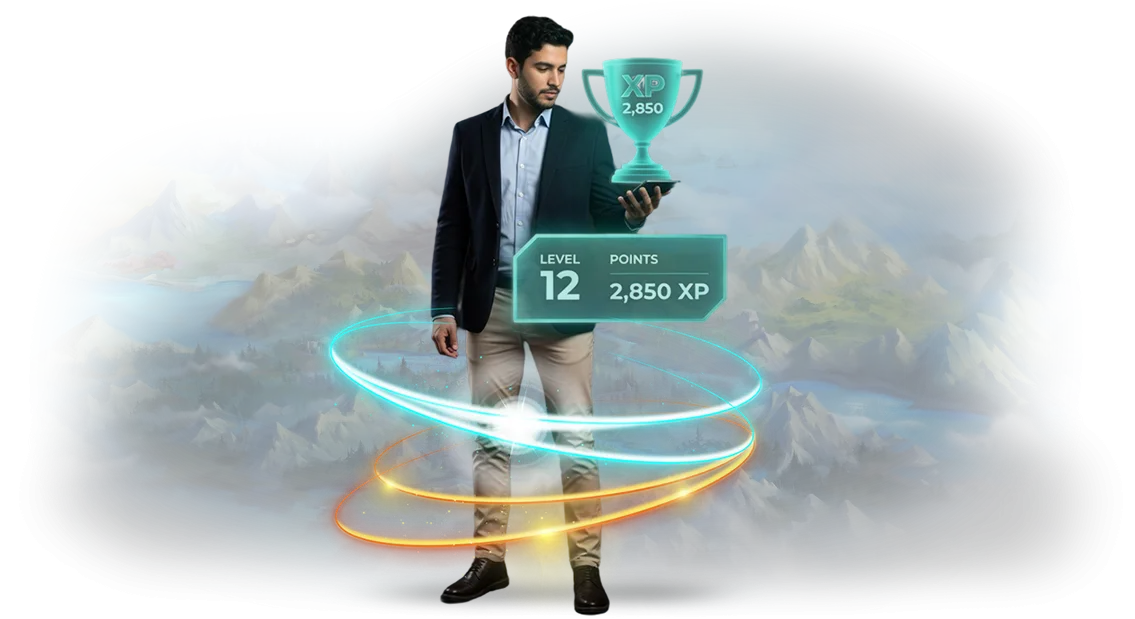
Interactive onboarding changes the very mechanics of the first month. Instead of instructions and scattered calls, a new employee follows a clear scenario: getting to know the product, the team, and the rules through action rather than through reading.
Newcomer engagement grows because a person immediately sees their contribution instead of waiting for a busy manager to finally get around to them.
We build such a scenario for a specific company: 3D avatars and the company world on Unity make new employee onboarding visual and identical for everyone — regardless of city, department, or mentor's workload.
The manager gets a predictable first month, and the team stops being the only channel for transferring knowledge.
What a business gets from gamified onboarding
Interactive onboarding is not "a game for the sake of a game" but a tool that directly affects three things you are responsible for: speed of adaptation, newcomer retention, and employer brand.
When an employee on their first day doesn't read a policy document but instead goes through a scenario in the company's 3D world, they remember the product, processes, and people faster — because they act themselves rather than flipping through slides.
Speed of adaptation is the first benefit. A newcomer gets answers to their questions at the moment they arise, not a week later on a call with a mentor.
The manager sees where the person is "stuck" and steps in precisely, instead of taking everyone through the same program.
Newcomer retention is the second.
Most people leave in the first months not because of the tasks but because of the feeling that "everything here is foreign." Gamified onboarding removes this: from day one, a person understands how the company is structured, who to go to, and what is expected of them.
Turnover during the probation period drops, and the costs of re-hiring and retraining drop along with it.
Employer brand is the third. Such onboarding becomes part of the story about the company: it's talked about in interviews, shared on social media, and it sets you apart from those who send a 40-page PDF.
For HR it's an argument in hiring; for the business, it's recognition without a separate advertising budget.
We handle this task turnkey: we design a scenario around your processes, build the company's 3D world and avatars, launch it, and support it. You get a working tool, not a demo — with a clear metric: how quickly a newcomer reaches results and how many people stay on the team.
Formats of interactive onboarding for the task
The format is chosen not by the beauty of the visuals, but by the task you are solving: to quickly bring a newcomer to results, to take the load off mentors, or to show the company from the outside.
Below are the working scenarios that we assemble most often, and what each of them gives you as a client.
| Format | For whom | What it gives the client |
|---|---|---|
| Game-based introduction scenario | Mass hiring, distributed teams | A newcomer completes the first day on their own, without a mentor: fewer questions in chats, a more even start for everyone |
| Quest for newcomers through processes | Companies with a long onboarding cycle | An employee memorizes regulations through action rather than through reading — reaches independent work faster |
| 3D company world as a tour | Employer brand, presentations for clients and candidates | The same world works for both onboarding and attraction: you show culture and scale without traveling |
| Training levels on the product | Product and service teams | Product knowledge is tested in practice, not by a test: you can see who is truly ready to work with a client |
| Competitive tasks for teams | Large divisions, seasonal hiring | Engagement and team connections from the first weeks, and for the manager — a clear picture of the newcomers |
How to choose a format for your team
Focus on three things: how many people you onboard at once, how complex the processes they need to master are, and whether you have the task of showing the company to the outside.
If there are many newcomers and the flow is constant — start with a game-based introduction scenario, it pays off at volume. If depth matters more — go with a quest through processes or product levels.
What can be combined
The formats do not exclude each other: the 3D company world becomes a shared space within which both the quest for newcomers and the training levels live.
You launch one scenario, watch how real employees go through it, and build out the rest — without redoing everything from scratch. Describe the task and the team, and we will come back with an estimate and a plan for which format will deliver results fastest.
How a project works: from brief to launch
We structure the project so that at every stage you understand what is happening and what you will get as a result. No "surprises at the end": we agree on the scenario before development starts, and you see the first results already in intermediate builds.
- Brief and goals. We discuss the task: who you are onboarding, which roles and departments, what an employee should understand and do in the first days. We fix success criteria — for example, how many newcomers make it to the end of the program and how quickly they reach full workload.
- Plan and structure. We break the program into scenes and scenarios: getting to know the company, role tasks, key rules, and points of contact with colleagues. You see the map of the entire journey before development begins.
- Scenario approval. We show the logic of progression, the texts, and the branching, and make edits. This stage saves weeks: changing a scenario on paper is many times faster than redoing a finished interactive.
- Implementation. We build the interactive environment and avatars, fill it with content, and connect your materials and internal systems. Every 1-2 weeks we show working versions — you adjust along the way, not after delivery.
- Testing. We run the program through real scenarios: different roles, devices, weak spots. We check that a newcomer can go through the journey without prompts and understands where to go next.
- Onboarding launch. We deploy the program in your environment, train the team that will run it, and support the first wave of employees. At this stage it is important to resolve questions for HR and managers, not just for newcomers.
- Post-launch support. We monitor completion metrics, update content when things change in the company, and add new roles and scenes. The program stays alive rather than turning into an archived file a month later.
What you get at every step
- A clear plan with dates and areas of responsibility — no "we'll get on a call and decide".
- An approved scenario before development starts.
- Working versions for review, not a final result blindly.
- A team that stays in touch after launch.
Describe your task — we will come back with a timeline estimate and a stage plan for your onboarding.
What is included in the delivery
You receive not a set of files, but a working product that can be launched on the very first day after handover. Below is exactly what is included in the delivery and why your team needs it.
- A ready-made onboarding scenario. We walk through the newcomer's path from first login to independent work: getting to know the company, key rules, first tasks. The scenario is coordinated with your managers and takes into account the real questions that new employees ask.
- The company world. A virtual space with your departments, zones, and movement logic — a new employee immediately understands who is responsible for what and where to turn.
- 3D avatars and characters. Mentors and roles within the world that guide the newcomer through the scenario. Avatars can be expanded and supplemented as the team grows.
- Training for your team. We show you how to make edits to the scenario, add new employees, and update materials without us. We conduct training for those who will carry the project forward.
- Documentation and handover of materials. All source files, instructions, and access remain with you. You are not tied to us and can develop the project on your own or with any contractor.
- Post-launch support. We accompany the first weeks of operation, help with settings, and answer the team's questions until the process is up and running.
Such a package closes the main risk — that the finished product will remain a "black box" that no one inside can maintain. You get both the result and full control over it.
Case study: how game-based onboarding accelerated adaptation in retail
A large retail chain was facing turnover among newcomers in the first weeks: people came to the warehouse and the sales floor, but by the end of the probationary period almost every third person left.
The reason was not pay — newcomers got lost in the processes, were embarrassed to ask questions, and did not understand how their work affected the overall result of the store.
We proposed turning the introductory course into a game format: an employee spends their first working day in the company's digital world — gets to know the departments, "lives through" typical shift situations, and receives feedback immediately rather than a month later.
The world and characters were built on Unity so that scenarios could be quickly expanded for new stores and positions without rebuilding the course from scratch.
What changed after implementation
The time it took a newcomer to start working independently was cut by about a third: previously a mentor walked a trainee through the regulations for weeks, now the basic part is covered in the first days.
Turnover in the first months dropped by almost half — people come to a shift already understanding what awaits them and are less likely to leave in the first weeks.
Store managers noted a separate effect: newcomers' questions became more specific, and mentors stopped repeating the same thing to every group. Six months later, the chain commissioned a second stage — game modules for line managers and seasonal employees.
Why the result is reproducible
The secret is not in the graphics, but in the fact that the scenarios were written together with store employees: the game included real shift situations, not abstract slides.
We captured adaptation metrics — time to reach results, the share of those who passed the probationary period, repeat requests to the mentor — before and after launch, so the effect is visible in numbers, not in words.
This approach transfers to any chain: first we analyze exactly where newcomers get lost, then we build scenarios for those points, and only after that — the game world itself.
How to choose the right format for the task?
The format is determined not by technology, but by the task you want to solve. If the goal is to quickly introduce a newcomer to the product and the team, a short scenario with a clear goal and rewards is enough.
If you need to practice behavior in non-standard situations, the scenario is built around choices and consequences. Start with the question "what should the employee be able to do or understand after completing it," and the format will choose itself.
There are usually four selection criteria. The first is the audience: mass onboarding requires simple and repeatable scenarios, while small roles allow for deep immersion.
The second is the timeline: the shorter the path to the first working day, the more compact the story should be. The third is what we measure: speed of adaptation, the share of those who make it to the end, reduced load on mentors.
The fourth is who leads the project internally: you need a person who makes decisions about the content.
A scenario is not a decoration, but a working tool. We analyze your team's real tasks, extract the key situations from them, and turn them into a sequence of steps where the employee acts rather than reads.
This is how interactive onboarding answers the questions a newcomer is embarrassed to ask in the first weeks.
If you are hesitating between two formats, don't choose at random. Describe the task and the audience — we will propose a scenario, show how it will look in practice, and come back with an estimate and a plan.
Common doubts before ordering
Doubts before ordering interactive onboarding are a normal reaction for a manager: you are investing resources in a tool that dozens of people will have to adopt.
Let's break down the three fears we hear most often: "it will break and go down," "the team won't accept it," "there won't be enough time to implement it." For each one — what actually happens in practice.
"What if something breaks?"
We don't hand over the project and disappear. After launch, you get a working tool and a clear protocol: what to do in case of a failure, who to contact, how quickly a response comes.
Content updates — new scenes, employees, texts — we add as the company grows, without rebuilding everything from scratch. Support and development are built into the work from the start, not as a separate "later" service.
"The team won't accept it, they'll sabotage it"
New employees go through interactive onboarding with interest — it's a game format, not just another instruction manual.
Resistance usually comes from those accustomed to the old order, so we build in adaptation to real roles: everyone sees their own scenario and their own benefit. A pilot with one team shows how the format takes hold — and you make the scaling decision based on facts, not blindly.
"We don't have time to implement this"
We take on the bulk of the work: the scenario, the 3D world, avatars, integration with your processes. What we need from you is role expertise and feedback at key stages — that's hours, not months. The launch happens in stages so you see results before the finish line.
What happens if we need refinements after launch?
We stay in touch and develop the project: we add scenarios, update content to match changes in the company, and refine the logic for new roles. Support and development terms are fixed in advance so you understand the scope and timelines.
How difficult is it to connect interactive onboarding to our processes?
We take on the integration: we connect the tool with your systems and protocols so that for the employee it looks like a single, clear path. You don't need to understand the technical side — you get a ready-to-use working process.
What if the format doesn't suit our particular company?
We start with a pilot on one team and look at real metrics: how quickly newcomers reach results, how many questions they ask mentors, how they rate the process itself. If something doesn't work — we adjust before scaling to the whole company.
Let's discuss your task and come back with a plan
To keep the conversation focused rather than "about everything at once," let's start with a short description of the task: who the interactive onboarding is for, how many people go through it at the same time, and which adaptation stages you want to cover.
That's enough for us to come back with a timeline estimate and a work plan, rather than general promises.
After submitting a project request, you get a clear route — what we do and in what sequence, where your decisions are needed, and where we work on our own:
- analysis of the task and goals: which employees, which adaptation stages, what result you consider successful;
- timeline and scope estimate — with a buffer for approvals, no surprises midway;
- a stage-by-stage work plan: scenario, 3D avatars and the company world, assembly of the interactive onboarding, test run;
- demonstration of an interim result — you see how a newcomer goes through the scenario and make edits before the final version;
- launch: we place the onboarding wherever is convenient for your team and test it with real employees;
- post-launch support — updating scenarios, adding roles and sections when processes change.
We separately define how we measure the value: how many newcomers reach the end of the scenario, how quickly they take on a work task, and how many questions are resolved without a mentor's involvement. These metrics stay with you as a reference point for the next stages.
Describe the task in two or three paragraphs — we'll come back with a timeline estimate and a work plan. If questions about format or scope come up along the way, we'll discuss them before the start so the launch goes without rework.