

Why Employee Competitions Aren't Enough to Engage Your Team
One-off employee competitions create a burst of activity, but that burst quickly fades. The competition ends, and the team returns to its usual rhythm, leaving interest in work right where it was.
The problem is that this format of motivation focuses on a short-term impulse rather than on systemic changes in behavior.
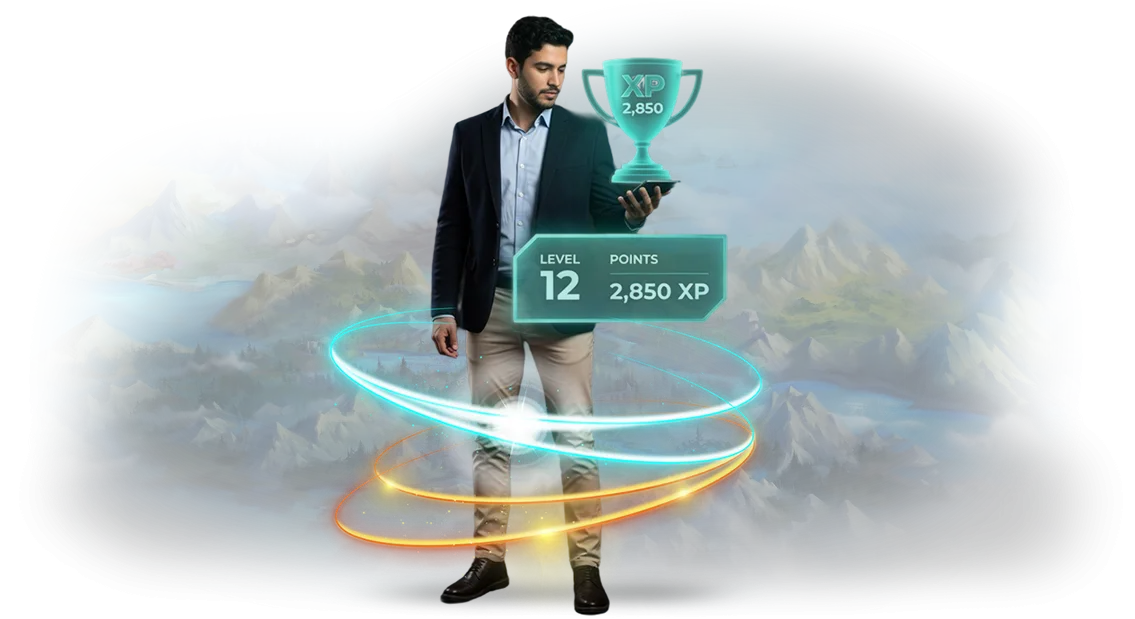
Process gamification works differently: it embeds game mechanics directly into daily tasks. Employees see progress, receive feedback, and understand how their actions affect the overall result.
This turns routine into a meaningful chain of achievements, where motivation is fueled continuously rather than from time to time. Employee engagement becomes the result of a well-structured HR strategy, not a one-off campaign.
When a competition is an event, its effect is measured in days. When gamification is a system, it builds a habit of achieving goals.
Managers get a tool that works toward a long-term goal: employees are personally invested in growing their metrics because they can see their results and areas for development.
For business, this means predictable team dynamics: lower turnover, higher task quality, and easier change implementation. That's why at our teamwe build gamification as part of your HR strategy — with clear rules, levels, and rewards tied to real business processes. This approach delivers what no one-off competition can.
What Changes in Business After Gamification Implementation
Immediately after launching employee competitions, the daily dynamic shifts: people engage more actively in tasks, take initiative more willingly, and track their results.
The first weeks show a noticeable increase in engagement across internal channels, and participation in corporate activities stops being a "Friday problem." For business, these are the first easily measurable results of gamification — fewer reminders, faster approvals, and genuine interest in shared goals.
After 2–3 months, the effect reaches the level of systemic change. Employees begin connecting their personal achievements with the company's success, and regular competitions become part of the natural work rhythm.
This is the stage where the main business benefit emerges: routine processes run without resistance, and internal communication becomes more transparent.
HR metrics — turnover, new hire onboarding speed, and probation completion rates — shift in a positive direction because retaining people becomes easier.
After six months and beyond, team loyalty becomes a sustainable competitive advantage. Employees don't just meet KPIs — they suggest ideas, help colleagues, and talk about their work externally, strengthening the employer brand without an additional advertising budget.
In the long run, gamifying employee competitions reduces hiring and training costs, and the team begins to operate as a cohesive organism focused on a shared outcome.
It's important to understand: these changes don't happen chaotically but in stages — from one-off bursts of activity to sustainable habits and manageable business metrics.
Each stage can be evaluated, so you see not "just fun for the team" but a measurable contribution to operational efficiency and company growth.
Gamification Formats for Company Objectives
Each gamification format solves a specific business objective: surprising the team at a corporate event is one thing; sustaining interest in company competitions over a quarter is another.
We select the format based on your goal — from short campaigns to a permanent 3D company environment where employees interact with the brand daily.
Below are typical scenarios our clients come to us with. In each case, we design not "a game for game's sake" but mechanics that measurably impact team engagement and results.
| Format | Best for | What it delivers for the client |
|---|---|---|
| 3D avatar and virtual office | "Best Employee" competitions, company anniversaries | Recognizable brand image, emotional connection with employees |
| Quest through a 3D company world | New hire onboarding, team building | Fast introduction to company values and internal processes |
| Leaderboards and virtual rewards | Ongoing KPI competitions | Continuous motivation without manual tracking and bureaucracy |
| Team competitions with tasks | New product launch or seasonal campaign | Playful announcement and increased employee activity |
This isn't just entertainment: each format collects participation data, so you can see which mechanics generate maximum engagement.
And thanks to a unified 3D environment built on the professional Unity engine, all scenarios can be easily scaled and refined as your team grows and new business objectives emerge.
How We Launch Gamification from Scratch
We manage every gamification project from the first brief to stable competition operation. You don't need to dive into technical details — you get a clear plan, comfortable control, and a result that solves your business objectives.
-
Brief and goals. We define the competition objectives, target audience, and key success metrics. You understand in advance what value gamification will bring and how to measure it.
-
Concept and plan. We propose the competition scenario, game mechanics, and visual style of your company's 3D world. We align on the concept before development begins — this eliminates unnecessary revisions and rework.
-
Prototype. We build the key scenes and avatars and show them to you. You see what the world will look like and can share feedback at an early stage, without additional costs.
-
Implementation. Using professional equipment and the Unity engine, we create the full world, connect the competition logic, and integrate it with your systems — website, CRM, or employee portal.
-
Testing and launch. We verify scenarios, load capacity, and usability, and run a pilot launch with a group of users. We make sure everything works reliably, then open the competition to the entire company.
-
Support and evolution. After launch, we stay in touch: we collect analytics, update tasks, and add new world elements. Gamification continues to deliver value and keep employees engaged.
This step-by-step approach reduces risk and makes the process predictable for your team. You always know where the project stands, when the launch will happen, and how gamification is impacting employee engagement.
What's Included in a Turnkey Gamification Project
Here's what a turnkey gamification project looks like: the client gets not just a "demo" but a working tool that engages employees from day one.
You avoid the headache of hunting for developers, designers, and handling implementation — we manage every stage from idea to launch and deliver a clear package that's easy to use without a technical team.
What's included in the delivery package:
- Scenario and rules for competitions — clearly written mechanics and conditions so everyone understands how to participate and win. The scenarios are reusable: they work for quarterly reviews and corporate celebrations alike.
- Game design and development — your company's branded style, avatar characters, and a game world people enjoy being in. All graphics are created around your identity and corporate culture.
- Admin panel for your manager — task configuration, participant management, automated reports, and an achievement showcase. No programmers needed — the interface is intuitive.
- Training for your team — short instructions, a hands-on session, and ready-made guidelines so you can run competitions on your own from day one. All documentation is written in plain language, free of technical jargon.
- Technical support and maintenance — we stay in touch after launch: we help set up new competitions, update the system, and quickly resolve any issues so the game runs smoothly and keeps employees engaged.
After the handover, you're not left alone with the system. We take responsibility for stable operation and engagement growth: we advise on which formats will work best and develop the project together with your team.
Case Study: How a Corporate Loyalty Program Came to Life
The client — Retail Group, a chain of 40 stores with 1,200 employees. The corporate loyalty program was purely formal: nobody tracked the points awarded through the internal portal, and quarterly competitions attracted just 15% of the staff.
Managers saw the problem not in the materials but in the boredom: employees didn't understand why they should participate and got no emotional payoff from the process.
We proposed moving the competition into a 3D world where each participant creates an avatar and advances it along an internal corporate career ladder.
The project was built on Unity — this ensured smooth graphics and consistent performance on any computer, including office machines.
Within two weeks, employees completed the brief, customized their avatar's personal style, and started completing tasks: training, mentoring, healthy habits. Points began accruing automatically, and progress was displayed on a large screen in the office and in the corporate chat.
The results exceeded expectations: participation grew from 15% to 68% of the staff in the first quarter, and 42% of employees entered the world daily.
The average activity score quadrupled, and the competition stopped being a "mandatory chore" — it developed its own heroes, stories, and team rivalries.
Numbers After Launch
Six months in, the company measured the business impact. Staff turnover in engaged teams dropped by a third, and the retraining plan was completed two weeks ahead of schedule.
The gamification case showed that investing in a 3D avatar and company world paid off not only through increased engagement but also through a real impact on operational metrics.
The project is alive and growing: the client has already ordered a new phase with expanded special missions and raffles. For us, this is the strongest signal — the client is ready to scale the story.
What If We Have Specific Processes?
Specific processes aren't the exception — they're the norm. We rarely meet two identical companies: motivation systems, KPIs, internal regulations, and even the way winners are congratulated all differ.
That's why an "off-the-shelf" solution almost always requires customization — and that's not a problem but a task we solve through project adaptation during the brief stage.
For us, the brief isn't a formal questionnaire but a conversation about your business. Tell us how your processes work, which rules matter, and where there's room for flexibility — we'll ask clarifying questions and propose mechanics that fit your logic.
If standard scenarios don't work, we design a custom solution: from awarding points for non-standard actions to special conditions for different departments.
A common concern sounds like this: "we already tried standard tools, and they didn't account for our nuances." Our answer — deep customization at every level: calculation rules, employee roles, interface, and integration with internal data.
Along the way, you review intermediate versions so you can adjust course in time and never end up with a system that contradicts your regulations.
Adaptation continues after launch too: competition conditions change, teams grow, and new metrics appear. We build in the capacity for updates so the project stays functional months later instead of turning into a static banner.
In short: the more specific your processes — the more interesting the result, because the system is built around your management structure, not the other way around. All it takes is starting with a brief discussion — from there, we handle the design and implementation.
Frequently Asked Questions About Gamifying Employee Competitions
Before launching an employee competition, clients most often ask about three things: whether people will get confused by the mechanics, whether we'll be ready in time for their target date, and what happens if activity comes in lower than expected. Here are our answers — this should make the decision easier.
Won't employees struggle with gamification? It seems complicated
The mechanics are built on the principle of "less text, more action." A participant simply opens the page and completes 2-3 straightforward steps: answer a question, upload a photo, or congratulate a colleague.
The instructions fit on a single screen, and hints appear automatically, so the barrier to entry is minimal.
For the organizer, it's even simpler: rules are set once, and the system calculates points and rankings automatically. Employees see their progress in real time — this sustains the excitement without extra mass emails.
Will competition preparation take too long?
A typical competition takes 2-3 weeks: the first week we finalize the mechanics and design, then we build and test. If you already have a corporate portal or messenger, we integrate the game there so your team doesn't have to learn a new system.
Timelines are fixed in the contract and synced with your event date. If needed, we can launch a simplified version in 5-7 days and fine-tune the full version while the competition is already running.
What if employees aren't actively participating?
Low activity is usually the result of boring mechanics, not a bad team. We build in short daily tasks and quick wins that deliver an emotional payoff on the very first day.
The leaderboard creates healthy competition, and reminders are configured so people can easily join in from their phones.
In our experience, participation in corporate competitions has reached up to 80% of the team. That's enough to engage the majority while still highlighting the most active participants.
How do we know the competition worked?
You'll receive a clear report: how many people participated, what share completed all tasks, and how activity grew across corporate channels. This shows the real effect — increased engagement, product awareness, and the emergence of opinion leaders.
If the target metric isn't reached, we refine the mechanics free of charge. For us, it matters that the competition solves your objective rather than just formally going through the motions.
Still have questions — reach out directly. We'll respond within one business day and, if needed, show you a demo example of a similar competition before you even sign the contract.Discuss Your Project and Get a Gamification Implementation Plan
You come to us not for a "pretty picture" but for a working tool that strengthens employee motivation and boosts engagement.
We view gamification as a system where every element delivers a measurable result: increased activity, reduced turnover, higher sales, or greater brand awareness.
What happens next is simple and transparent: you submit a request, we hold a short consultation with an engineer, and within a few days we come back with an implementation plan. No abstract promises — just concrete details for your objective and realistic timelines.
Here's what you get after your first inquiry:
- A quick project assessment — how well gamification solves your business objective and which format will deliver maximum impact.
- An implementation plan tailored to your company — what we do at each stage, who participates on the client side, and what materials are needed.
- An engineer consultation — a specialist explains in plain terms how the employee competition will work and answers your questions without technical jargon.
- A transparent cost calculation — you know in advance what you're paying for and can adjust the scope of work to fit your budget.
- Clear timelines and milestones — from brief to launch: you see the checkpoints and know when you'll receive the finished result.
- Examples from our practice — we'll show you cases similar to your objective so you can evaluate the outcome before work begins.
The entire consultation comes with no obligation. Fill out the short form on our website — we'll get in touch within one business day, answer your questions, and propose a plan of action. Submit your request to take the next step toward gamification implementation.