

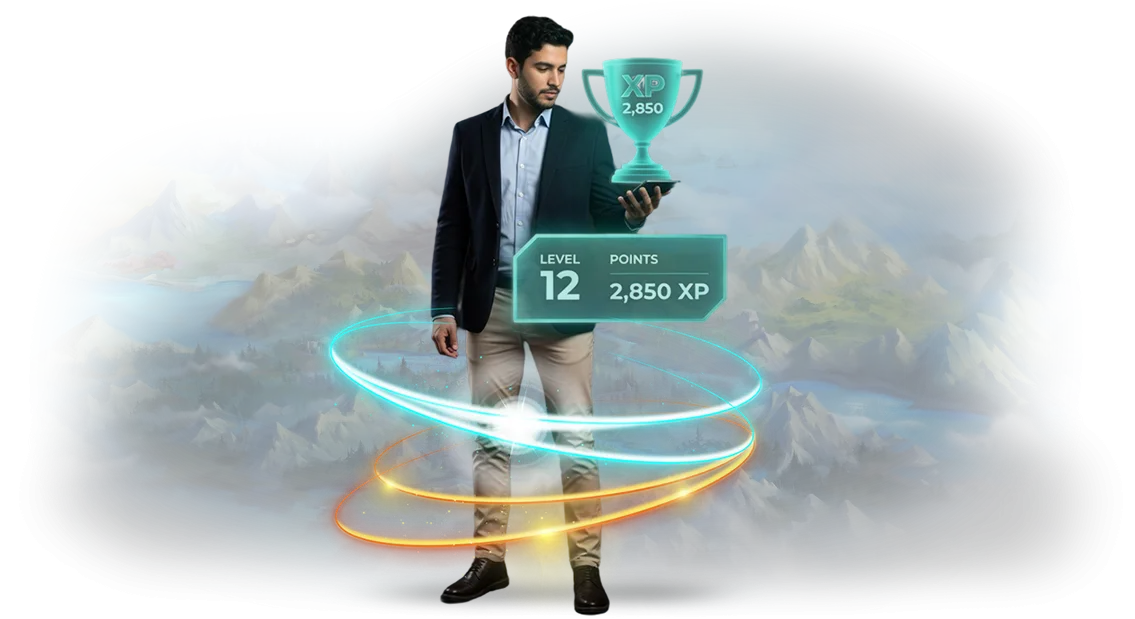
Why conventional dealer training stopped generating profit
Conventional dealer training follows one pattern: presentation, briefing, test. The dealer is formally present, but an hour later can't recall the key arguments. In the end, the training budget is spent, while sales figures stay flat — real skills never actually develop.
Look at your dealers: these are people who earn from every sale. They need a fast practical result, not theory. When training doesn't answer their question "how do I sell more," attention drops by the tenth minute. Engagement is zero, training effectiveness is minimal, and this directly cuts into your profit.
Wehave been solving this problem for manufacturers and distributors for 10+ years. We turn dealer training into an interactive world: the dealer lives through sales scenarios, makes decisions, and sees the consequences.
This isn't a game for the sake of a game — it's a way to boost training effectiveness and achieve measurable sales growth.
Instead of boring lectures — gamification of business processes: from product introduction to handling objections. The dealer remembers the material faster and applies it more willingly on the job. That's how training stops being a formality and becomes a tool for your profit.
Three areas where gamification will strengthen your business
Dealer training often turns into a formality: long presentations, dry instructions, mandatory tests. Dealers sit through it, and a week later forget the product's key arguments. Gamification flips this process — training becomes an event people want to take part in.
The first area — dealer engagement and reaction speed. In the company's interactive 3D world, the dealer works through real scenarios: objections, presentations, dealing with client doubts.
Immersion in a virtual environment helps retain information faster and act more confidently in live conversation. As a result, dealers ask fewer follow-up questions, find arguments quicker, and close deals more skillfully.
The second area — team motivation. Points, levels, rewards, and ratings turn training into a competition. Dealers come back to the material to improve their score, not because they're forced to.
Team competitions strengthen team spirit and encourage experience sharing — especially important for distributed branches and multi-generational workforces.
The third area — brand recognition and new leads. A vibrant 3D company world becomes a talking point: dealers share screenshots, discuss levels in messengers, and invite colleagues.
Contact collection mechanics can be organically built into the world — for example, a prize for completing a quiz with an email address. That's how training seamlessly flows into marketing and brings in real inquiries.
These three areas are not scattered features, but a single business gamification system. A professional 3D world built on Unity combines training, motivation, and promotion in one solution.
You get not just a course, but a business tool that pays off through dealer response, team interest, and a stream of leads.
Gamification formats: from simulator to full-fledged world
Gamification formats don't compete with each other — each solves its own task.
An interactive simulator gives a dealer confident product handling within hours, a business game tests skills in near-real conditions, and a 3D company world builds a holistic perception of the brand and its values.
We choose a format not on the principle "the more complex, the better," but based on a specific business goal: getting a newcomer to plan faster, increasing the average check, or reducing time-to-productivity.
For dealer training, it's especially important that the format matches the dealer's experience level.
A new employee needs a safe simulator where a mistake doesn't cost money; an experienced one needs cases with difficult clients; and managers need an environment where the whole company ecosystem is visible.
That's why we combine formats within a single program rather than trying to cover everything with one universal simulator.
| Format | For whom | What it gives the client |
|---|---|---|
| Interactive simulator | New dealers and managers | Fast product mastery without risk to real sales |
| Business game | Experienced employees | Practice of complex negotiations and non-standard situations |
| 3D company world | Entire team and partners | Brand immersion, unified knowledge standard, emotional connection |
Different gamification formats cover the full cycle: from initial training to ongoing knowledge support. We build the scenario so each format reinforces the others, and you see results — in how fast a dealer reaches plan, fewer errors, and growth in repeat orders.
How the project launch works: step by step, without surprises
We've structured the process so that at every step you understand what's happening and what result you'll get. No hidden stages, no surprise revisions — from the first conversation to post-launch support, we follow a transparent route proven across dozens of projects.
Key stages
-
Brief and task immersion. We study how dealer training currently works, what their pain points are, and what should change after gamification launches. We lock in goals and success criteria — so everyone understands where we're headed.
-
Scenario and concept approval. We show what the virtual world, avatars, and training situations will look like. You see the future product before development starts and make changes on paper, not after the code is already written.
-
Prototype development. We quickly assemble a working draft — with basic graphics and logic. You can "touch" it, walk through the scenario, and verify that the mechanics are engaging and clear for your dealers specifically.
-
Full version build. We polish the graphics, fill the scenario with content, and connect the reward and progress system. Everything comes together into a single product that's easy to integrate into your current training program.
-
Testing with real participants. We run a pilot with a small group of dealers, see where they get stuck, what they skip, and what excites them. Based on test results, we make final adjustments.
-
Launch and support. We deploy the solution, set up access, and train your administrators. After launch, we stay in touch — helping with updates, answering questions, and refining scenarios for new business tasks as needed.
What's included in the delivery and how it will strengthen dealer training
We've assembled everything needed to launch gamified dealer training: from the first scenario to analytics. You won't need to hunt for separate contractors for each piece — you get a complete package that pays for itself from the first groups of employees.
Here's what's included in the delivery and how each element works toward your goal:
- Training scenarios tailored to the dealer's tasks. A ready-made storyline for the roles of "sales manager," "service engineer," "location manager" — plus customization for your products, policies, and client objections.
- Game mechanics that hold attention. Tasks, levels, points, competition between participants — dealers complete the training instead of quitting after the first lesson.
- 3D environment with avatars and showroom. The employee sees the product in action, not in a presentation: these skills transfer to real sales much faster.
- Materials for launch and support. Instructions, method guides, implementation plans — your team runs the training without involving developers.
- Analytics and reporting system. Track who completed the course, how much time they spent, which scenarios are the hardest — and adjust the program accordingly.
- Content updates under your own rules. Change a training scenario or add a new product — without rebuilding the entire project.
This package turns a one-off dealer training into a systematic process that runs again and again without expensive specialists.
Dealers remember key facts faster, understand your product better, and share results with the team themselves — while you save time and budget on constant field visits and corporate training sessions.
The key point: you get not a "showcase," but a working tool — with a scenario, mechanics, and materials that will strengthen dealer training within the first month of launch.
Case study: how gamification boosted sales and motivation for a network
In conventional training programs, dealers passively listen to lectures and quickly lose interest. By the end of the session, only 10–15% of the information remains — and, more importantly, it never turns into real sales skills.
Gamification solves this problem: it moves training into a practical space where every participant works through scenarios and sees their mistakes right away.
Case study: the AvtoPremium dealer network
For the AvtoPremium dealer network, we developed a 3D simulator where managers honed their objection handling in a virtual showroom. The training ran as a competition: participants earned points for successful negotiations, saw their colleagues' rankings, and unlocked new levels.
As a result, 150 managers completed the simulator in two months, and conversion to real sales grew by 27% in the first quarter.
Numbers that speak for themselves
Three months after launch, the dealers' average check grew by 15%, and the share of repeat inquiries increased. Importantly, the effect held: managers kept returning to the simulator as a reference before tough negotiations.
Gamification didn't just entertain — it changed the approach: training became a revenue driver, not a formality.
Client testimonial
— We expected it to be interesting, but we didn't expect training to become a sales driver. Our team didn't just build a beautiful 3D scene — they embedded our actual scripts and objections into it.
Managers asked to keep playing on their own, and six months later we ordered an additional module for new products.
This case shows: when training engages, results don't keep you waiting. Gamification of business processes pays off not through entertainment, but through measurable sales growth, team motivation, and lower turnover.
If you want a similar result for your network — let's discuss your task and calculate the potential.
How to choose the right format for your task without overpaying
Choosing the right format starts not with technology, but with a question: what exactly should dealers be able to do after training? If the goal is to practice objections, a dialogue simulator with an avatar will do.
If you need to introduce the team to a new product in the context of real situations — an interactive scenario without expensive 3D graphics is enough. A full virtual company world is justified when you're dealing with mass training and employer brand building.
We deliberately don't push the "heaviest" format — we select the minimally sufficient solution. To do this, we define metrics together with you: the share of dealers who successfully complete training, time-to-productivity for newcomers, repeat support inquiries. Based on these goals and audience size, we propose one of three formats:
| Format | For which tasks | What it gives the client | Investment level |
|---|---|---|---|
| Dialogue simulator with 3D avatar | Practicing negotiations, objections, sales scripts | The employee trains in a safe environment, mistakes don't cost a client | Low-to-medium |
| Interactive scenario with decision choices | Product introduction, policies, standard situations | Quick engagement, clear rules, instant feedback | Medium |
| Virtual company world | Mass training, onboarding, events | Unified environment for all branches, presence effect, high engagement | High |
This approach lets you avoid paying for 3D avatars when interactive slides are enough — and not skimp where a deep experience is required. During the brief, we ask about the scenarios dealers need to practice, the number of participants, and their current skill level.
The answers make it clear which format will deliver the needed result without an unnecessary budget.
If you're unsure — we'll offer a pilot on a single training module. You'll see the real training dynamics and can scale the solution with confidence. That way you get a predictable outcome, not a bill for "technology for technology's sake."
Frequently asked questions about gamification: answered before you start
Before a project kicks off, clients ask the same questions: will gamification fit into current processes, how long will implementation take, and how will employees receive it? We answer the key ones — without technical jargon, in the language of business and results.
How long does a gamification launch take?
A typical project from brief to launch takes 4-6 weeks. It depends on the number of scenarios and depth of development: for a first pilot module, a month is usually enough. After that, you get a ready-made model that's easy to scale to new areas.
How will dealers and employees receive the new system?
People adapt to an interactive format quickly, especially when it replaces tedious briefings. We deliberately design the mechanics so entering the game takes less than a minute. Employees don't need to study complex manuals — two or three sessions are enough to feel confident.
Will gamification disrupt current business processes?
The solution integrates into your existing workflows, not replaces them. We run a short training audit to find the integration points — usually an internal portal or a learning management system.
After launch, everything works in parallel with familiar tools, with no downtime or duplicate effort.
What if the result doesn't meet expectations?
We work with mandatory approval checkpoints: we show scenarios at the prototype stage before full development and make changes together with your team.
After launch, we stay in touch — supporting the first weeks, gathering feedback, and adjusting settings so dealer training delivers measurable value.
Every project starts with a short conversation: you describe the task, we propose a format and give you a timeline. That way you'll know whether gamification is right for your team before signing anything. Still unsure — ask your question, we'd be happy to answer.Let's discuss your project? Leave a request for a consultation
Every dealer training program is unique: its own product line, its own employee skill levels, its own goals — from fast new product launches to regular certifications.
Gamification helps hold attention and improve knowledge retention, but it only works when designed around a specific business task, not copied from someone else's template.
That's why we start with a consultation: we listen, clarify your goals, and walk through your training scenario. It's non-binding — but it gives you a full picture of how gamification will fit into your processes.
Leave a request for the service — and during the consultation you'll receive:
- an analysis of your task and dealer training goals;
- a recommendation on the gamification format for your audience — from a 3D company world to game scenarios inside an existing system;
- a preliminary project estimate: scope of work, timeline, stages — without hidden surprises;
- examples of implemented cases from adjacent industries and the results clients achieved;
- plain-language answers to technical questions — what's needed from your systems, who participates on your side;
- a clear next-steps plan, even if you're not ready to start yet.
After the consultation, you'll know exactly whether gamification suits your training and what result is realistically achievable. If the project makes sense — we'll prepare a detailed proposal with a cost calculated after audit for your task. If not — we'll tell you honestly and suggest alternatives.
Fill out the form below — it takes a couple of minutes. We'll get back to you within one business day, agree on a convenient time, and answer all your questions. Let's start with a conversation about your task — the rest will follow.