

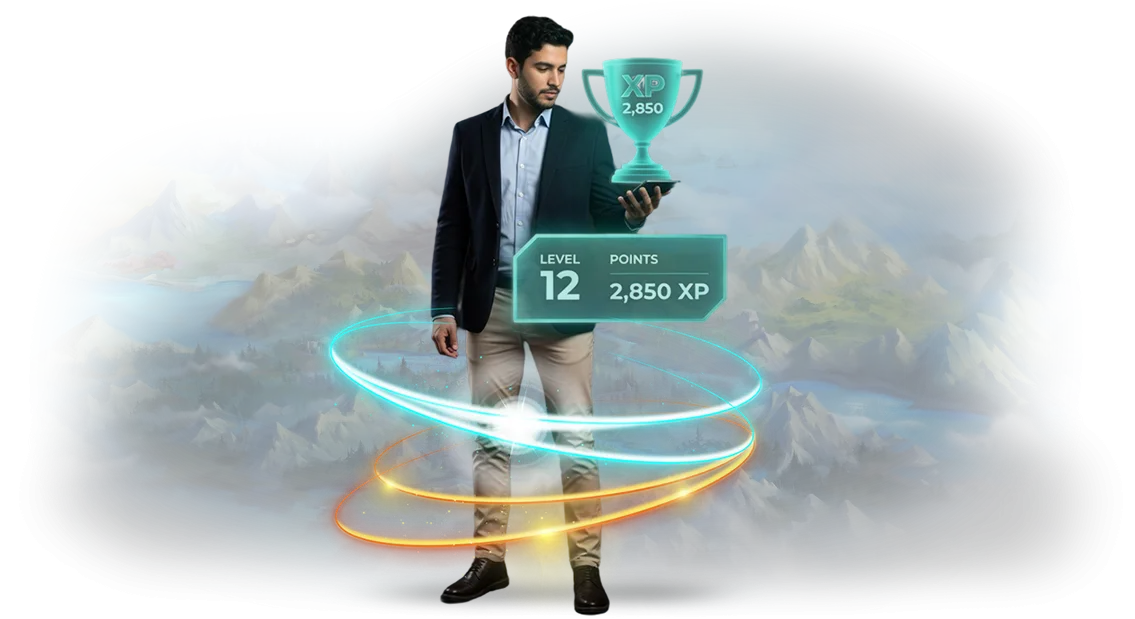
Why customer service training doesn't work without gamification?
When a company invests in staff training, but employees continue to work the old way after the course, the problem isn't the people. Classic lectures and tests don't create skills: theory is easily forgotten, and a stressful customer situation requires automaticity.
Training effectiveness drops because there is no decision-making practice or emotional engagement. People sit through mandatory hours and return to their old habits.
Customer service suffers when an employee doesn't know how to react to a conflict, objection, or request outside the script. They act at random — and this leads to lost customers, negative reviews, and reduced revenue.
The company pays for training, but in reality gets only formally listened-to material that doesn't affect actual work quality.
Business gamification changes the approach: training becomes an interactive scenario where the employee experiences real dialogues and sees the consequences of their decisions.
They see a dissatisfied customer and choose the tone, arguments, and actions — the system responds instantly, just like in real life. In a safe virtual environment, you can make mistakes, try different strategies, and bring skills to automaticity.
That is exactly how sustainable behavior is formed — behavior that carries over to real customer interactions.
We develop 3D avatars and a virtual company world for customer service training: employees train on typical and complex cases, receive feedback, and can compete with each other.
Each scenario can be repeated until the result becomes stable, and the manager sees progress and precise growth areas. The client gets not "yet another training" but a tool that changes team behavior and makes training effectiveness measurable.
How gamification improves customer service and increases loyalty
Standard briefings and lectures don't hold employees' attention: after a week of training, barely a third of the material stays in memory. When it comes to customer service, the price of such forgetfulness is lost customers and reputation.
Gamification turns boring regulations into live scenarios where employees themselves try, make mistakes, and reinforce the right behavioral patterns.
The key effect is engagement. Game mechanics create healthy competition and interest in the process, not fear of evaluation.
Employees go through training with enthusiasm and, importantly, make it to the end: the average completion rate of training programs in game format is significantly higher than that of classic courses.
For business, this means fast onboarding of new hires to working level. Staff adaptation time shrinks: instead of a long "floundering" next to a mentor, a new employee practices customer dialogues in a safe game environment within a short time.
This is especially important for mass hiring, when you need to train many people at once without losing quality.
Training results directly affect customer loyalty: an employee who has worked through difficult objections in a game acts confidently and politely in a real conversation. The customer senses competence and care — and comes back again. Improved service quality consistently converts into growth in repeat sales and average ticket size.
We have been building such projects on professional game engines for over ten years, and every time the client sees a measurable business effect: from adaptation speed to revenue growth.
Which gamification formats are right for your tasks?
Before choosing a format, answer three questions: how many employees need to be trained and how often? Are there specific scenarios — conflicts, complaints, upselling? Do you need a one-time initiative or ongoing skill development? The answers will tell you which gamification format will pay off faster.
- If the goal is to quickly bring new employees up to standard, short trainers work well.
- If you need to practice complex dialogues, choose simulators with branching storylines.
- If team dynamics matter — quests where participants solve tasks together.
- If the goal is systematic service improvement, launch a long-term program with point accumulation.
Four basic formats cover almost any customer service task:
| Format | For which tasks | What it gives the client |
|---|---|---|
| Trainer | Practicing communication standards, typical objections, scripts | Quick leveling of service quality, fewer errors "on the line" |
| Simulator | Immersion in conflict negotiations, non-standard situations | Employee confidence, fewer escalations and complaints |
| Quest | Introduction to the product, company values, onboarding | Faster material retention, engaging newcomers from day one |
| Long-term program | Continuous service improvement, maintaining motivation | Growth in repeat sales, visible progress for each employee |
Practice shows that the best result comes from a combination: a short trainer for the basics, then a simulator for complex cases, and then a long-term program for reinforcement.
At the start, we analyze your scenarios and offer a format for your specific business task — so you pay only for what actually works.
How we create gamification for your company
Gamification pays off only when the creation process is transparent and manageable. We have completed dozens of implementations and turned development into a clear route — with fixed timelines, approval points, and quality control at every step. Below is how we structure work on your project.
- Brief and business immersion. We start with interviews with you and your employees: we study real customer service scenarios, typical objections, and the metrics that matter to you. Based on that, we agree on a technical specification clear to both you and our team.
- Plan and estimate. We fix the team composition, scope of work, and stage timelines. You receive a calendar plan with demo dates and final delivery — no hidden delays or unexpected costs.
- Game mechanics prototype. We quickly assemble a working scenario prototype: dialogues, a points and rewards system. At this stage, you see how employees will go through the training and can make edits without excessive rework costs.
- Development and content. We build the full solution: characters, scenarios, interface, and progress analytics. Every 2–3 weeks we show intermediate results — so you stay in control of progress and can adjust priorities.
- Testing and quality control. First we run internal testing, then launch a pilot with your team. We collect feedback, fix issues, and refine scenarios to match real employee needs.
- Launch and support. We train administrators, help embed gamification into your training system, and stay in touch after launch. Based on the first weeks' results, we refine scenarios so the outcome meets business expectations.
What's included in a business gamification project
A business gamification project is not an entertainment quest but a working customer service training tool.
We build it around a specific company's tasks: so employees master standards faster, respond to questions more confidently, and make fewer mistakes in customer communication.
What's included in the package? Five key components.
-
Training scenarios. We develop real situations from your practice — phone calls, chats, in-person meetings, objections. Employees train on cases they will actually encounter on the job and stop getting lost on non-standard questions.
-
Game mechanics. Tasks, levels, points, and instant feedback turn boring theory into a dynamic process. Engagement rises: people complete modules to the end instead of quitting halfway.
-
Training analytics. A convenient dashboard shows each employee's progress: which scenarios come easily and where mistakes occur. The manager sees who is ready for real customers and who needs additional training. Decisions are made based on data, not guesses.
-
Convenient integration. We embed gamification into existing training processes or launch it as a standalone program. We don't rebuild the whole system — we strengthen what already works.
-
Post-launch support. We train your administrators, support the project in the first weeks, and make prompt edits when scenarios change. You get a working solution and a team that stays in touch.
In the end, you receive a complete turnkey product: ready scenarios, clear mechanics, transparent analytics, and support. Training becomes measurable, and employees become more confident with customers. That is exactly what makes the investment pay off quickly and raises service quality.
Real case: how gamification improved employee results
One of our regular clients — the federal coffee shop chain Fresh Bun — came with a typical pain point: new employees took too long to reach the required service level.
Text instructions and tests gave short-term results — within a month half the standards were forgotten, and mystery shopper checks recorded an average of 3.2 out of 5.
We proposed replacing rote rule memorization with a game-based trainer. The employee acted in a virtual shift: greeted guests, took orders, handled objections and non-standard requests.
Every action received instant feedback, and mistakes were analyzed as part of the training scenario — without stress and in front of colleagues.
Over two weeks, each participant completed 12–15 short sessions a day, creating a cumulative effect.
After a quarter, we measured the metrics: the mystery shopper score rose to 4.6, service complaints dropped by a third, and the share of newcomers who successfully passed their probation period climbed from 68% to 92%.
Turnover among new employees nearly halved — the company stopped spending budget on endless recruiting and retraining.
For the business, this means stable service during peak hours and direct resource savings.
The chain has already ordered the second phase — a game for training senior baristas — and we got yet another confirmation: gamification delivers measurable results when it is built on real processes and scenarios every employee can relate to.
Common questions about gamification implementation
Before launching gamification, clients ask the same questions: how reliable is it, how will it fit into the existing training system, and who will support the project after launch. We have collected answers to the most frequent ones so you can make an informed decision. If your question isn't here — just write to us, and we'll tell you in detail.
What guarantees do you provide on results?
We fix goals and performance indicators in the contract, and you accept work in stages — you pay only for what already works. We provide a guarantee on all completed stages: for one year we fix any failures and shortcomings for free. These terms are spelled out so you have no risks.
How does gamification integrate with our training system?
Gamification does not replace your learning management system — it complements it. We embed scenarios into your corporate portal and configure data transfer on employee progress. You won't have to give up familiar tools — everything works inside your existing environment.
Who will support the project after launch?
After launch we don't disappear: we connect tech support, monitor stability, answer user questions, update content when needed, and add new levels. The support schedule and response times are fixed in advance so you always know who to contact.
What are the risks and how do you mitigate them?
Any innovation carries risk, so we start with a pilot launch on one group. You see real engagement and results, adjust the scenario, and only then do we scale the project. Business processes don't stop, and employees have time to get used to the new approach.
Get a gamification estimate for your company
For gamification to truly change employee behavior, it must be based on your business goals and the specifics of your customer service. There is no universal solution — so it's better to start not with a ready-made scenario but with a preliminary estimate.
We assess your situation, suggest a suitable format, and only then prepare a commercial proposal.
Leave a request — and get in return:
- A consultation: we analyze the task, your audience, and your customer service training goals.
- A preliminary cost estimate for your scale: number of employees, training scenarios, launch timelines.
- A commercial proposal describing the format, stages, and expected results.
- Project examples from your industry that confirm the effectiveness of the approach.
- An assessment of gamification's impact on adaptation speed, engagement, and customer service quality.
- Recommendations on how to integrate gamification into your existing training system without unnecessary costs.
The estimate is non-binding — you get a transparent picture and can make a calm decision. If the format suits you, we'll propose a pilot launch on one team; if not, we'll honestly tell you which tools will deliver a greater effect.
To get the estimate, fill out the short form on the page. We'll call you back at a convenient time, clarify the details, and prepare a proposal within a few working days.