

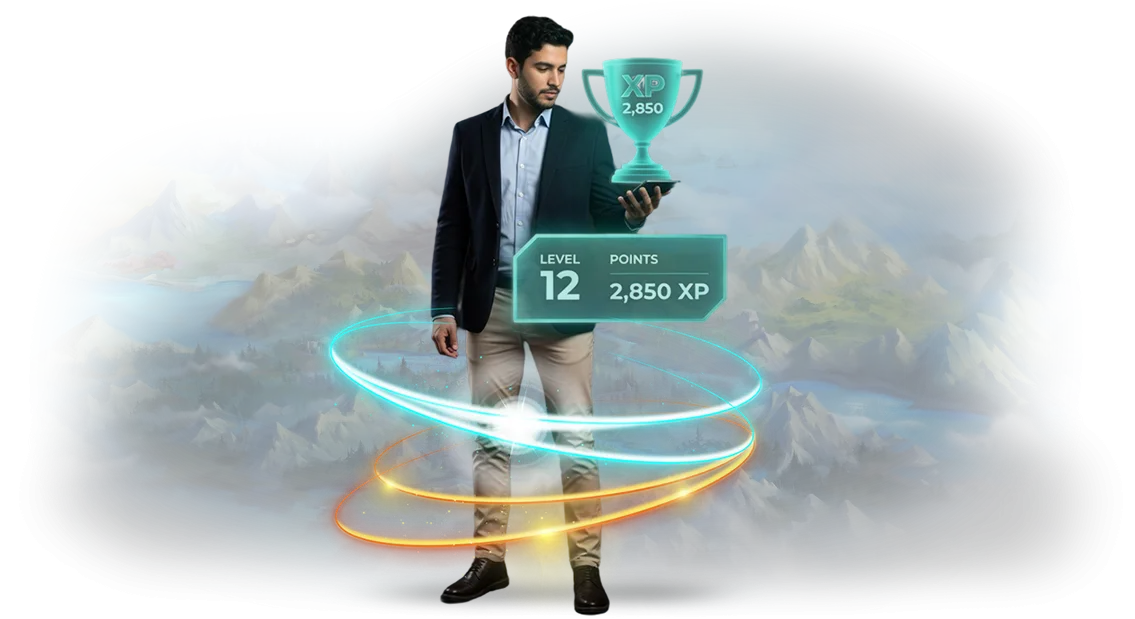
Why Auto Service Technician Training Requires Gamification
Classic auto service training programs often fail before an employee even finishes watching the third video lecture. Theory is disconnected from real tasks, tests are boring, and results are assessed formally—by "checkmarks" in a log.
As a result, staff training becomes a compulsory chore that does not change the quality of work or bring measurable benefit to the business.
The problem lies in motivation: an adult does not retain information presented passively. They remember only what they have processed through their own experience, mistakes, and practice.
Training gamification solves exactly this problem—it turns boring material into a sequence of small professional challenges where the technician tests their own decisions and sees the consequences.
In auto service training this is especially important because the cost of error is high: a wrong diagnosis, missed deadlines, a dissatisfied customer.
Game mechanics allow safely practicing complex situations—from vehicle intake to an unusual breakdown—before they occur in real work. The technician is not afraid to make mistakes and therefore masters new technologies and procedures faster.
Moreover, training gamification gives the manager a transparent picture of progress: who actually mastered the material and who just showed up. Levels, points, and scenarios become not a toy, but a competency assessment tool.
Thus, training ceases to be an abstract event and becomes a managed process that increases both the skills and motivation of employees—and therefore affects the service's revenue and reputation.
We close this gap: we structure training so that the technician does not get distracted by the phone or wait for the end of the shift.
They work through real cases from practice, compete with themselves, see their own growth, and apply the skills the very next day after the training.
What Changes After Implementing Game Mechanics in Training
Implementing game mechanics in auto service technician training solves three main problems: lengthy onboarding of newcomers, high turnover, and the gap between theory and real work.
Instead of boring instructions and lectures, employees practice skills in an interactive environment—with mistakes that do not hurt the budget, and with fast feedback.
Our team builds such scenarios based on real business processes, so results are visible within the first weeks.
Here is what changes after implementation:
-
Qualification growth without interrupting operations. The technician works through scenarios on a 3D avatar: diagnostics, component replacement, customer communication. The skill is reinforced in a safe environment, and the employee approaches a real car already prepared.
-
Faster onboarding for new hires. The average time to full productivity is reduced by 2–3 times. A new technician learns service standards and internal procedures faster—through the game rather than through trial and error.
-
Reduced turnover and better staff retention. Interactive simulators increase engagement: training becomes interesting, technicians see their progress and growth areas. This directly reduces the urge to quit after the probation period.
-
Growth in additional service sales. Scenarios practice client conversations: how to offer additional work, how to justify the price, how to overcome objections. As a result, the average ticket and the share of upsells in the auto service grow.
-
A uniform quality standard across the whole network. All technicians are trained using the same scenarios, regardless of experience and seniority. Errors related to the human factor decrease, and service quality levels out from branch to branch.
Gamification does not replace a mentor, but it removes routine work and accelerates the practice of standard situations. Technicians get a clear development path, and the company gets measurable competency growth and sustainable profit.
Gamification Formats for Staff Training
Every business has its own tasks: sometimes you need to quickly train dozens of technicians, sometimes you need to refine rare skills of an experienced team.
Gamification covers both scenarios without taking employees away from work: the employee trains in a safe environment, and mistakes do not affect clients or the budget. The format is selected for the goal—from mass training to individual programs.
| Format | For whom | What it gives the client |
|---|---|---|
| 3D trainer | New technicians and trainees | Quick adoption of service standards without risk to the car |
| Interactive simulator | Experienced employees | Practice of complex cases, improved work quality |
| Corporate 3D world | All employees | Engagement, competitive spirit, a unified culture |
| Virtual reality training | Technicians in the regions | Reduced expenses on business trips and training stands |
The table does not tell the main thing—how this affects the business. 3D trainers reduce the onboarding time by two to three times: the technician starts generating profit faster and does not make mistakes on real orders.
Auto service simulators cover emergency situations that are rare in real life: from component replacement to working with new models.
You get not just a "game", but a measurable training tool. We record each employee's progress and show management the results in numbers: the number of completed scenarios, reaction speed, and the share of successful tasks. Training investment ceases to be a black box—you see how qualification grows and what to adjust.
It remains to choose a scenario: mass training or individual programs for key specialists. We will help with both—from defining the task to integrating it into the service's daily operations.
How the Project Works: From Brief to Launch
Turnkey gamification development is not a black box. Our team breaks the project into clear stages so you can control timelines, budget, and results. Below is how the work goes from brief to launch.
- Brief and immersion — we study how technicians are currently trained, where they lose motivation, and which skills matter. We capture goals that can be measured after launch.
- Plan and estimate — you get a detailed plan with timelines, stages, and cost. You know in advance what you will receive and can adjust priorities.
- Scenario sign-off — we show the storyline, tasks, and reward system. The mechanics are approved before development—this eliminates rework and unexpected expenses.
- Development and testing — we create the 3D world and avatars, testing them on your real cases. You see intermediate results instead of getting a pig in a poke.
- Launch and adoption — we onboard employees, conduct short training, and help in the first days. Technicians immediately understand how it works.
- Support and growth — we analyze results, collect feedback, and refine the mechanics. We stay in touch after launch as well.
What Is Included in the Deliverable and Priorities for Results
We build a solution for the task of training technicians, not just "deliver files". The package includes everything needed to launch and support training on your own: from scenarios to performance analytics.
The deliverable includes:
- Methodological materials — ready-made training programs, instructions, and checklists for trainers. Your technicians understand what they are learning and how it applies to their work.
- 3D simulator with world and avatars — a digital copy of your auto service where the employee practices operations without risking equipment or clients.
- Training scenarios — standard and emergency situations: from scheduled maintenance to complex diagnostics. Each scenario addresses a specific beginner mistake.
- Training analytics — dashboards showing the progress of each technician and the entire team. You see who has absorbed the material and who needs additional practice.
- Administrator training — we hand over rights and skills for managing the platform. Your staff can add scenarios and track results on their own without involving developers.
- Technical support during the launch stage — we accompany the implementation so the transition to the new training format goes smoothly without failures or downtime.
The main priority is not the number of 3D models, but measurable competency growth. Therefore, every solution in the deliverable serves one goal: the technician acts faster and more accurately after training, and you reduce costs for error correction and retraining.
Analytics shows exactly where training pays off, and the manual helps reproduce the result for new employees.
Case Study: Gamification of the Training Process
New technicians at an auto service usually learn from instructions and videos, but that is not enough: a third make it to the end, and they start "real" work only after several months.
For the AvtoTechCentr auto service chain, we built gamified training in the company's 3D world on Unity.
Instead of boring lectures—scenarios just like in real work: vehicle intake, diagnostics, customer communication. The employee completes levels, earns points, and immediately sees their mistake without risking equipment or reputation. The game is designed so that every step brings closer to real skills, not abstract theory.
The result is visible in numbers: course completion grew from 30% to 90%, and newcomer adaptation time halved. Previously, a technician started independent work after several months; now it takes one and a half months.
This means the service gets a capable employee faster—someone who is not afraid of complex tasks and does not call the shift supervisor about every question.
For an auto service manager, the benefit is clear: training ceases to be a formality and becomes a staff retention tool. People see development, fewer leave in the first months, and work quality is stable because everyone goes through the same scenarios.
This format addresses the main pain point—the gap between "knows the theory" and "can do it". If your company has the same problem, let's discuss how to adapt the solution to your business processes.
How to Choose a Gamification Format for Your Task?
A universal gamification format does not exist—the choice depends on the specific business goal and audience. If you need to train auto service technicians, the right solution is an interactive simulator with 3D avatars and the company's virtual world.
If you want to increase motivation and engagement—ratings, team quests, and a reward system work well. Therefore, the first step is not choosing technology, but clearly understanding the task.
In practice, we help clients find their way as follows: first, we define what should change in employee or customer behavior after launch. For example, reducing training time, lowering error rates, increasing repeat visits, or raising brand awareness.
Both the format and the complexity of the mechanics depend on this. Together with you, we define the desired metrics and choose a scenario that can be easily integrated into the current training system.
For training auto service technicians, a scenario with a virtual environment that replicates work processes is especially effective: the employee learns actions in a safe mode, sees the consequences of decisions, and brings skills to the point of automaticity.
This approach reduces introductory training and helps newcomers reach the level of experienced colleagues faster.
If the task is team building or increasing staff loyalty, we offer competitive formats with personal progress, team scoring, and feedback. The main thing is that game mechanics fit into the work process and do not create extra load.
We always work on the principle of an individual approach: we discuss efficiency criteria with you, select a scenario that fits your tasks and timelines, test it, and hand over a convenient management system.
As a result, you get not just a "game", but a tool that addresses exactly your need and measurably improves business indicators.
Frequently Asked Questions About Implementing Gamification
Implementing gamification in auto service technician training raises natural questions: will work processes stop, how long will development take, and when will measurable results appear. Below are answers to the most common concerns we hear from managers.
Is it difficult to integrate gamification into the current training system? Gamification does not replace existing programs but complements them: 3D simulators and scenarios are integrated into courses and briefings that are already in use.
We adapt modules to your specifics—from newcomer internships to advanced training for experienced technicians—so the launch process does not require stopping production or completely restructuring training.
How long does development take, and when will the first result appear? The timeline depends on the scope: a standard scenario for one profession can be launched in a few weeks, while a full implementation with the company's world and a set of simulators fits into 2–3 months.
You see the first pilot module right at the start—so you can evaluate the approach and adjust details in time.
How do you assess return on investment if training does not bring direct revenue? Count the savings on the technician's and mentor's time: faster onboarding, fewer repair errors, higher customer service speed.
Gamification provides measurable metrics—the number of completed scenarios, a decrease in repeat visits, and higher exam scores. These indicators directly affect the service's profit.
What if employees perceive the training as a game and stop taking it seriously? We design realistic work situations: diagnostics, customer communication, complex repair cases.
The competitive element and ratings motivate rather than distract—technicians strive to show the best result. The manager sees each employee's statistics and understands who needs additional preparation.
Who will support the system after launch? We support the project after implementation: we update scenarios for new car models, add difficulty levels, and quickly resolve technical issues. The client receives not a one-off product, but a tool that develops together with the business.
Ready to Discuss Your Project? Leave a Request
Training auto service technicians is not just transferring technology, but also practicing skills to the point of automaticity. A gamified simulator helps reduce adaptation time and the number of mistakes. To understand how it works in your specific business, start with a short request.
After your request, you receive:
- a consultation on gamifying business processes: whether your scenario suits interactive training;
- a project cost estimate based on the number of employees and scenario complexity;
- examples of our work in training auto service technicians from our practice;
- a pilot launch plan and efficiency evaluation criteria;
- recommendations for integrating the simulator into an existing training program.
We work remotely, so geography does not matter. Over 10 years, we have come a long way from the first prototypes to solutions for companies with thousands of employees.
Every project starts with immersion in the task—so that we do not simply "make a game", but achieve a measurable result: faster readiness for a shift, fewer mistakes on real orders, and higher loyalty among new employees.
Leave a request for gamification—within one business day we will send a selection of relevant examples and answer your questions. After that it is simple: you make the decision, and we take on development and launch.