

Why doesn't information security training work?
Classic corporate information security training for employees has turned into a formality. An employee listens to a lecture, passes a test, and returns to old habits: simple passwords, suspicious attachments, public networks. The company's risks remain the same — they're just invisible until an incident occurs.
The cost of a mistake is real losses. One click on a phishing link or accidentally sending data to the wrong place leads to a leak, fines, and lost trust. The human factor is the main cause of incidents, so training must change employee behavior, not just check a box.
Standard lectures and tests can't handle this. They are passive: an employee memorizes instructions but doesn't practice their reaction. In a critical situation, they act on habit, not by the slides — and the risks remain.
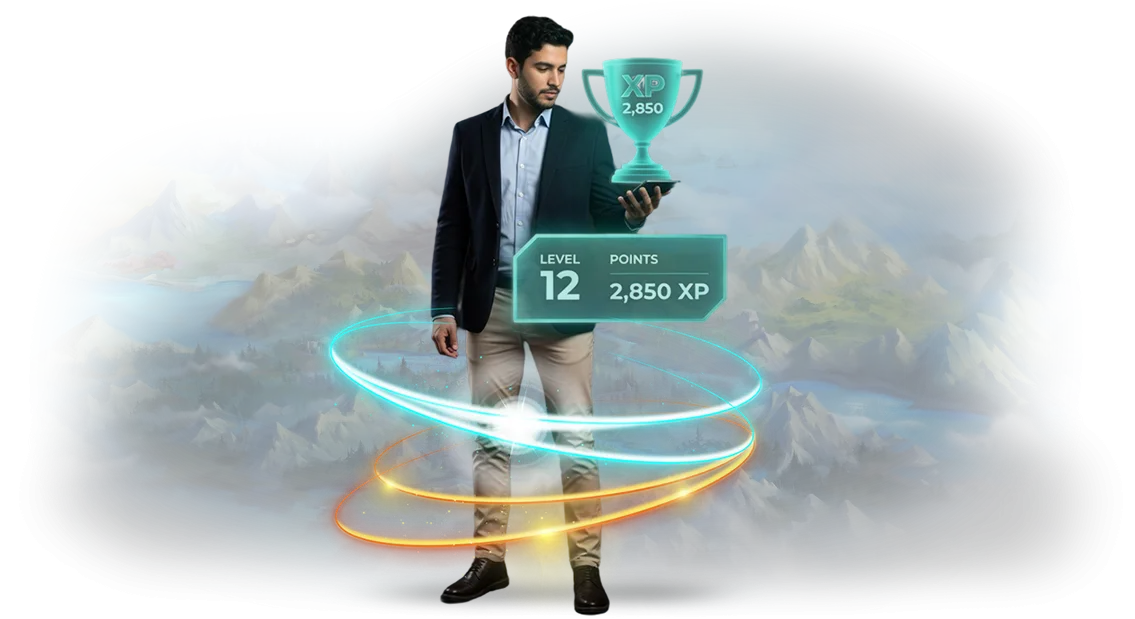
Gamification of training solves the problem differently. An employee goes through scenarios similar to real threats and makes decisions, seeing consequences immediately — but for the game character, not for the company. This builds a conscious protective habit.
We combine these scenarios with 3D avatars and a brand's virtual world, turning training into an engaging immersion. The employee gains experience that genuinely reduces the company's risks. This is information security training that works.
Gamification of training: what value for the company
Engagement and training effectiveness
Employees sit through standard information security lectures just to check a box — the material is forgotten by the end of the day. Gamification turns training into a game where everyone becomes an active participant.
This increases engagement: people complete the course voluntarily, remember the rules of safe work, and apply them in practice. Training delivers real results, not formal marks.
When employees know how to handle data and recognize threats, the company faces fewer leaks and incidents. Savings on the consequences of mistakes are a direct benefit to the budget.
Risk reduction and digital culture
The human factor is the main source of risk for business. One careless click on a fraudulent link can lead to serious losses. Gamification practices such scenarios in a safe environment: employees learn to respond to threats without real consequences. This reduces the number of incidents and leaks, and the security team gets fewer false positives.
The game builds a digital culture: employees consciously protect data, follow the rules, and report suspicious activity. This behavior becomes the norm, strengthens the company's reputation, and reduces the cost of incident recovery.
Gamification implementation formats: choose the right one for you
Every business approaches information security in its own way. Some need just a short test, some need full incident response practice, some need to engage distributed teams in a unified program.
Gamification is not a toy but a tool that must address a specific business objective: reduce risks, raise employee awareness, and give management clear metrics. That's why we've developed several implementation formats — you choose the one that fits your team.
All formats are built on the Unity platform, which guarantees consistent visual quality, smooth scenario flow, and the ability to scale the project without missing deadlines.
An employee enters the company's virtual world or talks to a 3D avatar — and in both cases gains hands-on experience, not dry theory.
Interactive training is embedded into the usual workflow, so it doesn't require a separate dedicated day and is perceived as a useful task, not an obligation.
Formats for your objective
| Format | Who it's for | What it delivers to the client |
|---|---|---|
| Scenarios in the company's virtual world | For businesses with offices in different cities or production sites | The employee enters a familiar environment and practices responding to a phishing email or suspicious file. You get an objective picture: who has absorbed the material, where the weak spots are |
| Training with a 3D avatar | For teams where personal interaction and feedback matter | A virtual mentor explains the rules, asks questions, and reacts to answers. The employee isn't afraid to make mistakes, and you see each person's progress and understand who needs additional work |
| Combined format: world + avatar + tests | For a full training cycle — theory, practice, and assessment | First the employee goes through a scenario in the virtual world, then practices actions with a 3D avatar, and finishes with a final test. One project covers all types of learning activity |
Choosing a format shouldn't be complicated. At the consultation, we review your current training system, goals, and resources — and suggest either one format or a combination.
The key criterion is not "will employees like it," but "will their behavior change." That's exactly what the scenarios, avatars, and virtual spaces we create together with you are aimed at.
How gamification implementation works: step by step
We've structured the implementation process so you understand what's happening and what results you're getting at every stage. No "black box": you approve key decisions, see intermediate demos, and approve the launch together with us.
-
Brief and audit of current training. We capture which employees take the course and which information security skills are critical for your company. We analyze where employees lose focus and make mistakes.
-
Concept approval. We propose a scenario and game mechanics that solve your specific task: from a simple quiz to a full 3D world with avatars. You make edits before gamification development begins — without extra costs.
-
Gamification development. We create an interactive environment, fill it with information security scenarios, and integrate it into your training portal or corporate system. At this stage, you get a test version and see what the training will look like.
-
Pilot launch. We launch the training on a pilot group of employees. We collect feedback and refine the scenarios so the final version works from day one.
-
Company-wide training launch. We roll out the course to all employees, set up access, and monitor completion. You see results in convenient analytics: who has completed it, which topics cause difficulties.
-
Project support. We don't abandon you after launch: we update scenarios, add new situations, and track metrics. If employee engagement drops, we suggest and implement improvements.
What's included in the delivery: a turnkey package
You don't get scattered 3D models and scenario drafts — you get a ready-to-use working package. All elements, from training mechanics to reporting, are assembled into a single system and ready to launch on your side.
-
Information security training scenarios — from phishing to working with confidential data. The employee enters a simulated situation and practices their reaction in a safe environment, so they act more confidently in practice.
-
3D characters and virtual worlds in the company's corporate style. A recognizable environment lowers the barrier to entry into training: people immerse themselves more deeply in the process and retain the material better.
-
Training analytics — clear reports on progress, mistakes, and completion time broken down by team and role. You see who has already mastered the rules and who needs additional training.
-
Administrative panel: adding employees, changing difficulty, managing scenarios and reports. Setup is handled by a manager or HR without involving programmers.
-
Integration with your corporate training platform — the course runs in a familiar interface, without extra redirects or account desynchronization.
-
Support package: documentation, administrator training, and technical support for the entire usage period. We stay with you after launch and help with any questions.
-
Closing materials and licenses — source files and rights to modify the project in-house. You're not tied to us and can expand the training simulator as your company grows.
Case study: how gamification trained employees in a month
In one implementation case, information security training turned from a formality into a driver of company security.
Employees didn't click through slides — they walked through a virtual office in a 3D world built on Unity, where they solved real work situations as an avatar: opening an attachment from the "director," sharing a password with a "colleague," clicking a link from a messenger. In a month, this approach replaced two-hour lectures.
The key isn't the graphics but the scenarios with instant feedback. A mistake in a safe environment produces immediately visible consequences, so the correct course of action is remembered emotionally, not on paper.
Engagement grew dramatically: people completed the training without reminders and even forwarded completed chapters to each other.
After a month, we measured security metrics. 94% of employees completed the entire course, whereas previously only a third showed up to lectures.
The number of incidents related to clicking malicious links dropped by half, and the average final assessment score rose by 40 percentage points. The security department received analytics for each scenario and a list of employees who repeat dangerous actions.
"For the first time, I've seen security training completed quickly, without resistance, and with genuine interest.
People reminded their colleagues to complete the next chapter and discussed the scenarios in the hallway," says the head of the company's information security department.
After the first stage, the client ordered an extended course for new hires and scenario updates to match changes in internal policies.
We replicated this successful project at a bank, a logistics operator, and a retailer.
The process from brief to launch and training results measurement is well-established, so a new client gets not a raw prototype but a ready-made game world adapted to their specific context and daily security threats.
How to choose the right gamification format?
Choosing a gamification format starts not with technology but with the learning objective: what exactly employees need to absorb — basic rules or complex action scenarios for threats.
If the goal is to introduce new hires to security policy, a short interactive course with quest elements is enough. If you need to practice behavior in emergency situations, you'll need a full 3D world with role-playing scenarios.
The closer the format is to the real work environment, the higher the chance that knowledge turns into a skill.
The second criterion is the audience. Younger employees engage more easily through gamification, but competitive elements also work well for experienced specialists.
It's important that the format is understandable to everyone: no complex software installation required, and it runs in a browser or on a work computer.
We account for the level of digital literacy — so training doesn't become a fight with the interface, but stays a fight against threats.
The third criterion is budget and timeline. If the project is time-constrained, we choose a modular approach: first launch a basic scenario, then add new levels and locations.
If the budget allows, we immediately create a detailed company world with employee avatars and realistic office situations. This doesn't inflate the project cost if the stages are planned properly. We help find a balance between the desired scope and available resources.
The main rule: don't buy the "coolest" format — choose a solution for your specific tasks and capabilities. At the start, we conduct a short audit of your training program, identify weak spots, and offer 2-3 implementation options with different levels of immersion.
You compare what fits best and finalize the scope together with us — so you get a predictable result and a clear cost estimate.
Frequently asked questions about gamification implementation
When it comes to gamification of information security training, the most common questions are about timelines, implementation complexity, and employee reaction. We answer these questions — briefly and to the point, with guarantees backed by the contract.
How long does development take?
A typical project takes from 4 to 8 weeks depending on the volume of scenarios and the level of detail. We show initial results after the first week, and then you receive intermediate versions every few days — there will be no final surprise.
Will employees manage the new format?
Gamification is built on clear actions: choosing a solution, going through a scenario, seeing a visible result. The employee moves at their own pace, and hints guide them to the right conclusions.
Before a company-wide launch, we run a pilot test on a group of users and adjust the material based on feedback.
What difficulties can arise during implementation?
The most common difficulty isn't technical but motivational: employees greet any new training without enthusiasm.
That's why we work out an engagement system in advance: competitive elements, rewards for completion, and a clear connection between actions in the training simulator and the company's real security. We also help create a communication plan so the launch goes smoothly.
What does technical support include after launch?
After the project is handed over, we stay in touch. For the duration of active use, we assign a specialist who monitors stability, answers user questions, and promptly fixes any issues. Support is included in the first month of maintenance; after that, you decide whether to extend it.
What if the training scenarios change?
The material doesn't become a static course. We structure it so you can update individual topics, add new situations, and change the game rules without a complete rework of the project. Typically, a new version is ready within a few days.
Launch gamification in your company
Gamification has already proven its effectiveness: employees complete information security training 3-4 times faster and remember the rules long-term. But to get this result, you don't just "buy a game" — you need to integrate it into your business processes.
That's exactly what we do: we take the entire journey from idea to launch and help the client achieve measurable value.
Contact us to order gamification for your specific task. At the first consultation, we'll break down how the training will fit into your system, which scenarios will deliver the greatest impact, and how quickly the project will pay off.
After that, we'll prepare an accurate project cost calculation — no hidden terms and no surprise add-ons.
What you get by working with us:
- Expert consultation — we help you define training goals and choose a format that fits your team.
- A cost calculation tailored to your task — we assess timelines, scope, and budget before we start, so you can plan your budget with confidence.
- Training implementation without stopping your business — we launch gamification alongside your regular operations; employees complete the course at their convenience.
- Adaptation to your processes — game mechanics are configured around your internal policies, not replacing them.
- Training that stays in the company — after launch, you monitor progress and results yourself, without constant developer involvement.
- A guaranteed result — we define success criteria in the contract and support the project after launch.
Implementing information security training isn't about technology — it's about getting your employees to act correctly and without reminders.
We've already delivered dozens of such projects for companies across industries and know how to make the process easy for your team and valuable for your business.
Leave a request for a consultation — we'll explain how gamification will work specifically for you and prepare a cost estimate within a few days. Start with a short conversation, and we'll take the entire project from there.