

Training for New Equipment: Why Old Formats Don't Work?
Every new piece of equipment is a challenge for the entire team. While employees master the machinery through trial and error, the company loses time, materials, and money.
Mistakes made by newcomers on real equipment result not only in damaged parts but also in downtime, missed deadlines, and additional strain on mentors who have to step away from their own tasks.
Classic on-the-job training costs more than it seems: consumables, potential breakdowns, risk of injury, and staff demotivation after early failures.
What's more, even successfully completing the orientation doesn't guarantee that the employee will retain the skill and not lose it within a week. Training turns into stress rather than confident mastery of new machinery.
We solved this problem through gamification: the employee trains on a safe digital simulator, repeats complex operations without risk or expense, and the system clearly shows where they make mistakes.
That way, staff gain experience before working with real equipment, and the business gets a stable training process without downtime or unnecessary costs.
What Benefits Gamification of Business Processes Delivers
Fast Path to Stable Performance
New equipment always carries downtime risk: by the time an employee figures things out, a week or more has passed.
Gamification compresses this timeline many times over: people master processes in an interactive format where every step is reinforced by practice rather than by reading manuals.
As a result, a newcomer reaches planned productivity in 2–3 days instead of the usual two weeks. Early mistakes don't damage real equipment, so the employee acts confidently and isn't afraid to experiment.
Fewer Errors and Accidents
Training on real equipment is expensive and dangerous — every mistake can turn into a breakdown or an injury. In a game scenario, the employee repeatedly practices difficult situations with no risk to production or people, then carries those skills into real work.
Companies that adopt this approach report a noticeable reduction in accidents within the first month. What's more, safe skills become reflexive — the employee acts correctly even under stress.
Staff Engagement
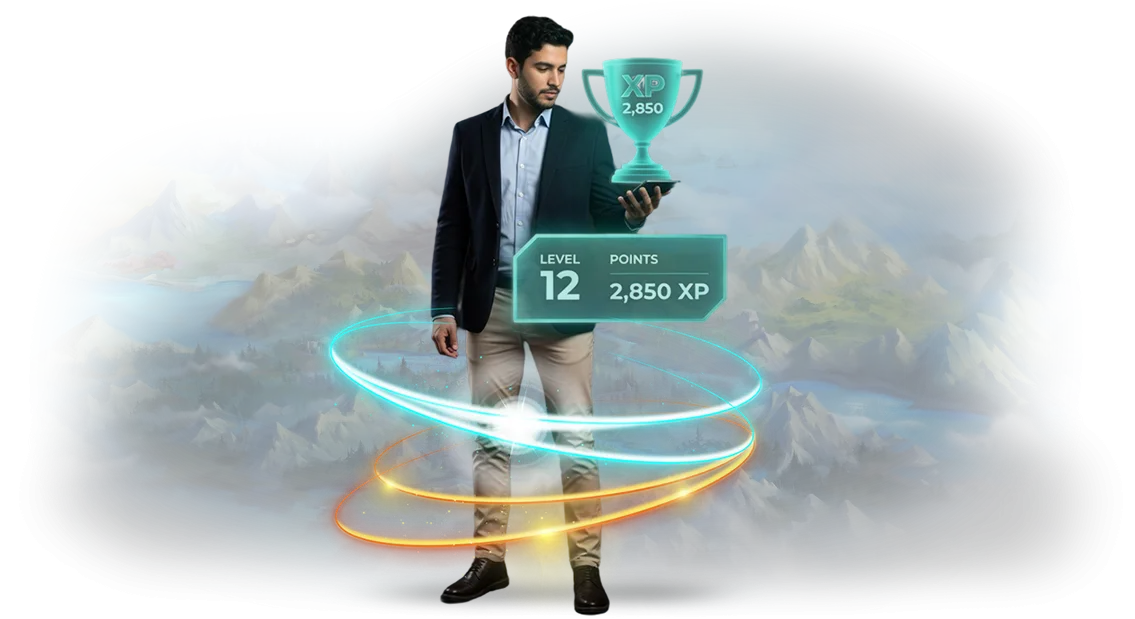
Ordinary courses and lectures are boring, while gamification turns training into a game: points, levels, competition with colleagues. Employees come back to the simulator in their spare time on their own — because it's interesting, not because they "have to."
High engagement directly affects results: people don't just clock hours, they actually absorb the material. Knowledge sticks faster, and interest in the work grows along with confidence in their abilities.
Saving Company Resources
Online training doesn't require renting venues, instructor travel, or stopping equipment for practice. You create a course once — and connect new employees anywhere without additional costs.
This is especially beneficial with regular hiring: you invest in development once and use it for years. Plus, there's less consumption of materials and less wear and tear on machinery, which are unavoidable with hands-on training — that's direct budget savings.
Gamification Formats for Different Tasks
Staff need different types of training: an operator needs to get hands-on practice with new equipment, a manager needs to see the entire chain as a whole, and adjacent departments need to align with each other.
There's no one-size-fits-all format, so we offer four gamification options tailored to the specific task.
| Format | For whom | What it gives the client |
|---|---|---|
| Virtual simulator | Operators, process engineers | Practicing skills on new equipment without the risk of downtime or breakdowns. The employee can make as many attempts as needed to bring movements to automaticity. |
| 3D quest | New employees, trainees | Learning regulations and safety procedures in the form of an investigation or adventure. Interest is maintained, and retention is higher than with reading manuals. |
| Process simulation | Managers, logistics specialists, planners | Running "what if..." scenarios without stopping production. Bottlenecks and consequences of decisions are visible before they hit the budget. |
| Business game | Cross-functional teams, executives | Practicing interdepartmental interaction and finding shared solutions in conflict situations. Reduces errors caused by misalignment. |
The formats can be combined: for example, start with a 3D quest for theory, then a virtual simulator for practice, and finish with a business game to reinforce collaboration.
We select a set tailored to your task and timeline — you get a clear training plan and measurable results.
How Staff Training Implementation Works
Implementation isn't a "black box" — it's a clear route with clear checkpoints. We break the project into stages, fix the timeline, and document approvals so you always know what's happening and what's needed from you.
In the end, employees get a working simulator, and you get a measurable result: fewer mistakes and faster onboarding to new equipment.
-
Brief and task audit. You tell us about your processes, regulations, and equipment specifics. We ask questions, review documentation, and determine which skills are critical for employees. The outcome is a clear understanding of goals and scope.
-
Agreeing on the plan and timeline. We prepare a roadmap: stages, deadlines, approval points. You approve the plan and know when you'll see first results. We also document what's included in the project and what can be added later.
-
Scenario and prototype. We develop the training scenario: what situations the employee works through and how feedback is structured. You see a prototype at an early stage — details can be adjusted before the main development begins.
-
Building the 3D world and avatars. We populate the virtual space: work environment, equipment, avatars of colleagues and instructors. You receive a ready-made environment that mirrors real conditions and helps the employee act without risk to production.
-
Testing with a group of employees. We validate scenarios with a real audience: is the interface clear, is the learning effect achieved. We collect feedback and make adjustments. You see how the training works in practice before the official launch.
-
Launch, support, and analytics. We roll the system out to all employees, train administrators, and hand over documentation. After launch, we track completion statistics and help update content — the training stays relevant when processes change.
At every stage, we stay in touch and respond promptly to questions. You control the process but don't dive into technical details — that's our job.
What's Included in the Delivery Package
The delivery package isn't just a collection of files — it's a ready-made solution for launching training. We hand over everything needed for employees to start working with new machinery faster and without mistakes, while you see the results in numbers.
- Training scenario tailored to your process — step-by-step logic from getting familiar with the equipment to complex operations. The employee follows a path that mirrors real tasks without jumping between topics.
- 3D world of your enterprise — a virtual copy of your site or workshop. Trainees operate in a familiar environment, so after the course they don't need to adapt to the real space.
- Interactive avatars — virtual mentors and characters that accompany the employee at every stage. They provide hints, flag errors, and create the feel of live training.
- Built-in instructions and hints — the employee gets guidance right at the moment of action. No need to flip through manuals or search for answers — everything appears when needed.
- Training analytics for each employee — you see who completed the course, who is making mistakes, and which operations are the hardest. This lets you refine the program and reduce the risk of breakdowns.
- Integration with your HR system — training results are automatically sent to your HR or development department. You get ready-made reports without manual data collection.
- Technical support at launch — we help deploy the solution and train your administrators. Launch happens without stopping workflows.
Case Study: How We Trained Factory Employees
At a machine-building plant, we were given a task: bring a new equipment line into operation, but staff training was taking too long and involved too many errors.
Paper manuals didn't work — operators were afraid of the expensive machinery, and mentors physically couldn't cover all shifts.
How We Built the Training
We created an interactive simulator for the plant using Unity — an exact 3D copy of the workshop with the new equipment. Each employee "walked through" all operations in a safe virtual environment, from line startup to emergency situations.
An error on the simulator didn't cause a breakdown or downtime — only a hint and a chance to repeat the action.
Training began to feel like a video game rather than a boring lecture. People voluntarily replayed difficult stages until they brought the skill to automaticity.
Meanwhile, the system logged every step — managers could see who was ready for real work and who needed additional instruction.
Results the Plant Saw
The key metric: onboarding time was cut by 2.5 times. Instead of a two-month internship, new operators reached the line in three to four weeks. Defects at the startup stage dropped by 30% — employees had already rehearsed the correct actions before touching real equipment.
The format adoption was particularly gratifying: 96% of staff completed the training to the end, and the plant workers themselves asked for access to the simulator outside working hours — to "sharpen their skills." Today, this product is used for regular retraining and new-hire onboarding, and the plant's management has made it part of the standard training program.
For us, this case confirms a simple truth: gamification removes the fear of complex machinery and delivers a measurable effect in the first training cycle. If you have a similar task — we're ready to show a demo and calculate what this approach could deliver at your facility.
How to Choose the Right Format for Your Task?
Choosing a gamification format for new-equipment training isn't a matter of preference — it's a matter of economics. You need to understand how many employees will be trained, what equipment they work with, and how often it's updated.
These selection criteria determine what will pay off: a lightweight interactive course or a full 3D simulator with a virtual replica of your company.
If you're dealing with dozens or hundreds of specialists, a scalable solution is better — an interactive course with 3D models and knowledge checks. It can be completed at a comfortable pace, and results are easy to track.
If the group is small and the equipment is complex, it's worth investing in individual scenarios where each employee practices actions without risk to machinery or people.
The type of equipment is the second key criterion. For expensive, dangerous, or rarely encountered machinery, a virtual simulator is indispensable: it lets you make a mistake and learn from it without real consequences.
This matters especially in manufacturing, energy, logistics, and medicine, where the cost of error is high.
The frequency of updates and the scale of investment also factor in. If you purchase new equipment every year, choose modular gamification: it's easy to replace part of a scenario without paying to rebuild everything from scratch.
And it's better to budget on the principle of "basic scenario first — expansion later," so you get results quickly and scale from there.
We help you find the right format for your task — we analyze the number of employees, equipment specifics, and update plans, then propose a solution with a clear economic effect.
Tell us about your task on a short call — you'll get a recommendation and a calculated implementation plan for business gamification.
Frequently Asked Questions About Training Gamification
Training gamification is a new format, and clients naturally have doubts before launching. Here are answers to the most common questions: reliability, timelines, equipment, and employee engagement.
What happens if the system crashes during training?
We support the project after launch and formalize warranty obligations in the contract. We design a fallback scenario in case of failure, and the technical team stays available via chat and phone to resolve the issue quickly and keep training running.
How long does implementation take?
It depends on the scope of the task. We launch a basic scenario in 2–3 weeks; a comprehensive project with a 3D world of the company and multiple courses takes a month and a half to two months.
We provide exact timelines after the brief and document them in the work plan so you understand the stages and checkpoints.
Do we need to purchase new equipment?
In most cases, the standard computers or laptops your company already has are sufficient. We optimize the project for your existing hardware, so employees train at their usual workstations with no downtime and no additional spending on technology.
Our employees don't like learning — how do we get them engaged?
Gamification turns training into a game: levels, points, rewards, and competition among colleagues. People get drawn in on their own because it's engaging and delivers quick results. Mastering new equipment happens naturally, and repeated runs reinforce the skill.
If you still have questions — send them in the comments or contact us directly. We'll review your situation and show how gamification can solve the training challenge for your specific company.Get Your Cost Estimate and Implementation Plan in 1 Day
Leave a request, and within one business day you'll receive a project cost estimate and a gamification implementation plan tailored to your task. We've already built 3D training for new equipment, so we understand the difficulties employees face and how to hold their attention.
During the consultation, we'll discuss which format suits you best: from a training simulator to a full corporate world. We'll show example projects for companies in your industry and send a checklist so you can assess your team's readiness for implementation.
Immediately after your inquiry, you'll receive:
- Cost estimate and timeline for your scenario — no hidden work or "pay-as-you-go" surprises.
- A gamification implementation plan with stages and results for each stage.
- Examples of 3D training for new equipment — see how it works in practice.
- A "Company Readiness for Gamification" checklist — understand what needs to be prepared on your side.
- A consultation with an expert: we'll answer questions about employee engagement, technical support, and integration with your processes.
- Format recommendations: simulator, trainer, quest, or a combined scenario.
This is not binding: the estimate and plan are meant to help you make an informed decision. If the project isn't right for you — you'll walk away with the checklist and a clear understanding of next steps.
Leave a request now — we'll start with a consultation and show you by tomorrow how gamification can accelerate training and reduce equipment downtime.