

Why Are Employees Not Engaged in Project Management Training?
Employees see project management training as an obligation: sit out the hours in a conference room, get a certificate, and return to familiar tasks.
The material is presented abstractly — slides full of terms, examples from other companies, rarely connected to the team's real tasks. As a result, employee engagement stays formal, and new knowledge never reaches practice.
This is especially noticeable in project management — a discipline where skills matter, not theory. Without the chance to try, make mistakes, and adjust course, people see no connection between training and their actual work.
They retain 10% of the information, and within a week they are back to old methods — missed deadlines, team conflicts, and lost tasks.
For business, this means double losses: the corporate training budget is spent, while productivity and project quality fail to improve.
Managers receive formal reports on course completion, but no measurable improvement — no faster releases, predictable timelines, or accountable employees.
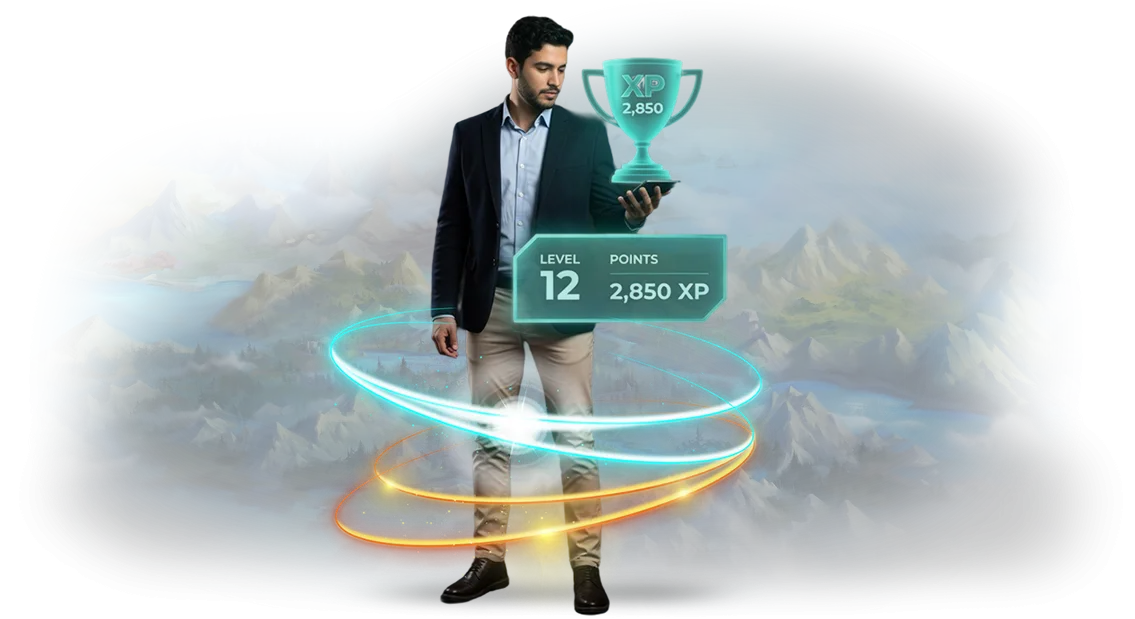
The problem is not laziness or low motivation — it is the format. Gamification of training solves exactly this: it turns the adoption of project management methodologies into an engaging process with a clear goal, feedback, and the right to make mistakes.
Employees begin applying project management tools in practice, and their engagement grows — because training becomes a personal experience, not a lecture.
Three Results from Gamifying Employee Training
Managers often complain that employees go through training formally and forget half the material within a month. The reason is simple: ordinary courses and presentations do not create emotional engagement.
Gamification solves this by turning the process into an engaging game with clear rules, levels, and rewards.
The first measurable result of implementation is increased engagement. Employees do not skip modules, they complete tasks with interest, and they make it to the end of the program.
Instead of coercion, intrinsic motivation kicks in: they want to clear a level, earn points, and outrank colleagues on the leaderboard.
The second result is faster learning. When people see their progress and get instant feedback, they grasp the essentials quicker and get distracted less.
Companies that have introduced gamification into employee training cut training time by one and a half to two times — that is direct savings in hours and budget.
The third result is better knowledge retention. Training material presented in a game format is absorbed through action and emotion, not rote memorization. That is why knowledge stays in memory longer and converts into practical skills faster. Employees ask the same questions less often and work more confidently in real situations.
Together, all three effects deliver the main thing: greater overall training effectiveness. You see not "checkmarks for course completion," but real changes in employee behavior and outcomes. These are the benefits of gamification that we help you achieve on your project.
Three Gamification Formats for Business
Gamification of project management training turns dry theory into safe practice. The employee makes decisions in game scenarios, sees the consequences, and remembers action algorithms — rather than just listening to a lecture.
We offer three formats that differ in depth of immersion and participant coverage. Choose the one that solves your company's challenge: from skill practice for a single team to building a permanent learning environment for the entire workforce.
| Format | For whom | What it delivers to the client |
|---|---|---|
| 3D trainer | For teams that need to quickly practice specific project management skills | Employees train in a realistic environment, receive instant feedback, and refine their actions to automaticity |
| Avatar-based simulation | For managers and project teams that want to improve communication and decision-making in complex situations | Participants experience scenarios with avatars, see the consequences of their decisions, and change their behavior without business risk |
| Corporate 3D world | For a company building a corporate university and wanting to involve employees in regular training | A unified environment appears: employees learn, compete, and apply knowledge in projects, while you track each person's progress |
All three formats integrate easily into your existing training program and adapt to company policies. We handle scenario development, avatar creation, and integration — all you need to do is set the objective and get trained employees.
How Gamification Implementation Works
We structured the process so you always understand what is happening and what result you will get at each step. Gamification implementation takes 4 to 8 weeks, depending on scenario complexity and the number of employees. Below is the standard workflow, which we tailor to your company's objectives.
- Brief and immersion. On a call, we break down the goals: project management training, skill practice, engagement growth. You tell us about your team and pain points — we propose the right mechanics.
- Scenario design. We design the narrative and game situations that mirror real work tasks: timeline planning, resource allocation, prioritization. We define how to measure employee progress.
- Concept approval. We present a prototype and the game logic at an accessible level — no technical details. You make edits and approve the final scenario before development begins.
- Development and assembly. We build the game on a professional engine, integrate it with your learning system, and configure roles and levels. At this stage, you receive a test version and see how it looks.
- Launch and team training. We launch the gamification, help run the first session, and advise on motivating employees and answering their questions.
- Support and evolution. We analyze results, refine scenarios per your requests, and add new levels — so the game stays useful long-term.
After the first month, you receive clear reporting: who completed the training, which topics were difficult, and how the speed and quality of project task completion changed. We stay in touch and make changes promptly so gamification delivers measurable business value.
What Is Included in Delivery and Setup
We prepared the delivery package so that launch takes minimal time and the result is predictable. You get not a "folder of files," but a ready-made tool: scenarios, characters, settings, and instructions.
Employees start using the trainer on the very first day after approval — no long ramp-up or technical questions.
What is included in the delivery package:
- Project management training scenario. Game situations with branching paths where participants choose solutions, assign tasks, and manage risks. Built-in assessment criteria show how sound each choice was — ready-made analytics for HR.
- Your company's 3D world. Virtual offices, meeting rooms, shared spaces — a familiar environment that is easy to navigate. This immersion boosts engagement: employees perceive the scenario as part of the job, not a formal course.
- Employee 3D avatars. Each participant has a personal character that acts within the scenarios. Avatars help practice communication and decision-making skills in near-real conditions — far more useful than slides.
- LMS integration. Training results, scenario completions, and scores are automatically transferred to your tracking system. No need to collect data manually or build reports — everything is visible in one window.
- Instructions and documentation. Clear guides for launching the trainer, configuring settings, and troubleshooting errors. They work even for employees without a technical background, so training will not stall after we hand over.
- Administrator training. We run hands-on sessions for your team: how to manage the course, adjust scenarios, and track progress. Administrators work confidently with the system after just two sessions.
In the end, you get a transparent tool that does not require ongoing developer support. Your specialists manage the process independently, while employees practice project management skills in a safe 3D environment.
If needed, we stay in touch — helping with refinements and expanding scenarios for new business challenges.
Case Study: Implementation at a Manufacturing Company
For a manufacturing company with distributed shifts and high personnel turnover, classic training had stopped working: employees took courses "just to check the box" and forgot basic processes within a month.
The goal was strict — build a program that truly engages and holds attention, not one that simply logs that the content was viewed. We proposed turning the training into a gamified project management scenario with employee 3D avatars and virtual production floors.
Instead of dull slides — an interactive simulator: the employee makes decisions, allocates resources, responds to disruptions, and sees the results of their actions on screen.
The results were telling: training engagement grew by 45%, and course completion speed accelerated by 30% — employees began completing the program at convenient times without interrupting production.
For the company «PromTechEngineering» we implemented a similar solution. Staff satisfaction with the training reached 4.8 out of 5, and a repeat order for new modules confirmed the effectiveness of the approach. Post-course knowledge assessment scores nearly doubled compared to the previous text-based version.
What does this mean for you as a client? Faster time-to-productivity for new hires, reduced burden on mentors, and fewer errors caused by the human factor. Gamification is not entertainment — it is a tool for measurable results.
You see concrete numbers: who completed the training, which topics are lagging, and how team productivity changed after the program.
How to Choose a Format for Your Task?
The choice of gamification format depends directly on the result you want from project management training. If employees need to quickly master specific skills — for example, task prioritization or risk management — a compact trainer is enough.
If the goal is to teach the team to work as a single mechanism, see the entire process end-to-end, and make decisions under uncertainty, a deeper simulation or a full-fledged 3D world will be required.
A trainer is short scenarios with a clear action algorithm and instant feedback. It is great for practicing specific competencies: in 20-30 minutes, an employee works through a situation, sees their mistakes, corrects them, and reinforces the right behavior model.
This format is easy to embed into regular training and use for quick knowledge checks before real projects.
A simulation is a larger-scale experience where the participant manages a whole project from initiation to closure.
Here there is a budget, deadlines, resources, unforeseen circumstances, and the need to communicate with "stakeholders." Simulation teaches you to see interdependencies, make well-considered decisions, and take responsibility for them. It is ideal for current managers and employees preparing for leadership roles.
If you need not just to train, but to engage and unite the team — choose the 3D world. Participants immerse themselves in the company's virtual space, interact with each other, solve tasks as a team, and see how their decisions affect the overall result.
This format strengthens emotional engagement and material retention — people do not just complete a course, they live it.
We help you select a format for your task: we analyze goals, audience, number of participants, and desired outcomes.
Together we will determine whether a trainer is enough for targeted skill development, whether a comprehensive simulation is needed, or whether the team would benefit from immersion in a 3D world.
Either way, you get a solution that measurably improves the effectiveness of project management training.
Common Client Concerns and Our Answers
Any gamification of training project raises questions — that is normal, because you are investing budget and time. We answer the most frequent concerns so you can make your decision calmly and without hidden risks.
"Budget — won't it cost more than classic training?"
We are not selling an "off-the-shelf box" — we create a tool that pays for itself through increased engagement and faster skill acquisition.
Employees start applying knowledge in practice sooner, and mistakes that once cost losses are worked through in a safe environment.
The cost is fixed at the brief stage and does not change during the process. You receive an estimate with clear stages — no "surprises" mid-project.
"Timeline: we don't have a month for ramp-up and approvals"
We work by a clear framework: from brief to launch takes a pre-agreed amount of time. You get a calendar plan with dates, showing what will be ready by each stage.
Thanks to ready-made assets and a fine-tuned team, we do not waste time on experiments. You launch the training on schedule — and see results immediately.
"Employees won't figure out the 3D world — it's too complicated"
Quite the opposite: avatar-based spaces are intuitively clear even to those who have never played games. We design the interface so people spend their effort on learning, not on figuring out the technology.
Scenarios are embedded in real work situations — the employee is not "beating a level," but solving actual cases. Onboarding support and a short guide resolve all questions within the first day.
"Integration into current processes — will we have to rebuild all training?"
We embed gamification into the system you already have: we connect it to your corporate portal, LMS, or use it as a standalone module. There is no need to change familiar tools — just set aside a couple of hours in the training schedule.
Our team handles the technical setup and coordination with your IT department. You get a ready-made training block that works from day one.
If a concern remains — ask us directly. We will respond within one business day and show how similar tasks were solved for projects in your industry. A convenient format — a short consultation after which you will understand whether gamification is right for you.Order Turnkey Gamification
By ordering turnkey gamification, you remove all operational load from your team — from scenario development to launch and support.
We handle design, content, technical implementation, and integration, while your employees immediately get a ready-made tool for project management training.
No abstract "interactive gimmicks." After a short consultation, you receive a scenario tied to your business processes, roles, and the team's real tasks. This is not an entertaining quest, but a trainer that reinforces the right skills and delivers measurable results.
What you get when you order:
- A project estimate tailored to your task: format, scope of work, and timeline — before we start, with no hidden stages.
- A scenario based on your business processes, not a template course.
- A prototype and approval of key mechanics before full development.
- A complete turnkey solution: setup, team training, and launch.
- Post-implementation support and assistance as the program evolves.
- A clear results report: engagement, progress, and employee growth areas.
Each item addresses a specific pain point: you do not overpay for extras, do not lose time on technical details, and do not risk getting a "game for the sake of a game." Gamification becomes part of the project management training system, not a one-off standalone event.
Submit a request for a project estimate — we will discuss your task, choose a format, and show how it will work in your company. It carries no obligation: you will get a scenario and an honest timeline assessment, then make your decision afterward.