

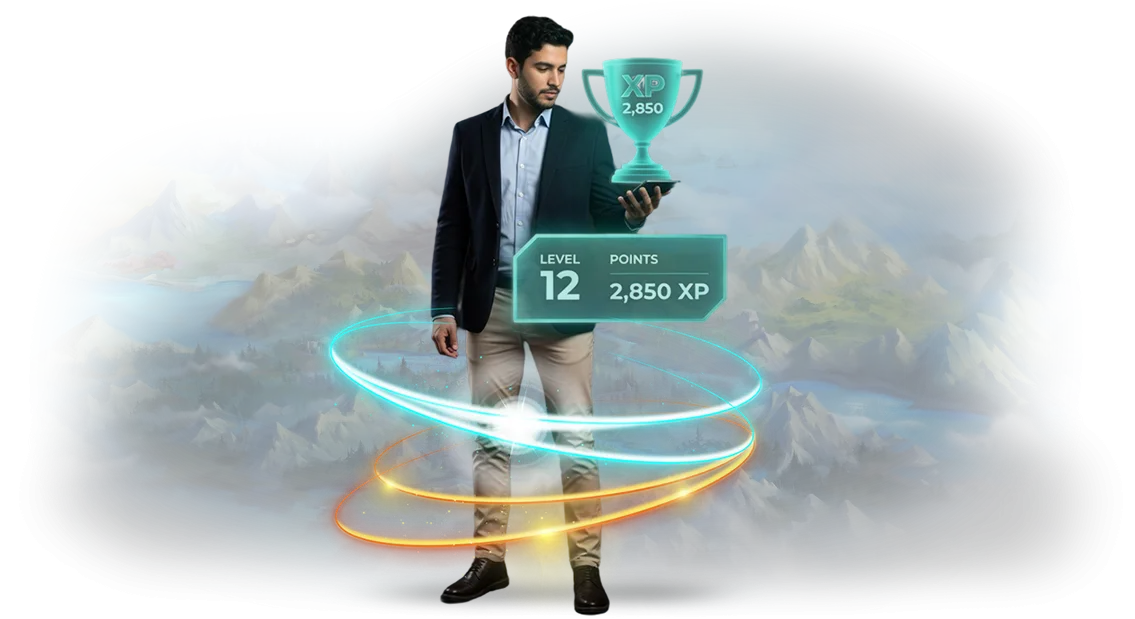
Why training in internal systems requires gamification
When employees complete internal system training "just to check a box," the business gets the illusion of competence. All screens have been viewed, tests have been passed, but a week later colleagues are again calling support with a basic question.
The reason is simple: corporate training in the form of presentations and manuals creates neither interest nor an emotional connection with the material.
Traditional staff training is built on memorization, not understanding. An employee reads the regulations but does not imagine how to act in a non-standard situation. As a result, mistakes repeat, processes slow down, and each new employee costs more than they should. This is not a motivation problem — it is a format problem.
Gamification of training turns a boring obligation into a conscious action. Employee engagement happens through clear mechanics: goals, levels, feedback, rewards for results.
A mistake stops being a failure — it becomes part of the process, where you can try again and see the consequences of your decisions in a safe environment.
Why is this especially important for internal systems? They contain many steps, rules, and non-obvious scenarios. Learning them from a manual is impossible — practice is required. Gamification provides this practice in a game scenario close to real tasks.
The employee trains on a virtual example rather than on live data, so they master the system faster and more confidently.
We cover this need by developing 3D avatars and a company world on Unity — the employee trains in a familiar brand environment rather than in an abstract program. As a result, time-to-competency decreases, the number of support requests drops, and knowledge stays for a long time.
What gamification gives a company's business processes
Employees do not complete boring briefings — that is a fact. Traditional presentations and text-based manuals are forgotten within a day. How quickly a person masters internal systems affects their productivity and the number of errors. Gamification turns training into a process employees want to complete rather than put off.
The main benefit is engagement. When internal system training looks like exploring the company's 3D world, with avatars, quests, and competition, employees return to the material on their own.
They see their progress, receive instant feedback, and are not afraid to make mistakes — this is especially important when working with complex corporate services where the cost of an error is high.
The second benefit is speed. Practice in a game environment is learned several times faster than reading instructions. A new employee covers in a couple of days what previously took weeks, and starts delivering value to the business sooner.
Gamification also reduces turnover: employees feel the company is investing in their growth, so they stay on the team longer.
At our team we build such solutions on Unity — this allows us to create a detailed 3D company world with characters that naturally guide the employee through the scenario.
The mechanics are refined on real projects, so you get not a toy but a working tool for staff onboarding and training.
In the end, gamification gives the business a measurable result: increased engagement, faster training, and lower turnover. Most importantly, employees actually start using internal systems instead of working around them.
Gamification formats for your company's tasks
There is no universal solution for training in internal systems: gamification formats are chosen based on the task and audience. New employees need fast onboarding, experienced ones need practice of complex scenarios, and managers need visible dynamics.
That is why at our teamwe first break down the task and then choose: simulations, employee quests, or continuous process gamification.
Each format addresses a specific business need. Training simulations let employees try without consequences, quests build team interaction, and ratings keep interest alive after launch. Below is a table to help you choose.
Simulations, quests, and ratings: what to choose
| Format | For whom | What it gives the company |
|---|---|---|
| Training simulations | New employees and those in complex roles | Faster onboarding, practicing mistakes without harming the business |
| Employee quests | Teams that need to improve collaboration | Engagement and reinforcement of processes through real-life scenarios |
| Process gamification | All departments after a system rollout | Regular system use and reduced resistance |
| Ratings and achievements | Managers and active specialists | Transparent progress and healthy competition within teams |
Formats are rarely used separately. Most often we launch simulations at the start, then add employee quests, while process gamification maintains the result. This is how training in internal systems turns from a one-time event into a continuously working mechanism.
How gamification development works with our team
We have structured the process so that you see results at every stage and understand where the effort is going.
Gamification development starts not with code, but with immersion in your business task: what processes need to be accelerated, where employees lose motivation, and how success should be measured.
Then comes step-by-step work, with each step bringing the launch closer — without disruptions or unexpected rework.
- Brief and training audit. We study your internal regulations and work scenarios and find the points where employees most often make mistakes or lose interest. We define gamification goals: reducing time to mastery, lowering error rates, and increasing engagement.
- Concept and scenario. We show what the company world and 3D avatars will look like and what game narratives will help employees remember information more easily. You approve the overall idea before production begins — this saves budget and time.
- Mechanics design. We define the rules: how points are awarded, which levels and rewards motivate employees in different roles, and how to provide feedback. We also build a clear progress system for each employee.
- Development and integration. We create the gamification module itself and carefully integrate it into your platform or training portal. Employees do not need to switch between systems — everything works inside the familiar interface.
- Pilot launch. We enable gamification for a small group, collect first reactions, and check whether the mechanics actually increased activity. We adjust what did not work before the full rollout.
- Launch and administrator training. We deploy the solution to all employees and show your team how to manage content, add tasks, and track results without developers.
- Support and evolution. We monitor metrics, update scenarios, and add new levels and rewards so interest does not fade. Gamification continues to work after launch — it is not a one-off project but a living system.
Timelines depend on scale: a basic module with avatars and levels takes about a month, while a full company world with multiple training scenarios takes up to three months. At each stage you receive intermediate demos and can influence the result before final delivery.
What is included in the employee training package
When preparing the solution, we put together a package that contains everything needed for a quick start and for controlling employee training.
It is not just a scenario on a screen, but a ready-made system: from a simulator to analytics that can be used in the very first working week.
- Interactive scenarios — we model real operations from your internal system. The employee learns to perform tasks in practice rather than memorize instructions.
- 3D company worlds — we create a virtual space that reflects elements of your office, brand, and processes. This increases engagement and makes training part of the employee's own environment.
- Training materials — the simulator includes built-in hints and reminders, plus ready-made guides for review. The employee can always return to the necessary step.
- Training analytics — you see progress for each person: who completed the training, where difficulties arise, and how long it took to master the material. This makes it easier to understand who needs additional support.
- Methodological recommendations — we help integrate training into the current workflow: use scenarios during onboarding, retraining, or preparation for certification.
- Department customization — different scenarios and access levels for different roles. You decide which blocks an employee sees at first login and which appear after an exam.
- Technical support and updates — we support the training after launch: adjust scenarios when needed, answer user questions, and make sure everything works reliably.
The main result is a training system that reduces onboarding time and improves work quality. Employees start confidently using internal tools faster, while managers get an objective picture of how well the material was learned — without having to collect reports manually.
Case study: how gamification increased employee engagement
Companies often invest in training, but employees complete courses formally and forget everything within a week. As a result, the business gets not knowledge but a spent budget and operational errors.
We solved this problem for a large retail chain, Market-Line — instead of boring lectures, we built an interactive simulator based on a 3D world of the office and warehouse.
New employees, in the role of an avatar, performed real operations: receiving goods, processing returns, and working with the cash register. Every correct action earned points and unlocked new levels. Training became a game people wanted to return to, not a mandatory task to sit through.
In one month, 800 employees completed the training. 92% made it to the end — by comparison, no more than 60% finish ordinary courses. Time to steady performance was cut in half, and the number of errors when processing orders fell by a third. Managers saw results immediately after the first pilot launch.
The HR director noted: "Employees themselves asked for access to the simulator instead of postponing the training.
We got measurable growth in speed and quality of work." After the successful launch, the company ordered a second module — this time for training store managers. This confirms: gamification gives the business not a toy but a working tool that pays off.
How to choose a gamification format for your task?
Choosing a gamification format often seems difficult, but there is no universal solution. Everything depends on three things: the complexity of the business process, the number of employees, and the result you want to measure.
If employees need to master a complex internal system, choose an interactive simulator with a 3D avatar. It allows them to go through scenarios step by step, make mistakes without consequences, and immediately see results.
For simple rules and instructions, light mechanics with rewards are enough — they hold attention without overloading.
The size of the audience is also important. When dozens or hundreds of people go through training, a modular format is more convenient: everyone moves at their own pace, while the manager sees progress.
If teamwork is critical to the process, add competitive elements — they increase engagement several times over.
The third criterion is a measurable result. If you need to evaluate the speed of getting up to speed, choose a format with action and error analytics.
If the goal is to strengthen loyalty to the brand, an exploratory world works well — where employees find answers themselves and gain an emotional experience.
We will help you choose the format that solves your specific task: we analyze goals, audience, and success criteria, then propose a solution. This way you get gamification that employees actually use, not a "game for the sake of a game."
Answers to common questions about gamification
Any new training system raises questions. Especially when it comes to gamification: won't it be too complicated, won't it distract employees from work, and how do you know the training is actually useful? We have gathered answers to the most common concerns from managers — short and to the point.
Below are typical fears and how we address them in real projects.
Is gamification difficult to implement and will we have to stop work processes?
Implementation happens in stages, in parallel with your current tasks. We analyze business processes, find the points where employees most often make mistakes, and create training scenarios.
Employees complete short 10–15 minute modules per day — this does not disrupt the rhythm of work. Technical issues are handled by our team; all you need to do is give us a clear understanding of your processes.
Does gamification distract employees from their main responsibilities?
Gamification is not a game for its own sake, but a way to reinforce knowledge through practice. The scenarios mirror real actions in your system, so employees learn and immediately apply their skills at the same time.
As a result, they complete tasks faster and make fewer mistakes — the time spent on training pays off within the first weeks.
How do we measure training effectiveness?
Before the start, we define target indicators: speed of system login, number of errors, and time spent on standard operations. In the dashboard, you see each employee's progress against these metrics.
This makes it easy to see where the training is working and which material needs a deeper review. If the effect is not visible after the pilot, we adjust the program free of charge.
If you still have questions — leave a request. We will advise on how gamification can help with training for your specific internal systems and offer a pilot project so you can see the results in practice.Order gamification development for your business
Training employees in internal systems is an investment in the speed and quality of your company's work.
Gamification turns boring manuals into clear scenarios where every employee masters processes through practice, not "on paper." We handle the entire journey: from idea to launch of a ready-made solution tailored to your tasks.
Fill in the form on the website — and after a short consultation, you will receive a project estimate with exact timelines and cost. We will discuss your system, your team's tasks, and propose a gamification format that fits your budget and delivers measurable results.
By ordering gamification development at our team, you get:
- A personalized solution for your business processes — we do not sell templates; we design mechanics around your specific needs.
- A clear training interface: the employee sees progress, rewards, and their mistakes — this increases engagement and reduces resistance to change.
- Fast implementation without stopping company operations: training is embedded in the workflow, does not require a separate day, and does not distract from tasks.
- Post-launch support: we adapt scenarios, add new levels, and adjust the program based on first results.
- A cost estimate tailored to your budget: during the consultation, we show different scopes of work so you can choose the best starting point.
Leave a request right now — we will call you back within one business day, answer your questions, and prepare an individual proposal. We will start with a consultation: we will review your situation and point out where gamification will deliver quick results.
Do not put it off — the sooner your employees start working confidently in the new system, the sooner its implementation pays off.