

Employee Loyalty Programs Don't Work: Here's Why
Employee loyalty programs are often built on a single template: points are awarded, certificates are handed out, and everything is tied to performance metrics. Formally, the system works, but emotionally it's empty.
Employees see no meaning in abstract points, don't feel recognized, and quickly lose interest. As a result, engagement drops, and with it, retention, quality, and speed metrics.
Managers wonder: we implemented everything, why isn't it working? The reason is that points don't resonate. The human brain responds to visible progress, competition, unexpected rewards — to things you can see and feel. A formal loyalty program gives only abstract rewards, while people want real-time feedback.
That's why business gamification is taking center stage. When staff motivation is built on clear mechanics of levels, rewards, and team competitions, the employee becomes a participant, not a passive recipient of bonuses.
Employee engagement ceases to be a line item in a report — it shows up in actions: people propose ideas on their own, help colleagues, and take responsibility.
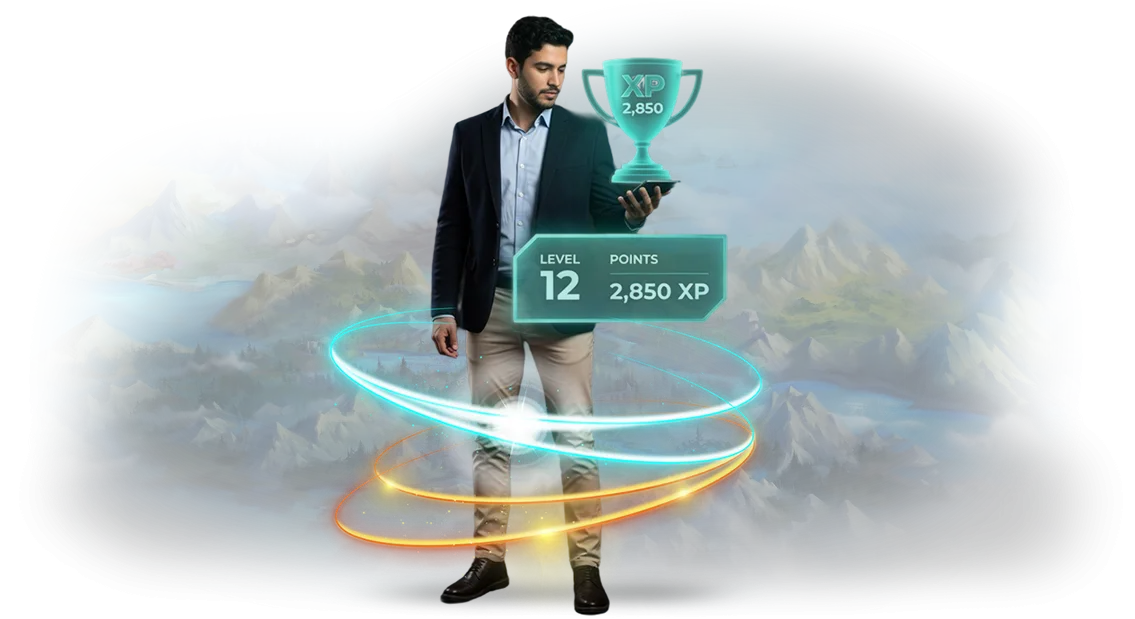
Developing 3D avatars and a company world on Unity lets you turn a loyalty program into a living environment: employees see their progress, compete with colleagues, and receive rewards in a game format.
This isn't just "another portal" — it's a space people want to return to. Our task is to close the gap between a formal program and real motivation.
How to Turn a Loyalty Program into a Growth Driver
Many companies implement loyalty programs, but employees quickly lose interest: points and bonuses don't stir emotions, and reports and spreadsheets don't motivate.
In the end, a tool meant to drive engagement becomes a formality — and the business doesn't get the expected return.
Gamification changes the approach. We build a 3D company world with employee avatars on the professional Unity platform — a virtual space where completing tasks becomes a game with levels, rewards, and competition.
Employees see their progress, earn recognition from colleagues and managers, and routine actions become part of a larger goal.
The business impact is clear: engagement grows, productivity rises, and employee loyalty stops depending on the size of the bonus. Through game mechanics, we convey company values — teamwork, initiative, results orientation — in a clear and engaging form.
Statistics confirm this: according to Gallup, companies with high employee engagement are 21% more profitable and 17% more productive. These are not just numbers — they reflect the real impact of well-designed gamification.
We help turn a loyalty program into a growth engine that pays for itself through improved team efficiency and a stronger corporate culture. In this process, every employee is not a passive bonus recipient but an active participant in a game where everyone wins.
Gamification Formats for Company Goals
Every company has its own goals: some want to retain employees, others want to onboard new hires faster, and others want to boost sales through game mechanics. There is no universal "magic" format, so we tailor the mechanics to your objective and team size. The key is that the game drives business metrics, not just entertainment.
Below is a comparison of popular gamification formats we implement. It will help you identify which option fits your situation. Each row describes a concrete scenario, without technical details.
| Format | For whom | What it delivers to the client |
|---|---|---|
| Quests and tasks | Teams that need to build cohesion or launch a new product | Engages employees quickly, encourages collaboration and fast results |
| Ratings and leaderboards | Sales and support departments, any units with measurable KPIs | Transparent competition, higher output, clear bonus criteria |
| 3D company world | Mid-size and large businesses with distributed teams | Builds corporate culture, unites employees across offices, strengthens loyalty |
| Training scenarios | Companies with high turnover or frequent product launches | Reduces time-to-productivity, increases training completion rates, eases the load on mentors |
| Blended programs | Complex goals — motivation, training, and employer brand development | Maximum audience reach, flexibility across employee groups, unified mechanics with a clear outcome |
We'll help you choose the format that solves your specific problem — without paying extra for unnecessary features. At the first briefing, we'll assess the scale, goals, and expectations of your team, then propose the optimal configuration. You'll get a game that drives your business metrics, not abstract "engagement."
How a Gamification Project Progresses: Stages
We've structured our work so you always know where the project stands and what comes next. Each stage ends with a concrete deliverable: a document, a prototype, or a working version — and you're involved at key decision points. Below is a typical gamification project journey from brief to launch and support.
- Brief and discovery. We discuss the loyalty program's goals: which employees we're engaging, which actions to reward, and which success metrics to track. We capture expectations and constraints.
- Concept and scenario. We propose the game mechanics and the look of the company world — how avatars, tasks, and rewards connect to employees' real work. We show how this will affect motivation and activity.
- Approval. You receive a description of scenarios and a visual concept for sign-off. We make revisions at this stage — it's cheaper and faster than changing a completed solution.
- Development and build. We create virtual spaces, avatars, and a points-and-levels system. We prepare integration with your HR or corporate systems so employee action data syncs automatically.
- Testing and refinement. Together with your HR specialists, we run through the main scenarios: registration, completing tasks, and claiming rewards. We fix issues and check interface usability.
- Launch and adoption. We onboard the first users, train administrators, and help with internal communication. At this stage, you're already seeing the first engagement results.
- Support and evolution. We stay in touch: collect feedback, refresh content and game mechanics to match evolving business needs. We add new scenarios and seasonal activities when necessary.
Timelines for each stage are fixed in the contract. At the start, we create a schedule with milestones — typically, a project takes 4 to 8 weeks depending on scope.
You don't need to understand the technical details: we handle development, coordination with your internal teams, and the final integration of gamification into your workflows.
What's Included in the Gamification Delivery
The gamification delivery package is not just a program — it's a complete solution for employee engagement. You get everything you need to launch and manage the loyalty program without involving developers. All elements are interconnected, so you get a unified ecosystem rather than disconnected modules.
- Virtual company office — a 3D space that reflects your brand's style. Employees move through it, communicate, and complete tasks.
- Personal 3D avatars — each participant gets a customizable character that reflects their role, level, and achievements.
- Admin panel — you configure tasks, points, levels, and rewards yourself, without programmers.
- Training materials and guides — a knowledge base for administrators and employees so the launch is fast and trouble-free.
- Reporting system — clear statistics on activity, conversion, and engagement, broken down by team and individual participant.
- Integration with corporate services — we connect your HR system or messenger for automatic data synchronization when needed.
- Post-launch support — configuration, updates, and consultations so the program evolves alongside your business.
The delivery scope is tailored to the company's size and goals: a basic set is enough for a small team, while a large holding gets advanced analytics and integrations. Everything listed above is included in the project cost and delivered on time. We support the launch, train your team, and stay in touch after the work is complete.
Case Study: How We Tripled Engagement
For the Voskhod retail chain with 1,200 employees, we built an internal game platform. Interest in standard loyalty programs was fading: only 26% of the team participated in surveys, and monthly contests drew half that number. The goal was to make participation a natural habit, not an obligation.
We developed a 3D company world on Unity: every employee received a personal avatar, completed tasks, unlocked achievements, and exchanged points for real bonuses. The game mechanics combined training, communication, and recognition — without coercion or new instructions.
Project Results
Within a month, active users tripled: 78% of employees opened the platform instead of 26%. Key metrics — contest participation and return frequency — grew 3.2 times.
This means people remind each other about tasks on their own, and managers get a transparent picture of engagement.
We also note the emotional effect: teams began showing off their avatars in shared chats, and internal memes and mini-events emerged. Gamification doesn't distract from work — it strengthens motivation. Employees experience the game as part of the corporate culture.
Client Testimonial
"We expected interest, but not like this. Employees asked for new levels and tasks on their own. Most importantly, training quality improved: knowledge check scores rose from 62% to 91% without adding load to the HR department. This is the best project result," — Head of HR at the Voskhod chain.
We believe this case succeeded thanks to a combination of well-designed game economics and technical reliability. The same model works for banks, manufacturing, and logistics. We'll show you how to adapt it to your goals.
How to Choose the Right Gamification Format?
There is no universal gamification format — the right choice depends on your business goals and target audience, not on trendy technology. Before looking at ready-made solutions, ask yourself: what should the game change?
Speed up new-hire onboarding, increase learning engagement, retain valuable employees, or raise sales through excitement and competition? That's what drives the choice of mechanics, complexity, and program duration.
Then look at your audience. Younger employees are usually drawn to ratings, levels, and quick rewards; experienced specialists value recognition, status, and non-obvious perks.
If different generations take part, you need a format that lets everyone play at their own pace and get clear value. We always start with a short audience analysis — this prevents the mistake of building attractive mechanics that nobody connects with.
The gamification budget is the second key factor — but it doesn't limit the result, it defines the scale. On a limited budget, we build lightweight programs based on points, missions, and leaderboards: they launch quickly and deliver tangible results in the first month.
With more resources, we add virtual spaces, avatars, and complex growth scenarios. What matters is that every invested resource works toward your business goal, not just toward an impressive visual.
Here's how it looks in practice: you describe your objective, and we propose 2-3 formats with forecasts for implementation time and expected impact on key metrics. You choose the one that fits your budget and company culture, and we handle implementation and support.
This way, you get not a "trendy toy" but a tool that solves a specific employee loyalty program challenge.
Frequently Asked Questions About Business Gamification
Business gamification typically raises three questions for managers: won't it become a "game for the sake of the game," is it difficult to integrate the mechanics into existing processes, and will it distract employees from work.
In reality, a properly designed system does the opposite — it connects routine actions with clear, measurable value for the employee.
We handle the full cycle: analyze current processes, embed game scenarios into your company's existing services, and train the team. Below are answers to the most common concerns clients raise before starting a project.
Employees will reject gamification or simply not participate. How do we avoid this?
Game elements are not imposed — they're integrated into natural work actions: complete a task, earn points; hit your quarterly plan, unlock a new level. Participation is voluntary, and the value for employees is immediately clear: bonuses, peer recognition, career opportunities.
We design the mechanics so that early achievements are accessible to everyone from the very first days. This creates a quick positive experience and triggers natural competition.
In our practice, employee activity is sustained and grows when the game system is regularly updated — and that's part of our post-launch support.
Can we integrate gamification with our existing CRM, HR systems, and services?
Yes, that's exactly what an individual project is for. We connect game scenarios to your existing infrastructure: corporate portal, CRM, time tracking systems, or internal messenger.
Employees don't need to learn a new tool — the mechanics work inside the environment they already use.
During the audit stage, we identify which integration points will deliver maximum results without burdening your IT team. The rollout is phased, so you control the process and see the first metrics from the pilot group.
How secure is employee data, and who gets access to it?
We follow your company's confidentiality policies. Access to personal data is restricted by role settings: managers see team analytics, employees see only their own progress and achievements.
All information is stored in a secure environment; we don't share data with third parties or use it for our own purposes.
After the project is completed, you receive a system that remains under your control. We document data handling procedures and configure access rights to match your organizational structure.
How quickly will employees learn the new system, and will we need a separate team to support it?
The interface is designed to be intuitive, so basic training takes no more than an hour. We run a short onboarding webinar for the team and prepare guides for self-paced learning. Employees can start using the system on day one.
No new specialists are needed for support — administration is handled by your HR manager or department lead. We also provide clear documentation and stay available for consultations if questions arise.
We understand that any change to workflows requires confidence in the result. That's why we set goals, indicators, and timelines at the start — so you can see how gamification affects team efficiency and business metrics, not just the number of points on a leaderboard.What You Get After Launching Gamification
Gamification is not just a "game for employees" — it's a tool that translates your business metrics into concrete figures. After launch, you see engagement grow, routine processes speed up, and team loyalty improve. Below are the final benefits you get as an owner or manager.
- Growth in key KPIs: sales plan attainment, request processing speed, and other metrics you can build into the game mechanics.
- Increased employee loyalty: the team gets a clear system of rewards and recognition, not abstract "well done" praise.
- Transparent motivation: every employee sees which actions earn points, badges, and statuses — disputes about "unfair" evaluations disappear.
- Manager time savings: most operational motivation issues are automated rather than requiring personal oversight.
- An additional communication channel: a corporate portal or app with avatars becomes the entry point for news, training, and internal events.
- Measurable business impact: you get reporting on activity, achievements, and each department's contribution — you see what really affects results.
This works not in words but in practice: we design gamification around your process and KPIs so the effect is visible within the first weeks. To discuss your objective and get an effect estimate, leave a request on the page. We'll show how gamification fits into your business and propose a solution within your budget.