

Why Employees Burn Out Without a Manufacturing Motivation System
When a production facility lacks a well-designed staff motivation system, work quickly turns into an endless sequence of identical tasks.
Employees stop seeing meaning in their actions, lose interest in the result, and gradually slip into a "just get through the shift" mindset. That is exactly how burnout begins: engagement drops, initiative disappears, and product quality slowly deteriorates.
For the business, this translates into lost efficiency: the number of errors grows, order lead times increase, and delivery failures become more frequent. Managers have to spend time on endless oversight and "micromanagement" instead of focusing on growth.
Staff turnover creates additional costs for recruiting and training new people, while experienced specialists leave for places where their work is noticed and valued.
The root cause is that classic schemes — salary plus fines — do not tap into a person's inner motivations. People need to see their progress, compare themselves with colleagues, and receive recognition for achievements.
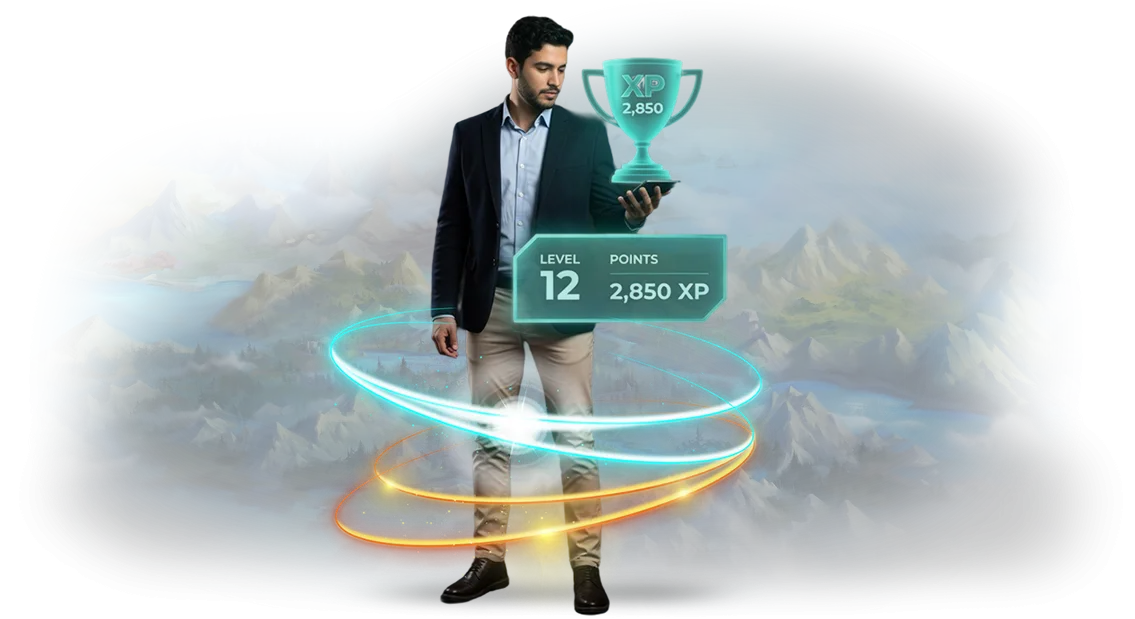
Gamification of business covers exactly these needs: it turns production metrics into a clear game with goals, levels, and rewards. Employees strive to complete the plan better and faster on their own — because it is engaging, not because they "will be made to."
A well-designed manufacturing motivation system based on gamification brings back the excitement and sense of growth. Every day, employees see how their personal contribution moves the team toward the overall result, and that becomes stronger than any administrative incentive. Burnout recedes, productivity rises, and the management burden decreases.
We help build such a system: we develop 3D avatars and a virtual company world where every employee achievement becomes visible.
This is not an abstract "motivation for the sake of motivation" but a tool that integrates into production processes and delivers measurable results for the entire enterprise.
What Gamification Delivers: Productivity Growth and Loyalty
Gamification of business processes turns monotonous work into an engaging game with clear goals and rewards. Employees stop working "under the whip" — they become genuinely interested in the outcome.
For the business, this means measurable performance growth without increasing headcount or the motivation budget.
Benefit: Productivity Growth
When every employee sees their contribution to the overall result, productivity grows naturally. Game mechanics — levels, points, rewards — turn meeting the plan into a personal challenge.
Companies that have implemented such systems report a 15–30% increase in output within the first months after launch.
Employees begin competing not with colleagues but with their own achievements — this eliminates toxic competition. Managers get a transparent picture: who is the leader, who needs support, and which processes are stalling.
Benefit: Employee Engagement
Boredom and burnout are the main enemies of productivity. Gamification brings interest back to work: employees look forward to new tasks, take part in shared events, and propose ideas. Engagement grows, and with it the quality of work and the atmosphere in the team.
This works especially well in manufacturing, where repetitive operations stop feeling like routine. 3D avatars and a virtual company world built on Unity let everyone see their achievements and status within the team. This creates a sense of belonging that no bonus can replace.
Benefit: Reduced Turnover and Loyalty
Staff turnover costs businesses enormous amounts: recruiting, training, loss of experience. When employees see that their efforts are noticed and rewarded, they do not look for work elsewhere. Personnel loyalty means stable teams and predictable results.
Gamification creates a long-term connection between personal goals and company goals. Employees understand that their development directly affects the overall success and stay with the company for years. For the business, this means lower hiring costs and greater efficiency from every worker.
Gamification Formats for Business Processes: Choosing the Right One for the Task
Gamification of business processes only works when the format precisely matches the task. A training game cannot replace a competition, and a one-off contest will not create long-term motivation.
That is why, before development, we work with the client to determine which of the three basic formats will deliver the greatest effect for their specific production facility.
For clarity, here is a comparison based on typical scenarios: what to choose for rapid onboarding of new employees, for boosting output, and for retaining experienced staff.
| Format | Who It Is For | What It Delivers to the Client |
|---|---|---|
| Training scenarios and quests | New employees, workers moving to new areas | Fast mastery of processes without risk to production, fewer errors, and shorter time to full proficiency |
| Competitive mechanics and leaderboards | Shifts, teams, departments | Higher output and quality through healthy competition, meeting the plan without increasing the payroll budget |
| Long-term programs with avatars and levels | The entire workforce, key specialists | Sustained engagement, loyalty, lower turnover, and stable results month after month |
If the task is more complex than a single scenario, formats can easily be combined. For example, a new employee spends the first two weeks completing an onboarding quest and then enters the shared competitive system with a personal avatar.
We design such a combination so that it does not overload employees and delivers measurable KPI growth within the first few months.
How Implementation Works: 6 Stages of a Gamification Project
Implementing gamification is not about buying an off-the-shelf "box" — it is a joint project to transform production motivation.
We have built a transparent six-stage process: you always understand what is happening, what is being approved, and what result you will get at each step.
-
Brief and deep dive into the task. We study your business process, employee profile, and current motivation system.
We determine which behaviors need to be strengthened and how we will measure the effect — so that the gamification solves your specific problem rather than being just an "interesting gimmick."
-
Concept and mechanics approval. We present the gamification scenario: which actions earn points, levels, and rewards, and how these affect real metrics. You approve the logic before development begins — this removes the risk of mismatched expectations.
-
Interface and visual world design. We design the screens, avatars, competitive elements, and the employee-facing interface. You see how the system will look in the workplace and can make changes before development starts.
-
Development and testing on your data. We build the system using professional tooling and connect it to your accounting system. We test it against real work scenarios so that there are no failures or delays by launch time.
-
Pilot launch on a control group. We enable gamification for a portion of employees, collect feedback, and adjust the settings. This lets us fine-tune the mechanics without risking the entire production line.
-
Full launch and ongoing support. We deploy the system across all areas, train administrators, and hand over instructions. After launch, we stay in touch: we help, update motivation mechanics, and analyze metrics so that the system keeps delivering results.
What Is Included in the Delivery: A Complete Package for Launch
We deliver not just a "program" but a ready-to-use system that your team can start using immediately after launch.
The package includes methodologies, settings, scenarios, and training — everything needed for the production motivation system to function as part of your business processes.
What is included in the delivery:
- Motivation methodology — a description of game mechanics, metrics, and point-accrual rules adapted to the specifics of your production facility and your established KPI system.
- Usage scenarios — ready-made procedures for running competitions, challenges, and rewards: from individual teams to the entire workshop. Each scenario is mapped out by roles and stages.
- A configured 3D company world — a virtual space with employee avatars and areas that visually display achievements and progress. It is both an element of corporate culture and a management tool.
- Administrative interface — a simple panel for managing roles, tasks, and levels. Your administrators can change settings without involving programmers.
- Launch materials — communication templates and guides that help explain the rules of the game and system benefits to employees and answer their initial questions.
- Team training — hands-on sessions for administrators and managers: how to run scenarios, handle disputes, and use data for management decisions.
- Support and maintenance — a warranty period and dedicated communication channels: we are available if scenarios need refinement or help with system growth.
This package allows you to launch motivation within days of implementation and quickly see the first results — higher engagement and meeting production targets.
You get not a "black box" but a clear tool that your team can develop independently, with our support along the way.
Case Study: How Gamification Increased Output at a Manufacturing Plant
For a mid-sized machine-building plant, Vektor, we implemented a production motivation system based on 3D avatars. The plant faced a typical problem: the plan was met, but output was stagnant, and bonuses were taken for granted.
Gamification changed the attitude toward work: every employee sees their progress, status, and contribution to the overall workshop result — in real time, not at the end of the month.
How the Project Was Built
First, we audited the production operations: which metrics to track, where the bottlenecks were, and what actually affected speed and quality.
Together with the workshop supervisors, we configured the rules for points and levels so that the system rewarded concrete results rather than "showing up." Workers received personal 3D avatars in a virtual workshop, and a shared screen displayed the shift dynamics and the status of each area in real time.
Result and Client Feedback
In the first three months, output at the assembly area grew by 18%, and the number of reworks dropped by a quarter. People began proactively suggesting process improvements — something that had never happened before.
Six months later, the plant ordered an expansion of the system to adjacent workshops: for us, that is the clearest sign that the mechanics work not as a one-time motivator but as a sustained driver of growth.
The production manager noted: "The key here is not the points, but the fact that people are genuinely engaged. The plan stopped being an abstraction — there is healthy excitement and a visible result every shift.
We stopped having to persuade people — they now want to meet the standard faster and better themselves."
That is precisely the goal of gamification in manufacturing: sustainable output growth through engagement, not a temporary spike in activity.
When employees see their contribution and status, they start working for results — and the business gets a measurable return on every unit invested in motivation.
How to Choose a Gamification Format for Your Business?
Choosing a gamification format always depends on three things: goals, budget, and team specifics. There is no one-size-fits-all solution that works equally well for a small production workshop and a distributed office.
That is why we first analyze your situation — what tasks the system must solve, who will use it, and what result you want to achieve in a few months.
If you need a quick effect and have a limited budget, lighter mechanics work well: leaderboards, challenges, and virtual rewards for meeting the plan. They are fast to implement, require no infrastructure changes, and deliver a noticeable engagement boost.
For long-term motivation, a full 3D company world with employee avatars, levels, and development scenarios is the better choice — it works as an ongoing tool that sustains interest and builds corporate culture.
It is important to consider how your people actually work. For workshop employees, simple interfaces and shared terminals are convenient — you do not want to pull them away from their machines.
For office teams, it makes sense to embed gamification into familiar work applications so that participation takes minimal time.
We match the format to your real conditions rather than the other way around — we do not force teams to change their habits for the sake of the mechanics.
At the start, we offer several scenarios and calculate them against your budget: from a pilot launch in a single area to full integration across all processes. You see how much each option costs, what effect it delivers, and how quickly it pays off. That allows you to make a decision without the risk of wasted spending.
In the end, the right format is the one that solves your specific problem — not the one that is trendy or complex. We help find the balance between goals, budget, and team capabilities, take responsibility for implementation, and guarantee results. Start with a short consultation — we will show which mechanics will work in your case.
Frequently Asked Questions About Gamification of Business Processes
We understand: gamification in manufacturing is a serious decision. You are accountable for results and company data, so having doubts is normal. We have gathered answers to the main questions managers ask before getting started.
What if the system does not work?
Then we refine it. We launch a pilot in one area or team — within 2–4 weeks it becomes clear whether engagement and KPIs are growing. Based on the results, we adjust the mechanics: we change rewards, task difficulty, and the scenario. This is included in the cost — you are not paying to "try and forget."
How will I know the system is actually working?
We give you a personal dashboard with clear analytics: which employees are active, which tasks are completed faster, and how output is changing. On top of that, you get weekly email reports. You see the effect in numbers and timelines, not "by eye."
Won't company and employee data leak?
We use a server architecture with role-based access control. Data is stored in a protected environment, and only authorized employees have access. We operate in compliance with personal data legislation — this is documented in the contract.
Will the system fit into our processes?
Yes. We design gamification around your current motivation system, not "on top of it." Integration happens without stopping production, and employees are trained within a single day. Our team handles the entire technical side — from design to launch and support.
Convinced that the risks are under control? Then the next step is a short conversation about your task. In 15 minutes, we will determine whether gamification suits your goals and propose a pilot format.Launch a Motivation System: Results in Just 2 Months
You already know what an ideal motivation system looks like: employees see their progress, compete for leadership, and meet their targets. We launch it in your production facility in two months — without lengthy approvals, equipment changes, or work stoppages.
From there it is simple: you leave a request, we get on a call, and in 30 minutes we break down your task. You will receive a plan with concrete next steps and an understanding of what will change in the workshop in 4 and 8 weeks. No abstract theory — only what will bring real value.
What you get immediately after your request:
- An analysis of your production process and motivation growth points.
- An estimate of the effect of gamification: higher engagement, lower defect rates, faster onboarding for new employees.
- An implementation plan with clear stages, deadlines, and assigned responsibilities.
- A demonstration of a similar solution in action — you will see how the motivation system works.
- A dedicated project manager who will answer questions and keep deadlines on track.
- A fixed cost estimate with no hidden fees or technical surprises.
To order gamification, click the button below or simply call us — get a consultation and discuss the details. We will prepare a solution tailored to your production specifics and show you an effective path to performance growth.
Do not put it off: in two months, the motivation system can be working in your workshop, not just on a presentation slide.