

Employee Rating Systems: How to Stop Churn with Gamification
Employee turnover is one of the most expensive problems in business. Every departure means costs for searching, hiring, and onboarding a new person, loss of accumulated knowledge, and a blow to team morale.
Most often, people leave not because of salary but because of an unfair or unclear personnel evaluation system: efforts go unnoticed, professional growth looks random, and colleagues' successes are a mystery.
Lack of transparent criteria directly reduces employee engagement. Even a strong specialist starts to work half-heartedly if they don't understand which actions bring them closer to a promotion, bonus, or new level.
Formal metrics and annual reviews don't solve this problem: they are disconnected from daily tasks, don't provide quick feedback, and are perceived as an obligation rather than support.
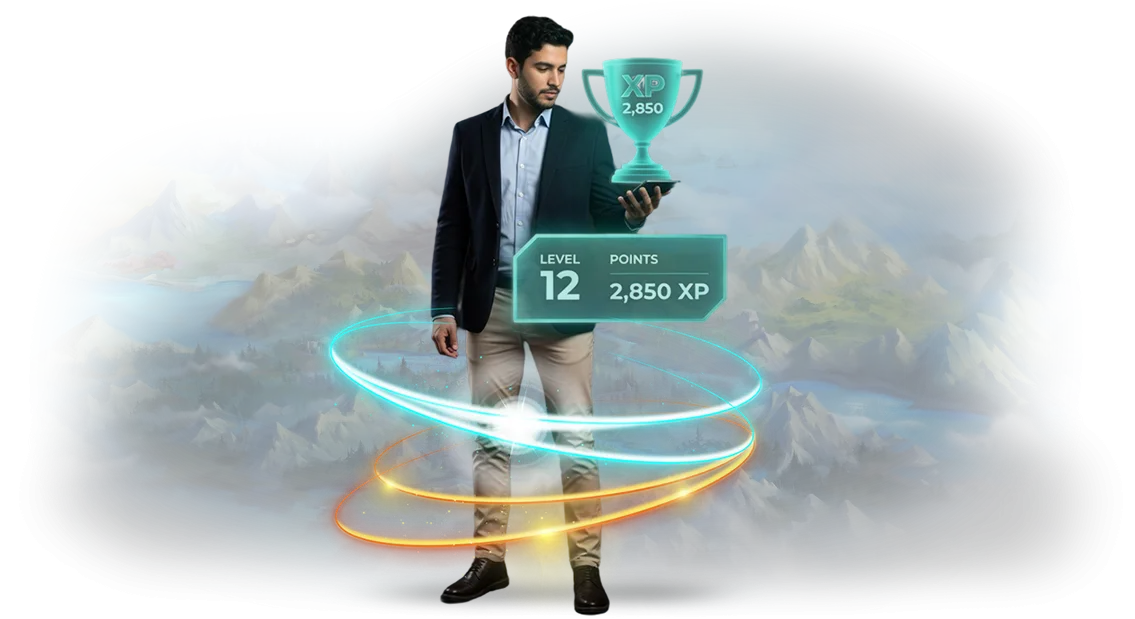
Motivation gamification closes exactly this gap. When an employee sees their progress through a 3D avatar, earns points for work achievements, and moves up the ranking in real time, routine turns into a game with clear rules.
This is not entertainment for its own sake, but a tool that makes employee rating systems transparent, visual, and manageable.
We develop a three-dimensional company world on a professional game engine, where each employee is represented by their avatar and achievements are reflected in their position on the overall leaderboard.
You get not a dry score table, but a space where people themselves strive to grow, compete, and help the team. This approach increases engagement, retains valuable specialists, and reduces turnover—without revising payroll or applying administrative pressure.
Gamification pays off through reduced recruitment and onboarding costs, as well as increased team productivity.
Why Business Needs Game Formats in Personnel Evaluation
Personnel evaluation often becomes a formal procedure: employees don't understand the criteria, and managers run into demotivation. Game mechanics change the very logic—instead of an inspection, a clear system of goals, progress, and rewards emerges.
It is exactly these formats we implement on the professional Unity platform, so the client gets a stable and predictable result.
The main effect of gamification is increased engagement. When an employee sees their progress in the company's 3D world, competes with colleagues for a place on the leaderboard, and receives virtual bonuses for real achievements, routine tasks gain meaning.
People start working not "under the whip" but with interest—this directly affects productivity.
A transparent rating system removes the grounds for conflict. All participants see the unified point-scoring rules and can track exactly what a reward was given for.
This reduces tension in the team and increases trust in management: employees understand that their efforts are noticed and evaluated objectively.
An additional bonus is employee loyalty. Game formats create positive emotions and a sense of belonging to the team, which is especially important for retaining valuable specialists.
The company gets not just an evaluation tool, but a way to strengthen corporate culture and reduce staff turnover.
Ultimately, game mechanics turn evaluation from stress into a growth driver: higher motivation, fewer disputes, a more stable team. And for business, this means predictable results and a simple way to manage performance without strict control. This is an investment that pays off through increased engagement and retention of strong employees.
Gamification Formats for Business
Choosing a gamification format is a matter of the business task. For some, a leaderboard is enough to boost sales; others need a virtual office with 3D employee avatars to retain valuable specialists and strengthen the employer brand.
We work with different levels of complexity: from simple ratings to full-scale worlds. Each format pays off in its own way, and it's important to choose the one that fits your team.
| Format | For whom | What it provides |
|---|---|---|
| Corporate employee rating | Companies with clear metrics that need to boost sales or work speed | Transparent leadership system, healthy competition, improved metrics |
| Rating with badges and levels | Departments where consistency matters: support, training, internal services | Builds habits, increases engagement and employee retention |
| 3D employee avatars | Brands that want to strengthen internal PR and recognition | Employee sees their status, creating emotional connection and pride in achievements |
| Company virtual world | Large companies, distributed teams, frequent events | A unified space for communication, awards, and training; strong corporate culture |
A simple rating can be implemented in a few weeks and delivers fast results. A virtual world is a long-term investment in retention and employer attractiveness.
We'll help you choose a format for your budget and timeline, then deliver it turnkey: from mechanics to launch and support. As a result, you get a system that improves team productivity and loyalty.
How Gamification Development and Launch Work
We have structured the process so that at every step you understand what's happening and what result you'll get. Implementing gamification takes from two weeks to two months—the time depends on the complexity of the scenarios and the number of employees. Below are the stages all projects go through.
- Brief and task immersion. We conduct interviews with managers and employees and study the current motivation system and ratings. You receive a document with gamification goals and proposed mechanics.
- Concept alignment. We show a prototype of the future system: what the ratings look like, which actions earn points, how employees see their progress. You make edits before development begins.
- Plan and timeline estimation. We lock in an exact work plan, a list of milestones, and review dates. You know when and what you'll receive, and unexpected delays are ruled out.
- Development and configuration. We build the system: 3D world, avatars, integration with your employee database. Inside, there are regular demos: you see the system in action at each stage.
- Testing with real data. We run a test period, check point accrual, ratings, and rewards. You receive a report on fixed bugs and launch recommendations.
- Launch and training. We implement the system, train managers and employees, and advise on how to announce the change. After launch, we support and refine the mechanics.
This sequence allows gamification to be implemented without chaos or downtime. You always control the process, and we are responsible for the result.
What's Included in the Delivery: From 3D Avatars to Analytics
Gamification of business processes is not just entertainment, but a motivation management tool. To deliver measurable results, it's important to get not a set of isolated scripts, but a coherent system.
That's why our delivery package includes all necessary components: from avatars to analytics. You launch the project without extra refinement costs and see the effect quickly.
The package includes:
- 3D employee avatars — digital representations that reflect status and achievements. Employees see their progress and strive for new levels. Avatars are easily adapted to the company's corporate style.
- Company virtual world — a space for events, awards, and team activities. This creates a sense of belonging to the brand and increases loyalty. The world scales to any number of participants.
- Rating mechanics — flexible point-scoring rules, levels, badges, and competitions. You decide which actions matter and link the system to performance indicators. The mechanics motivate employees to achieve goals.
- Rating analytics — clear reports for managers: leaders, dynamics, departmental activity. The data helps you understand which mechanics work best and adjust them in a timely manner.
- Employee training — instructions, demo videos, and a training session for administrators. The team quickly learns the system, and you save time. The format works even for distributed teams.
- Documentation — a complete guide to setup and operation. Everything is transparent; you aren't dependent on a specific contractor and can easily develop the system yourself.
Each module works on a single platform, ensuring stability and easy integration with your internal systems. We handle the launch, and afterward we support and update the solution without disruptions. The entire system is configured to your tasks, not the other way around.
Real Case Study: Engagement Growth After Gamification Implementation
For a retail chain with eight hundred employees, we developed a gamification-based rating system. Before implementation, performance evaluation was based on managers' subjective opinions, and staff didn't understand how it affected their careers. This created tension and increased turnover.
What We Did
We turned routine performance metrics into transparent rating mechanics with 3D avatars. Each employee sees their level, achievements, and growth areas in a game interface.
The competitive element is reinforced by peer recognition and bonuses, so the rating became not a tool of pressure but a motivation.
What We Achieved in Three Months
Engagement on the corporate portal increased by 40%—employees log into the system daily to check their progress. Turnover dropped by a quarter: people are less likely to quit when they understand how to grow. Savings on recruitment became a direct result of this.
Managers got an objective picture: the rating automatically accounts for plan completion and quality of work. Disputes disappeared because evaluations became measurable and understandable. This increased trust in the system and reduced time spent on conflict resolution.
After three months, the client expanded the project: gamification was connected to the training program and a competition between stores was launched. The repeat order confirms that the system brings measurable value to the business, not just a modern look.
Frequently Asked Questions About Gamification Implementation
Before implementing gamification, every client has similar questions: is it too complicated, how long will it take, how will employees react, and who will support the employee rating system after launch. We answer these concerns directly.
Is gamification too difficult to implement?
Implementation doesn't require restructuring your business processes. We adapt ready-made mechanics to your current tasks and use proven tools, so launching the employee rating system takes a few weeks and doesn't distract the team from core work.
How long will the project take?
From approval to launch usually takes 3–6 weeks depending on scope. At the start, we set milestones and timelines; you see progress and know when the system will start working. If you need it faster, there's an expedited format.
How will employees react to the change?
We design the mechanics to be clear and motivating: ratings are built on transparent criteria and perceived as a game, not as monitoring. As a result, staff adaptation is quick, and engagement grows from the first days. The key is to show the benefits and rewards right away, and the team gets on board.
Who will support the system after launch?
We stay in touch: technical support answers questions, updates mechanics, and adds new scenarios. Support is included in the standard work format, so you're never left alone with the system. Everything needed for stable operation is on our side.
Ready to Boost Motivation and Retain Valuable Specialists?
Ready? Here's what will change. Employees will stop clock-watching and start competing for results: complete a task—earn points, rise in the ranking, see your avatar higher in the virtual office.
This turns work into a game with clear rules, and the company into a community people want to stay in.
Ordering gamification today means getting a system that works from day one. We handle turnkey development: from idea to launch of ratings, including the virtual world and avatars.
You don't need to understand technologies or coordinate contractors—you simply get a tool that will start affecting metrics within a week.
Start with a short consultation: we'll show you what the finished system looks like and give you timelines and a cost estimate for your team size. No obligations—just an assessment that will immediately fit into your motivation plan.
When you order development, you get:
- a rating system visible to every employee that motivates without additional bonuses;
- a virtual office with avatars—a recognizable world for your company, not a template builder;
- fast launch and support—we don't abandon you after delivery; we accompany you through the first months;
- training for key employees—your HR and managers will be able to manage levels and rewards themselves;
- scalability—add new scenarios and contests as your team grows.
Leave a consultation request—in 30 minutes we'll review your case and calculate the implementation cost. Take the first step toward ratings that retain top specialists.
How to Choose a Gamification Format for Employee Ratings?
Choosing a gamification format for employee ratings isn't about "what's trendier," but "what will work in your team." There is no universal solution: what motivates a sales department can ruin the atmosphere in a service department.
So first, define the goal: increase task completion speed, improve customer service quality, or engage employees in training.
Answer a few simple questions. What behavior do you want to reinforce: sales volume, faster ticket processing, or fewer errors? Is your team more competitive or oriented toward collective results? How comfortable are employees with seeing their rating publicly?
The answers immediately narrow down the choice: for example, open leaderboards and prizes suit a young team, while personal levels and hidden achievements suit a conservative one.
Specific requirements of your process are equally important. How often are metrics updated—once a day or continuously? What data already exists in your accounting system? Who will monitor the fairness of calculations and resolve disputes?
If these nuances are ignored, even beautiful mechanics will become a source of conflict and demotivation. Professional gamification selection always starts with an audit of the current motivation system and transparent point-scoring rules.
That's why we don't offer off-the-shelf templates. At the first meeting, we ask about goals, culture, and processes, then design a custom solution: mechanics, reward frequency, visual style, and integration with your ratings.
You get a clear framework of "what, why, and how it works"—and a system employees perceive as a game, not as surveillance.