

Gamification of Business Processes for Banks: How to Retain Customers
Customers are increasingly less likely to stay with a bank solely because of favorable rates — today, a dozen offers with similar terms appear nearby. Without an emotional connection, the decision to switch takes minutes: a person sees slightly higher cashback and leaves.
Banks spend huge budgets on acquisition but lose customers at the retention stage, because after issuing a card or opening a deposit, interaction becomes routine.
Employees are the same story. Tellers, sales managers, and support specialists follow the same instructions day after day. Without a clear goal and feedback, their engagement drops, and with it, service quality and plan fulfillment.
Ordinary KPIs and orders to "do more" provide weak motivation: people need visible progress, competition, and quick rewards for results.
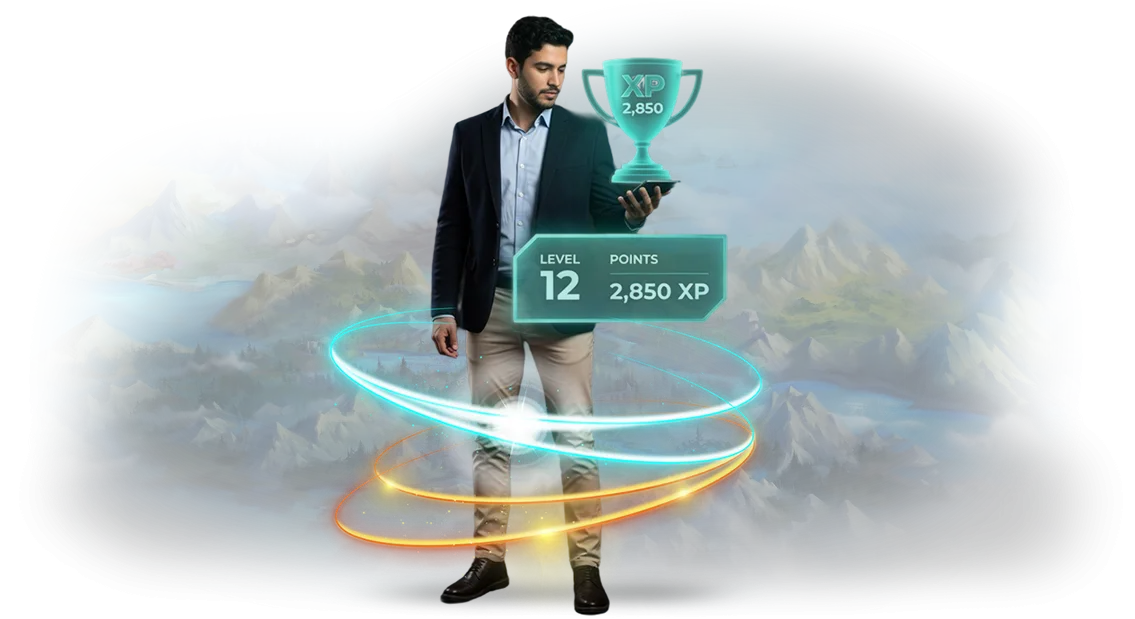
Game mechanics solve both problems. Ratings, levels, badges, and challenges turn boring banking operations into a clear game with transparent rules.
The customer sees their status grow, accumulates points, and unlocks new privileges — this keeps them engaged at the moment they're thinking about switching to a competitor.
The employee sees their place among colleagues, understands what's missing to reach the top, and gets instant feedback on their actions.
Gamification of business processes for banks is not an entertainment layer, but a behavior management tool.
We help implement mechanics that organically integrate into your products and workflows — without complex changes to the IT architecture and without the need to retrain staff.
You get a living motivation system that works to retain customers and increase employee engagement every day.
5 Measurable Benefits of a Game System for a Financial Organization
Financial organizations get not just emotions from gamification, but measurable results. Here are five key benefits that will appear in your reports after the system launches.
Benefit 1: Sales Growth
When routine turns into a game, employees get excited. They offer products more actively, strive to outpace colleagues in the ranking — and this delivers a measurable increase in sales.
Benefit 2: Service Speed
Game scenarios set a clear work rhythm. Each employee sees how long application processing takes and strives to complete tasks faster. As a result, queues in branches shrink and throughput grows.
Benefit 3: Customer Loyalty
An engaged team works with a smile and attention. Customers feel this, use services more willingly, and recommend the bank to acquaintances. Repeat inquiries increase.
Benefit 4: Team Efficiency
A transparent rating shows each person's contribution. The manager sees strong employees and those who need help, and can distribute workload fairly.
Benefit 5: Staff Stability
Recognition and healthy competition make work more interesting. Employees leave less often, and retaining experienced staff saves budget on hiring and training.
Gamification Formats for Banks: Tournaments, Ratings, Team Championships
A bank rarely has just one task per quarter: boost sales, activate dormant customers, or engage branch employees. There's no universal game, so we select a format for a specific business result: a competition, a tournament, or a team championship.
| Format | For which bank tasks | What it gives the customer |
|---|---|---|
| Leaderboards | Growth in recurring sales, increased customer activity in the app | Continuous healthy competition: participants see their position and try to improve it; the bank gets steady growth in metrics without one-off spikes |
| Time-based tournaments | Launching a new product, seasonal promotion, "warm-up" before reporting | Concentration of effort in the right period: in 2–4 weeks, the target audience takes maximum actions; the bank sees a fast, measurable result |
| Team championships | Engaging branch employees, developing team spirit | Competition between branches: teams pull each other up, average indicators grow, while staff loyalty is strengthened |
Formats are easy to combine: for example, a personal rating within a team championship, or a quarterly tournament that transitions into a permanent rating.
We discuss your goal, timeline, and audience, then propose a scheme that will deliver a measurable effect, not just a "fun game for the sake of the game."
We support the project from brief to launch: we configure the rules, point accrual system, and result visualization so participants understand exactly what they earn points for. As a result, the bank gets not entertainment, but a working tool that influences key business metrics.
How Game Mechanics Are Implemented: 7 Steps to Launch
Implementing gamification in a bank is not a "trendy app," but a sequential project that must deliver a measurable result: sales growth, increased loyalty, or faster employee training. We've built a 7-step process that removes risks and lets you see results at every stage.
- Brief and immersion in the task. We study your business goals, customer profile, and current situation: what you want to improve — loan issuance, app activity, or service quality.
- Designing game mechanics and ratings. Based on the brief, we develop a points, levels, and ratings system that motivates your specific audience. We align the rules and key performance indicators with you.
- Prototype and approval. We show what the screens and interaction will look like. You see the future result before launch and make adjustments without unnecessary costs.
- Integration with banking systems. We connect gamification to your processes: CRM, internet banking, or internal portal. We comply with security and data protection requirements.
- Focus group testing. We launch among a small group of customers or employees. We collect feedback, fix issues, and fine-tune the balance.
- Launch and team training. We put the system into operation, provide clear instructions, and support your administrators so they can manage the mechanics without developers.
- Support and development. We monitor metrics, analyze engagement, and decide together which mechanics to add next. Thanks to regular improvements, the game stays interesting and continues to deliver value.
What's Included in the Delivery: A Starter Kit for a Loyalty Program
We've put together a kit that lets you launch a loyalty program in a bank without lengthy development and approvals. You don't need to think about how gamification works internally — you get ready-made materials that just need to be adapted to your product and put to work.
Each element of the kit is designed so the bank's team can quickly implement the mechanics, and customers immediately see clear rules and the benefit of participating. Here's what's included:
- Game rules and participation terms — a ready-to-use document describing the competition logic, point accrual, and prize conditions. Legal and marketing teams get a transparent basis for approval.
- Customer journey scenarios — a description of interaction with the program at every stage: registration, first actions, reaching a new level. It's clear how to guide the customer and nudge them to the next step.
- Level and status matrix — a rank system that motivates customers to return and perform target operations. You see which status is tied to which activity and what effect it produces.
- A set of ready-made offers and rewards — reward options: from increased cashback to partner bonuses. Choose the ones that match your strategy and connect them in a few days.
- Results reporting dashboard — clear performance indicators: participant activity, growth in transactions, share of repeat visits. Marketing sees data for each customer and segment in a convenient format.
- Communication templates — texts for push notifications, in-app messages, and email campaigns. You can launch campaigns immediately after the start without spending time on copywriting.
- Support team manual — answers to typical customer questions and algorithms for resolving disputes. It takes the load off the call center and makes service predictable.
- 30-day launch plan — a step-by-step roadmap: what tasks the team handles, in what order, and who's responsible. The program starts without chaos or downtime.
All documents are packaged into a single kit and delivered with source materials. You get not an abstract description of an idea, but a working tool your team can use immediately after launch.
If needed, we adapt any element to your bank's specifics — from status names to point accrual conditions.
Case Study: How a Game Rating Boosted Branch Sales by 40%
For a regional bank, we developed a branch rating. Before the project, manager activity was uneven: some worked steadily, others ran out of steam by mid-month. Management wanted not just motivation, but a clear system that would link daily actions to an overall goal.
We proposed gamification of business processes: an overall branch rating, individual nominations, and team challenges. Each employee saw their contribution to the overall result, and branches saw sales dynamics compared to others.
The system accounted not only for sales, but also for activity: meetings, calls, applications. This made the competition fair.
Following the pilot launch, branch sales grew by 40%, and the share of employees meeting their plan doubled. The leaders remained leaders, while the rest caught up with them — thanks to transparent criteria and public recognition.
Vector Bank continued using the rating after the pilot and expanded it to all branches. The company saw the greatest growth in the first two months. Then we added seasonal storylines and collective goals — this sustained interest without additional budgets.
This case shows: game mechanics work when embedded in a business process, not when they exist on their own. We design gamification for a specific result — sales growth, staff loyalty, or service speed. Every project ends with measuring the effect, not with launching a "pretty game."
How to Choose a Gamification Format for Your Bank's Tasks?
Choosing a gamification format in a bank starts not with mechanics or game elements, but with answering the question: what specific behavior of employees or customers do you want to change?
It could be sales growth in branches, increased activity in the mobile app, reducing onboarding time for new employees, or increasing the share of repeat inquiries.
Each of these tasks requires its own mechanics: what motivates a manager to close new deals won't work for a customer who just wants to quickly resolve their issue.
If the goal is competition among employees, dynamic leaderboards with real-time updates, rewards, and public recognition work well. For customers, a smooth progression story with levels and bonuses that reward regularity rather than one-off actions is important.
Training programs, on the other hand, are built on simulation and feedback — an employee must safely practice a skill before a real conversation with a customer. Trying to transfer mechanics from one area to another usually produces weak results and gets boring fast.
Our approach to format selection: first we define the desired business metric — number of deals, share of active users, time for an employee to reach target performance. Then we identify the audience and its motivation, and only then choose the mechanics.
It often turns out that a simple level system or team scoring is enough — without complex game scenarios that slow down the launch and complicate support.
The key is not to chase "game trends," but to ensure a measurable contribution to the bank's results. We help you choose a format that's easy to integrate into existing processes and that will be clear to both employees and customers.
At the start, you get a clear plan of the mechanics, launch timeline, and a forecast of the impact on key indicators — so the decision is considered and pays off.
Answers to Questions About the Reliability and Security of the Game System
Managers often worry: will the system break down in the middle of a program? Will employees have to calculate points manually and monitor every action? We design game mechanics so they work on their own, and you get transparent results without extra routine. Below are answers to the most frequent questions about reliability and security.
What happens if the system fails during a corporate promotion?
We use professional equipment and proven tools, so failures are unlikely. Even in an unforeseen situation, participant data is preserved — backup is in place. Technical support will quickly restore operation, and you'll receive a final report.
Will gamification overload employees with additional tasks?
On the contrary, the system automates point tracking, accrual, and rating generation. Employees see their progress in a personal account, and the manager sees consolidated figures without manually compiling spreadsheets. Gamification motivates rather than creating extra workload.
How does the manager control the fairness of results and can they intervene?
Ratings are built on objective data you set yourself. The admin panel shows the history of participant activity, and program terms can be adjusted if necessary. Access levels are configured to keep results transparent for you and protected from outside interference.
Who is responsible for technical support and training?
We support the project at all stages: we help launch the program, train employees, and provide consultations along the way. A dedicated specialist is assigned during active campaigns to resolve issues promptly. You're never left alone with the system — support is there when you need it.
Get a Gamification Plan for Your Bank in 2 Days
Submit a request for gamification — and within 2 business days you'll receive a personalized plan for your bank.
We don't offer template solutions: we analyze your business processes, target metrics, and employee motivation to propose mechanics that will actually change team behavior. Competitive mechanics in a bank only work when tied to real metrics — and that's how we build the plan.
A gamification plan for banks is not an abstract presentation. It's concrete steps: which processes to digitize, which competition system to launch, how to measure results, and how to engage staff without compromising service quality. In 2 days, we analyze your request and create a plan for your scale, budget, and timeline.
What you get after submitting your request:
- A personalized gamification plan — tailored to your business processes and goals, not a copy of someone else's case.
- An assessment of growth points: where competition and ratings will deliver the greatest increase in sales and loyalty.
- A consultation with an expert: we'll review how gamification fits into your current motivation system and HR processes.
- A transparent resource estimate: what's needed for launch, what the timeline is, and how quickly results will appear.
- Metric recommendations: how to measure the result — from reach to repeat customer inquiries.
- A final list of solutions: what to implement first and what can wait.
Submit your request on the website — we'll get in touch within one business day, clarify the details, and prepare the plan. You'll get a ready-made basis for a decision, not general discussions. Start with a consultation — it comes with no obligation.