

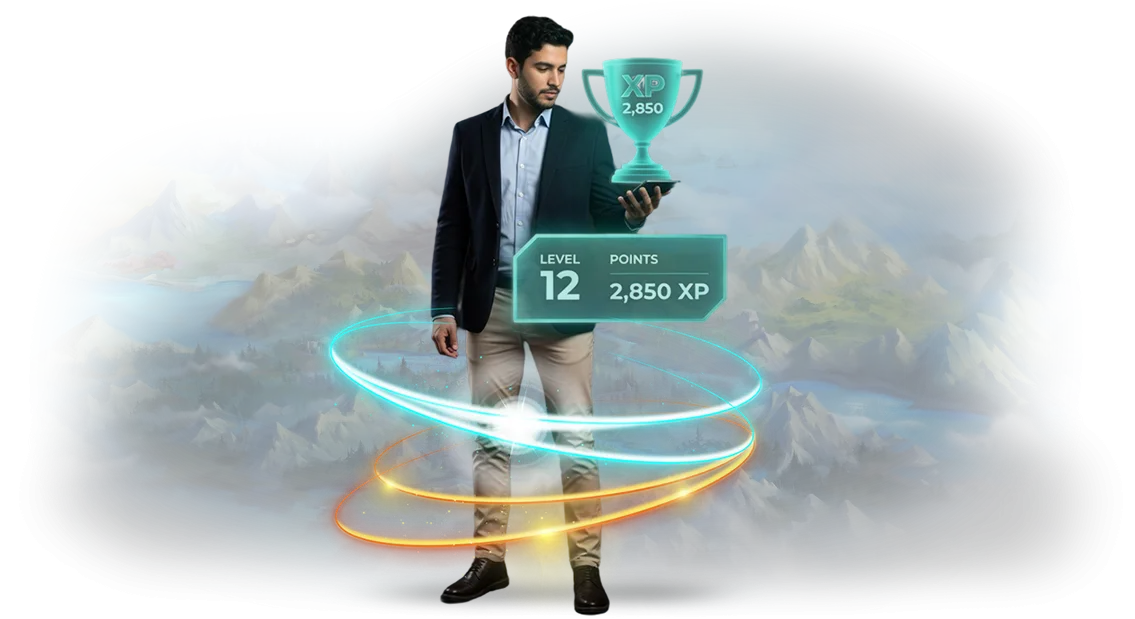
Why private schools and online education platforms lose students
Modern students have grown up in a world where games, rankings, and instant feedback are the norm. Traditional courses and lessons without competitive dynamics quickly become boring, interest drops, and with it attendance and results.
For private schools and online platforms, this is a direct path to losing students: parents choose projects where children engage willingly.
Low engagement directly hurts student retention — courses remain unfinished, and reviews about “boring learning” spread quickly.
Competition in education is growing, and projects that do not use game mechanics lose out to those that motivate students through competition, rewards, and status. Even a good program will not retain students if they lose interest as early as the second week.
But simply adding points or badges is not enough: without a well-designed rating system and transparent rules, the effect quickly fades.
A holistic gamification of education is needed, where every element — from point allocation to leaderboards — works toward regular participation and visible progress. This approach turns learning into an engaging competition with oneself and others.
We help private schools and online platforms implement game mechanics that increase student engagement and reduce churn. You get a system that students and parents understand, one that motivates learners to come back to classes again and again.
Implementing game mechanics in the educational process: 5 key benefits
Students lose interest when the material is presented monotonously: tasks are done out of inertia, and the result remains abstract. Heads of private schools and online platforms see this in declining academic performance and student churn.
Gamification turns learning into a game format with goals, rewards, and healthy competition — this is exactly what retains the audience and turns routine into a conscious process.
The first benefit is increased engagement. Points, levels, and rewards provide instant feedback: the student sees progress after every lesson.
Instead of “I have to do this,” “I want to find out what’s next” appears — the excitement carries through the entire course and makes learners return to the platform again.
The second benefit is sustainable student motivation. Competitive mechanics such as ratings and leaderboards tap into the natural desire to be among the best.
At the same time, the system rewards not only winning but also personal development: even a struggling student receives recognition for growth rather than a static low grade.
The third is improved academic performance. Interactive tasks with scenarios and mistakes that can be corrected immediately enhance material absorption. Teachers see data on typical class difficulties and adjust the program precisely, not “as usual.”
The fourth is audience loyalty. Emotionally engaged students associate positive experiences with the school or platform, are less likely to switch to competitors, and are more willing to recommend the learning to friends. Parents also see measurable progress — and this strengthens their trust in you.
The fifth is long-term effectiveness. Game mechanics show which formats work best: where engagement is higher and where students “get stuck.” You receive data for product development and do not waste budget on ineffective methods.
As a result, the benefits of gamification work toward your core business metric — student retention and academic performance.
Gamification formats for different educational project goals
Each educational model has its own goals. A private school needs a public ranking to motivate students and show parents a real picture of their achievements. An online platform needs quests and competitions to keep students’ attention and reduce the dropout rate. We encounter this every day in projects for schools and online platforms.
Below is a quick reference guide to three basic formats. This is not a dogma but a starting point for choosing the right approach for your audience.
| Format | Who it suits | What it gives the client |
|---|---|---|
| Ratings and leaderboards | Classes with different performance levels, individual work | Transparent ranking, incentive to improve results, visible progress for parents |
| Team competitions | Parallel classes, interest groups, school leagues | Competitive spirit, collaboration skills, increased subject engagement |
| Story-driven quests | Online courses, homework, long topics | Immersion in the material, sequential learning, fewer course dropouts |
Ratings and leaderboards address the need for individual motivation and public recognition. Team competitions develop socialization and collaboration skills. Quests provide structured immersion in the material, especially for complex topics.
We will help you choose the right format and adapt it to your methodology. For example, for primary school we usually recommend story-driven quests with gradual difficulty progression, while for high school and exam preparation — ratings and team tournaments.
As a result, students are naturally drawn to knowledge, and you receive measurable metrics: growth in attendance, time on the platform, and academic performance.
How gamification implementation works: 6 steps from brief to result
A clear process is half the success of a project. We have structured our work so that you always know what is happening and can influence the outcome. No “black box” — only transparent stages, understandable decisions, and checkpoints where you make key choices.
- Brief and task immersion. We conduct interviews with you or your team and study how learning and student motivation are currently organized. We record the goals: increase attendance, raise academic performance, boost engagement. The result is a document outlining the task and initial solution ideas.
- Game mechanic design. We determine which student actions we will reward and how the rating influences their behavior. We plan how gamification will fit into your curriculum without distracting from the core process. We agree with you on the scenario and point allocation rules.
- Prototype and rules approval. We show how the system will look and how the competition logic will work. You see the result before development begins, make edits, and approve the final version. This eliminates surprises and unnecessary rework costs.
- Development and integration. We build the competition and rating system and connect it to your platform or learning process. At each stage, we show intermediate results so you can see progress. We pay close attention to student data protection and system stability.
- Testing and launch. We test the system on real scenarios: how it behaves under high load, how students respond. We prepare training materials for teachers and administrators. We launch and monitor the first days of operation to ensure everything goes smoothly.
- Support and development. After launch, we stay with you. We monitor how the system works, help with user questions, and suggest improvements based on collected data. You can request further development at any time — for example, adding new competitions or rewards.
Each stage ends with a clear deliverable that you personally approve. The typical launch period is one to two months depending on complexity. We take responsibility for the system working reliably and delivering measurable value.
We start with the brief — within a week after the start, you already see the first solution prototypes.
What is included in the game system delivery
The delivery package includes everything needed to launch a game system in a private school or on an online education platform.
You do not have to assemble the mechanics from pieces or figure out technical details — you get a ready-made solution that immediately works toward student engagement and better results.
Check what is included in the project:
- Competition and rating game mechanics — a ready-made system of points, levels, rewards, and an overall class ranking. Students see progress, compete with each other, and the school gains increased activity and attendance.
- Documentation package — participation rules, point allocation regulations, and instructions for teachers and administrators. Everything is written so staff can quickly understand it without questions.
- Integration with your platform — connection to your existing website or learning management system. Results, grades, and ratings update automatically, without manual data transfer.
- Staff training — a practical workshop for teachers and administrators. After it, the team confidently uses the system and manages game events on their own.
- Administrator dashboard — a convenient panel for setting up competitions, managing rewards, and viewing analytics by class, student, and the entire institution.
- Launch support — we accompany you during the first weeks after implementation, help run the first competition season, and adjust settings for real load.
- Game development plan — we propose ways to expand the mechanics and launch new seasons so student interest does not fade throughout the year.
Every item is already included in the project cost, not added as an extra charge. You know the scope of work and deadlines in advance, and we take care of everything else.
Case study: how we increased student engagement by 40%
For private schools and online education platforms, losing a student is not just a drop in attendance — it is a direct financial loss.
Parents choose competitors, platforms lose subscribers, and ordinary reminders and grades do not create an emotional connection — motivation fades within a few weeks.
We solved this through gamification: we implemented a competition, rating, and reward system for the “Lider” network of private schools. Students earned points for completed tasks, levels, team standings, and an achievement showcase.
Most importantly, visible progress and clear goals appeared, and teachers gained a tool for rewarding activity without manual record-keeping.
Over the school year, the results exceeded expectations: student engagement rose by 40%, the course completion rate increased 1.5 times, and the return to classes after absence grew by a third.
Active time on the platform increased from 20 to 35 minutes per day, while the load on teachers did not increase.
The school director confirmed: “We expected improvements, but we did not think the children would look forward to the next lessons so much. The rating system has become our competitive advantage when enrolling new families.”
We are still developing this project: the school ordered a second stage for high school, and the platform ordered the adaptation of the mechanics for other courses.
The case shows that gamification pays off not only in entertainment products but also in education when treated as a retention strategy tool.
Frequently asked questions about gamification implementation
Implementing gamification raises questions — usually about budget, timelines, and how well the new system will fit into existing processes. Let us address the most common ones so you can make a decision without uncertainty.
How much does developing a competition and rating system cost?
The cost depends on the format you need: a simple leaderboard, a multi-level reward system, or a full-fledged game module with teams and seasons. At the brief stage, we calculate a precise cost estimate for your tasks — without hidden charges or pushed options.
You pay for a result that affects student and parent engagement. Therefore, the cost includes mechanic design, interface development, testing, and post-launch support.
How quickly can gamification be launched?
A typical project takes 2 to 6 weeks — depending on scope and the readiness of your base. We work iteratively: first we launch a basic rating, then we add levels, badges, and rewards. You see results at early stages and can influence the progress.
If you need to align the launch with the start of the school year or a major event, we build in extra time and synchronize the stages with your calendar.
Is it difficult to integrate gamification with our platform?
We work with private schools and online platforms that already have their own systems: electronic grade books, personal accounts, CRM.
We embed competitive mechanics without replacing your infrastructure — we use proven tools and APIs, so student data and schedules remain in your system.
Our goal is for students and parents to see a unified interface, and for teachers not to waste time manually updating ratings. Everything updates automatically.
How is student data security ensured?
We understand that we are dealing with children, so data protection is a priority. All personal data remains on your servers or in a secure zone, with strictly limited access. We do not share information with third parties and do not use it for advertising purposes.
We document data processing terms in the project, and you always control who has access to the system and ratings.
After a short conversation, we will give you an accurate estimate of timelines, cost, and scope of work for your school or platform. Book a brief — it will take no more than 30 minutes.How to choose the gamification format for your goals?
Choosing a gamification format starts not with technology but with your business objective.
For a private school and an online education platform, these are different scenarios: in one case you need to increase attendance and parent loyalty, in another — retain students and increase course completion rates. There is no universal solution: the “best” mechanic is the one that works for your goal.
To understand how to choose gamification, we analyze your audience, learning process, and team resources. During the consultation, an expert asks about what is hindering growth, which formats have already been tried, and what students are saying. This allows us to propose a format matched to real conditions, not to passing trends.
If the main goal is a quick launch, short competitions with a public rating will work. If interest needs to be sustained for months, it is wiser to build a system of leagues and personal goals.
We will explain each option and show how it will change student behavior and what resources will be required.
We will take individual requirements into account: platform integration, curriculum specifics, and teachers’ level of digital literacy. You will receive not an abstract idea but a concept with projections for key metrics: activity, retention, and completed course numbers.
You can book a consultation right now — in 30–40 minutes we will review your situation and select a suitable format. It carries no obligation: the key is for you to leave with an understanding of how gamification will work in your context.
Order gamification development for your niche
Every school and online platform wants students to keep coming back to classes. Competitive mechanics and ratings turn learning into a game: a child sees their progress, compares results with others, and strives to reach the top of the leaderboard.
A ready-made competition and rating system is a tool that works for retention and motivation without constant teacher involvement. To launch it, you do not need to understand technical details — just leave a request, and we will take care of the rest.
Where to start
Simply write to us, and at the first consultation we will review your situation: what learning formats you have, where student attention is lost, and which competition mechanics will deliver quick results.
After that, we will prepare a cost estimate for your tasks — without hidden conditions or pushed options.
What you get by ordering gamification:
- A consultation — we will review goals, audience, and engagement growth points, and suggest suitable game mechanics.
- A cost estimate for your niche — an accurate quote within 2-3 business days, with scope and deadlines fixed before the start.
- An individual implementation plan — you understand how ratings and competitions will fit into your curricula and schedule.
- Transparent work stages — you always know where the project stands and what the result will be.
- Post-launch support — we help launch the system, answer questions, and refine mechanics based on feedback from students and parents.
- A turnkey ready solution — from idea to a working system that teachers can use as early as the next academic cycle.
Leave a request for gamification development — we will explain how competitive ratings will increase student engagement and prepare a personalized proposal for your school or platform.
The consultation carries no obligation: you will receive concrete solution options and understand what results are possible in your case.