

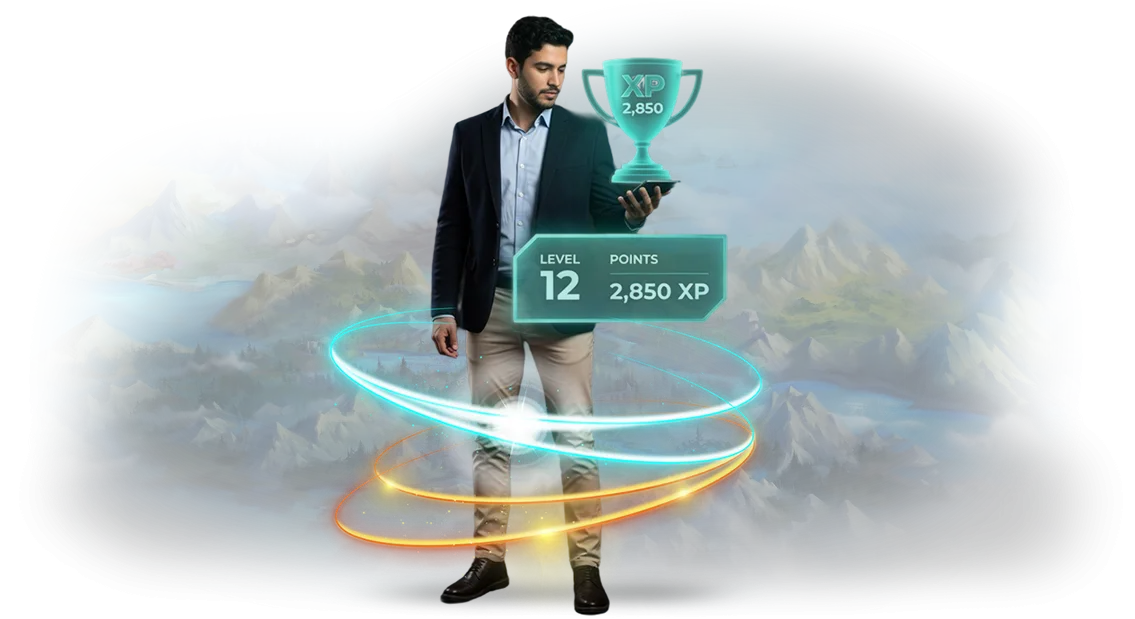
Why employees of energy companies lose motivation
Employees in the energy sector work under special conditions: strict regulations, shift schedules, remote facilities, and high responsibility. There is no room for improvisation — every step is governed by instructions, and results are rarely visible right away.
That is why employee motivation declines gradually: work becomes routine, and individual contributions fade into overall company metrics.
When interest disappears, staff engagement drops — and with it, the quality and speed of task completion.
Energy companies begin to notice the consequences in the form of staff turnover: experienced specialists leave for places where there is growth and recognition, and their replacements take months to train.
Replacing one employee costs the business not only money, but also the loss of accumulated expertise.
A separate problem is weak competition within the team. In day-to-day work, there is no reason to compare yourself with others, set personal records, or receive recognition for achievements.
The "average across the board" indicator inspires no one, and bonuses and KPIs are perceived as a formality. As a result, employees work from bell to bell without trying to do more.
We solve this problem through a game-based competition and rating system adapted to the specifics of the energy sector.
Transparent leaderboards, team and individual contests bring back the competitive spirit, make each person's contribution visible, and turn routine into a game with clear rules and prizes.
Employee motivation becomes manageable again — and the business gains higher engagement and lower turnover without extra HR costs.
What business results game mechanics deliver
Game mechanics shift work from routine to excitement: employees see their progress, compete with colleagues, and receive recognition for results.
For energy companies, gamification is especially valuable: staff motivation directly affects operational continuity and safety. Our team build such systems with the specifics of the industry in mind.
KPI growth
Rankings make progress toward planned targets visible: everyone can see who is moving toward the goal and how. As a result, task completion speed increases, and employees themselves look for ways to work more efficiently.
Faster employee training
Newcomers master regulations and safety procedures faster when knowledge is delivered as quests and levels. Practice shows that game-based training shortens the time to full proficiency, and experienced employees are more willing to share skills to climb the ranking.
Fewer errors
Game scenarios reward attentiveness: correct actions earn points, violations incur penalties. This builds the habit of following regulations, reducing the number of incidents and downtime.
Higher loyalty
A transparent reward system and a competitive spirit create a healthy team atmosphere. Employees feel their contribution is noticed, burn out less, and resign less often — which means the company saves on recruitment and retains expertise.
Gamification formats for different tasks
Different tasks in an energy company require different levels of engagement: speeding up safety briefings is one thing, while improving the efficiency of repair crews or coordinating communication between shifts is another.
There is no universal mechanic: the chosen format must match the goal, otherwise gamification either fails to engage employees or quickly turns into a formality.
We select a format to fit a specific business task. The table below shows typical scenarios for the energy sector and the benefits the company receives.
| Format | For whom | What it gives the client |
|---|---|---|
| Competitions | For individual employees and crews, when you need to quickly boost activity | Short-term productivity growth, healthy competition, and evaluation criteria that are clear to everyone |
| Rankings | For departments and shifts, when long-term dynamics matter | Sustained motivation, transparent results, and retention of strong employees |
| Team challenges | For cross-functional teams and sites, when you need to improve collaboration | Better communication between departments, joint goal achievement, and fewer incidents through collective responsibility |
In practice, formats work well in combination. For example, an overall departmental ranking sets the direction, while team challenges around emergency repair work strengthen crew coordination.
This way, gamification addresses several goals at once — from operational metrics to workforce stability.
Stages of gamification implementation for energy companies
Implementing gamification for energy companies is not a one-off app installation but a well-structured project with clear stages.
Over 10+ years of working with industrial clients, we have built a process where every step brings you closer to the result: engagement, fewer errors, and a stronger safety culture. You do not need to worry about the technical side — we handle the design, approvals, and launch.
- Brief and diagnostics. We define the goals: productivity, training, safety. We study processes and team motivation.
- Concept approval. We select rankings, team competitions, and points. We show how this fits into your culture.
- Scenario design. We draft the rules, levels, and rewards. We account for shift schedules and remote crews.
- Development and configuration. We build the solution on a proven platform. We connect it to internal data — points are calculated automatically.
- Pilot launch. We test with one group and collect feedback. You see the dynamics, and we adjust.
- Full launch. We prepare materials for employees and explain the rules. Everyone understands what earns points.
- Support and evolution. We analyse activity and update scenarios. The game keeps motivating employees months later.
What is included in a gamification project
Gamification is not a game for the sake of a game — it is a tool that must deliver results for the company. Therefore, the project includes not just a set of mechanics but a complete package of work: from strategy to post-launch support.
You get everything needed so the competition and rating system benefits both the business and its employees.
- Gamification strategy — a description of goals, scenarios, and performance indicators. You know in advance which business results should improve and how we will track them.
- Game system — competitions, ratings, levels, and rewards adapted to your business processes and employee tasks.
- Performance dashboards — clear dashboards for managers: team activity, progress against key metrics, and areas that need attention.
- Documentation — regulations, instructions, and usage scenarios. HR staff and administrators can navigate the system on their own.
- Team training — sessions for administrators and managers so they can manage game mechanics and adjust them without our team.
- Implementation and launch — we connect the system to your processes, set up access rights, and support the first competition cycles.
- Post-launch support — we answer questions, help develop the system, and make changes quickly.
The result is a ready-to-use project, not abstract presentations. You get a tool that shows within the first weeks how to capture employees' attention and direct their energy toward meeting production targets.
Case study: a rating system for an energy company
For an energy company, employee motivation is not a "soft factor" but controllability and safety.
The client, "VostokEnergo", wanted to move away from paper reports and formal "training plans." They needed a system that would itself show who is really driving the team forward.
We proposed a rating system built on gamification of business processes. Each department got its own leaderboard: points for meeting targets, completing courses, and participating in working sessions.
Department rankings and personal positions were updated automatically — employees saw their progress immediately, not at the end of the quarter.
The key point is that the rankings did not turn into a "race for numbers." We set the rules so that only actions affecting operational efficiency were rewarded: fast response to requests, compliance with regulations, mentoring. This helped avoid competition at the expense of quality.
What the client got
Within a few months, the company saw the effect: attendance at training programs increased, and meeting planned targets no longer required manual oversight. According to VostokEnergo's internal assessment, employee engagement grew by 37%.
Staff turnover also decreased — the rankings gave employees a sense of fair evaluation and career prospects.
The system now runs continuously. Managers see team dynamics, and employees set their own goals and compete with their previous selves. This is an example of how rankings turn a "boring process" into a regular, living practice without constant oversight from management.
How to choose the right gamification format?
Choosing a gamification format starts not with trendy mechanics but with the goal you want to achieve. For an energy company, this could be strengthening the safety culture, increasing staff engagement in training, or reducing time spent on routine operations. Understanding the end result is the first step toward the right solution.
We build the gamification selection around your business task and audience: number of participants, their age, digital literacy level, and frequency of interaction.
One thing is bringing a station shift team together, another is making competition between regional divisions transparent. That is why, before launch, we conduct a consultation and a short audit that takes a few working days.
As a result, you receive not an abstract concept but a comparison of two or three suitable formats: for example, a long-term rating system with an annual cycle or short team challenges for a specific period.
We show how each mechanic affects the metrics that matter — from reducing violations to increasing the number of completed training courses.
Most importantly, we do not offer standard templates — we adapt the mechanics to your specifics: work schedule, facility remoteness, and motivation patterns of different employee categories.
A session with our methodologist helps finalize your choice, where you can ask questions and see examples from our energy sector practice. After that, you make the decision, and we handle the implementation.
Frequently asked questions about gamification
Energy company executives often ask how gamification will affect production processes, whether it is compatible with existing systems, and when results will appear. Below we answer the main questions — the same answers we give clients at the briefing stage.
Will gamification affect the safety of production processes?
Gamification does not interfere with the operation of equipment or dispatch systems. It is a separate motivation layer that works with people: ratings, competitions, rewards for meeting targets.
Employee data is stored in an isolated environment, with access limited to authorized administrators.
Is the system compatible with our corporate software?
Yes. We integrate through open interfaces and do not require replacing accounting systems. Development is adapted to your infrastructure: from simple spreadsheet uploads to full integration with HR systems. During the audit stage, we show how the solution fits into your current regulations.
How quickly does development pay off?
We measure payback through concrete indicators: reduced onboarding time for new employees, lower turnover, increased crew productivity. Clients see a measurable effect within the first few months — usually faster adaptation and fewer errors in following regulations. The exact cost is calculated after an audit of your processes.
What happens after launch?
We do not abandon the project. We hand over instructions, train administrators, and support the system. If new tasks arise, we add scenarios and keep the rankings up to date. Warranty and support terms are specified in the contract.
If you would like to discuss gamification for your company, send us a description of your tasks. our team is your partner in developing motivation systems. Over 10 years, we have delivered hundreds of projects for industrial enterprises and always start with an audit of current processes and metrics.Order gamification development for your business
Competitive ratings turn routine metrics into a game every employee can understand. When an energy company implements such a system, staff naturally strives to meet KPIs, and managers get a transparent view of departmental efficiency. We handle the entire turnkey development — from concept to launch and support.
By ordering gamification now, you get:
- A consultation with a specialist who will analyze your task and propose a suitable competition format — without technical details, in business language.
- An individual scenario for your business processes: we account for energy sector specifics, seasonal workload, and motivation patterns of different employee categories.
- A ready-made motivation tool that works immediately after launch — participants see their results, leaders, and growth areas in a personal account.
- Transparent rules and protection against manipulation: the ranking is fair, so team trust is preserved, and disputes are resolved automatically.
- Fast implementation without stopping work processes — employees continue their tasks while the game simply records their achievements.
- Post-launch support and refinement: we stay available, helping adjust mechanics to the company's evolving goals.
Now is the optimal time to launch a competitive system in your energy company: your team gets a clear goal, and you get higher engagement and target achievement without additional administrative control costs.
Submit a request through the form on our website, and we will contact you within one business day. For initial consultations, we will show you how rankings will fit into your current motivation system and propose an implementation plan.
Order gamification development today — start getting results from the competitive drive of your employees.