

Employees drop training before finishing it
Every second employee abandons a corporate course before reaching the halfway point. At first, it looks like a minor shortcoming: someone got distracted, someone had urgent tasks.
But when year-end results show that only a small part of the team has completed most programs, it becomes obvious — the training system is not working.
Companies lose not only the money invested in content. Unabsorbed knowledge means errors on the job, slow processes, and unhappy customers. Employees themselves lose interest: they see that training is a formality and stop trying.
This creates a vicious circle: low engagement produces weak results, and weak results kill motivation.
The reason is usually not the content but the delivery. When training consists of long lectures and tests without feedback, there is nothing to grab onto. There is nothing to compare yourself with, no one to show yourself to.
Yet people are naturally competitive — especially when others' successes are visible and it is clear how to climb the ranking yourself.
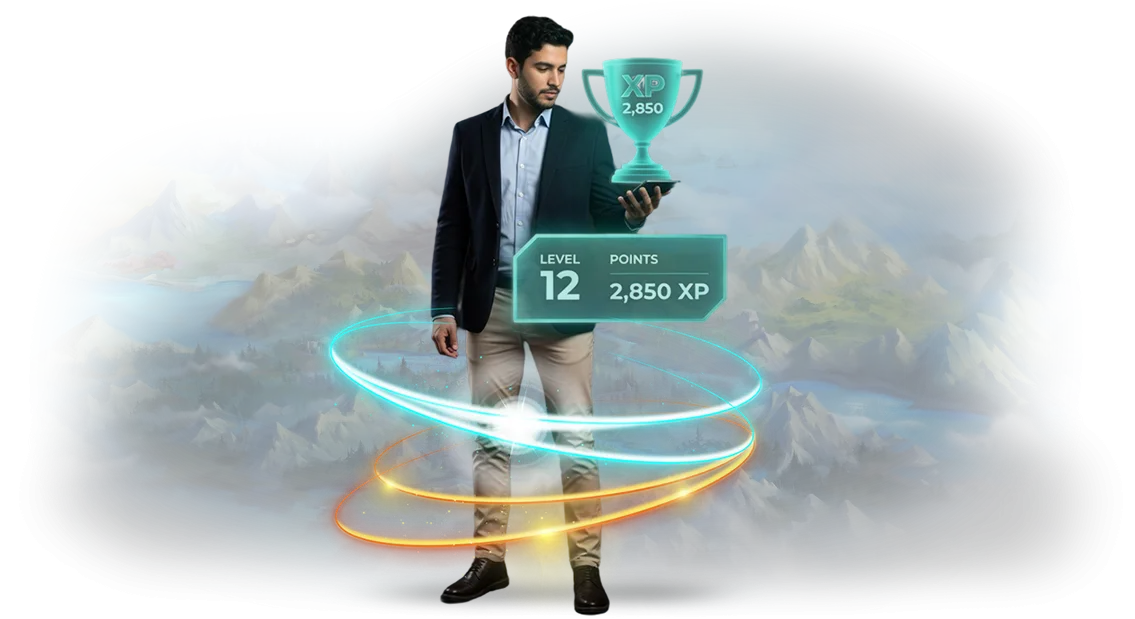
We build gamification for corporate training: we add competitions, ratings, and rewards to programs. Employees see their place on the overall leaderboard, strive to overtake colleagues, and complete the training.
This system turns boring compulsory coursework into a game, and the business gets a genuinely trained team. That is our answer to the problem of unfinished training.
Gamification for corporate training companies: benefits
For companies that train employees, gamification is not just points and leaderboards, but a working tool to increase training effectiveness. When an adult has a clear goal, competitive interest, and visible progress, they complete the course instead of dropping out halfway. This directly reduces retraining costs and accelerates employees' return to a working rhythm.
The key benefit is increased engagement without constant oversight from a mentor. The system itself holds attention: the employee sees their rating, compares results with colleagues, and gets feedback immediately after each step.
A manager does not need to spend time on reminders — training becomes a natural part of the work process.
The second advantage is transparent analytics for the business. You see how many employees actually reached the end, which topics cause difficulties, and who shows leadership qualities.
This data helps adjust training programs and make personnel decisions based on facts rather than guesses.
An additional plus is faster knowledge absorption. Short game mechanics, rewards for intermediate results, and team competitions make the brain turn information into skill more quickly. As a result, employees start applying new knowledge at work within days after training, not months.
Finally, gamification strengthens loyalty and the team's internal motivation. People love to win, and the opportunity to shine in competition increases job satisfaction.
For the company, this means lower staff turnover and a stronger HR brand — an advantage that pays off the investment in a game system. We help implement such mechanics in your training program, delivering measurable results already in the first quarter.
Gamification formats for training objectives
Each training program solves its own task: to familiarize a newcomer with processes, to improve the qualifications of specialists, or to unite teams. The gamification format must match that task, otherwise the game remains entertainment rather than a tool.
That is why we first analyze the goals of your program, and only then select the mechanics, levels, and rules.
Below are three basic formats we use most often in corporate training. Each task has its own approach.
| Format | For whom | What it gives the client |
|---|---|---|
| Learning quests | New employees, onboarding programs | Fast immersion: the employee goes through a scenario with tasks and hints instead of reading a long manual. Time to full productivity is reduced |
| Employee ratings | Regular courses, mandatory training | Healthy competition motivates completing modules on time. You see who leads and who lags, and can offer timely support |
| Learning competitions | Teams, departments, branches | Team spirit and experience sharing: groups compete for points and rewards. Results are achieved together, and knowledge sticks faster |
These formats are easy to combine: for example, a quest within a rating, or a team competition with individual scoring. We customize points, difficulty levels, deadlines, and rewards to your program without complicating the interface for the employee.
The client gets not a “game for the sake of the game” but a tool with measurable results: increased engagement, regular training, and clear progress metrics. After launch, you see which topics are easily absorbed and which require additional explanation.
How game mechanics are implemented
Implementing gamification is a turnkey project consisting of clear stages. We handle everything: from the initial brief to launch and ongoing support.
You get working competition and rating mechanics that are integrated into your training process and deliver measurable results — increased engagement, course completion, and interest in the material.
- Brief and task immersion. We discuss goals: what you want to change in training — coverage, regularity, completion speed. We clarify how your learning process works and which scenarios matter to your employees.
- Mechanics analysis and design. We determine which actions will be rewarded and how the system of points, levels, and ratings is structured. We design the rules so that they motivate the desired behavior and avoid creating competition where it gets in the way.
- Design concept. We show how leaderboards, rewards, and notifications will look. We align the style so that it matches your corporate brand and sparks emotion.
- Development and configuration. We build the game mechanics and integrate them with your learning system. We work on a proven platform that handles the load, so users don't notice technical details — only a smooth process.
- Testing and adjustment. The mechanics first run in a limited group. We observe how participants react, what actions they take, and where they get stuck. We make changes before rolling it out to all employees.
- Launch. We deploy the system for all participants and set up communication: announcements, rules, first challenges. You receive a complete set of materials for internal promotion.
- Support and development. After launch, we stay in touch: we monitor activity, answer questions, and adjust settings. If needed, we can add new seasons, levels, or competition formats.
This approach removes risks and uncertainty: you are not just buying a “box” but getting a solution that is carried through to results and works toward your business goal.
The key stage is the gamification launch: this is where we help ignite employees' excitement and interest, and then the system sustains their motivation on its own.
What is included in the delivery: launch kit
After placing an order, you receive not “source files” but a working kit — everything you need to launch an employee competition and see results without involving developers. We build the solution for your task and deliver it in a “plug and play” state.
- Description of the game mechanics — rules for scoring points, rating logic, and principles for rewarding leaders. The document is clear for both HR and department heads.
- Integration with your corporate training system — embedding ratings and competitions into the existing training portal, without changing the company's familiar tools.
- Administrator guide — how to add participants, launch stages, manage seasons, and adjust rules if training priorities change.
- Employee reference card — short and clear: how participants see the competition, what earns points, and how to climb the leaderboard.
- Methodology guide for HR and managers — how to read results, identify active employees, and use rating dynamics to increase engagement.
- Startup support — assistance during the first launch and the early competition cycles. We answer questions, help adjust rules for the current season, and make changes if anything needs adaptation.
As a result, you get not just a standalone module but a working system that increases employees' interest in training and makes results transparent for management.
Support during implementation reduces risks, and the first visible results appear within the first month of the competition.
How gamification boosted engagement by 40%: a case study
One of our clients — a retail chain ProductLand with 120 locations across the country — faced a typical retail problem: employees completed mandatory courses “for show,” and knowledge was not applied on the job.
Engagement in training was falling, staff turnover was rising, and money on programs was wasted. The company needed a format that would turn boring compulsory training into a process people want to return to.
We developed a game system of competitions and ratings: each store became a team, employees earned points for completed modules, and results were published on a shared leaderboard.
Within the team, personal achievements and rewards for regularity were added — so both team spirit and personal motivation kicked in.
What worked in practice
Two months after launch, the share of employees who fully completed the course grew by 40%. Attendance at voluntary training also improved: people asked for additional materials on their own to earn more points.
For retail, this means not just nice numbers, but real savings on retraining newcomers and a better-prepared workforce.
What mattered most was that the gamification case proved successful not just once: the client extended the contract and scaled the system to all 120 stores. Now the competitive format is used both for onboarding newcomers and for developing managers.
The engagement growth became a sustainable trend — and that is a sign of a successful project that brings real value to the business.
Frequently asked questions about training gamification
Training gamification promises higher engagement, but before launch we hear the same questions. Below are answers to the four main concerns companies have. This will help you understand how we remove risks and what results you can realistically achieve.
Will the implementation be too difficult for our team?
We handle the implementation ourselves: from strategy to launch. You don't need to hire developers or change familiar processes. The process has been refined across dozens of implementations, so it usually wraps up within a couple of weeks. You simply announce the start of the game, and everything then works automatically.
Will we be able to use ratings with our learning system?
We integrate competition and rating mechanics with your training programs, so the leaderboard and points appear in the familiar interface. We handle the technical aspects — you only need to agree on access parameters at the start. We discuss all details in advance so nothing interferes with training.
How much does it cost, and will there be any hidden payments?
The cost depends on the scale, but you receive a transparent estimate before launch. It includes all stages: design, configuration, and support for the duration of the project.
Additional options are discussed separately and do not affect the initial estimate — no unexpected bills after launch.
What result will we get, and what if it doesn't match expectations?
We measure the result in numbers that matter to you: the share of employees who completed the training, completion speed, and engagement growth. At the start, we set target indicators, and after launch we show analytics. If we see a deviation, we adjust the mechanics to achieve the set goals.
If you still have a question, write to us, and we will review your case in detail.Ready to launch gamification in your training?
You have already invested in training, but employees are losing motivation? Gamification turns the process around: people get involved in the competition on their own, and all you have to do is watch the numbers grow. To see how this would work for you, no presentations are needed — a short consultation is enough.
To calculate the cost and implementation plan, we need to know a few things about your training system:
- Who the learners are: managers, line employees, salespeople, or mixed groups. The rating and competition mechanics depend on this.
- Which business metrics should grow: plan fulfillment, speed of onboarding newcomers, test pass rate, and error reduction.
- How training is delivered: in-person trainings, online platform, webinars, or an internal portal. We will adapt the game to your format.
- What rewards you have already tried: points, gifts, honor boards. This will help strengthen what works.
- Whether you have regular knowledge checks or exams — we will turn them into competition stages so that preparation happens on its own.
No dismantling is required. We embed game mechanics into existing processes: from a simple rating to team battles and full-fledged stages. We will show examples for your industry on a demo stand — it takes 15 minutes.
Leave a request for a consultation — we will contact you within one business day, clarify the details, and prepare a cost estimate for your task.
You can order gamification in one click: write to us in a messenger, and we will take care of everything — from prototype to launch and support.
How to choose a gamification format for specific tasks?
There is no one-size-fits-all gamification format: what works great for one team can fail in another. The choice depends on the specific task — increasing sales, accelerating newcomer onboarding, or building the habit of using a new CRM.
Therefore, before launch, it is important to understand what result you expect and what employee behaviors should change.
Start by answering three questions: who you are training, what barriers prevent employees from completing courses, and which metric you will use to measure success. If the main problem is low engagement and routine, competitive mechanics with ratings and rewards will work.
If we are talking about complex skills, scenarios with decision-making and consequences are better, as they bring learning closer to real work.
The format also depends on corporate culture. In companies with high competition, leaderboards have a strong effect, while in creative teams, collaborative quests and team challenges are more appropriate. It is important that the game supports motivation rather than creates tension.
We help select a format based on individual requirements: we analyze the audience, existing programs, and business goals. Based on this, we propose a concept that can be tested on a pilot group and adjusted before the full launch. This approach reduces the risk of error and saves the budget.
In the end, choosing the right format means gamification works unobtrusively yet measurably: course completion rises, training time shortens, and work performance improves. Start by defining the task — we will handle the rest.