

Why Does Productivity Decline on the Factory Floor and How to Fix It?
Production managers often notice: with unchanged equipment and technologies, output starts to sag, and the number of errors and downtime grows. The reason is not equipment wear — it's the loss of employee engagement.
When work turns into monotonous routine, employees operate "on autopilot," lose interest in results, and stop suggesting improvements. As a result, productivity drops, and with it, the profitability of the entire enterprise.
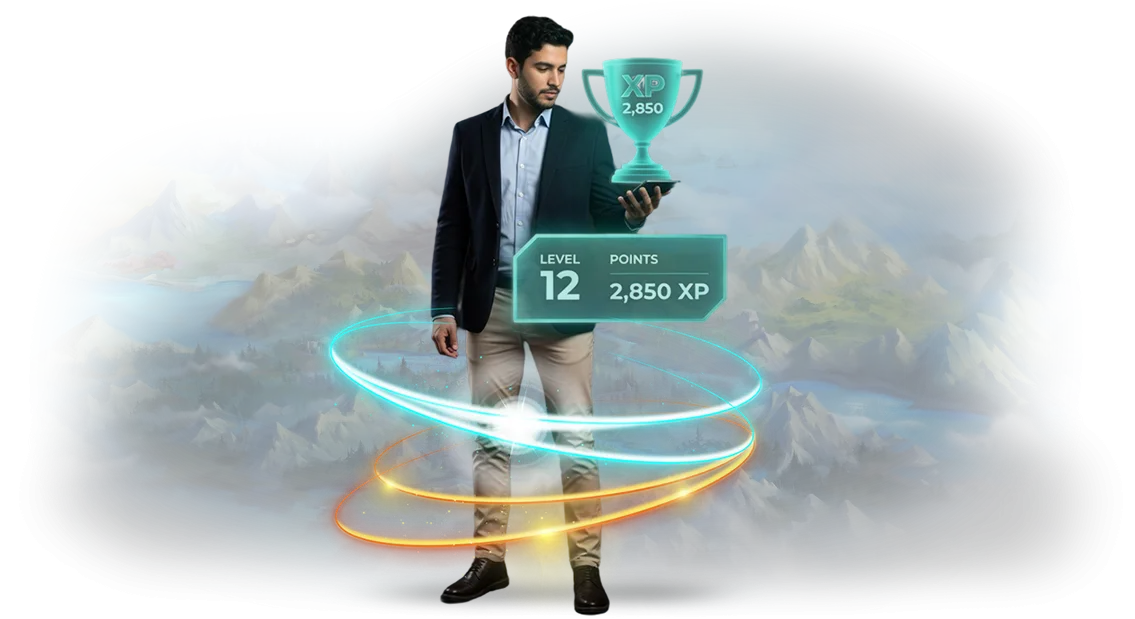
Competitive mechanics and transparent ratings bring excitement and meaning back to daily tasks.
People start seeing the connection between their actions and the overall result: who completed the shift assignment faster, who has fewer defects, who proposed a good process improvement.
This isn't a "toy" — it's a working management tool that taps into the natural human desire to be the best. But for ratings to motivate rather than demotivate, they must be properly designed with production specifics in mind, not just by drawing a pretty leaderboard.
We develop competition and rating systems that integrate into real production processes: they account for output standards, quality, safety, and contribution to the overall result.
Managers get an honest picture of employee engagement, and employees get clear goals and recognition for their accomplishments. In this way, we solve the problem of declining productivity without rigid administration or additional motivation costs.
What Does Gamification of Business Processes Give Manufacturing?
Gamification of business processes turns routine production tasks into a meaningful game: employees see their goals, receive instant feedback, and get fair rewards.
For manufacturing, this is not just a way to diversify the workday — it's a working tool that manages personnel behavior and delivers measurable results.
First of all, it improves efficiency. When a line operator has a visible rating, personal progress, and a clear goal, they work faster and make fewer mistakes.
Competition between shifts or workshops adds extra impetus: teams try to beat their own records, and average productivity grows by tens of percent.
Another significant effect is employee engagement and loyalty. An employee who sees that their work is noticed and valued is less likely to consider quitting.
Gamification reduces staff turnover and simplifies onboarding for new hires: it's easier for a new person to understand the rules and quickly get up to speed when they resemble a game.
In addition, game mechanics bring in additional leads and increase brand recognition. They can be used not only inside the factory but also at exhibitions, conferences, and industrial forums.
An interactive booth with a virtual production line, a quiz, or an assembly speed race attracts visitors, collects contacts, and leaves a more vivid impression than a regular presentation.
In the end, gamification of business processes pays off through productivity growth, lower personnel costs, and more clients. We handle the entire cycle — from process audit to launching the gaming system — and adapt the mechanics to the specifics of your enterprise. You get a working tool that delivers results within the first few weeks.
Gamification Formats for Different Manufacturing Tasks
The rhythm of production relies on discipline and hitting the plan, but routine quickly tires people out. Competitions and ratings turn the work process into a game: employees see their contribution, compare results with colleagues, and receive recognition for achievements.
This works without material incentives — healthy competition and the desire to be the best come into play.
We select gamification formats based on the specific manufacturing task: increasing output, reducing defects, accelerating new hire onboarding, or strengthening team spirit. Below are typical scenarios that have already proven their value at enterprises.
| Format | For Whom | What It Gives the Client |
|---|---|---|
| Leaderboards | Workshop and section managers | A transparent picture of each employee's results, rapid KPI growth, lower turnover |
| Shift-to-shift competitions | Production managers | Output growth of 10–15%, team spirit, healthy competition without conflicts |
| Quests and training missions | HR and mentors | Fast new hire onboarding, skill practice without risk to equipment |
| Individual challenges | Section supervisors | Fewer defects, greater personal responsibility, discovery of leaders |
Each format is customized to your metrics: planned targets, time standards, product quality. We don't just draw a table — we design rules that encourage the right behavior and fit easily into daily work.
You don't need to change processes — just introduce the game, and production will deliver more results with the same resources.
How We Develop Gamification for Your Manufacturing Operation
Working with manufacturing requires predictability: you need to understand what happens at each step, how long the project will take, and when results will appear.
That's why the gamification implementation process is structured as a clear sequence of stages — from the initial brief to launch and system support. We accompany you the entire way, align on every stage, and lock in the expected effect before work even starts.
- Brief and process audit. We study your production specifics: where routine dominates, which metrics matter, who will participate. The output is an understanding of the game's goals and success criteria.
- Plan and KPI alignment. We define which business metrics should grow: productivity, quality, team engagement. We set timelines and reporting formats so you can see the progress.
- Scenario and prototype. We design the game mechanics — competitions, levels, rewards. We show you how it will look and work and get your feedback before development begins.
- Development and configuration. We build the ratings and competition system with your production's specifics in mind. Data flows automatically from your accounting systems — employees don't have to enter results manually.
- Launch and team training. We roll out the system and train managers and participants. We explain how to use the ratings and how to keep employee interest alive.
- Support and evolution. We support the system after launch, analyze results, and adjust mechanics if we see engagement can be improved. You get regular reports and recommendations.
A standard project takes 4 to 8 weeks — the exact timeframe depends on the scale of production and the number of participants. You stay informed at all stages: we send brief status updates and align on key decisions personally.
This allows gamification to be launched without missed deadlines or downtime, and the first results are usually visible within the first month of system operation.
What's Included in the Gamification Solution Package
When the project is complete, you don't just get a game shell — you get a full-fledged tool for managing production performance. The package includes everything needed to launch, use, and grow the system, from game mechanics to analytics.
- Game mechanics and competition scenario — a ready-made system of ratings, tasks, and rewards adapted to your production's specifics and team goals.
- Integration into work processes — the system fits into daily operations without equipment downtime or changing the familiar rhythm of employees' work.
- Employee personal account — an intuitive interface with rating, personal achievements, current tasks, and a rewards showcase.
- Manager analytics dashboard — clear reports on engagement, metric dynamics, and the performance of individual sections.
- Methodology materials and instructions — launch guides, communication scripts, and reference cards for staff.
- Technical support and maintenance — help at every stage, from launch to regular updates and refinements for new tasks.
- Regular reports on gamification results — you see how productivity, work quality, and team atmosphere change.
This package lets you launch gamification without outside contractors and get an immediate effect for your business. The system works as a standalone tool — employees engage with achieving goals, and managers get a transparent view of what's happening on the floor.
Case Study: How We Boosted Output at a Factory with Gamification
For a manufacturer, one of the main priorities is that teams work steadily, without downtime and without "star" shifts followed by a slump. That's exactly the request an enterprise producing packaging materials brought to us — let's call it Gofropak.
There were five teams in the assembly section, but output dynamics fluctuated a lot: the best shifts produced a third more than the lagging ones, while average results didn't grow for months.
We proposed not training and not new equipment, but a gaming system of competitions and ratings. We launched a tournament table within the section based on key metrics: volume of packaged products, defect-free rate, and deadline compliance.
Teams saw the rating in real time on a screen in the workshop and in their personal accounts. No penalties — just transparent competitive mechanics and symbolic monthly prizes.
How This Affected Output
The very first month showed that gamification works not only as motivation but also as a management tool: output in the section grew by 14%, and order completion time dropped by 10%.
The lagging teams caught up with the leaders — the gap between the best and worst shifts narrowed by half.
The production manager got not just a rating, but a clear problem map: it became visible where equipment was idle and which team needed help.
After three months of the experiment, the client decided to scale the system to a neighboring workshop, and six months later came back with a request to develop similar gamification for the logistics department.
If you'd like a similar example — we'll start with an audit of your section and suggest which metrics are worth putting into a competition.
How to Choose a Game Format for Your Task?
The game format directly determines what emotions and behavior you get from employees. The same project can be built as an individual rating, a team championship, or a sequence of tasks — and each option solves its own business problem.
So first, it's worth answering the question: what exactly should change in the workshop or the entire production operation?
If you need to raise daily output and make each employee's contribution visible — ratings with results updated during the shift will work. If training personnel on new processes and quality standards matters more — use game scenarios with levels and rewards for mastering skills.
And when the goal is to unite shifts, reduce turnover, and facilitate knowledge sharing — team competitions work best, where the result depends on joint effort.
The second criterion is the engagement horizon. Short campaigns and weekly tasks give a quick burst of activity but then fade. Permanent ratings become part of the daily routine and hold interest for months, building a habit of healthy competition.
So the chosen format should match your rhythm: a one-off campaign, a quarterly marathon, or a standing motivation system.
The third consideration is the conditions of production itself: shift schedules, operating mode, quality control specifics. Good mechanics account for these constraints and don't create extra burden for employees — they fit organically into existing processes. Otherwise, the game will be perceived as an obstacle rather than a useful tool.
We help determine the optimal format before launch: we analyze goals and current metrics and select mechanics tailored to your enterprise's specifics.
In the end, you get a system that employees understand and managers can control — with clear win criteria and a measurable impact on production results.
Frequently Asked Questions About Gamification Implementation
Before launching gamification in manufacturing, managers ask the same questions. That's normal: a new system must pay for itself, not distract from work. We answer the main concerns so you can make decisions based on facts rather than guesswork.
How long will implementation take?
A typical project takes two to four weeks after requirements are agreed. A pilot launch with a limited number of participants is ready in 7–10 days — during that time you see the competitive mechanics in action and can adjust the rules before full rollout. This doesn't stop production: employees join the process gradually, shift by shift.
What guarantees do you provide?
We put measurable metrics into the contract: participant coverage, activity growth, regularity of task completion. If metrics aren't met, we refine the mechanics at our own expense.
After launch we stay in touch — for the entire period of use, you get technical support and rule adjustments at no additional charge.
Is it difficult to integrate the system into production processes?
Implementation doesn't require stopping lines or replacing equipment. It's enough to provide data on participants and tasks — after that, we adapt the ratings and levels to your regulations. Staff training takes one day, and the system runs on the devices already present in the workshop.
What does the cost depend on?
The cost is calculated after audit of your scope: the number of employees, the number of sections, and the complexity of competition scenarios. At the start, we prepare a transparent estimate with no hidden fees and offer a cost-effective option for a pilot launch. After you see the effect, we scale the system across the entire plant or enterprise.
Still have questions about timelines, guarantees, or pricing? Write to us — we'll explain how gamification will boost engagement specifically on your production floor.Ready to Improve Your Team's Efficiency? Leave a Request
You can already see how competitions and ratings change team engagement. All that's left is to take the first step — discuss your task.
We'll discuss your needs, suggest which formats will deliver fast results on your production floor, and estimate a project tailored to your scale.
After your inquiry, you'll receive:
- an analysis of your current personnel motivation and the definition of measurable goals;
- an accurate cost and implementation timeline calculation for your workshop;
- a launch plan that doesn't halt production or cause shift losses;
- a selection of competition mechanics suited to the specifics of your sections and roles;
- a recommendation for a pilot section to achieve quick first results;
- a clear work schedule and a dedicated manager for the entire project.
It's worth starting now because the effect of ratings compounds: in the first two to three weeks you'll see output dynamics, and then healthy competition between shifts kicks in. The earlier you launch the pilot, the faster you'll get data for scaling across all departments.
Leave a request — at the first consultation we'll review your situation, answer your questions, and propose a solution that pays off through productivity growth. It's completely non-binding, but you'll find out exactly which steps will lead to results on your production floor.