

For construction companies and developers: how to retain clients
In the construction industry and real estate development, competition for buyers grows every quarter.
For a developer, it is no longer enough to simply build a building — you need to keep the client engaged at every stage: from the first contact with the sales office to handing over the keys and beyond.
But classic tools — discounts, promotions, conventional metrics — stop working: interest fades, managers burn out, and buyers go to competitors.
Inside the company, the story is the same. Motivation in construction is often built on rigid plans and reprimands, which creates fear instead of excitement.
Developers' sales departments work by template, without a healthy competitive spirit, so conversion suffers and strong employees lose interest in results.
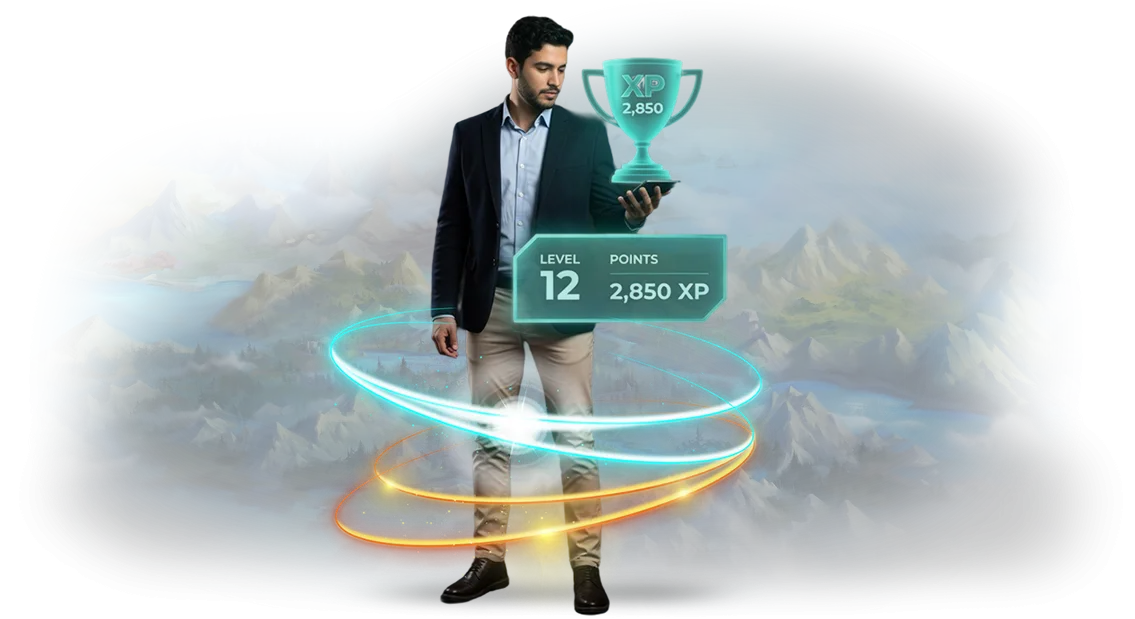
Business gamification changes the rules of the game. It is not game-playing for the sake of game-playing, but a clear system of goals, rewards, and rankings that links employee actions to company results.
When a manager sees their place in the overall standings and understands that their next steps determine the win, healthy motivation and the desire to do more kick in.
Developer sales become more transparent: rankings show who is really moving the project forward and who needs support. The result is higher conversion, stable plan fulfillment, and a team that pushes itself toward high performance.
For buyers, you can build your own loyalty system with stages and statuses so that the client comes back to you instead of considering other new developments.
We have been developing gamification solutions for construction companies and developers for over 10 years.
We create competition and ranking systems that integrate into your processes and deliver measurable business results — from motivating the sales department to retaining buyers.
What game mechanics bring to business: three results
In the construction industry, success depends on people: on how well superintendents, managers, and salespeople work together, and how loyal clients are to the brand.
Routine processes — deals, reports, project handovers — often fail to spark interest, while competition demands that every participant work toward results.
Game mechanics turn familiar tasks into a clear competition system where everyone's contribution is visible and the goal is obvious.
The first result is employee engagement. When employees see how their actions affect the overall ranking, healthy motivation emerges: they want to outperform colleagues, fulfill the plan faster and better.
Superintendents compete for the best performance in terms of deadlines, managers — for sales volume, and the business gets a team that works with enthusiasm rather than under duress.
The second result is transparent rankings for management. A manager no longer relies on subjective assessments and sees an objective picture: who is truly driving projects and who is falling behind.
This simplifies decision-making, reduces conflict in the team, and helps distribute bonuses and recognition fairly. Trust in leadership grows because everyone understands the rules of the game.
The third result is higher sales and client loyalty. Game mechanics nudge clients toward desired actions: choosing an apartment, leaving a request, recommending the company to friends.
The buyer receives a reward for each action, and the developer gets a measurable increase in deals. Such a system works as an additional communication channel that keeps the audience's attention even after the project is completed.
In essence, gamification is not entertainment but a management tool that pays for itself and delivers measurable indicators. Below, we answer common questions about how such systems are implemented in construction companies and what results can be expected from the very start.
Gamification formats for developers
For a developer, gamification is not entertainment but a management tool: it helps accelerate sales, motivate departments, and make the brand recognizable to buyers.
The key is to choose the right mechanics for a specific task: one works for the sales department, another for attracting clients, a third for internal competition between crews.
Below are the basic formats that we adapt to the business processes of a construction company.
| Format | For whom | What it gives the client |
|---|---|---|
| Rankings and leaderboards | Sales departments, marketing departments | Higher conversion through healthy competition: employees see their results and strive for the top |
| Competitions between crews | Construction sites, superintendents | Shorter project handover times and higher work quality with a transparent scoring system |
| Levels and badges system | Clients and buyers | Increased loyalty: the buyer returns for a new reward and recommends the company to friends |
| Quests and challenges | Sales department, corporate training | Fast engagement in new processes: employees learn scripts and standards through play |
| New development rating with reviews | Buyers, residents of residential complexes | Greater brand trust and more repeat inquiries to the sales office |
Internal competitions between departments are especially useful for construction companies with multiple projects. They turn routine reporting into a clear race for leadership: every quarter, month, or week, it is clear which team performed better against the plan and why.
For external clients, gamification works for brand recognition and repeat sales. Accumulated points, statuses, and referral bonuses create a sense of playing a game where the buyer wins together with your brand.
At the same time, the entire system is configured around your business indicators: number of deals, sales volume, speed of lead processing.
When choosing a format, we start with the process you want to accelerate: sales, project handovers, training, or client acquisition.
We select mechanics for the key objectives, then integrate them into existing CRMs, portals, and corporate applications so that employees and buyers can use them without extra effort.
How game mechanics are implemented: stages
Implementing gamification in a construction company or developer is similar to launching a new project: without a clear plan, deadlines are missed and results fall short of expectations.
We have structured the project stages so that you see value at every step and stay in control of the budget.
- Brief and audit. We analyze your objectives — from growing apartment sales to accelerating the sales department's work. We determine where competitions and rankings will deliver the greatest results.
- Plan and metrics. We define the goals used to evaluate the effect: employee activity, number of deals, reporting speed. We agree on timelines and cost.
- Mechanics design. We develop leagues, points, and rewards, adapting them to the corporate culture and motivation of different roles — from superintendents to managers.
- Implementation and integration. We build the system on a professional platform and connect it to your sales system and reports. We demonstrate a working prototype before launch.
- Pilot and launch. We test the mechanics in one department or on one project, adjust the balance, and then roll out the rankings across the entire company.
- Support and development. We analyze data, help launch new seasons, and make the mechanics even more effective.
This approach eliminates surprises: you know in advance what happens and when, and the launch of game mechanics does not disrupt core business processes. As a result, you get a working motivation system, not just a pretty table on a website.
What is included in the game system delivery
We have put together a delivery package so that you get a working turnkey system — with no surprises at the start and no need to finish anything yourself.
- Game platform for competitions and rankings — a ready-made system where construction crews, superintendents, or sales departments see their positions in the ranking, progress, and distance from the leaders.
- Game rules and scenario — clear scoring mechanics, levels, and win conditions. Nothing for show: the game is tied to your real business KPIs — project handover speed, plan fulfillment, quality of work.
- Participant's personal account — each employee sees their own indicators, achievements, and tasks. This removes questions like “why am I not in the top” and adds healthy competition.
- Manager's control panel — you assign tasks, change point weights, see real-time statistics, and understand which teams are pulling the project forward and which are stalling.
- Mobile and desktop versions — convenient both on the construction site via phone and in the office via computer. No barriers to participation.
- Onboarding and team training — quick launch without stopping work: we gather team leads, show the interface, and answer questions. One day is usually enough.
- Administrator's guide — so your HR or department head can independently set up seasons, change tasks, and add new participants without constantly contacting us.
After the launch, we do not disappear: for the first two or three weeks we support the project, adjust the settings to your real dynamics, and advise which mechanics to strengthen if activity drops.
If desired, we add extra options — for example, integration with your CRM, automatic point accrual based on data from 1C, or special team tournaments for different projects.
Case study: how game mechanics paid off in two months
When we took on a case for the developer «StroyGrad», the client faced a task familiar to any sales department manager: managers worked on autopilot, fulfilled plans at 70%, and competition among employees was more harmful than useful.
We needed to launch mechanics that would make the routine sales process easy and exciting — without heavy administrative burden on the manager.
We developed a competitive game system with rankings: individual and team standings, weekly leader changes, and clear criteria for everyone — viewings booked, contracts signed, upsells.
Participants saw their position in real time, and the best performers received not only recognition but also bonus incentives.
After two weeks, managers' behavior changed: they started calling clients back on their own, handled objections more actively, and shared successful techniques.
Results after two months:
- Sales plan fulfillment grew from 68% to 94%.
- Conversion from lead to contract increased by 32%.
- The share of repeat and referral sales rose 1.5 times.
- Department turnover halved — the competition engaged the team.
The most important indicator is payback: the cost of developing and supporting the system was recovered already in the second month through additional contracts.
The client not only extended the project for the next quarter but also asked to scale the mechanics to the commercial real estate department. This is a typical example of how properly designed gamification pays off not hypothetically, but in real money and in a short time.
How to choose a gamification format for your task?
There is no single “best” gamification format — the right option is determined not by fashion but by the specific business task.
In construction and development, tasks vary: increasing the speed of the sales department, improving discipline on site, speeding up data entry after a project stage is completed, or motivating contractors to hand over work ahead of schedule.
You should start with the question “what needs to change in the numbers?” — higher conversion, shorter deal cycle, fewer errors, greater reach.
The format depends on the answer: competitions and rankings (leaderboards) work well when you need to identify leaders and push laggards, while personal challenges are better for developing specific skills or regularly meeting planned targets.
The specificity of construction and development is that processes are extended over time and often spread across different sites.
Therefore, the format should provide a clear picture of progress and fast feedback: which manager is closer to a deal, which superintendent met the week's plan. Such mechanics work better than abstract points because employees see their role in the overall result every day.
We select the format for your situation rather than fitting tasks to a ready-made template. At the start, we analyze processes, find growth points, and propose mechanics that truly affect indicators.
After launch, we track dynamics and adjust the rules if we see that something is not delivering the expected effect.
The bottom line is simple: the right gamification format is the one that solves your task with a measurable result in the first few months. Everything else is a matter of tuning and support.
Frequently asked questions and concerns before starting
Before launching gamification, heads of construction companies and developers often have the same concerns: will the system turn into a toy that does not affect the construction business, who is responsible for the fairness of the ranking, and what happens after launch? These are legitimate questions — let us answer them honestly.
Will the system handle the load if we have hundreds of crews and contractors?
The architecture is designed for hundreds and thousands of participants working simultaneously. Before launch, we run load tests, so at peak moments — when results are tallied or points are awarded — rankings update steadily, without delays or data loss.
How do we control fairness and transparency?
Every participant action is recorded automatically, and the point-scoring rules are approved by you before the start. The final ranking can always be broken down step by step: who received points, for what, and when, and why a position changed. This eliminates disputes and manual manipulation.
Who will support the system after launch?
We stay with you after the release: we monitor stability, update scenarios for new tasks, and answer your team's questions. Support is included in the contract, so you are never left alone with the system.
Concerns before starting are a normal part of the process. Over 10 years, we have implemented such projects for construction companies and developers, and in every case the client received a clear system, full control, and a result visible in the numbers. Share your questions — we will review them before the contract is signed.Order gamification and achieve sales growth
To make gamification drive sales, you do not need complex theory. Leave a request — and we will start with an audit of your business processes to immediately see where rankings and competitions will create growth. You get a plan that is clear to managers and requires no deep dive into technology.
Immediately after launch, you receive:
- Implementation plan — within 1–2 days, you understand what changes and when;
- Process audit — we determine which metrics to tie to gamification;
- Ranking setup — mechanics tailored to your sales department;
- Manager training — learning to build employee motivation through competition;
- Pilot launch — you see the first changes in sales within 2–3 weeks;
- Ongoing support — we adjust the system until growth becomes stable.
We have been implementing gamification for construction companies and developers for over 10 years. We know the specifics of apartment and house sales, so we connect rankings to real deals, not abstract activity.
Ordering gamification means getting a turnkey implementation — without lengthy approvals, with a clear plan, and with support after launch. Leave a request — by the next day, we will prepare an implementation plan for your company.